- Safety Priority: Ensure the safety of yourself and the scene first.
- Info Prep: Have address, patient age, and medication info ready.
- Patient Communication: Stay calm, inform the patient, and give reassurance.
- Don'ts: Do not give water to an unconscious patient, do not move if trauma is suspected.
When a relative suddenly falls ill or has an accident, the minutes passing after calling 112 or Nova Ambulans can feel endless. Many people panic with anxiety like "What if I'm late?", "What if I do something wrong?". However, using this time correctly facilitates both the patient's safety and the ambulance team's job. The World Health Organization (WHO) road-traffic fact sheet warns that "delays of minutes can make the difference between life and death" in post-crash care [4] — the same principle applies to acute medical events at home. This is a practical waiting guide for patient relatives.
1) Check Your Safety and the Scene First
The first step to take while waiting for an ambulance is to ensure the safety of both yourself and the surroundings [1]:
- If in traffic, turn on hazard lights, pull the vehicle over if possible.
- Warn other drivers with a warning triangle, reflector, or flashlight.
- If there are risks like electrical leakage, fire, gas smell, move away and move the patient to a safe area only if there is a life-threatening danger.
Any intervention made without ensuring safety can lead to secondary accidents [1].
2) Don't Call the Call Center Repeatedly, Prepare Information
Instead of keeping the line busy after calling 112 or Nova Ambulans, keep the information that might be asked of you ready:
- Exact address or location link
- Patient's age, known diseases, and medications used
- When and how the event happened
The call center will call you back when necessary. Calling repeatedly can make it difficult for new calls to fall into the system.
3) How Should You Behave Next to the Patient?
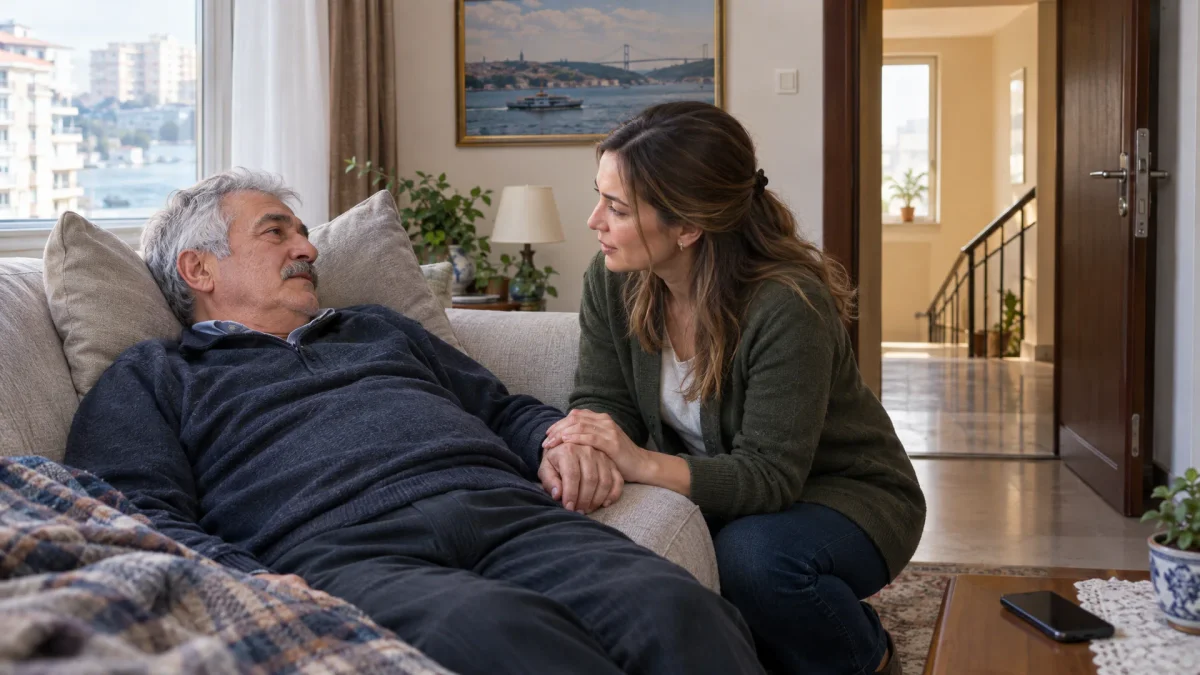
Communication with the patient while waiting for an ambulance is very important [2]:
- If conscious, introduce yourself by saying their name, say you are with them and help is on the way.
- Ask short and clear questions: "Where does it hurt?", "Are you having trouble breathing?", "Are you dizzy?"
- If they have thick clothes or tight garments, loosen them in a way that does not block air flow.
Panic and a loud crowd can aggravate the patient's condition [2].
4) What Should You Not Do?
Some well-intentioned behaviors can cause harm in an emergency:
- Do not give water or food to an unconscious or semi-conscious person [1][2].
- Do not move the patient unnecessarily if there is suspicion of neck, back, or head trauma [2].
- Do not try every "first aid method" you read on the internet or heard before.
If you do not have basic first aid training, it is best to strictly follow the directions of the 112 or ambulance operator [3].
5) How Can You Make Things Easier When the Ambulance Team Arrives?
Seconds matter when the ambulance team arrives. The following speed up the intervention:
- Ensure someone meets the teams at the door or building entrance.
- Share information like elevator, door code, and apartment location clearly.
- Keep medical documents (report, medication list, ID) ready in a single file.
Short and clear information makes it easier for the team to make the right decision.
Taking basic first aid training and creating an emergency plan within the family makes you feel more ready for these moments. The Centers for Disease Control and Prevention (CDC) reminds that "the sooner you get to an emergency room, the sooner you can get treatment to reduce the amount of damage to the heart muscle" [5] — your work at the scene buys that time. Nova Ambulans is with you with its experienced team in emergencies and planned transfers.
Frequently Asked Questions
Should I move the patient while waiting for an ambulance?
If there is no life-threatening danger like fire, explosion risk, or traffic, it is best to move the patient as little as possible, especially in case of trauma suspicion. In the possibility of neck, back, or head injury, move the patient only with the direction of the 112/ambulance operator or health team.
How many minutes does the ambulance arrive, how do I know if it's normal?
Ambulance arrival time varies according to traffic, weather conditions, and address clarity. The call center directs the nearest suitable team according to the urgency of the situation; instead of calling repeatedly while waiting, it is more beneficial to clarify the location and focus on basic first aid steps.
What should I prioritize if I am alone until the ambulance arrives?
Your priority should be scene safety and clear communication with 112/Nova Ambulans. Give short and clear information, use speakerphone or headphones to free your hands, and apply simple first aid steps (pressure on bleeding, opening airway, etc.) during this time.
Rapid Emergency Support
24/7 emergency ambulance service across Istanbul. Fast response, fully equipped team.
Average response time: 15 seconds
Related Articles
Ambulance Personnel Training Standards: 2026 Regulation Update
The 8 January 2025 and 24 June 2025 regulatory amendments made ministry-designated training modules mandatory for every ambulance health worker in Türkiye: hour breakdown, certification cycle, and a family verification checklist.
EducationWhen to Call an Ambulance for Seizures?
Learn in which symptoms you should call 112 or Nova Ambulans in seizure/convulsion situations seen in children and adults and the ambulance process.
EducationHome Care and Ambulance Support for Elderly Individuals
How can you plan ambulance support for safe transport, check-ups, and emergencies in your elderly relative's home care process?
Popular Ambulance Topic Clusters
You may also like
- Private ambulance pricing
- Istanbul private ambulance
- Intercity patient transport
- Doctor-accompanied ambulance
- Dialysis patient transport
- How intercity patient transport works
- Ambulance response time in Istanbul
- Home-to-hospital patient transport
- Modern ambulance equipment and team standards
- Heart attack symptoms and first response
This content is informational only and does not replace professional medical evaluation. In emergencies, call 112 or +90 216 339 00 39.
