- Night Vision: Increase following distance and reduce your speed.
- When You Hear Siren: Do not panic, slow down and clear the lane.
- After Accident: Turn on hazard lights, place reflector, and move to safe area.
- Team Expectation: Mark the scene and follow the team's instructions.
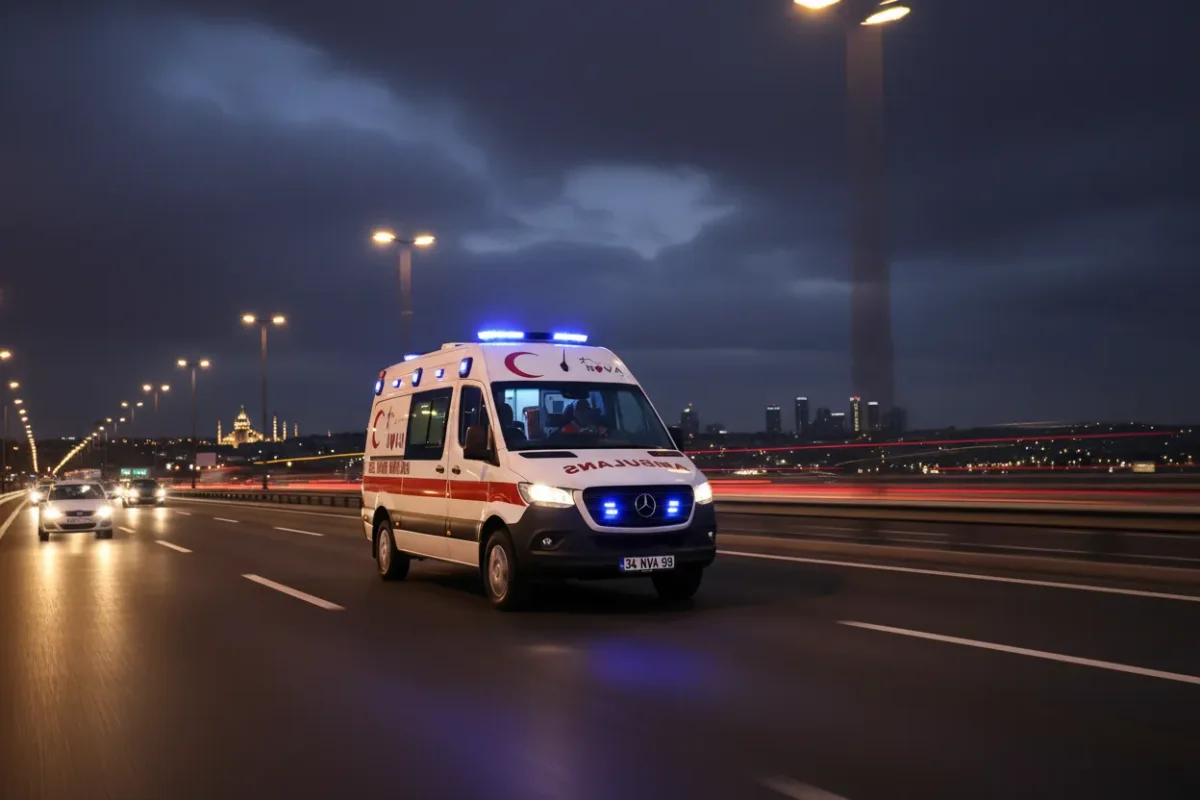
Seeing an ambulance with sirens on while driving on the highway at night always requires extra attention for drivers. Factors like limited visibility, high speed, and fatigue create risks in terms of secondary accidents and chain collisions [1]. Istanbul's three large east-west arteries -- the E-5 (D100), the TEM, and the Northern Marmara Motorway carrying the Fatih Sultan Mehmet and Yavuz Sultan Selim bridges -- form the backbone of nighttime traffic; on each, driver behavior toward an oncoming ambulance can make the difference between a single incident and a fatal pile-up.
Quick answer. Turkish Highway Traffic Regulations require hazard lights on a stopped or disabled vehicle and a reflective warning triangle placed at least 150 metres behind the vehicle on a motorway [1][2]. In a breakdown or accident at night on an intercity road, anyone who leaves the vehicle and stands at the roadside must wear a high-visibility vest (2022 amendment to the Highway Traffic Regulation) [7]. When you hear a siren: slow, pull right, and help form a "life corridor" down the centre.
Risk Profiles by Istanbul Artery
Risk shifts noticeably from one corridor to another; calibrate your driving accordingly:
- E-5 / D100: In-city motorway with frequent on/off ramps. Heavy night HGV lane-changing between Mecidiyeköy and Avcılar; tight curves between Maltepe and Pendik.
- TEM (O-3): Higher cruising speeds, longer braking distances. Steep grade and fog risk between Kavacık and Çamlıca; heavy commercial-vehicle density between Hadımköy and Mahmutbey.
- Northern Marmara Motorway (FSM, YSSK): Open-sea crosswinds can exceed 80 km/h; because air also circulates beneath bridges and viaducts, they cool faster and freeze sooner than the regular roadway, so near the freezing point humidity and drizzle can form black ice on the bridge surface [8].
- Inner-city viaducts (Bosphorus Bridge): Traffic decelerates sharply at exit ramps. When yielding, check mirrors and ease off the throttle rather than slamming the brakes.
Remember That Night Vision Is Limited
Factors like oncoming headlights, rain, or fog restrict night vision even more. Therefore:
- Keep the following distance longer than during the day. [2]
- Take care to keep your speed at a level suitable for your viewing distance. [2]
- Do not use rear fog lights unnecessarily; do not dazzle drivers coming from behind. [3]
These basic rules are the first steps of night highway safety, whether there is an ambulance or not.
What Should You Do When You Hear an Ambulance Siren at Night?
Instead of braking suddenly as a reflex when you hear a siren sound, follow these steps:
- First listen to the sound and try to understand which direction the ambulance is coming from.
- Determine its position by checking your mirrors.
- Slow down safely and clear the lane you are in to be suitable for the ambulance's passage. [3]
- If possible, contribute to creating a "life corridor" in the middle by pulling over to the right lane. [3]
Sudden braking and sharp maneuvers can endanger both you and the vehicles coming from behind. [2]
Warning Signs While Waiting for Ambulance After Accident
If you had an accident on the highway at night and are waiting for an ambulance, you need to increase visibility to prevent secondary accidents: [1]
- Turn on hazard warning lights if your vehicle is running.
- Place the reflective triangle warning sign if possible; this distance should generally be kept longer on highways. [3]
- Wear a reflective vest; on intercity roads at night, wearing a vest when you leave the vehicle is mandatory and markedly increases your visibility at the roadside. [3][7]
- Move to a safe area outside the road as much as possible; waiting inside the vehicle may not always be safe. [2]
These measures make it easier for ambulance and other emergency teams to reach you safely.
Extra Measures on Winter Nights
Istanbul's winter offers a distinct hazard profile: between December and February, humidity, fog, and freezing temperatures combine on the Northern Marmara Motorway, the TEM Çamlıca-Kavacık axis, and the Avrasya Tunnel approaches to produce black-ice conditions. The Centers for Disease Control and Prevention (CDC) winter driving guidance emphasises "stay in a safe area rather than the roadside" and "carry a blanket, water, and a phone-charger cable" [4]. A practical checklist:
- Is the windshield washer reservoir filled with winter (anti-freeze) solution?
- Is tyre tread depth above 4 mm; have winter tyres been fitted below 7 °C?
- Are a spare battery, flashlight, thermal blanket, and water in the car?
- Is the phone fully charged? (Live location sharing is critical while waiting at night.)
Expectations of Ambulance Teams in Terms of Road Safety
Ambulance teams expect the following when they come to the highway at night:
- The accident area should be marked as much as possible [1]
- Traffic flow should not be blocked by dangerous maneuvers
- Curious crowd should stay away from the scene
If you are at the scene, you can contribute to the safety of both yourself and the environment by following the team's instructions.
Encountering an ambulance on the highway at night can trigger a feeling of panic in many drivers. However, knowing the right steps allows you to turn this state of panic into controlled and safe behavior.
Frequently Asked Questions
Should I give way by exceeding the speed limit when I hear an ambulance siren on the highway at night?
No; instead of exceeding the speed limit or accelerating suddenly, you should give way by slowing down in a controlled manner and passing to the appropriate lane. Sudden speed changes and aggressive maneuvers risk the safety of both you and the ambulance.
Where should I put the warning triangle after an accident?
The general rule is to place the triangle at a safe distance behind the vehicle and at a point where drivers can notice you in advance. Distances should be kept longer on highways, and warning distances specified in the highway regulation should be followed if possible.
Why is it objectionable to take videos or photos at the scene?
Taking photos and videos can distract your attention from safety and risk the lives of both yourself and others. Also, in terms of protecting patients' privacy and personal data, it is necessary to focus on the directions of the professional team instead of taking images at the scene.
Rapid Emergency Support
24/7 emergency ambulance service across Istanbul. Fast response, fully equipped team.
Average response time: 15 seconds
Related Articles
Safety in Intercity Ambulance Transport on Highway
Key safety measures that protect the patient, companion, and other drivers during a long-distance intercity ambulance journey.
EducationHow is Patient Safety and Comfort Ensured in Private Ambulance?
How Nova Ambulans ensures patient safety and comfort: regularly serviced equipment, trained medical crews, and personalised transport planning for every journey.
EducationAmbulance Personnel Training Standards: 2026 Regulation Update
The 8 January 2025 and 24 June 2025 regulatory amendments made ministry-designated training modules mandatory for every ambulance health worker in Türkiye: hour breakdown, certification cycle, and a family verification checklist.
Popular Ambulance Topic Clusters
You may also like
- Private ambulance pricing
- Istanbul private ambulance
- Intercity patient transport
- Doctor-accompanied ambulance
- Dialysis patient transport
- How intercity patient transport works
- Ambulance response time in Istanbul
- Home-to-hospital patient transport
- Modern ambulance equipment and team standards
- Heart attack symptoms and first response
This content is informational only and does not replace professional medical evaluation. In emergencies, call 112 or +90 216 339 00 39.
