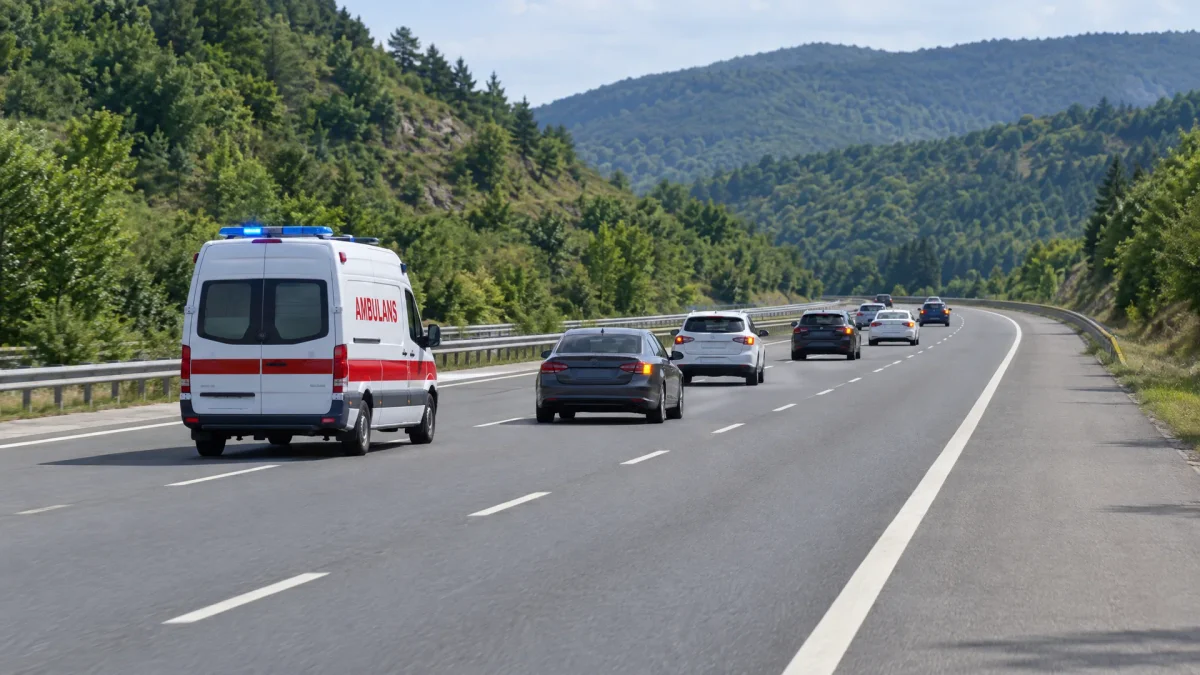
- Long Road Risks: Speed, weather conditions, and fatigue require special precautions.
- Patient Safety: Stretcher fixation and continuous vital sign monitoring are essential.
- Driver Warning: Do not panic when giving way to ambulance, clear the lane in a controlled manner.
- Preparation: Prepare epicrisis, medications, and destination hospital info in advance.
Intercity ambulance transport is not just a "long journey"; it requires special planning due to high speed, variable weather conditions, and heavy traffic [1]. Safety of companion and ambulance team should be kept in the foreground as much as the patient's safety. In this article, we discuss the basic points increasing safety in intercity ambulance transports made on the highway.
Why Does Intercity Transport Require a Separate Expertise?
Long-distance transports are different from short inner-city missions:
- Journey time is longer; this creates additional risk in terms of circulation, pressure sore, and pain management [2].
- Lane changes, ramps, and tunnels are seen more frequently in fast-flowing traffic.
- Weather and road conditions (rain, fog, snow) can show sudden changes.
Therefore, in intercity transport; equipped ambulance, experienced driver, and emergency medicine team are critically important [2][3].
Precautions Taken for Patient Safety
Professional ambulance teams manage many details simultaneously to increase patient safety on the long road:
- Correct fixation of the patient to the stretcher, control of belts and barriers [3]
- Continuous vital sign monitoring (blood pressure, pulse, oxygen saturation, etc.) [2]
- Stretcher height and position adjustment according to road shaking [3]
- Ensuring fluid balance, pain control, and comfort throughout the long road [2]
Companions also need to be informed about sitting position and seat belt use.
Safety Message for Other Drivers
Precautions other drivers should take while the ambulance is cruising on the highway are:
- When you see an ambulance with siren and beacon lights on, make controlled lane change instead of panic braking [1].
- Do not block the safety lane; remember that the ambulance can use this place when necessary [1].
- Do not try to speed up by sticking right behind the ambulance; this is both dangerous and illegal [1].
Remember: Every few seconds of road you open can be critical for the life of the patient on the stretcher.
Checklist for Families Before Intercity Transport
A short preparation before transport makes a big difference:
- Are epicrisis, reports, test results, and medications in the bag?
- Is the target hospital and department information (address, phone, responsible physician) clear?
- Are basic needs for the companion (water, snack, personal items) ready?
- Is the round-trip scenario (discharge or transfer to another institution) planned?
Frequently Asked Questions
Can a companion be taken in intercity ambulance transport?
In most intercity transports, a companion can be accepted as long as it does not hinder safety; the final decision is made according to medical requirements and vehicle layout. You must definitely state the number of companions and special needs (mobility restriction, additional oxygen need, etc.) during reservation.
Is a break given in long-distance transports?
Yes, short breaks can be given at planned points for both the team and patient/companion as long as the patient's condition permits. These breaks are adjusted considering the patient's safety and comfort without disrupting medical follow-up.
Is it safe to have intercity transport at night?
Night transports can also be done safely with professional team and appropriate planning; the important thing is to evaluate the route, weather, and road conditions in advance. While choosing the transport time, the patient's clinical condition, traffic density, and arrival time should be evaluated together.
Rapid Emergency Support
24/7 emergency ambulance service across Istanbul. Fast response, fully equipped team.
Average response time: 15 seconds
Related Articles
Ambulance Safety and Warning Signs on Night Highway
Basic rules increasing the safety of you and the environment when you encounter an ambulance on the highway at night or while waiting for an ambulance.
EducationAmbulance Personnel Training Standards: 2026 Regulation Update
The 8 January 2025 and 24 June 2025 regulatory amendments made ministry-designated training modules mandatory for every ambulance health worker in Türkiye: hour breakdown, certification cycle, and a family verification checklist.
EducationWhen is Ambulance Transport Needed After Doctor Exam?
Learn in which situations ambulance transport from hospital to home or another institution is necessary after outpatient clinic examination.
Popular Ambulance Topic Clusters
You may also like
- Private ambulance pricing
- Istanbul private ambulance
- Intercity patient transport
- Doctor-accompanied ambulance
- Dialysis patient transport
- How intercity patient transport works
- Ambulance response time in Istanbul
- Home-to-hospital patient transport
- Modern ambulance equipment and team standards
- Heart attack symptoms and first response
This content is informational only and does not replace professional medical evaluation. In emergencies, call 112 or +90 216 339 00 39.
