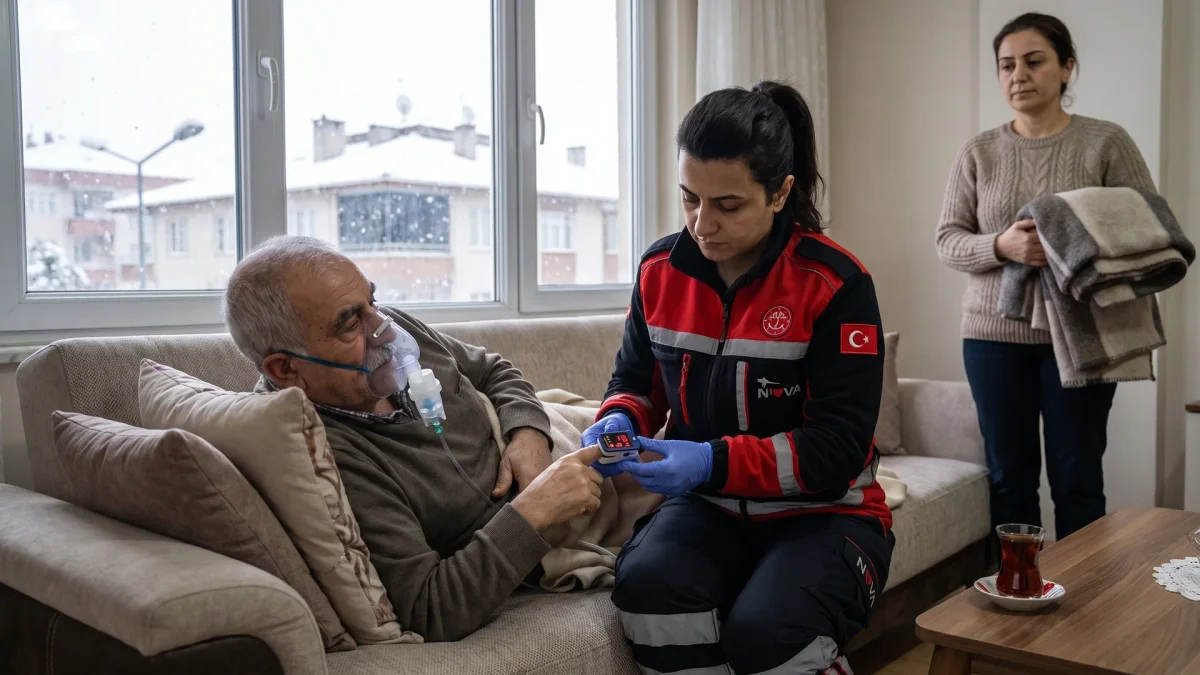
- Winter respiratory emergencies are not one entity but four: Chronic Obstructive Pulmonary Disease (COPD) exacerbation, asthma attack, acute bronchitis, and pneumonia.
- Warning sign: SpO₂ below 92%, central cyanosis, inability to speak in full sentences — call without delay (the COPD target is individualised).
- In the elderly, pneumonia may begin with confusion, falls or anorexia rather than fever; "looks like flu" is misleading.
- In children, chest-wall retractions, nasal flaring and stridor warrant an immediate ambulance.
Winter brings several respiratory threats simultaneously. Cold air narrows the bronchi reflexively while crowded, poorly-ventilated indoor spaces increase viral circulation [2]. According to the World Health Organization (WHO), Chronic Obstructive Pulmonary Disease (COPD) "was responsible for approximately 3.5 million deaths in 2021 — about 5% of all global deaths" [5]. Asthma affected an estimated 363 million people in 2023 and caused 442,000 deaths [6]. Pneumonia killed 740,180 children under 5 in 2019 alone — roughly 14% of all deaths in this age group [8]. This guide covers four critical winter presentations together — Chronic Obstructive Pulmonary Disease (COPD) exacerbation, asthma attack, acute bronchitis and pneumonia — because the symptoms, home response and ambulance threshold differ for each.
Cold air and the airways
Cold dry winter air triggers reflex bronchospasm — the primary mechanism behind winter exacerbations of Chronic Obstructive Pulmonary Disease (COPD) and asthma [3][4]. Increased indoor viral circulation (influenza, RSV, rhinovirus, SARS-CoV-2) accelerates the picture in already-compromised lungs [2][7]. The break in this chain is early decision-making at first symptoms.
What triggers winter asthma attacks
- Sudden temperature shifts (warm indoor → cold outdoor)
- Tobacco smoke, fuel smoke, indoor pollutants
- Mould, dust mites, damp environments
- Upper-respiratory infections
- Exercise-induced bronchospasm (especially outdoors)
What triggers Chronic Obstructive Pulmonary Disease (COPD) exacerbations
- Viral or bacterial respiratory infections — the leading cause [3]
- Air pollution, especially PM2.5 and NO₂
- Skipping maintenance inhaler therapy
- Cold + high humidity combination
Four conditions, four clinical signatures
| Condition | Typical winter onset | Distinguishing sign | Clinical threat |
|---|---|---|---|
| Chronic Obstructive Pulmonary Disease (COPD) exacerbation | In a known Chronic Obstructive Pulmonary Disease (COPD) patient: increased dyspnoea, change in sputum colour/volume [3] | Distinct worsening from baseline | Respiratory failure |
| Asthma attack | In a known asthmatic: wheezing, cough paroxysms, chest tightness [4] | Partial/late response to rescue inhaler | Status asthmaticus |
| Acute bronchitis | Post-viral prolonged cough, sputum, chest burning | Fever usually <38.5 °C, mild systemic illness | Exacerbation in Chronic Obstructive Pulmonary Disease (COPD)/asthma |
| Pneumonia | High fever, rigors, deepening cough, pleuritic chest pain [7] | Confusion (especially in elderly), low SpO₂ | Sepsis, respiratory failure |
Atypical pneumonia in the elderly
As the Public Health General Directorate of Türkiye (HSGM) emphasises in its winter-infection prevention guidance, pneumonia in older adults may present with sudden confusion, lethargy, anorexia or falls before fever appears [2]. Don't say "let's wait" if an elderly relative who "looks like they have flu" deteriorates noticeably within 24 hours.
SpO₂ — the single most important number in winter respiratory emergencies
A finger pulse oximeter is the most practical home decision tool [1]:
- 95–100% — generally normal in healthy adults.
- 92–94% — caution zone. Worsening symptoms or underlying Chronic Obstructive Pulmonary Disease (COPD)/heart failure → seek urgent assessment.
- below 92% — a warning sign that warrants urgent assessment, especially with dyspnoea; ambulance dispatch should be considered [1].
This 92% figure is a general "seek urgent care" trigger, not an absolute medical cutoff. In Chronic Obstructive Pulmonary Disease (COPD) patients the personal target set by the physician is typically in the 88–92% range, so the threshold must be individualised [1]; over-oxygenation can be harmful in patients adapted to low O₂ flow [3]. Don't open the home oxygen tank arbitrarily on the way to ER.
Emergency signs — call without delay
Any of the following warrants 112 or Nova Ambulans (+90 216 339 00 39):
- Speech difficulty — single-word answers, unable to form a sentence [4].
- Cyanosis — blue lips, tongue or nail beds [1].
- Use of accessory muscles — neck and chest muscles being drawn in; visible chest-wall retraction [3].
- SpO₂ below 92%, especially with a rapidly falling trend [1].
- Altered consciousness — drowsiness, lethargy, agitation, confusion.
- No response to rescue inhaler — no better, or worse, after using the rescue (blue) inhaler at 1 puff every 30–60 seconds up to 10 puffs [4].
- High fever + severe weakness — temperature >38.5 °C with inability to drink fluids or stand.
- Child in respiratory distress — fast breathing, chest retractions, nasal flaring, stridor, refusal to feed.
What to do at home until the ambulance arrives
These steps apply broadly across the four winter respiratory presentations.
- Position: Sit upright or in a half-sitting position with pillow support; leaning slightly forward gives the diaphragm more room [4].
- Environment: Remove from tobacco smoke, strong odours, excessive heat. Open a window without exposing the patient to a direct cold draught.
- Medication: If asthma/Chronic Obstructive Pulmonary Disease (COPD) is diagnosed, use the rescue inhaler as previously prescribed. If maintenance medication was skipped, take it now.
- Clothing: Loosen tight collars, ties, belts that restrict breathing or circulation.
- Monitoring: If you have a pulse oximeter, note SpO₂ and pulse every 5 minutes; report to ambulance crew.
- Fluids: If conscious and swallowing safely, small sips of warm fluid; do not force if consciousness is impaired.
Don'ts
- Giving water or oral medication to an unconscious person
- "Rubbing, hot bath" folk remedies in an asthma attack
- High-flow oxygen in Chronic Obstructive Pulmonary Disease (COPD) without medical guidance
- Saying "let's wait, it'll pass" — the most common fatal error in winter respiratory emergencies
ER on your own, or ambulance?
This frame clarifies the choice:
- ER under your own power: Mild dyspnoea, alert, SpO₂ ≥94% stable, no chest pain — but fever and cough worsening over 24–48 hours, or you're in a risk group.
- Ambulance: Any "emergency sign" above, or patient profile likely to need en-route intervention (advanced age, child, multiple chronic conditions).
If you drive yourself and the patient deteriorates en route, intervention capacity is limited; an equipped ambulance starts treatment from the moment it dispatches.
Children — special winter respiratory warnings
Babies and small children change the picture rapidly. Any of the following warrants an ambulance:
- Respiratory rate clearly above age-norm (newborn >60, infant >50, 1–5 yr >40)
- Chest-wall retractions, intercostal indrawing
- Nasal flaring, grunting
- Refusal to feed, persistent sleepiness, weak cry
- Stridor (barking cough + sound on inspiration) — croup suspected
- Cyanosis, especially perioral
Croup and bronchiolitis are the most common paediatric winter respiratory emergencies; viral in origin but capable of causing hypoxia [7].
Respiratory-equipped transport with Nova Ambulans
The quality of the transport vehicle directly affects outcome in respiratory crises. Nova Ambulans vehicles carry portable ventilator, flow-controlled oxygen system, nebuliser, and continuous SpO₂/ECG monitoring. Specialist paramedic teams begin treatment from the moment of pickup and monitor clinical state until arrival at hospital. For Chronic Obstructive Pulmonary Disease (COPD) patients on titrated low-flow oxygen, flow is titrated to the personal target.
Frequently Asked Questions
Why do Chronic Obstructive Pulmonary Disease (COPD) and asthma exacerbate in winter?
Two main mechanisms: cold-air-induced reflex bronchospasm, and increased indoor viral circulation [2][3]. Most Chronic Obstructive Pulmonary Disease (COPD) exacerbations are viral in origin.
Should I have a pulse oximeter at home?
Yes if a relative has Chronic Obstructive Pulmonary Disease (COPD), heart failure or chronic asthma — it's a useful home decision aid in winter [1]. Be aware that cold fingers, nail polish or motion can produce inaccurate readings.
When should I call an ambulance for asthma?
If you are no better — or getting worse — after using the rescue (blue) inhaler at 1 puff every 30–60 seconds up to 10 puffs, the patient can't speak in full sentences, lips are blue, or SpO₂ is below 92% — call an ambulance (112) without delay; while waiting, repeat the inhaler step after 10 minutes [4].
How do I recognise pneumonia in an elderly relative?
Atypical onset is common: sudden confusion, falls, anorexia, lethargy may precede fever [2]. If an elderly person who "looks like they have flu" deteriorates noticeably within 24 hours, ambulance assessment should be considered.
Can I open the home oxygen tank in Chronic Obstructive Pulmonary Disease (COPD)?
Only at the flow rate your physician set — not higher. In some Chronic Obstructive Pulmonary Disease (COPD) patients, high-flow oxygen can blunt respiratory drive [3]. In an emergency, the 112 or Nova Ambulans dispatcher will guide you over the phone.
Related Articles
- Flu Season: Symptoms, Vaccination and When to Call an Ambulance — Respiratory infections that trigger Chronic Obstructive Pulmonary Disease (COPD) and asthma crises.
- Chest Pain and Shortness of Breath in Cold Weather — Distinguishing cardiac from respiratory causes.
- Modern Ambulance Equipment and Team Standards — Ventilator, oxygen and nebuliser fleet equipment.
- Winter Emergency Health Guide — Pillar guide to all winter health risks.
Rapid Emergency Support
24/7 emergency ambulance service across Istanbul. Fast response, fully equipped team.
Average response time: 15 seconds
Related Articles
Concussion Symptoms After a Fall or Head Injury: Bystander Guide (2026)
After a fall or head injury, concussion symptoms bystanders must recognize, step-by-step first aid, the CDC HEADS UP danger signs that require calling 112 immediately, age-specific notes for children and elderly patients, and the recovery timeline — grounded in Türk Kızılay 2025 First-Aid Pocket Book pp.19-20 and 47-48, T.C. Ministry of Health May 2025 First-Aid Training Book Chapter X.A and VII.B, Gazi University Pediatric Emergency PECARN application review, Turkish Neurosurgery 2025 national survey (n=1,875 neurosurgeons), JAMA April 2026 pediatric concussion systematic review, and CDC HEADS UP with WHO falls data.
EducationSuspected Fracture and Dislocation: Splinting, Immobilization, and Calling 112 (2026)
What a bystander does at the scene for suspected fracture, dislocation, sprain and strain — the Turkish Red Crescent 2025 First Aid Pocket Book (pp.38–42), the Turkish Ministry of Health May 2025 First Aid Training Book Chapter XII, the Gazi University 2026 Ankara pediatric hand-foot fracture series (n=278), the İstanbul University Çapa 12-month hip fracture mortality data, and the World Health Organization (WHO) falls factsheet applied to splinting, immobilization, and the 112 chain.
EducationSepsis Symptoms: Flu or Sepsis? How to Spot It at Home and When to Call 112
Sepsis is an emergency in which the body responds to an infection in an extreme, uncontrolled way, and it can worsen within hours. If someone with a fever or an infection becomes confused, breathes very fast, has pale or blotchy skin, a rash that does not fade when pressed, or a very high or very low temperature, call 112 without waiting. Until the ambulance arrives, do not leave them alone, give them nothing by mouth and check their consciousness every 2-3 minutes.
Popular Ambulance Topic Clusters
You may also like
- Private ambulance pricing
- Istanbul private ambulance
- Intercity patient transport
- Doctor-accompanied ambulance
- Dialysis patient transport
- How intercity patient transport works
- Ambulance response time in Istanbul
- Home-to-hospital patient transport
- Modern ambulance equipment and team standards
- Heart attack symptoms and first response
This content is informational only and does not replace professional medical evaluation. In emergencies, call 112 or +90 216 339 00 39.
