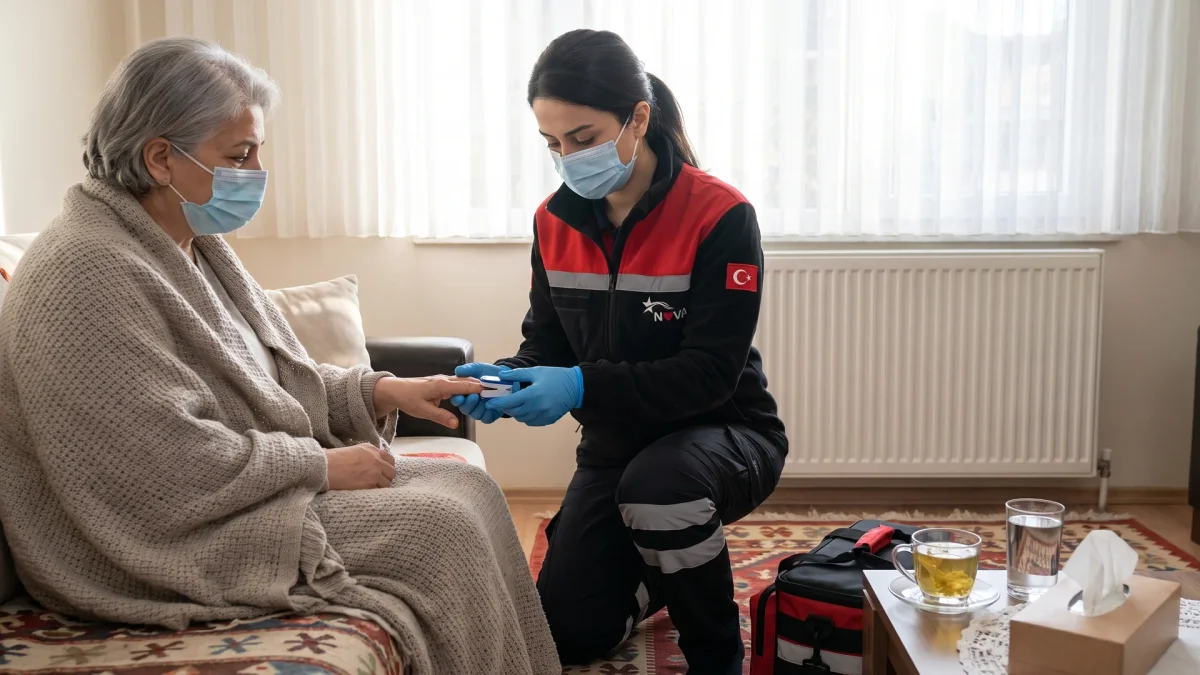
- Flu vs Cold: Flu starts suddenly with high fever and muscle aches.
- Home Care: Rest, fluids, and fever control in the first 48 hours.
- Risk Groups: Seniors (65+), young children, and those with chronic conditions.
- Vaccine Timing: Best in October-November to reduce severe disease risk.
- Red Flags: Call 112 or Nova Ambulans for shortness of breath, confusion, or severe dehydration.
With October, influenza (flu) and other respiratory infections tend to increase. School season, more time indoors, and changing weather all raise transmission risk. Here is a practical roadmap for the 2025-2026 season.
Quick answer. Türkiye's national influenza surveillance, run by the Public Health General Directorate (HSGM), shows seasonal flu activity peaking between December and February [2]. The optimal vaccination window is October-November; primary care prioritises adults 65+, pregnant individuals, healthcare workers, and chronic-disease patients. The Centers for Disease Control and Prevention (CDC) estimates that from 2010-2025 flu was associated with roughly 9.4-51 million illnesses, 120,000-710,000 hospitalisations and 6,300-52,000 deaths per year in the United States (excluding the atypical 2020-2021 season) [4].
Flu Season 2026: Symptoms, Vaccine Timing & Request an Ambulance
1) Flu vs. Common Cold—Key Differences
- Flu often starts suddenly: high fever, widespread muscle aches, headache, marked fatigue [8].
- Colds are milder: runny nose, sneezing, mild sore throat [8].
- COVID-19 can look similar; get tested if available [8].
2) Home-Care Plan
- First 48 hours: rest, adequate fluids, regular meals, fever control.
- Ventilate the room frequently; use individual towels; masks can reduce household transmission.
- Use medications as advised by your doctor; antibiotics don't work on viruses [1].
3) Who’s at Higher Risk?
4) Vaccine Timing and 2025-2026 Notes
The optimal vaccination window is October-November; the vaccine's protective effect begins about 2 weeks after vaccination [2]. Türkiye's Ministry of Health ranks primary-care vaccination priority as follows [2]:
- Adults 65+
- Pregnant individuals (Türkiye's Ministry of Health recommends vaccination in the 2nd-3rd trimester; it is not advised in the first 3 months) [2]
- Children aged 6 months to 5 years (under-2 carry the highest risk)
- Chronic-disease patients: Chronic Obstructive Pulmonary Disease (COPD), asthma, cardiovascular disease, diabetes, kidney/liver disease
- Immunocompromised individuals (chemotherapy, corticosteroids, post-transplant)
- Healthcare workers (both for personal and patient protection)
- Long-term-care facility residents and staff
World Health Organization (WHO) data show that vaccination reduces severe disease and hospitalisation risk and can make illness milder even if breakthrough infection occurs [1]. Mild fever or muscle aches after vaccination are common and usually resolve within 1-2 days [2].
Centers for Disease Control and Prevention (CDC) Annual Flu Burden
The Centers for Disease Control and Prevention (CDC) does not classify season severity with a fixed look-up table of numbers; instead it grades each season as low, moderate, high or very high using indicators such as flu-related medical visits, hospitalisation rates and death indicators. Across 2010-2025, CDC estimates flu was associated with roughly 9.4-51 million illnesses, 120,000-710,000 hospitalisations and 6,300-52,000 deaths per year in the United States [4].
For Türkiye, equivalent surveillance is published by the Public Health General Directorate (HSGM) as weekly bulletins; follow those for current trend data [2].
5) When to Call 112 or Nova Ambulans
Red flags for urgent assessment:
- Shortness of breath, cyanosis, chest pain
- Confusion, persistent sleepiness, stubborn high fever (especially in children)
- Severe dehydration: reduced urination, excessive thirst, dizziness
- Rapid deterioration in high-risk individuals
- In children: fast breathing, chest retractions, blue lips, inability to feed
Call 112 or Nova Ambulans (0216 339 00 39) without delay in these situations. Nova Ambulans provides advanced life support equipment and experienced crews for safe transport and initial care at home or on the road.
6) Prevention—Simple but Effective
- Hand hygiene, masks and distancing in crowded/indoor spaces
- Adequate sleep, balanced diet, regular exercise
- Rest and isolate when sick; limit contact with high-risk people
Frequently Asked Questions
How can I distinguish between flu, COVID-19, and a common cold?
Flu starts suddenly with high fever, muscle aches, and fatigue. Colds are milder with runny nose and sneezing. COVID-19 may include loss of taste or smell. Since symptoms can overlap, testing is the only reliable way to confirm the diagnosis.
When is the best time to get a flu vaccine?
October through November is the ideal window. Getting vaccinated before flu activity peaks gives your immune system time to build protection. High-risk groups — seniors, young children, pregnant individuals, and those with chronic conditions — should not delay.
When should I call an ambulance for flu symptoms?
Call 112 or Nova Ambulans if you experience severe shortness of breath, chest pain, cyanosis (bluish skin), persistent confusion or drowsiness, inability to keep fluids down, or rapid deterioration — especially if you are in a high-risk group.
Do antibiotics help with the flu?
No. Flu is caused by a virus, and antibiotics only work against bacteria. Antiviral medications like oseltamivir (Tamiflu) may be prescribed by a doctor within the first 48 hours of symptom onset to reduce severity and duration.
Rapid Emergency Support
24/7 emergency ambulance service across Istanbul. Fast response, fully equipped team.
Average response time: 15 seconds
Related Articles
Mushroom Poisoning Symptoms and First Aid: When Do Symptoms Start, When to Call 112?
If nausea, vomiting, diarrhea, abdominal pain or any other symptom begins after eating foraged mushrooms or mushrooms of unknown origin, call 112, whatever hour it began; do not induce vomiting and give nothing by mouth. People without symptoms, including a child who ate a mushroom in a garden or park, still need hospital assessment; call 112 and explain, because with amatoxin, which damages the liver, the symptom-free interval averages 8-10 hours. The National Poison Information Center (UZEM) on 114 gives advice but does not replace 112.
EducationBee, Wasp, and Hornet Sting First Aid: When a Sting Reaction Needs 112
Step-by-step first aid for honeybee, wasp, and hornet stings — the bystander's 30-second stinger-scrape technique (credit-card scrape, never tweezers), local vs large-local vs systemic reaction decision tree, when to call Türkiye's 112 emergency line, adrenaline auto-injector application to the outer thigh, and what to do until the ambulance arrives — with verbatim protocols from Türk Kızılay Cep Kitabı 2025, T.C. Sağlık Bakanlığı May 2025 First-Aid Training Manual, the Turkish National Society of Allergy and Clinical Immunology (AİİAD), the Society of Pediatric Allergy and Asthma Academy (CAAAD), the 2025 Katran cohort of 194 526 patients at Istanbul Süreyyapaşa Hospital, the 2021 Öziş Baba cohort of 7 904 Trabzon schoolchildren, the American Academy of Allergy, Asthma & Immunology (AAAAI) and the McMurray 2026 Hymenoptera venom anaphylaxis review.
EducationWhen to Call an Ambulance for Seizures?
Learn in which symptoms you should call 112 or Nova Ambulans in seizure/convulsion situations seen in children and adults and the ambulance process.
Popular Ambulance Topic Clusters
You may also like
- Private ambulance pricing
- Istanbul private ambulance
- Intercity patient transport
- Doctor-accompanied ambulance
- Dialysis patient transport
- How intercity patient transport works
- Ambulance response time in Istanbul
- Home-to-hospital patient transport
- Modern ambulance equipment and team standards
- Heart attack symptoms and first response
This content is informational only and does not replace professional medical evaluation. In emergencies, call 112 or +90 216 339 00 39.
