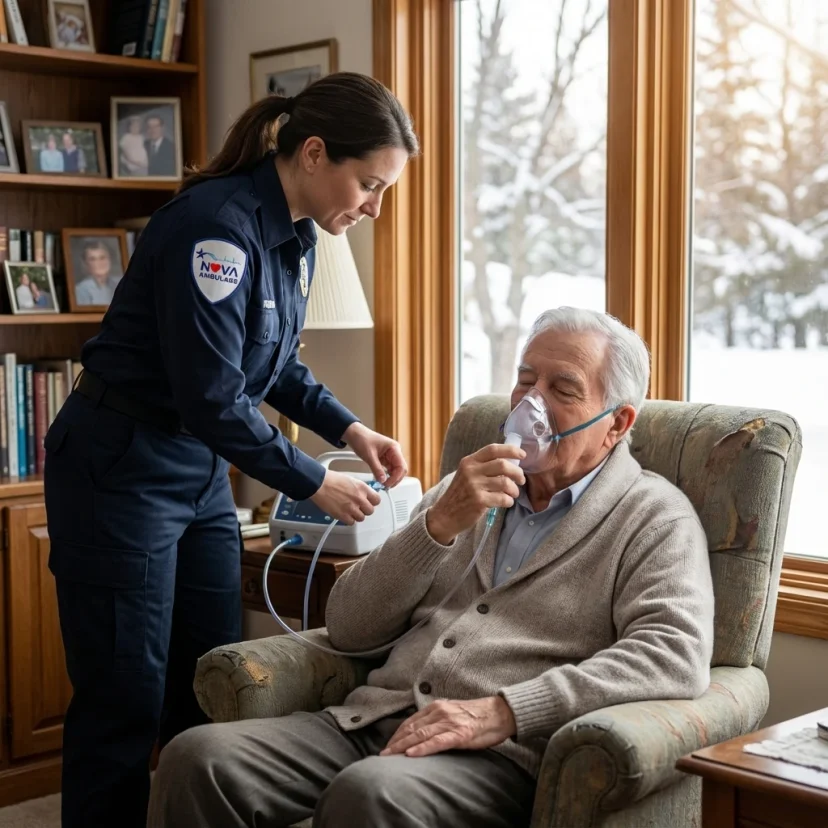
- According to the Turkish Ministry of Health's May 2025 First Aid Training Book, an asthma attack is a life-threatening condition; if symptoms do not improve within 5 minutes after the patient's own prescribed inhaler is used, call 112 Emergency or have someone else call.
- The Global Initiative for Asthma (GINA) 2025 Summary Guide recommends that for a moderate attack the rescue short-acting beta-2 agonist (SABA) — in Türkiye the blue salbutamol inhalers (Ventolin, Salbutol) — be given as 4–10 puffs via metered-dose inhaler and spacer every 20 minutes, up to three doses if needed.
- A patient who can speak in phrases, prefers sitting to lying and breathes normally is in a mild/moderate attack; one who can only speak in words, leans forward and breathes more than 30 times per minute is in a severe attack; one who is drowsy, confused or whose chest has fallen silent is in a life-threatening attack — in the second group 112 is called directly, in the third group with zero delay.
- The Turkish Adult Asthma Registry's 2025 publication of 2,053 patients identified illiteracy as an independent risk factor for hospitalisation (Odds Ratio [OR] 2.687; 95% confidence interval [CI] 1.235–5.848); this is why a written asthma action plan at home must be prepared in plain Turkish.
- A 2024 Danish prehospital cohort analysing 6,318 ambulance transports in which paramedics administered an inhaled bronchodilator (short-acting bronchial relaxer) reports 0% 30-day mortality among the 233 adults with asthma — early ambulance activation combined with in-ambulance bronchodilator treatment is life-saving in this picture.
Quick answer. A bystander's job during an asthma attack has three layers: sit the patient upright and give the patient's own prescribed rescue inhaler — in Türkiye most commonly blue salbutamol — with a spacer if one is available; the Global Initiative for Asthma (GINA) 2025 Summary Guide recommends 4–10 puffs every 20 minutes [7]; per the Turkish Ministry of Health May 2025 First Aid Training Book, if no improvement is seen within 5 minutes after the medicine, 112 Emergency is called directly [1]. Adult asthma prevalence in Türkiye is 9.8% [3]; in the 2024 mortality statistics released by the T.C. Turkish Statistical Institute (TÜİK) on 19 June 2025, respiratory system diseases climbed to a 15% share and rank third among causes of death [4]. A disease burden at that scale makes a learnable first-five-minute decision chain mandatory even for an untrained bystander.
Asthma attack: what it is, how it starts, why it is dangerous
Asthma is a chronic inflammatory narrowing of the airways. An attack — also called an exacerbation, crisis or wheezing crisis — is a picture of bronchial hyper-contraction, increased mucus secretion and difficulty of airflow on exhalation. The Turkish Ministry of Health May 2025 First Aid Training Book sums it up: "asthma is a disease that narrows the airways; an asthma attack is a life-threatening condition" [1]. The Global Initiative for Asthma (GINA) 2025 Summary Guide places the same line: "severe asthma exacerbations require urgent health care and can cause death" [7].
Türkiye's burden is meaningful on two scales. First, prevalence: the 6 May 2025 World Asthma Day announcement of the T.C. Ministry of Health Directorate-General of Public Health (HSGM) gives the adult asthma prevalence in Türkiye as 9.8% [3]. Second, mortality: TÜİK's 2024 mortality bulletin lists respiratory system diseases as the third leading cause of death at 15% of all deaths [4]; the World Health Organization (WHO) Asthma Fact Sheet of 28 April 2026 gives the global asthma patient count as 363 million for 2023 and the death count as 442,000 [8]. The practical meaning of all these numbers is the same: respiratory emergencies have asthma at their backbone, and a bystander's correct first five minutes is the preventable portion of hundreds of thousands of deaths globally and thousands in Türkiye.
Which triggers, why are spring–summer riskier
In a city with a high pollen, high particulate matter (PM2.5) and high humidity profile like Istanbul, the typical May–June triggers are: tree pollen (plane, juniper), grass pollen, increasing house-dust mite density, pet dander exposure, viral spread (especially rhinovirus), simultaneous tobacco-smoke exposure and exercise-induced bronchospasm. The Global Initiative for Asthma (GINA) 2025 risk-factor list adds "use of three or more 200-dose salbutamol canisters per year", "a history of severe exacerbation or intensive-care unit (ICU) admission in the past year" and "lack of low-dose inhaled corticosteroid (ICS) treatment" as independent risk factors [7]. The 2,053-patient January 2025 publication of the Turkish Adult Asthma Registry shows that illiteracy is an independent risk factor for hospitalisation with an Odds Ratio (OR) of 2.687 [9]; this is concrete evidence of why the household asthma action plan must be written in plain Turkish.
The first 5 minutes: a bystander decision protocol
The sequence below is the simplified bystander version of the asthma-attack algorithm on pages 105–107 of the Turkish Ministry of Health May 2025 First Aid Training Book combined with the Global Initiative for Asthma (GINA) 2025 Summary Guide's Figure 9 primary-care protocol.
1. Step — Stay calm and assess the environment (0–30 seconds). Tell the patient "I am here, we are together." Open the windows. Move smoke, perfume, cleaning sprays or any other triggers away. Loosen tight collars, belts and ties. The Turkish Ministry of Health 2025 protocol states "help the patient adopt the most comfortable position; do not force the patient to lie down" [1]; in practice most patients breathe better sitting upright or leaning forward — arms on knees or a table, the "tripod" posture.
2. Step — Give the rescue inhaler (30 seconds – 2 minutes). The patient's own prescribed rescue inhaler is a short-acting beta-2 agonist (SABA) — in Türkiye most commonly the blue salbutamol canister (Ventolin, Salbutol, Asthalin brands). If a spacer (Turkish: aracı tüp) is available, use it. The Global Initiative for Asthma (GINA) 2025 Summary Guide Figure 9 protocol verbatim says for a mild/moderate attack: "SABA 4–10 puffs by pMDI + spacer, every 20 minutes for 3 doses, if needed" [7]. This is the backbone of the bystander adult asthma-attack protocol. Each puff is given one at a time; after one puff the patient takes 4–5 more breaths or holds 10 seconds through the spacer, then the second puff is given.
3. Step — Count five minutes (2–7 minutes). The verbatim rule on page 107 of the Turkish Ministry of Health May 2025 First Aid Training Book is: "if no improvement is seen within 5 (five) minutes after the medicine is taken, call 112 Emergency or have someone else call" [1]. This is the most important numerical threshold of the protocol for an untrained bystander; watch the minute counter on a wristwatch or phone screen, not the hour. There are two exceptions to the "5-minute rule": (a) if at the moment of giving the medicine the patient already cannot form a sentence, has gray-blue lips or nail beds, or is confused — do not wait, call 112 now; (b) if there is relief after the first dose but symptoms recur within 20 minutes — give the second dose and call 112 in parallel.
4. Step — Call 112 correctly (no delay ever). When calling 112, give the semantic category correctly: "asthma attack, used the rescue inhaler, did not improve within 5 minutes." Our previous post on the Health Command and Control Centre (Sağlık Komuta Kontrol Merkezi, SKKM) call-classification process and the ASOS — Emergency Health Automation System infrastructure that handles call–case–transport explains the chain at length. Give the location clearly (neighbourhood, street, building, apartment, floor, lift status). Do not hang up the line; the SKKM team stays with you step by step. The patient can continue using the inhaler; you do not need to terminate the 112 call to manage on your own.
5. Step — Observe until the medical team arrives (7–20+ minutes). Do not leave the patient. The Turkish Ministry of Health 2025 protocol states "do not leave the patient and continue to observe until the medical team arrives" [1]. If the patient loses consciousness, place into the recovery position (also called lateral position, recovery position, fixed side-lying); our recovery-position step-by-step guide explains the technique. If there are no vital signs — no breathing, no pulse — begin Basic Life Support (BLS); our adult CPR — basic life support bystander guide repeats the 30:2 ratio rule.
Classification: how severe is the attack? The GINA 2025 table
The Figure 9 classification on page 36 of the Global Initiative for Asthma (GINA) 2025 Summary Guide gives the bystander a numerical answer to the "what level of emergency" question.
Mild or moderate attack. Can speak in phrases or sentences, prefers sitting to lying but is not agitated, respiratory rate below 30 per minute, accessory respiratory muscles not in use, pulse 100–120, oxygen saturation 90–95% on room air [7]. The three-dose SABA 4–10 puffs every 20 minutes protocol is started in this patient.
Severe attack. Can speak only in words, sits leaning forward, agitated, respiratory rate above 30, uses accessory respiratory muscles (neck and shoulder muscles prominent), pulse above 120, oxygen saturation below 90%, peak expiratory flow (PEF) below 50% of personal best [7]. SABA is started but 112 cannot wait; the "5-minute rule" cannot be allowed to delay the call.
Life-threatening attack. Drowsy, confused or silent chest (no wheezing because airflow is about to stop) [7]. This corresponds to the Turkish Ministry of Health 2025 protocol items "gray-blue colour at the lips and nail beds, loss of consciousness" [1]. 112 immediately, without counting any other step.
The practical synthesis of the two lists is this: if any of the following is present, 112 is called directly and without delay — (1) inability to form sentences, (2) more than 30 breaths per minute, (3) prominent neck-shoulder muscle use, (4) gray-blue colour at the lips or nail beds, (5) agitation or panic, (6) drowsiness or confusion, (7) silent chest, (8) worsening despite the medicine.
Inhaler technique: with and without a spacer, step by step
How an inhaler is held is discussed less often than puff timing but is just as important. The CAİAD 6 May 2025 World Asthma Day statement lists "insufficient anti-inflammatory inhaler use and excessive SABA use" as the first barrier to asthma control in Türkiye [5]. Correct technique solves half of that problem.
With a spacer — the Global Initiative for Asthma's standard recommendation
A spacer is a transparent valve chamber placed between the metered-dose inhaler canister and the patient's mouth (in Türkiye Aerochamber, Volumatic and Babyhaler brands are widely available without prescription at a pharmacy). The steps:
- Check the valve at the mouthpiece end of the spacer (it looks like a small blue or transparent flap).
- Shake the canister 4–5 times and remove the cap.
- Insert the canister into the socket at the other end of the spacer (you should hear a click).
- The patient sits upright, lifts the chin slightly, takes the mouthpiece between the teeth and seals the lips tightly.
- The patient exhales fully.
- Press once for a single dose.
- The patient takes slow, deep breaths through the spacer for 4–5 inhalations — about 10 seconds (in a child or an elderly person the valve should give a "tick-tick" sound).
- Wait 30–60 seconds and give the second puff; repeat up to 4–10 puffs.
In a child under age 6, a mask spacer (such as a Babyhaler) is used instead of a mouthpiece spacer; the mask must seal the nose and mouth without leakage. Both the Turkish Ministry of Health 2025 and the Global Initiative for Asthma (GINA) 2025 show the masked spacer as the paediatric standard for an attack [1][7].
Without a spacer — direct inhaler technique
If no spacer is available at home, the metered-dose inhaler can still be used effectively but the technique is more critical. Apply the same Step 1–8 sequence above, replacing the spacer with the patient placing the mouthpiece directly between the teeth and sealing the lips tightly; the press of the canister must be synchronised with the start of the slow inhalation. This coordination is hard for children, agitated adults and the elderly — which is why the Global Initiative for Asthma (GINA) 2025 lists "metered-dose inhaler + spacer" as the first-line recommendation [7]. A spare spacer should always be in an asthma patient's bag.
Dry-powder inhaler and nebuliser
A dry-powder inhaler (Diskus, Turbuhaler, Easyhaler type) is not preferred during an attack because fast, forceful inhalation is required — which the patient cannot generate during an attack. Even if the family uses a dry-powder inhaler as a daily preventer, during an attack the metered-dose inhaler + spacer combination should be the primary choice. Nebulisers (jet or ultrasonic compressor + mask) are used in the hospital and on a doctor-led ambulance; the output of a home nebuliser is usually slow and during an attack waiting 5 minutes for a home nebuliser pointlessly extends the rule.
Differences for children, pregnant patients and the elderly
Paediatric (child) attack
The asthma-attack steps of the Turkish Ministry of Health 2025 protocol apply to children as well, but the threshold is lower [1]. The severity criteria shift in a child:
- Chest-wall retractions (visible intercostal or subcostal indrawing)
- Nasal flaring (the nostrils opening and closing with each breath)
- Inability to feed, cry or laugh
- A previously distressed child under age 5 becoming quiet (fatigue, a bad sign)
In 6–11-year-olds, the Global Initiative for Asthma (Global Initiative for Asthma, GINA) 2025 Summary Guide sets the oxygen-saturation target at ≥94% [7]. For a moderate attack the prednisolone dose is 1–2 mg per kg, maximum 40 mg per day, for 3–5 days. Under age 6 the metered-dose inhaler + mask spacer combination is mandatory. Our paediatric emergencies parent guide explains the paediatric decision tree page by page.
Pregnant asthma patient
Continuing the existing inhaler (rescue short-acting beta-2 agonist and inhaled corticosteroid) during pregnancy is given as a standard recommendation in the Global Initiative for Asthma (Global Initiative for Asthma, GINA) 2025 Summary Guide [7]; during an attack, hypoxia (low oxygen) harms the baby directly through the placenta — sustaining the medicine, not stopping it, is the safe choice for the baby. In a pregnant attack patient, the lateral position with left-side-down is preferred over the supine position; this prevents vena cava compression.
Elderly patient
Above age 65, asthma often coexists with Chronic Obstructive Pulmonary Disease (COPD); the differential is not always possible at the scene. The Turkish Ministry of Health 2025 protocol prescribes the same inhaler delivery during a COPD attack and the same "if no improvement within 5 (five) minutes after the medicine, call 112 Emergency or have someone else call" rule [1]. Our COPD and asthma attacks in winter post compares the two pictures and explains which protocol takes priority in which situation.
Do and do not while waiting for the ambulance
Do
- Keep the patient upright, preferably leaning slightly forward in the "tripod" posture.
- Limit speech; phrase questions as yes/no. Prevents breathlessness escalation.
- Repeat 4–10 puffs every 20 minutes for up to three doses in an adult attack — per the Global Initiative for Asthma (GINA) 2025 metered-dose inhaler + spacer protocol [7].
- If a pulse oximeter is available, use it; per the Global Initiative for Asthma (GINA) 2025, the saturation target in an adult is 93–95%, in a child ≥94% [7].
- Have a family member meet the ambulance team at the door; pre-inform the SKKM of lift status (they already ask).
- Have the medication boxes and the doctor's written asthma action plan ready when the team arrives.
Do not
The "do not force the patient to lie down" and "help the patient use their own prescribed inhaler" lines of the Turkish Ministry of Health 2025 protocol [1] are also the negatives of the five most common bystander errors:
- Giving someone else's inhaler. Type, dose and formulation can differ; (for example a long-acting beta-agonist alone) it can worsen the attack.
- Forcing the patient to lie down. The supine position increases pressure on the diaphragm in most asthma-attack patients, making breathing harder.
- Going beyond "stay calm, breathe slowly" by giving water, honey, hot drinks, antihistamines or painkillers by mouth. NSAID sensitivity makes ibuprofen or aspirin a trigger; the aspiration (airway-entry) risk of giving fluids is high in a fatigued airway.
- "The cigarette has burned, let it die out fast" by puffing on it indoors to extinguish it. Tobacco smoke is an asthma trigger; the cigarette is extinguished immediately and removed from the room.
- The "it has passed, let me cancel the ambulance" call. Biphasic recurrence risk runs for 4–12 hours; do not give up the referral for hospital observation. Our until-the-ambulance-arrives guide lists page-level alternatives to these five errors.
Why the ambulance matters in asthma: prehospital bronchodilator evidence
A 2024 multicentre cohort by Hagenau et al. analysed 6,318 ambulance transports in the Central Denmark Region in 2018–2019 in which paramedics administered a nebulised beta-2 agonist. The verbatim finding: "The 30 day mortality rate for all patients was 10.7% (95% CI 9.8-11.6), with zero deaths within 30 days among adults with asthma and those under 18" — that is, the 30-day mortality rate across all prehospital bronchodilator patients was 10.7% but in the 233 adult-asthma group and in those under 18 it was zero [10]. The same study writes that the need for a prehospital bronchodilator is "a clear and unmistakable marker for moderate to severe respiratory distress" that "enables early intervention" [10]. The practical meaning: delaying the 112 call and adopting an "we will manage until the ambulance arrives" attitude is paid for dearly; the combination of prehospital nebuliser + early hospital referral is life-saving in asthma.
In Türkiye nebulisers and salbutamol are standard equipment on doctor-led, ICU and private ambulance teams alike; our required equipment in ambulances post details the Ministry of Health regulation's minimum equipment list with Resmî Gazete citations. Our difference between 112 and private ambulance post separates which service is called in which situation.
After the attack: hospital observation and the value of chronic control
After the attack subsides, the Global Initiative for Asthma (GINA) 2025 Summary Guide recommends a follow-up visit within 2–7 days in adults and within 1–3 working days in children [7]. More critical: review of chronic therapy after the attack.
The CAİAD statement of 6 May 2025 emphasises that "insufficient anti-inflammatory inhaler use and excessive SABA use" is the main problem in Türkiye [5]; this is why the 2 September 2025 emergency-bag guide of the Turkish Alerji ve Astım Derneği lists the personalised "Asthma Action Plan" — "the personal plan written by your doctor is the guide during a crisis" — as one of the six core items of the bag [6]. The Global Initiative for Asthma 2025 does not recommend SABA-alone treatment for adults and adolescents; it verbatim states that the "Track 1" strategy combining low-dose inhaled corticosteroid–formoterol "reduces the risk of severe exacerbations by half to two-thirds, compared with SABA alone" [7]. The practical meaning is: if you tell the doctor at the post-attack visit "I only use the blue inhaler," reviewing ICS-formoterol combination therapy is the priority topic.
A 2,053-patient January 2025 publication of the Turkish Adult Asthma Registry shows the direct effect of socioeconomic factors on asthma control at the Odds Ratio (OR) level: illiteracy for hospitalisation OR 2.687 (95% CI 1.235–5.848); low household income OR 1.76 (95% CI 1.002–3.09) [9]. The social-policy implication aside, this is the concrete proof of why the household asthma action plan must be written in plain Turkish, why pharmacy-counter inhaler access matters, and why notifying schools and workplaces of the written plan is life-saving.
A practical bystander checklist for Istanbul
- Trigger tracking. Place the pollen calendar (March–May tree pollen, May–June grass pollen, August–October weed pollen) onto the patient's calendar; on high-pollen days keep windows closed and use a humidifier/HEPA filter.
- Air quality. Track the Istanbul Metropolitan Municipality's hourly PM2.5 and PM10 data; on "bad/very bad" days limit outdoor exercise.
- Written action plan. A doctor-signed asthma action plan (personal rescue dose, controller dose, 112 threshold, nearest emergency department address) on the fridge or in the inside pocket of the bag — the Turkish Alerji ve Astım Derneği emergency-bag guide also lists this card among the minimum bag contents [6].
- Two spare inhalers. One in the bag, one at the bedside; check expiry every 3 months (shelf life is usually 12–24 months).
- Spacer. One at the bedside, one in the bag; a masked model for paediatric age.
- Pulse oximeter. Available at a pharmacy in the 200–600 TL band; for saturation tracking.
- Smartphone quick contact. "112" on the home screen; family members on the speed-dial list.
- Health information card. Medications, allergies, doctor's name, insurance details written down; placed in the wallet.
Our emergency-kit guide details a content list customised for asthma patients and a renewal calendar.
Nova Ambulans asthma-attack transfer line
After an asthma attack, 112 takes the patient who needs hospital admission to the nearest emergency department directly. But when the attack has subsided, hospital discharge has been done and a respiratory-monitored transfer is needed on the way home — or planned transport to a chest-diseases outpatient clinic is required for routine follow-up — this is where Nova Ambulans is the licensed operator. Our doctor-led or paramedic-staffed ambulance carries nebuliser and salbutamol/ipratropium bromide as standard equipment and is ready 24/7 for planned asthma-patient transport within Istanbul and intercity. When you share your asthma action plan, the latest inhaler prescription and the doctor's referral note with us, the team sets up in-vehicle monitored follow-up before departure so you reach your routine follow-up appointment on the Asian side of Istanbul on time. Our city patient transport service details the pricing structure and process steps of the planned asthma transport line; our Nova Ambulans Medical Board page lists the specialty fields of the board members who review this content.
Frequently asked questions
I am not an asthma patient but I had shortness of breath — was that an asthma attack?
Diagnosing an asthma attack is a physician's job; it depends on history, physical examination, spirometry, allergy testing and peak expiratory flow measurement. The Global Initiative for Asthma (GINA) 2025 Summary Guide lists wheezing, shortness of breath, chest tightness and persistent cough — especially worsening at night or in the morning — as typical asthma symptoms [7]. If this is your first episode of breathlessness, the cause may not be asthma — pulmonary embolism, heart failure, vocal cord dysfunction, anaphylaxis or an upper airway foreign body can produce the same picture. Emergency physician evaluation is mandatory.
Will combined antihistamine + paracetamol or a painkiller help an asthma attack?
No. Antihistamines do not relieve airway bronchospasm. Paracetamol has no effect on an asthma attack. Nonsteroidal anti-inflammatory drugs (NSAIDs) such as ibuprofen and aspirin can trigger an attack in known NSAID-sensitive asthma; the risk in unknown cases is also not zero. The attack medicine is the rescue short-acting beta-2 agonist (in Türkiye salbutamol).
Must a nebuliser always be at home?
It can be, but it is not mandatory for an attack; in most mild/moderate attacks a metered-dose inhaler + spacer combination is as effective as a nebuliser and faster. If your doctor has prescribed a nebuliser, use it — it is practical especially in a child under age 5 or in an elderly patient with coordination difficulty. Clean the mask and filter of a home nebuliser monthly; bacterial colonisation can itself trigger an asthma attack.
The Turkish Ministry of Health set a "5-minute rule" while the Global Initiative for Asthma has a "20-minute rule" — which one is correct?
They measure different things. The Turkish Ministry of Health "5-minute rule" is a 112-call threshold for the untrained bystander at the scene — "if no improvement is seen 5 minutes after the first dose, call 112" [1]. The Global Initiative for Asthma "20-minute rule" is a treatment-repetition rule — "every 20 minutes 4–10 puffs, up to three doses" [7]. The practical synthesis: no improvement 5 minutes after the first dose → call 112, then continue giving additional doses on 20-minute cycles.
My asthma patient — can I give oxygen from a home tank while waiting for the ambulance?
A standard home oxygen concentrator at 1–3 L per minute low flow does not over-inflate the lungs; keep the patient upright when using it. Leave high-flow oxygen delivery to the ambulance team. The Global Initiative for Asthma 2025 gives the saturation target as 93–95% in adults and ≥94% in children [7]; high-flow oxygen without saturation measurement is not routine.
Is there an "exercise-induced" form of asthma? Should I stop training during an attack?
Exercise-induced bronchospasm is a real subgroup and is especially seen in outdoor runners, footballers and cyclists. In mild symptoms, stop exercise, give 2 puffs from the rescue inhaler and rest seated for 10 minutes. If no improvement, start the on-scene protocol (the 5 steps above). If exercise-induced attacks recur, your doctor may prescribe 2 puffs from the inhaler as a preventive measure 15 minutes before training.
I have asthma and I am going to a concert or crowded event — how do I prepare?
In crowded settings — concerts, matches, festivals — triggers compound: tobacco smoke, perfume, reduced airflow, anxiety. Two spare inhalers, one spacer, one asthma action plan card, a smartphone with quick 112 access, a companion who knows — that is minimum preparation. Our concert ambulance and medical team post explains the regulation side that mandates a medical team for outdoor events, and our outdoor events health and ambulance planning post covers the attendee side.
I live alone — can I call 112 during an attack on my own?
Yes, and the rule is not "medicine first then 112" — it is "during an attack, if you feel uncomfortable, call 112 at a low threshold". The 112 operator does not hang up; they stay with you step by step, asking you to unlock the door, asking what is in your cabinet, and even guiding you step by step through using your rescue inhaler. Your neighbour, the convenience-store staff next door or a family member via video call can also play the "remote bystander" role. For people who live alone with asthma, the "one-touch 112" shortcut on a smartwatch or a doorbell camera is life-saving.
Related blog posts
- COPD and Asthma Attacks in Winter — Cold-triggered bronchospasm and a comparison of the four winter respiratory emergencies.
- Anaphylaxis and Adrenaline Auto-Injector Guide — Adrenaline priority and lateral position when anaphylaxis accompanies asthma.
- Stroke Symptoms and the FAST Test — Sibling post in the acute-emergency symptom-recognition cluster: face–arm–speech–time.
- Hypertensive Crisis: When to Call 112 — Reference for asthma patients on beta-blockers and drug-interaction concerns.
- Pediatric Emergencies: Parent's Guide — Paediatric attack decision tree and mask-spacer use.
- Emergency Kit Guide — Bag layout customised for asthma patients with spacer, spare inhaler and action-plan card.
- City Patient Transport Service — Nova Ambulans service line for post-attack observation and outpatient follow-up transport.
Rapid Emergency Support
24/7 emergency ambulance service across Istanbul. Fast response, fully equipped team.
Average response time: 15 seconds
Related Articles
Bee, Wasp, and Hornet Sting First Aid: When a Sting Reaction Needs 112
Step-by-step first aid for honeybee, wasp, and hornet stings — the bystander's 30-second stinger-scrape technique (credit-card scrape, never tweezers), local vs large-local vs systemic reaction decision tree, when to call Türkiye's 112 emergency line, adrenaline auto-injector application to the outer thigh, and what to do until the ambulance arrives — with verbatim protocols from Türk Kızılay Cep Kitabı 2025, T.C. Sağlık Bakanlığı May 2025 First-Aid Training Manual, the Turkish National Society of Allergy and Clinical Immunology (AİİAD), the Society of Pediatric Allergy and Asthma Academy (CAAAD), the 2025 Katran cohort of 194 526 patients at Istanbul Süreyyapaşa Hospital, the 2021 Öziş Baba cohort of 7 904 Trabzon schoolchildren, the American Academy of Allergy, Asthma & Immunology (AAAAI) and the McMurray 2026 Hymenoptera venom anaphylaxis review.
EducationTick Bite First Aid: Correct Removal Technique and the Crimean-Congo Haemorrhagic Fever (CCHF) Decision
When a tick attaches to the skin, the bystander’s step-by-step response: gloved, fine-tipped tweezers gripping the tick’s head as close to the skin as possible with steady upward traction, no alcohol, petrol, nail polish, matches or lit cigarettes, saving the removed tick in a labelled sealed plastic bag, a 14-day watch schedule for Crimean-Congo Haemorrhagic Fever (CCHF), the 112 decision when a fever, severe muscle pain, bleeding or profound weakness appears, and safe transfer to an infectious-diseases clinic — with primary sources from the Turkish Red Crescent 2025 First-Aid Pocket Book, the Turkish Ministry of Health May 2025 First-Aid Training Manual, the Turkish Red Crescent Esenyurt First-Aid Training Centre 2024 verbatim protocol, the Turkish Ministry of Health CCHF Scientific Council bulletin, Karanfil et al. 2026 (n=7,776 national surveillance), Güllü et al. 2025 (n=1,103 18-hospital cohort), the World Health Organization (WHO) 2025 fact sheet, the European Centre for Disease Prevention and Control (ECDC) factsheet, and Norman et al. 2025 European review.
EducationDrowning First Aid: Step-by-Step Rescue and the 112 Chain for Adults, Children, and Infants (2026)
Bystander first aid for a drowning victim at the sea, at a pool, or in a bathtub: the no-swim rescue chain (Reach–Throw–Row), breathing check and decision tree after removal from water, adult and child modifications to Basic Life Support with 5 rescue breaths, infant two-finger chest compressions and mouth-and-nose ventilation technique, and the danger signs that require calling 112 immediately — grounded in Türk Kızılay 2025 First-Aid Pocket Book pp.49-50, T.C. Ministry of Health (SB) May 2025 First-Aid Training Book Chapter XI pp.140-143, American Heart Association (AHA) November 2024 Focused Update on Drowning, and the Sinop 13-year seawater drowning cohort (Ersen 2025, BMC Emergency Medicine).
- First Aid Training Book — Chapter J. Shortness of Breath, pp. 105–107T.C. Ministry of Health, Directorate-General of Emergency Health Services (May 2025 edition; ISBN 978-975-590-913-4; Ministry Publication No. 1293) ↗
- First Aid Pocket Book 2025Türk Kızılay (Turkish Red Crescent) ↗
- 6 May 2025 World Asthma Day announcementT.C. Ministry of Health, Directorate-General of Public Health (HSGM) — Rize Provincial Health Directorate mirror ↗
- Death and Cause of Death Statistics, 2024T.C. Turkish Statistical Institute (TÜİK) ↗
- World Asthma Day 6 May 2025Pediatric Allergy and Asthma Academy Association (Çocuk Alerji ve Astım Akademisi Derneği — CAİAD) ↗
- Preparing for an Asthma Attack: Emergency Bag ChecklistAlerji ve Astım Derneği (Turkish Allergy and Asthma Society) ↗
- Summary Guide for Asthma Management and Prevention — For Adults, Adolescents and Children 6–11 Years, Updated 2025Global Initiative for Asthma (GINA); Science Committee Chair Helen Reddel; Board Chair Prof. Arzu Yorgancıoğlu ↗
- Asthma — Key FactsWorld Health Organization (WHO) ↗
- Socioeconomic status has direct impact on asthma control: Turkish adult asthma registryClinical and Translational Allergy (peer-reviewed; PMID 39865387) — Turkish Adult Asthma Registry (Arslan B, Türk M, Hayme S, Aydin Ö, Gokmen D et al.) ↗
- Final diagnoses and mortality rates in ambulance patients administered nebulized β2-agonists bronchodilatorsInternal and Emergency Medicine (peer-reviewed; PMID 39527233; PMC12331766) — Springer — Hagenau V, Mulvad MG, Valentin JB, Jensen ASR, Gude MF ↗
Popular Ambulance Topic Clusters
You may also like
- Private ambulance pricing
- Istanbul private ambulance
- Intercity patient transport
- Doctor-accompanied ambulance
- Dialysis patient transport
- How intercity patient transport works
- Ambulance response time in Istanbul
- Home-to-hospital patient transport
- Modern ambulance equipment and team standards
- Heart attack symptoms and first response
This content is informational only and does not replace professional medical evaluation. In emergencies, call 112 or +90 216 339 00 39.
