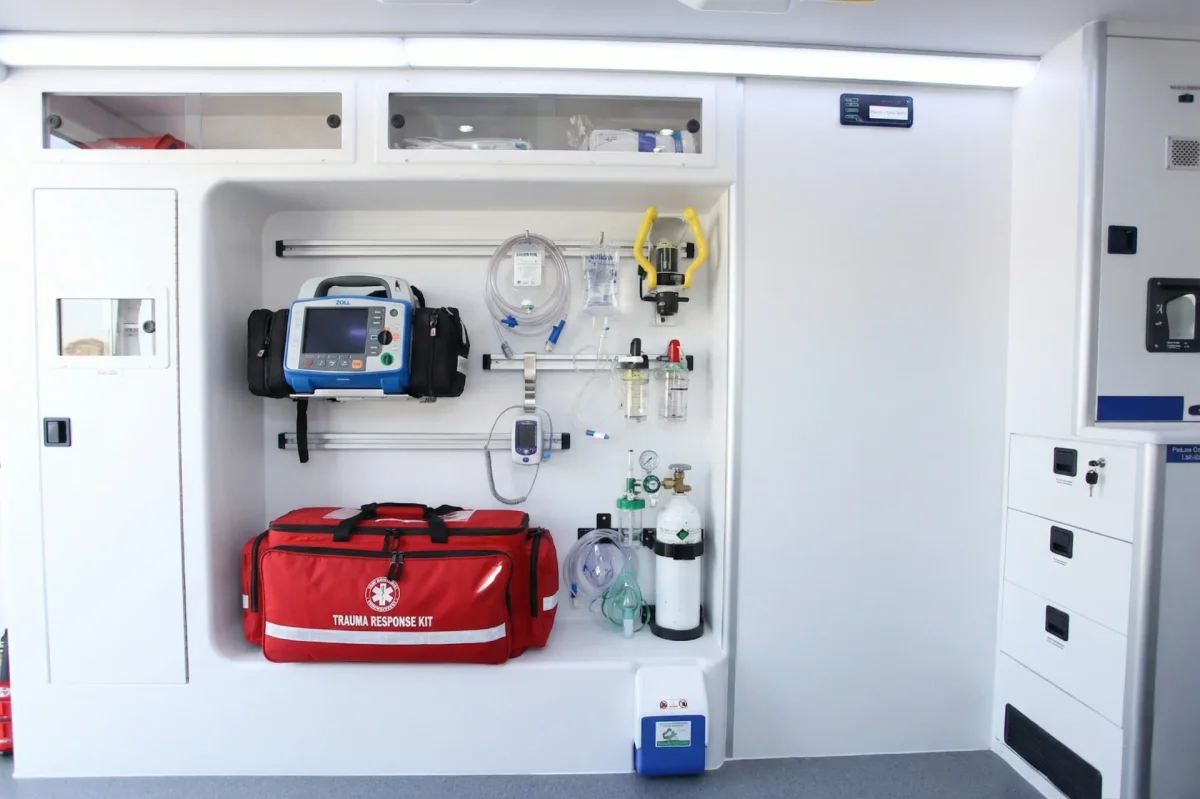
- Ambulance equipment requirements are defined in Annex-1 (technical) and Annex-2 (medical) of the 2025 Regulation.
- All medical devices must undergo regular maintenance, repair, testing, and calibration (Article 30/s).
- Equipment must be complete, functional, and sterilely stored at all times (Article 14/2-h).
When you call a licensed ambulance in Turkey, the vehicle that arrives must carry a defined set of equipment. The 2025 Ambulance Regulation specifies required items across two annexes: Annex-1 for technical equipment and Annex-2 for medical equipment. The responsible manager is legally accountable for ensuring all items are present, functional, and properly stored at all times (Article 14/2-h). [1]
Technical Equipment (Annex-1)
Every Emergency Ambulance must carry:
- Warning systems: Flashing lights (red stripe, fluorescent) and siren
- Vehicle tracking device — connected to Ministry monitoring systems
- Camera device package — recording inside and outside the ambulance
- Mobile device package — for Emergency Health Automation System (ASOS) case entry and Health Command and Control Center (SKKM) communication
- Radio (VHF/UHF) — for communication with the Health Command and Control Center (SKKM) during missions
Medical Equipment (Annex-2)
The core medical load includes:
- Defibrillator / cardioverter — for cardiac rhythm management
- Multi-parameter patient monitor (ECG, SpO₂, NIBP)
- Ventilator / bag-valve-mask — for airway support
- Oxygen system — cylinders, flow meters, masks
- Aspirator (suction device) — for airway clearance
- Stretcher and patient-handling equipment
- Emergency drug kit — per Ministry specification
- Trauma and immobilization set — splints, cervical collars, spine board
- IV access materials — cannulas, infusion sets, fluids
- Emergency delivery kit and burn care supplies
Sterilization and Storage (Article 14/2-h)
Article 14(2)(h) of the Regulation requires ambulance services to meet defined sterilization and disinfection standards: [1]
- Medical supplies must be kept in their sterile packaging.
- The patient compartment must be disinfected after every case.
- Disinfection procedures are logged and verified during audits.
- Reuse of single-use materials is strictly prohibited.
Maintenance and Calibration (Article 30/1-s)
Article 30(1)(s) of the Regulation is a prohibition clause: it bans the use of any medical device on which the required maintenance, repair, testing, inspection, and calibration has not been performed in accordance with applicable legislation. It does not set a numeric calibration frequency. [1] The calibration period itself is governed by the Regulation on the Testing, Inspection and Calibration of Medical Devices and by the manufacturer's interval recorded in the Product Tracking System (ÜTS); for devices such as defibrillators and ventilators this interval is typically 6 to 12 months. [6] Nova Ambulans tracks service intervals for every device and removes any item from service if it cannot be verified as compliant.
Nova Ambulans Equipment
Each Nova Ambulans vehicle is checked before every shift. Equipment status is logged in the Emergency Health Automation System (ASOS). Our fleet carries all Annex-1 and Annex-2 required items plus supplementary advanced life support equipment maintained to current clinical standards.
Frequently Asked Questions
Does every ambulance carry a defibrillator?
Emergency Ambulances and ICU ambulances are required to carry a defibrillator/monitor. [1] Patient-transport ambulances have a more limited core equipment list, though some private operators also keep a defibrillator on their transport vehicles.
How often is ambulance equipment maintained?
Article 30(1)(s) of the Regulation is a prohibition clause: a medical device that has not undergone the required maintenance, repair, testing, inspection, and calibration cannot be used in an ambulance, but the article does not state a numeric frequency. [1] The calibration period is set under the Regulation on the Testing, Inspection and Calibration of Medical Devices and by the manufacturer's interval recorded in the Product Tracking System (ÜTS); for defibrillators and ventilators it is typically 6 to 12 months. [6]
How do I know an ambulance has the required equipment?
Ask the crew to show the vehicle qualification certificate. This certificate is issued only after the Provincial Health Directorate confirms the ambulance meets all Annex requirements.
Can equipment be removed during transport to save weight?
No. Equipment must be present and functional at all times during operation. Intentional removal without an approved reason is a regulatory violation.
What happens if required equipment is found missing during an audit?
Missing mandatory equipment is recorded on the Annex-10/B audit form and can result in the vehicle's qualification certificate being suspended until the deficiency is corrected.
Related Posts
Rapid Emergency Support
24/7 emergency ambulance service across Istanbul. Fast response, fully equipped team.
Average response time: 15 seconds
Related Articles
What Does a Gray Ambulance Mean? The Patient-Transport Ambulance and Turkey's 2025 Color Regulation
The gray body with a blue stripe you see in traffic or in front of a hospital is a patient-transport ambulance, redefined by Turkey's Official Gazette regulation of 8 January 2025 (RG-8/1/2025-32776). This guide explains where the gray (RAL 7004) color comes from, how it differs from the white emergency ambulance, the restriction on audible warning systems, the detachable blue light restored by the 24 June 2025 amendment, the transition period that closed on 1 January 2026, and how to behave when you see a gray ambulance in traffic — grounded in the T.C. Ministry of Health and World Health Organization (WHO) sources.
EducationTick Bite First Aid: Correct Removal Technique and the Crimean-Congo Haemorrhagic Fever (CCHF) Decision
When a tick attaches to the skin, the bystander’s step-by-step response: gloved, fine-tipped tweezers gripping the tick’s head as close to the skin as possible with steady upward traction, no alcohol, petrol, nail polish, matches or lit cigarettes, saving the removed tick in a labelled sealed plastic bag, a 14-day watch schedule for Crimean-Congo Haemorrhagic Fever (CCHF), the 112 decision when a fever, severe muscle pain, bleeding or profound weakness appears, and safe transfer to an infectious-diseases clinic — with primary sources from the Turkish Red Crescent 2025 First-Aid Pocket Book, the Turkish Ministry of Health May 2025 First-Aid Training Manual, the Turkish Red Crescent Esenyurt First-Aid Training Centre 2024 verbatim protocol, the Turkish Ministry of Health CCHF Scientific Council bulletin, Karanfil et al. 2026 (n=7,776 national surveillance), Güllü et al. 2025 (n=1,103 18-hospital cohort), the World Health Organization (WHO) 2025 fact sheet, the European Centre for Disease Prevention and Control (ECDC) factsheet, and Norman et al. 2025 European review.
EducationBee, Wasp, and Hornet Sting First Aid: When a Sting Reaction Needs 112
Step-by-step first aid for honeybee, wasp, and hornet stings — the bystander's 30-second stinger-scrape technique (credit-card scrape, never tweezers), local vs large-local vs systemic reaction decision tree, when to call Türkiye's 112 emergency line, adrenaline auto-injector application to the outer thigh, and what to do until the ambulance arrives — with verbatim protocols from Türk Kızılay Cep Kitabı 2025, T.C. Sağlık Bakanlığı May 2025 First-Aid Training Manual, the Turkish National Society of Allergy and Clinical Immunology (AİİAD), the Society of Pediatric Allergy and Asthma Academy (CAAAD), the 2025 Katran cohort of 194 526 patients at Istanbul Süreyyapaşa Hospital, the 2021 Öziş Baba cohort of 7 904 Trabzon schoolchildren, the American Academy of Allergy, Asthma & Immunology (AAAAI) and the McMurray 2026 Hymenoptera venom anaphylaxis review.
Popular Ambulance Topic Clusters
You may also like
- Private ambulance pricing
- Istanbul private ambulance
- Intercity patient transport
- Doctor-accompanied ambulance
- Dialysis patient transport
- How intercity patient transport works
- Ambulance response time in Istanbul
- Home-to-hospital patient transport
- Modern ambulance equipment and team standards
- Heart attack symptoms and first response
This content is informational only and does not replace professional medical evaluation. In emergencies, call 112 or +90 216 339 00 39.
