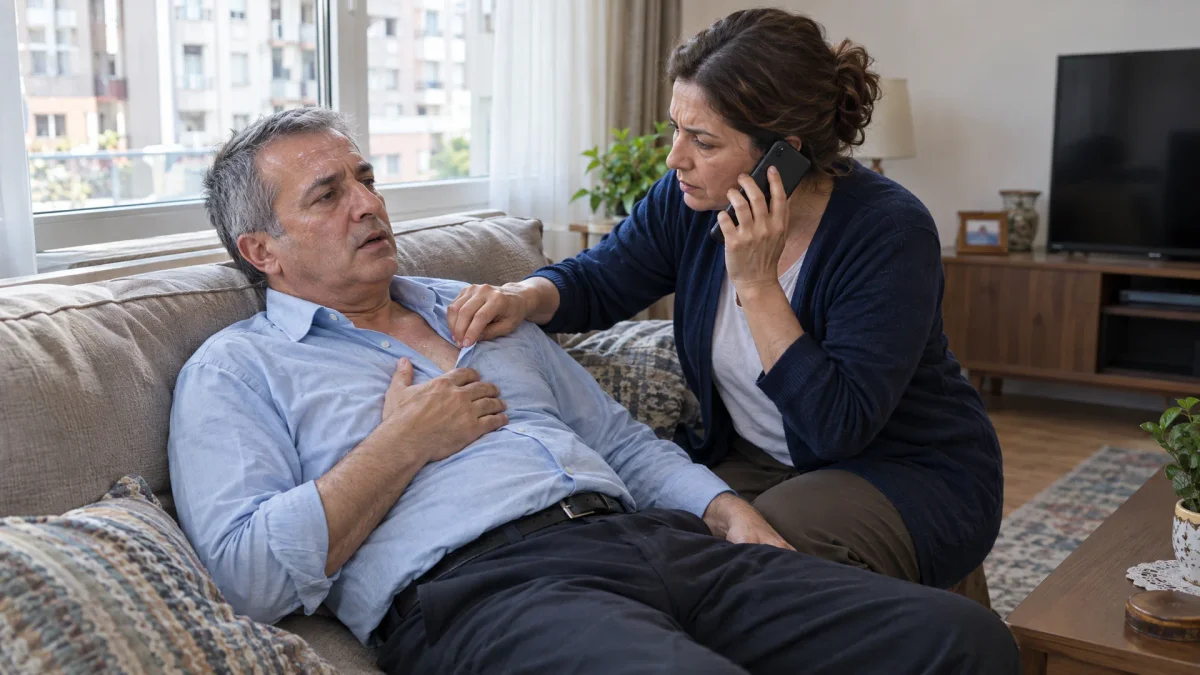
- Time is the most critical factor -- act the moment symptoms begin.
- Not every chest pain is a heart attack, but every chest pain should be taken seriously.
- In women and diabetic patients, symptoms may present as nausea or fatigue rather than classic chest pain.
- Always call a fully equipped ambulance instead of attempting to drive to the hospital yourself.
A heart attack (myocardial infarction) occurs when one or more of the coronary arteries supplying blood to the heart muscle become suddenly blocked [1][2]. Within minutes, the affected heart tissue begins to die from oxygen deprivation. The first minutes after symptom onset -- often called the "golden hour" -- are decisive in preventing permanent damage and saving lives [3]. The World Health Organization (WHO) reports that "an estimated 19.8 million people died from CVDs in 2022, representing approximately 32% of all global deaths" [7] -- most of those events are time-sensitive and treatable when caught early.
What Is a Heart Attack (Myocardial Infarction)?
A heart attack happens when a blood clot forms inside a coronary artery, cutting off the oxygen supply to a section of the heart muscle. The medical term, myocardial infarction, literally means "death of heart muscle tissue."
Key fact: Heart muscle cannot regenerate [1][3]. Every minute without oxygen increases the risk of permanent damage. Do not wait to be "sure" before calling for help -- when in doubt, call immediately.
Most Common Heart Attack Symptoms
Symptoms vary from person to person. Some patients experience intense, unmistakable distress, while others -- particularly the elderly and people with diabetes -- may have milder, easily overlooked signs.
1. Chest Pain and Pressure
This is the most typical symptom, reported in the majority of heart attack cases [1]. The American Heart Association describes it plainly: "Most people having a heart attack feel discomfort in the center of the chest. It can last more than a few minutes, or it may go away and then return" [5]. The Centers for Disease Control and Prevention (CDC) adds that the discomfort can be in the center or left side of the chest [6].
- Character: Not a sharp, stabbing pain but rather a heavy pressure, squeezing, or tightness -- often described as "an elephant sitting on my chest."
- Duration: Usually lasts longer than 5-10 minutes and does not improve with rest. The American Heart Association (AHA) instruction is unambiguous: "Call 911 if you have heart attack warning signs. It's almost always the fastest way to get lifesaving treatment" [5].
- Radiation: The pain may spread to the left arm, shoulder, neck, jaw, or back.
2. Shortness of Breath
Even without chest pain, a person may become suddenly breathless, as though they had just run a marathon. This can be related to fluid accumulating in the lungs as the heart struggles to pump effectively.
3. Cold Sweating and Pallor
A sudden onset of cold, clammy sweat -- sometimes called a "death sweat" -- along with a grayish skin tone is a significant warning sign caused by the body's stress response.
4. Nausea and Indigestion
Especially in women and diabetic patients, the dominant symptom may be severe nausea, vomiting, or what feels like bad indigestion rather than chest pain. This is frequently mistaken for a stomach bug, causing dangerous delays.
Who Is at Risk? Understanding Silent Heart Attacks
In certain groups, heart attacks can progress silently with atypical symptoms. These individuals should pay extra attention:
- Diabetic patients: Nerve damage (neuropathy) may prevent them from feeling chest pain [4].
- Elderly individuals: The main symptom may be nothing more than unusual fatigue or confusion [1].
- Women: Back pain, jaw pain, and extreme fatigue are more commonly reported than classic chest pain [1][2].
If you or someone around you belongs to a high-risk group, always err on the side of caution and seek medical evaluation promptly.
Step-by-Step Actions When You Suspect a Heart Attack
If you suspect a heart attack in yourself or someone nearby, stay calm and follow these steps:
Step 1: Call 112 or a 24/7 Private Ambulance Immediately
Never attempt to drive to the hospital yourself. A cardiac rhythm disturbance (arrhythmia) can develop at any moment during transport, and you will not be able to respond without medical equipment. A fully equipped ambulance like those operated by Nova Ambulans provides intensive-care-level monitoring from the moment of pickup.
Step 2: Position the Patient in a Semi-Upright Position
Do not lay the patient flat on the ground -- this increases the heart's workload and makes breathing harder. Support their back and help them into a semi-reclined, seated position.
Step 3: Loosen Tight Clothing
Remove or loosen ties, belts, shirt collars, and any clothing that may restrict breathing or circulation.
Step 4: Medication (If Previously Prescribed)
If the patient has a nitroglycerin (sublingual) tablet prescribed by their doctor, help them take it. Chewing 150–300 mg of non-enteric-coated aspirin can help reduce clot formation by inhibiting platelet aggregation [2][3], but this should ideally be done after consulting with the 112 or Nova Ambulans dispatch operator. Never give food, water, or medication to an unconscious person.
Step 5: Be Prepared for Cardiopulmonary Resuscitation (CPR)
If the patient loses consciousness and stops breathing, begin chest compressions immediately (30 compressions, 2 rescue breaths) and continue until the ambulance arrives or the patient resumes breathing.
Common Mistakes to Avoid
- Trying to make the patient cough forcefully: This can aggravate arrhythmia rather than help.
- Splashing cold water on the patient: The shock can cause blood vessels to constrict, potentially worsening the crisis.
- "Let's wait and see if it passes": This mindset is the single most dangerous response. Minutes of delay can mean the difference between full recovery and permanent heart damage -- or death.
- Driving to the hospital in a personal vehicle: Without monitoring equipment and a defibrillator, a cardiac arrest during the drive leaves the patient with no chance of survival.
Safe Transport with Nova Ambulans
In heart attack cases, it matters not only that you reach a hospital, but which hospital you reach [2][3]. Transfer to a facility with an angiography (PCI) unit and a 24-hour on-call cardiologist is essential for timely intervention.
Nova Ambulans evaluates the patient's condition and ensures transport to the nearest appropriate cardiac center. Our vehicles are equipped with cardiac monitors, defibrillators, and advanced life support equipment, providing full medical coverage throughout the journey.
Frequently Asked Questions
What is a silent heart attack?
A silent heart attack occurs without the classic chest pain symptoms. It is more common in diabetics, elderly patients, and women. Symptoms may include unusual fatigue, mild shortness of breath, or discomfort mistaken for indigestion.
Should I take aspirin during a suspected heart attack?
If you have no known aspirin allergy and have not been advised against it, chewing 150–300 mg of non-enteric-coated aspirin can help reduce clot formation by inhibiting platelet aggregation [2][3]. However, calling 112 or Nova Ambulans (0216 339 00 39) must always come first — never delay calling for emergency help.
How do heart attack symptoms differ in women?
Women are more likely to experience atypical symptoms such as extreme fatigue, back or jaw pain, nausea, and shortness of breath instead of — or in addition to — classic chest pain. This can delay recognition and treatment.
Why are the first 60 minutes so critical?
The first 60-90 minutes after symptom onset is the optimal window for reopening a blocked coronary artery. Treatment within this period can significantly limit heart muscle damage and greatly improve survival chances.
Rapid Emergency Support
24/7 emergency ambulance service across Istanbul. Fast response, fully equipped team.
Average response time: 15 seconds
Related Articles
Concussion Symptoms After a Fall or Head Injury: Bystander Guide (2026)
After a fall or head injury, concussion symptoms bystanders must recognize, step-by-step first aid, the CDC HEADS UP danger signs that require calling 112 immediately, age-specific notes for children and elderly patients, and the recovery timeline — grounded in Türk Kızılay 2025 First-Aid Pocket Book pp.19-20 and 47-48, T.C. Ministry of Health May 2025 First-Aid Training Book Chapter X.A and VII.B, Gazi University Pediatric Emergency PECARN application review, Turkish Neurosurgery 2025 national survey (n=1,875 neurosurgeons), JAMA April 2026 pediatric concussion systematic review, and CDC HEADS UP with WHO falls data.
EducationSepsis Symptoms: Flu or Sepsis? How to Spot It at Home and When to Call 112
Sepsis is an emergency in which the body responds to an infection in an extreme, uncontrolled way, and it can worsen within hours. If someone with a fever or an infection becomes confused, breathes very fast, has pale or blotchy skin, a rash that does not fade when pressed, or a very high or very low temperature, call 112 without waiting. Until the ambulance arrives, do not leave them alone, give them nothing by mouth and check their consciousness every 2-3 minutes.
EducationSuspected Fracture and Dislocation: Splinting, Immobilization, and Calling 112 (2026)
What a bystander does at the scene for suspected fracture, dislocation, sprain and strain — the Turkish Red Crescent 2025 First Aid Pocket Book (pp.38–42), the Turkish Ministry of Health May 2025 First Aid Training Book Chapter XII, the Gazi University 2026 Ankara pediatric hand-foot fracture series (n=278), the İstanbul University Çapa 12-month hip fracture mortality data, and the World Health Organization (WHO) falls factsheet applied to splinting, immobilization, and the 112 chain.
Popular Ambulance Topic Clusters
You may also like
- Private ambulance pricing
- Istanbul private ambulance
- Intercity patient transport
- Doctor-accompanied ambulance
- Dialysis patient transport
- How intercity patient transport works
- Ambulance response time in Istanbul
- Home-to-hospital patient transport
- Modern ambulance equipment and team standards
- Heart attack symptoms and first response
This content is informational only and does not replace professional medical evaluation. In emergencies, call 112 or +90 216 339 00 39.
