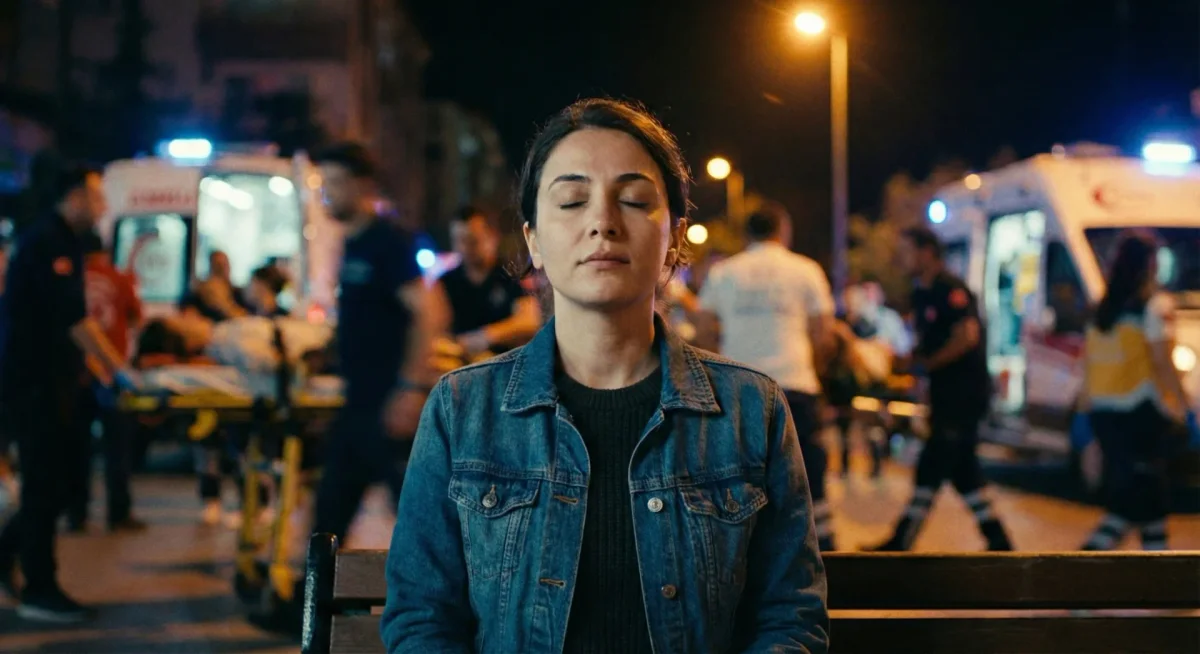
- Apply the 3-second rule in panic: Stop, breathe, think.
- Assess the situation objectively, avoid assumptions.
- Give clear information when calling professional help (112 or Nova Ambulans).
- Focus on the simplest and most useful action you can do.
- Calm your mind with positive self-talk.
Panic is natural when you see a relative having an accident. The heart races, breath shortens, thinking becomes difficult [1]. As the American Heart Association warns, "minutes matter. Fast action can save lives — maybe your own" [4]; the World Health Organization (WHO) road-traffic fact sheet adds that "delays of minutes can make the difference between life and death" in post-crash care [6]. Composure is what unlocks those minutes for the people around you.
Strategies to Stay Calm
Here are 5 practical tips to help you maintain your composure in those difficult moments:
Stop and Take a Deep Breath — the 4-7-8 Tactical Pattern
Your brain doesn't get enough oxygen during panic. Stop for just 3 seconds before acting, then run the 4-7-8 tactical breath: 4 seconds in through the nose, hold for 7, exhale through the mouth for 8. One cycle is about 19 seconds; a few minutes of slow breathing (a few cycles) can raise parasympathetic (vagal) activity and measurably lower heart rate and systolic blood pressure [7]. Major first-aid bodies frame deliberate breathing as the primary self-regulation tool before any further action [1][2].
Assess the Situation Quickly, Don't Assume
Panic makes us think of the worst-case scenarios. Instead, assess the situation objectively. What happened? Is there another danger around (traffic, fire, etc.)? Is the person needing help conscious? Are they breathing? Is there bleeding? [1] Focusing on concrete facts pulls you out of the emotional whirlpool of panic.
Know Your Duty: Call Professional Help
Remember, your duty is not to play doctor, but to ensure professional help arrives as quickly as possible [2][3]. Call 112 or Nova Ambulans immediately. If you have a private hospital preference, you can state this to Nova Ambulans; however, remember that you may be directed to the nearest public hospital in case of full capacity. Give the following information to the operator in a clear and calm voice: Exact address, what happened, number and condition of patients/injured. [1] Even completing this step will give you a sense of control.
Focus on the Simplest Thing You Can Do
Trying to do everything at once increases panic. Focus on the simplest and most useful thing you can do at that moment. This could be pressing a clean cloth on a bleeding area [1][2], sitting next to the patient and holding their hand and talking to them, or just keeping the curious crowd away. Accomplishing a small task reinforces the feeling that you are in control.
Repeat to Yourself "Stay Calm, Help Is Coming"
Replace negative thoughts passing through your mind with a simple and positive mantra. Repeating sentences like "Stay calm, I am doing the right thing, help is on the way" to yourself helps you reprogram your brain and suppress panic.
Composure is not a superpower, it is a learnable skill [2]. These tips will be your biggest helper in those critical moments.
Decision Speed: Hick's Law and the Fewer-Choices Strategy
The Hick-Hyman Law in experimental psychology states that decision time increases roughly linearly with the base-2 logarithm (log2) of the number of options — so as the number of choices doubles, decision time grows logarithmically rather than disproportionately; choosing among 7 possible steps in a crisis is noticeably slower than choosing between 2 [8]. So a household emergency plan should hard-code two binary checkpoints:
- "Is the scene safe?" — verify ground safety before moving the person.
- "Have I called 112 or Nova Ambulans?" — do not move to any other action until that call is complete.
More complex options (positioning, dressing, medication) belong to a step that follows. Adding a third option breaks the panic loop; a fourth one is usually best left to the responding crew.
Five Istanbul-Specific Scenarios — Apartment vs. Villa
Composure is also about communicating with your environment. The Nova Ambulans operations centre sees the following five high-frequency scenarios in Istanbul, and each has a critical detail tied to the dwelling type:
- Panic inside a flat in an apartment building — open the inner door first, then the building's main entrance; if there is no caretaker, dictate the entry code clearly to the operator. In multi-storey blocks on the Anatolian side, telling dispatch the lift dimensions in advance shortens stretcher access.
- Detached villa or gated-community house — give the gate (north/south), the inner street name, and the villa number; otherwise patrol time can extend by 4–6 minutes.
- High-traffic arterial (E-5, coastal road) — a bystander places a warning triangle 30 m back and clears the right-hand lane to form a corridor for the ambulance.
- In-vehicle emergency on a Bosphorus bridge or tunnel approach — tell the operator which bridge, which direction; the dispatcher routes you to the nearest emergency turn-out.
- Rural or wooded property (Şile, Polonezköy axis) — without a precise pin, response is slowest; sharing a Google Maps location (or a precise locator such as what3words) helps the crew find the exact spot and typically shaves a few minutes off ETA (for hard-to-reach pins, Nova Ambulans field observations show this gap can be larger).
In each case, the visible sign of composure is the same: delivering address + event + number of patients in twenty seconds.
Frequently Asked Questions
What should be the first thing I do if I feel like I'm panicking?
First, focus on slowing down your heart rate and breathing rhythm by taking three deep breaths. Then, try to manage the event in parts by passing the sequence "Safety first, then 112 or ambulance, then simple steps" through your mind.
Does staying calm mean being emotionless?
No; we are talking about managing your emotions, not suppressing them. Fear and anxiety are normal; the important thing is not to let these emotions completely take over your ability to think and help.
Can I improve staying calm by practicing beforehand?
Yes; taking basic first aid training, visualizing possible scenarios in your mind, and doing breathing exercises allows you to react more controlled automatically in moments of crisis. Creating a simple emergency plan within the family also strengthens this skill.
Rapid Emergency Support
24/7 emergency ambulance service across Istanbul. Fast response, fully equipped team.
Average response time: 15 seconds
Related Articles
Dog and Cat Bite First Aid: Rabies Risk, the 15-Minute Wash and When to Call 112
If a dog or cat bites or scratches you, wash the wound at once with plenty of soap and water for at least 15 minutes, press directly on it if it bleeds, cover it with a clean cloth and go to a health facility the same day. Rabies cannot be treated once symptoms begin; a doctor decides whether you need the vaccine. Call 112 for bleeding that pressure does not stop or for any threat to life.
EducationMushroom Poisoning Symptoms and First Aid: When Do Symptoms Start, When to Call 112?
If nausea, vomiting, diarrhea, abdominal pain or any other symptom begins after eating foraged mushrooms or mushrooms of unknown origin, call 112, whatever hour it began; do not induce vomiting and give nothing by mouth. People without symptoms, including a child who ate a mushroom in a garden or park, still need hospital assessment; call 112 and explain, because with amatoxin, which damages the liver, the symptom-free interval averages 8-10 hours. The National Poison Information Center (UZEM) on 114 gives advice but does not replace 112.
EducationTick Bite First Aid: Correct Removal Technique and the Crimean-Congo Haemorrhagic Fever (CCHF) Decision
When a tick attaches to the skin, the bystander’s step-by-step response: gloved, fine-tipped tweezers gripping the tick’s head as close to the skin as possible with steady upward traction, no alcohol, petrol, nail polish, matches or lit cigarettes, saving the removed tick in a labelled sealed plastic bag, a 14-day watch schedule for Crimean-Congo Haemorrhagic Fever (CCHF), the 112 decision when a fever, severe muscle pain, bleeding or profound weakness appears, and safe transfer to an infectious-diseases clinic — with primary sources from the Turkish Red Crescent 2025 First-Aid Pocket Book, the Turkish Ministry of Health May 2025 First-Aid Training Manual, the Turkish Red Crescent Esenyurt First-Aid Training Centre 2024 verbatim protocol, the Turkish Ministry of Health CCHF Scientific Council bulletin, Karanfil et al. 2026 (n=7,776 national surveillance), Güllü et al. 2025 (n=1,103 18-hospital cohort), the World Health Organization (WHO) 2025 fact sheet, the European Centre for Disease Prevention and Control (ECDC) factsheet, and Norman et al. 2025 European review.
Popular Ambulance Topic Clusters
You may also like
- Private ambulance pricing
- Istanbul private ambulance
- Intercity patient transport
- Doctor-accompanied ambulance
- Dialysis patient transport
- How intercity patient transport works
- Ambulance response time in Istanbul
- Home-to-hospital patient transport
- Modern ambulance equipment and team standards
- Heart attack symptoms and first response
This content is informational only and does not replace professional medical evaluation. In emergencies, call 112 or +90 216 339 00 39.
