- District & Location: Access conditions vary between European and Asian sides of Istanbul.
- Time Factors: Traffic, time of day, call priority, and address accuracy are decisive.
- While Waiting: Share live location, perform basic first aid, keep the line open.
- Private Ambulance: Offers hospital choice and comfort for stable patient transfers.
- Access: Share gate codes, building entry, and floor info to reduce arrival time.
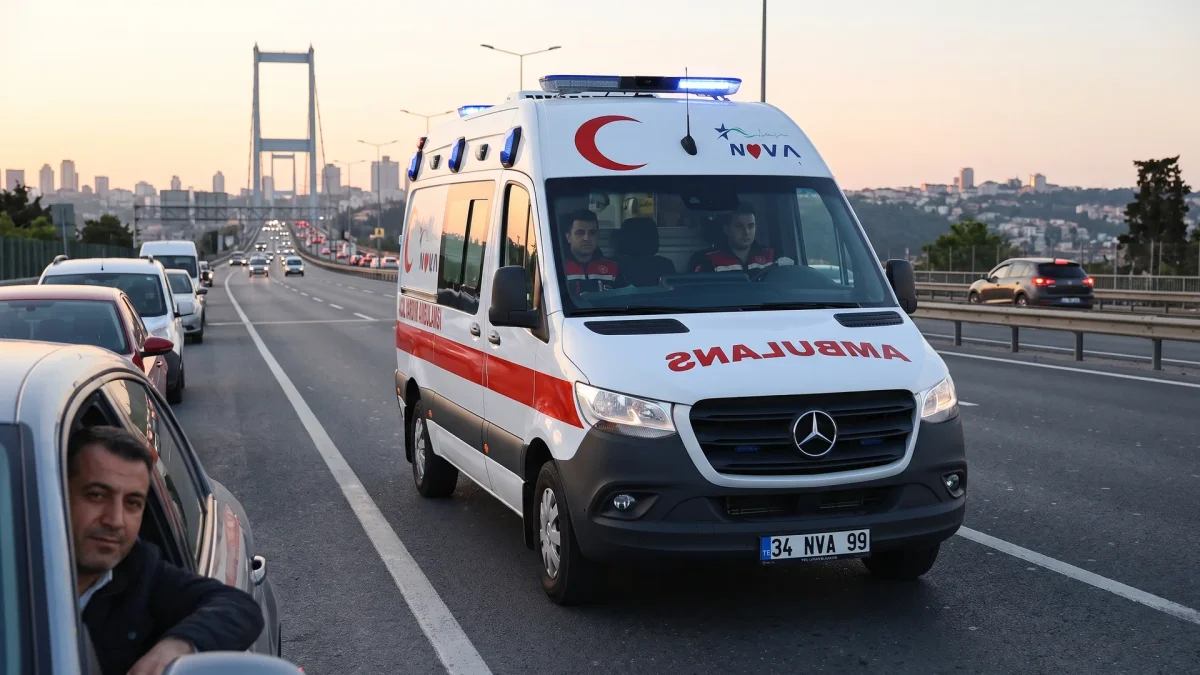
Ambulance arrival time depends on call priority, traffic, weather, crew availability, and how precise your address is [1]. Istanbul — a megacity of over 15.7 million people (TurkStat ADNKS 2024: 15,701,602) spanning two continents with notoriously heavy traffic — presents unique challenges for emergency response. [5] In 2026, smart traffic systems and dynamic crew deployment have improved, but according to Istanbul Municipality data variation between districts is expected. [4]
This guide covers the key factors affecting ambulance response across Istanbul, the differences between the European and Asian sides, district-level access conditions, and exactly what to do while you wait.
Istanbul Ambulance Response Time Guide 2026
Key Factors Affecting Response Time
- Triage (priority) level: Life-threatening calls dispatch the nearest appropriate crew. Red-zone (critical) calls take priority over yellow and green classifications. [1]
- Traffic and road conditions: Accidents, roadworks, poor weather, and congestion on the E-5 (D-100) highway, TEM Motorway, and Bosphorus bridges can cause significant delays. [4]
- Time of day: Morning rush (07:00–09:30) and evening rush (17:00–20:00) are peak traffic windows that extend response times. Late-night hours (roughly 00:00–06:00) see the lowest traffic and clearer main arteries, shortening arrivals. That said, nighttime building access (locked doors, sleeping security staff) can add delay. [4]
- Location accuracy: Building number, cross streets, and nearby landmarks (mosque, school, shopping mall) are critical. An incomplete or incorrect address delays the crew's arrival. [1]
- Building access: Gated communities, security checkpoints, door codes, underground parking entrances, and elevator availability affect how quickly crews reach the patient. [1]
- Weather conditions: Heavy rain, snow, and fog slow traffic and reduce visibility. In winter, northern districts (Sariyer, Beykoz, Sile) face particularly challenging road conditions.
European Side vs Asian Side Differences
Istanbul's position across two continents is a major geographic factor affecting ambulance access.
European Side:
- Higher population density; districts like Esenyurt, Kucukcekmece, and Bagcilar have narrow streets and dense residential areas that can slow ambulance maneuvers. [5]
- E-5 and TEM interchange congestion particularly affects routes between Bahcelievler and Bakirkoy.
- Historic peninsula areas like Fatih, Beyoglu, and Eminonu have narrow one-way streets that create additional challenges.
- Remote western districts like Silivri and Catalca may face longer response times due to distance from the city center.
Asian Side:
- Generally more systematic urban planning and wider arterial roads; central districts like Kadikoy, Atasehir, and Uskudar typically see faster access.
- The Istanbul–Kocaeli corridor along the D-100 and the Pendik–Tuzla corridor can experience heavy logistics traffic.
- Northern areas of Sile and Beykoz feature rural roads and greater distances that extend response time.
- Rapidly growing districts like Sancaktepe and Sultanbeyli face gaps between infrastructure development and population growth.
Bosphorus crossing: Transit via the 15 July Martyrs Bridge, Fatih Sultan Mehmet Bridge, or Eurasia Tunnel can add 10–25 minutes depending on traffic. In emergencies, the nearest hospital on your current side of the city is usually the fastest option. [4]
District-Level Access Conditions
Below is a summary of the main conditions affecting ambulance access across Istanbul's different zones:
| Zone | Example Districts | Primary Access Factor |
|---|---|---|
| European center | Besiktas, Sisli, Beyoglu | Narrow/one-way streets, parking traffic |
| European west | Esenyurt, Beylikduzu, Buyukcekmece | High population density, distance |
| European north | Sariyer, Eyupsultan | Hilly terrain, winter conditions |
| Asian center | Kadikoy, Uskudar, Atasehir | Relatively good infrastructure, busy side streets |
| Asian east | Pendik, Tuzla, Kartal | D-100/TEM interchange congestion |
| Asian north | Beykoz, Sile, Cekmekoy | Rural roads, forest areas, distance |
For detailed ambulance access information by district, visit our Istanbul district ambulance guide.
112 vs Private Ambulance Comparison
| Criteria | 112 Emergency | Private Ambulance (Nova Ambulans) |
|---|---|---|
| Service type | Emergency response, public hospital transfer | Emergency + planned transfer + hospital choice |
| Hospital choice | Nearest appropriate facility — usually a public hospital | Your preferred private or public hospital |
| Equipment | Standard emergency equipment | Full emergency ambulance standard equipment |
| Cost | Free | See pricing |
| Hours | 24/7 | 24/7 |
| How to call | 112 | 0216 339 00 39 or contact us |
What to Do While Waiting for the Ambulance
Taking the right steps while waiting improves patient safety and helps the crew respond faster.
- Keep the line clear: Avoid repeatedly calling — keep your phone line open. The dispatch center will contact you if needed. Unless the patient's condition changes significantly, there is no need to call back.
- Share live location: Send your real-time location from your smartphone map app. What3Words or similar three-word address systems provide pinpoint accuracy.
- Perform basic first aid: Apply clean cloth pressure for bleeding, maintain an open airway if unconscious, and check breathing regularly. [2][3]
- Secure the area: In traffic, use hazard lights and place a warning triangle; indoors, clear crowds and ensure ventilation.
- Prepare building access: Notify building security, share gate codes, and keep the elevator ready. If possible, send someone to meet the ambulance team at the building entrance.
- Prepare patient information: Current medications, known allergies, chronic conditions, and recent medical procedures — this information helps the crew make faster decisions. [1]
When Should I Call a Private Ambulance?
Call 112 or Nova Ambulans when a life-threatening emergency is suspected. Here are the key differences:
- Emergencies: 112 routes the patient to the nearest appropriate emergency department based on condition and current capacity (in practice usually a public hospital), while Nova Ambulans can take you or your loved one to your preferred private or public hospital.
- Stable patient transfers: A private patient transfer vehicle provides planned routing, appropriate equipment, and comfortable transport. For intercity transfers, advance planning is especially important.
- Hospital-to-hospital transfers: When a patient needs to be referred between facilities, Nova Ambulans provides safe planned patient transfer service.
- Intensive care transfers: ICU ambulances transport critical patients under full monitoring.
Important: Private hospitals may occasionally decline patients due to capacity or equipment limitations. In such cases, Nova Ambulans will find the most suitable alternative private hospital, or transfer to the nearest public hospital for patient safety.
Night, Day, and Weekends: How Timing Affects Response
The time you call an ambulance directly impacts response speed:
- Night (00:00–06:00): Lowest traffic window. Major arteries (E-5, TEM) are clear, significantly reducing response times. [4]
- Morning rush (07:00–09:30): Work commutes and school traffic overlap; bridge and highway crossings see heavy congestion.
- Midday (12:00–14:00): Moderate congestion in commercial zones, but residential areas are relatively clear.
- Evening rush (17:00–20:00): The day's heaviest traffic. Bridges, metro bus corridor surrounds, and the E-5 route exceed capacity.
- Weekends and holidays: City traffic is generally lighter, but coastal routes (Bakirkoy, Maltepe, Kadikoy waterfront) and shopping center areas may still be congested.
Seasonal and Weather Variations
- Winter: Snow and ice make roads challenging, especially in higher-elevation northern districts (Sariyer, Beykoz, Cekmekoy). Heavy snowfall can gridlock Istanbul's entire traffic system.
- Summer: Holiday traffic adds congestion in western districts (Silivri, Buyukcekmece) and along coastal routes.
- Rain and storms: Istanbul's sudden downpours can flood underpasses and low-lying areas, disrupting both traffic and ambulance access. [4]
- Fog: Reduces visibility around the Bosphorus and northern districts, limiting ambulance driving speed.
5 Things You Can Do to Reduce Ambulance Response Time
- Give a complete address: Neighborhood, street, building number, floor, apartment — leave nothing out. Example: "Kadikoy, Caferaga Mahallesi, Moda Caddesi No: 12, Floor: 3."
- Send a live location: Share your location with one tap via WhatsApp or a map app.
- Prepare building access: Call security, share the door code, and keep the elevator open.
- Send someone to the entrance: Station someone at the building door to meet and guide the ambulance crew.
- Mention a nearby landmark: Use universally known reference points like "next to X Mosque" or "across from Y Shopping Mall."
In an emergency, call 112 or Nova Ambulans (0216 339 00 39). Clear address and access information helps crews reach you as quickly as possible.
Frequently Asked Questions
What is the average ambulance response time in Istanbul?
There is no single "standard time" because multiple factors — triage priority, traffic intensity, time of day, and address accuracy — determine the duration. Generally, central districts (Kadikoy, Besiktas, Sisli) see shorter call-to-arrival times, while outer districts (Sile, Silivri, Catalca) may take longer due to distance. Sharing the most precise information possible during the call is the most effective way to minimize the wait.
Is ambulance response faster on the European or Asian side?
Access to central districts is generally faster on both sides. The Asian side benefits from a more organized road network, while the European side may have more ambulances and crews. The decisive factor is your distance from the nearest ambulance crew and current traffic. Cross-continent transfers via bridge or tunnel can add significant time.
Does repeatedly calling 112 or Nova Ambulans make the ambulance arrive faster?
No — unnecessary repeat calls tie up the line and can actually slow the system down. Unless the patient's condition changes significantly, the dispatch center will contact you when needed. Only call back if symptoms worsen or a new condition develops.
Is nighttime ambulance response faster?
Generally yes — during late-night hours (especially 00:00–06:00), Istanbul traffic drops dramatically and ambulances can move much faster on main roads. However, building access at night (locked doors, sleeping security staff) can create extra challenges, so always share door codes and floor information.
Does calling Nova Ambulans replace 112?
Both 112 and Nova Ambulans can be called for life-threatening emergencies. The key difference is hospital routing: 112 transfers to the nearest appropriate facility based on capacity (usually a public hospital); Nova Ambulans can take you to your preferred private or public hospital with emergency ambulance-level equipment. If you have a private hospital preference or need a planned transfer, Nova Ambulans provides a flexible solution.
What information should I have ready when calling an ambulance?
Prepare these details: (1) Full address — neighborhood, street, building number, floor, apartment; (2) Patient's condition — conscious? breathing? bleeding?; (3) Patient's age and gender; (4) Known chronic conditions and current medications; (5) Building access info — door code, security phone number, elevator status. [1]
What should I do if a Bosphorus crossing is needed?
When an emergency requires crossing between the European and Asian sides, bridge and tunnel traffic can cause significant delays. Heading to the nearest emergency room on your current side is usually faster. Nova Ambulans uses real-time traffic monitoring to determine the optimal route and can redirect to an alternative hospital on the same side when needed.
Rapid Emergency Support
24/7 emergency ambulance service across Istanbul. Fast response, fully equipped team.
Average response time: 15 seconds
Related Articles
Ambulance Personnel Training Standards: 2026 Regulation Update
The 8 January 2025 and 24 June 2025 regulatory amendments made ministry-designated training modules mandatory for every ambulance health worker in Türkiye: hour breakdown, certification cycle, and a family verification checklist.
EducationFlu Season 2026: Symptoms, Vaccine Timing & Request an Ambulance
As respiratory infections rise in autumn, here’s home-care advice, guidance for risk groups, and emergency red flags.
EducationDog and Cat Bite First Aid: Rabies Risk, the 15-Minute Wash and When to Call 112
If a dog or cat bites or scratches you, wash the wound at once with plenty of soap and water for at least 15 minutes, press directly on it if it bleeds, cover it with a clean cloth and go to a health facility the same day. Rabies cannot be treated once symptoms begin; a doctor decides whether you need the vaccine. Call 112 for bleeding that pressure does not stop or for any threat to life.
Popular Ambulance Topic Clusters
You may also like
- Private ambulance pricing
- Istanbul private ambulance
- Intercity patient transport
- Doctor-accompanied ambulance
- Dialysis patient transport
- How intercity patient transport works
- Ambulance response time in Istanbul
- Home-to-hospital patient transport
- Modern ambulance equipment and team standards
- Heart attack symptoms and first response
This content is informational only and does not replace professional medical evaluation. In emergencies, call 112 or +90 216 339 00 39.
