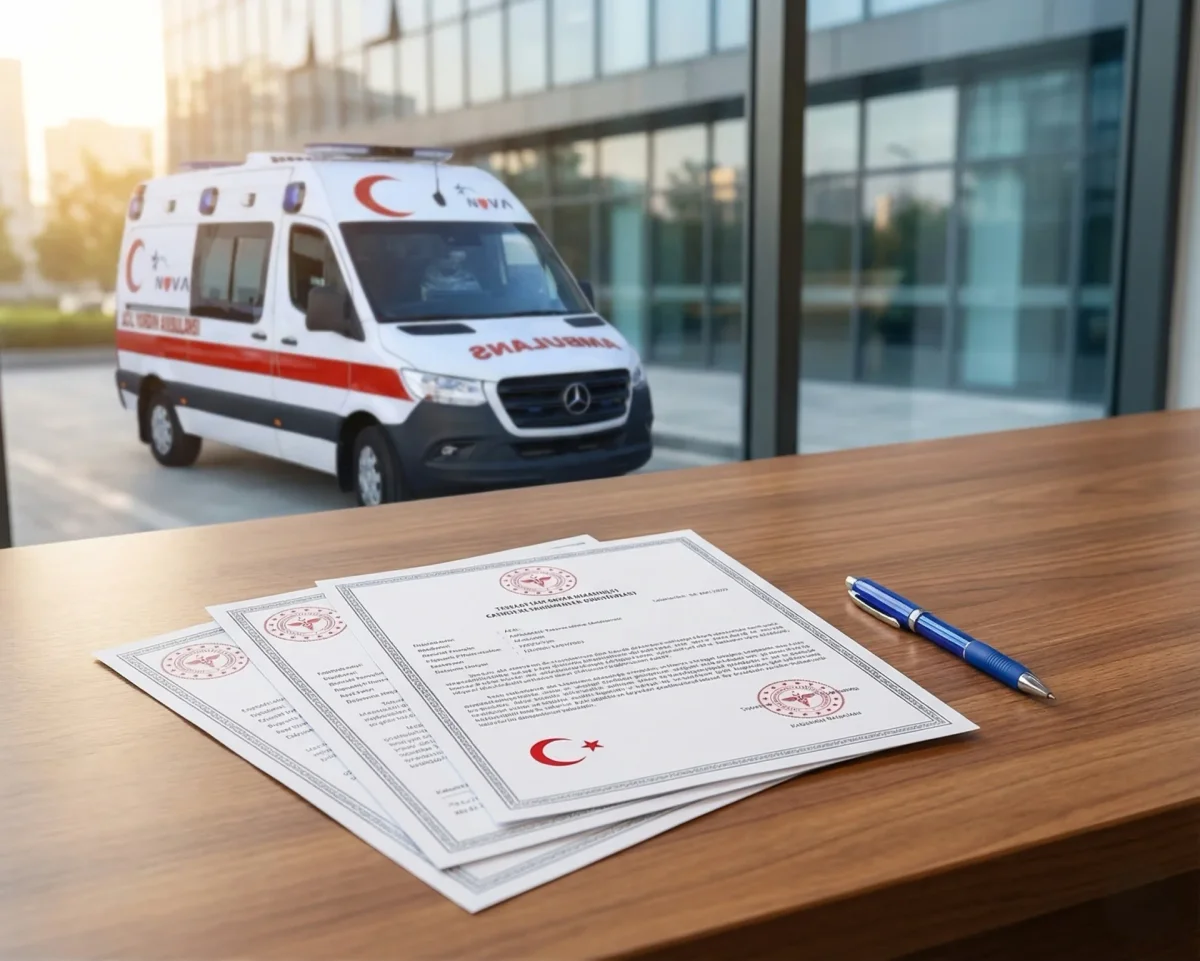
- An ambulance service must obtain a service certificate before operating and a qualification certificate for each vehicle (Articles 10–12).
- Istanbul (İ1 group province) requires a minimum of 5 ambulances to open a service (Article 10).
- All vehicles must pass TSE inspection and receive a Provincial Health Directorate qualification certificate (Article 9).
Operating a private ambulance service in Turkey requires passing through a structured licensing process defined by the 2025 Ambulance Regulation. Two key documents govern legal operation: the ambulance service certificate (ambulans servisi uygunluk belgesi) and, for each vehicle, the qualification certificate (yeterlilik belgesi). [1]
Ambulance Service Certificate (Article 10–12)
Before any ambulance is deployed, the service operator must apply to the Provincial Health Directorate with a complete documentation package (Annex 9). A three-person inspection team — including at least one health professional — conducts an on-site review against the physical requirements in Annex 14.
Minimum fleet size varies by province group. The regulation does not define the province groups itself; it classifies provinces according to the İ1–İ9 grouping set out in Annex-1 of the Ministry of Health's Provincial Organisation Administrative and Service Units Staff Standards Regulation (Official Gazette of 4/1/2012, No. 28163). Article 10(2) then sets the minimum number of ground ambulances per group: [1]
| Province Group | Minimum Ground Ambulances |
|---|---|
| İ1 | 5 (at least one an Emergency Ambulance) |
| İ2 and İ3 | 4 |
| İ4 and İ5 | 3 |
| İ6, İ7, İ8, İ9 | 2 |
Which province falls into which group (for example, Istanbul being İ1, or Ankara and İzmir being İ2) is determined in the referenced Staff Standards Regulation Annex-1, not in the ambulance regulation itself. The highest minimum is 5 ambulances, required for İ1-group provinces such as Istanbul, where at least one vehicle must be an Emergency Ambulance. [1]
Once approved, the service certificate is issued. Within 30 days, vehicle qualification certificates must be obtained for each ambulance; otherwise the service certificate is revoked.
Vehicle Qualification Certificate (Article 9)
Each ambulance must:
- Pass a TSE (Turkish Standards Institute) inspection confirming compliance with the relevant standards. The underlying standard, TS EN 1789 for medical vehicles and their equipment, is published by TSE and covers vehicle dimensions, equipment layout, ventilation, and safety fittings. [4]
- Receive a qualification certificate from the Provincial Health Directorate following an Annex 2 and Annex 4 review. Article 9(1)(b) of the regulation states: "Following the review and evaluation conducted by the Directorate in the province where the service will be provided...the qualification certificate in Annex-6 is issued by the Directorate." [3]
- Be registered at a notary with both certificates on file. The June 2025 amendment, Article 7(4), additionally requires "trainings determined by the Ministry" for all health personnel before they may operate on the certified vehicle. [2]
Responsible Manager and Personnel Documents
Every licensed service must designate a responsible manager (mesul müdür) — a physician, paramedic (AABT/acil tıp teknikeri), or EMT (ATT/acil tıp teknisyeni) — who holds a responsible manager certificate. Article 12(4) sets out the certificate-issuance procedure: applicants approved by the Directorate are issued the ambulance service compliance certificate (Annex-5), the responsible manager certificate (Annex-7) and, for each other employee, a personnel work permit (Annex-8); a qualification certificate (Annex-6) must then be obtained for each ambulance within 30 days. [3] The responsible manager's role as the Directorate's point of contact for the service's establishment, operation and audit processes is instead defined under Article 14 (duties and responsibilities). [1] All staff who work in or alongside ambulances receive individual personnel work permits from the Directorate. The Emergency Medicine Association of Turkey (TATD) in turn anchors the post-licence training pipeline on "supporting the training and development" of pre-hospital professionals. [6]
Operationally, the service's vehicles, personnel and case records are tracked through the Emergency Health Automation System (ASOS), the Ministry of Health's nationwide registration system administered by the Directorate General for Emergency Health and Disaster Services. [5]
Nova Ambulans
Nova Ambulans holds an ambulance service certificate, vehicle qualification certificates for each ambulance in our fleet, and a responsible manager certificate — all issued by the Istanbul Provincial Health Directorate.
Frequently Asked Questions
How often do ambulance qualification certificates need to be renewed?
The regulation does not specify a fixed renewal cycle but requires continuous compliance. Qualification certificates may be revoked following failed audits or non-compliance findings.
Can a company without a health service mandate open an ambulance service?
No. Article 10 specifies that only public institutions and private legal entities whose business activities include health service provision may open ambulance services.
What is the minimum number of ambulances required in Istanbul?
Istanbul is classified as an İ1-group province in Annex-1 of the Staff Standards Regulation, and Article 10(2) of the ambulance regulation requires İ1-group provinces to keep at least 5 ground ambulances, with at least one classified as an Emergency Ambulance. [1]
Related Posts
Rapid Emergency Support
24/7 emergency ambulance service across Istanbul. Fast response, fully equipped team.
Average response time: 15 seconds
Related Articles
What Does a Gray Ambulance Mean? The Patient-Transport Ambulance and Turkey's 2025 Color Regulation
The gray body with a blue stripe you see in traffic or in front of a hospital is a patient-transport ambulance, redefined by Turkey's Official Gazette regulation of 8 January 2025 (RG-8/1/2025-32776). This guide explains where the gray (RAL 7004) color comes from, how it differs from the white emergency ambulance, the restriction on audible warning systems, the detachable blue light restored by the 24 June 2025 amendment, the transition period that closed on 1 January 2026, and how to behave when you see a gray ambulance in traffic — grounded in the T.C. Ministry of Health and World Health Organization (WHO) sources.
EducationAmbulance Personnel Training Standards: 2026 Regulation Update
The 8 January 2025 and 24 June 2025 regulatory amendments made ministry-designated training modules mandatory for every ambulance health worker in Türkiye: hour breakdown, certification cycle, and a family verification checklist.
EducationConcussion Symptoms After a Fall or Head Injury: Bystander Guide (2026)
After a fall or head injury, concussion symptoms bystanders must recognize, step-by-step first aid, the CDC HEADS UP danger signs that require calling 112 immediately, age-specific notes for children and elderly patients, and the recovery timeline — grounded in Türk Kızılay 2025 First-Aid Pocket Book pp.19-20 and 47-48, T.C. Ministry of Health May 2025 First-Aid Training Book Chapter X.A and VII.B, Gazi University Pediatric Emergency PECARN application review, Turkish Neurosurgery 2025 national survey (n=1,875 neurosurgeons), JAMA April 2026 pediatric concussion systematic review, and CDC HEADS UP with WHO falls data.
Popular Ambulance Topic Clusters
You may also like
- Private ambulance pricing
- Istanbul private ambulance
- Intercity patient transport
- Doctor-accompanied ambulance
- Dialysis patient transport
- How intercity patient transport works
- Ambulance response time in Istanbul
- Home-to-hospital patient transport
- Modern ambulance equipment and team standards
- Heart attack symptoms and first response
This content is informational only and does not replace professional medical evaluation. In emergencies, call 112 or +90 216 339 00 39.
