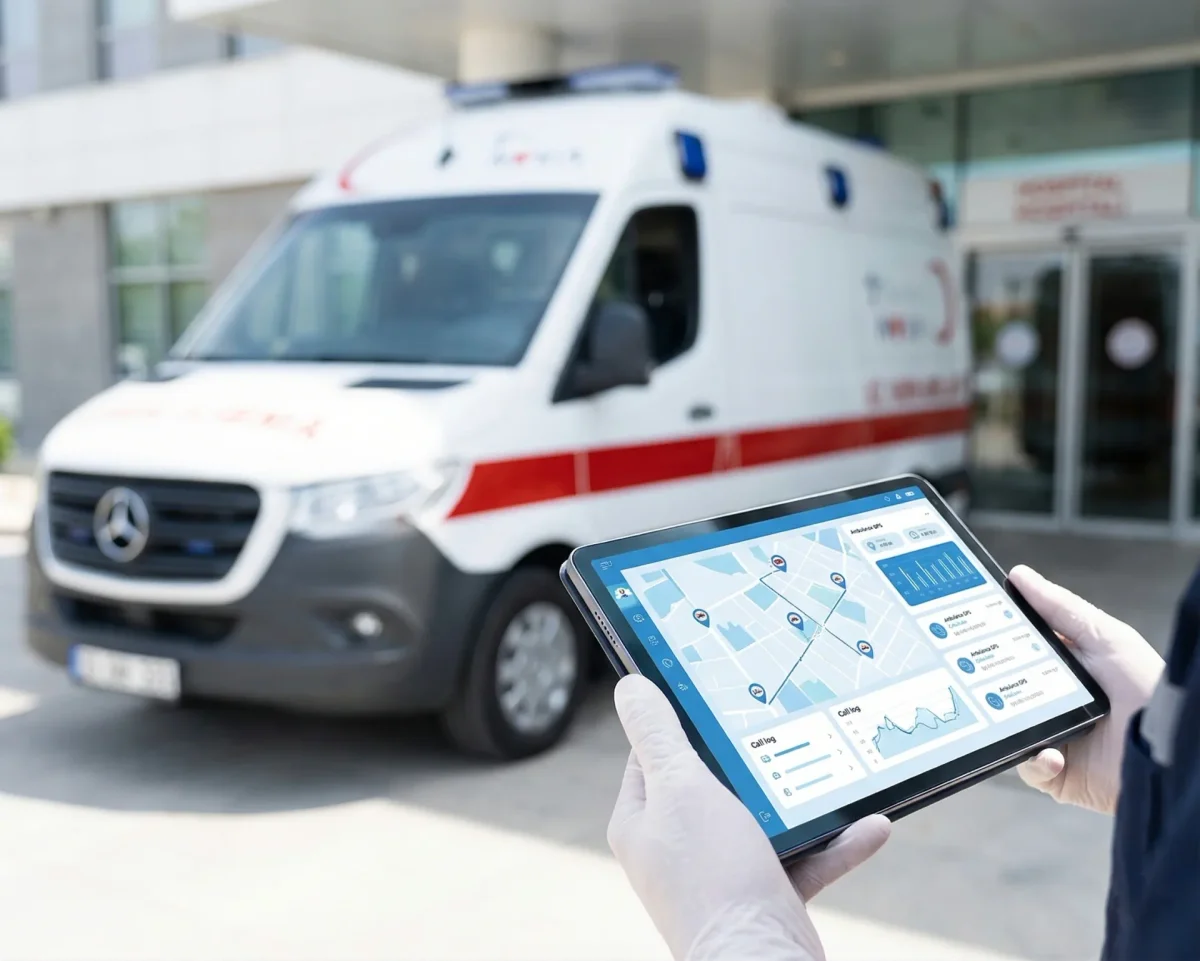
- ASOS is the central information system, run within the Directorate General of Emergency Health Services, that holds records of pre-hospital emergency and patient-transport cases from call to hospital handover.
- All private ambulance services must integrate with ASOS and report each case to the Health Command and Control Center (SKKM) in real time (Article 17).
- Patient data in ASOS is protected under KVKK; records are kept for 5 years (Article 24).
ASOS — short for Acil Sağlık Otomasyon Sistemi (Emergency Health Automation System) — is the central information system, run within Turkey's Directorate General of Emergency Health Services, that underpins every licensed ambulance service in the country. Article 4(c) of the 2025 regulation defines it as "the information system used in delivering pre-hospital emergency health services and patient transport services, in which all records and transactions deemed appropriate by the Directorate General are kept and which can be integrated with relevant institutions or organizations where necessary." Under the Ambulances and Emergency Health Vehicles Regulation that came into force in January 2025, all ambulance operators are legally required to connect to ASOS and use it for case recording, dispatch coordination, and reporting. [1]
What Does ASOS Do?
In practice, ASOS is the digital spine of ambulance operations in Turkey. Its core functions include:
- Case registration — Every call handled by a licensed service is opened as a case in ASOS the moment dispatch is confirmed (Article 17).
- Real-time Health Command and Control Center (SKKM) coordination — The Health Command and Control Center (SKKM), embedded in the 112 call center, receives instant notification of every case through ASOS.
- Crew tracking — Work schedules for every ambulance crew must be entered into ASOS by the 25th of the preceding month (Article 14).
- Audit trail — ASOS records are the primary source used during the mandatory annual audits (at least three per year, Article 26).
- Data archive — All records are retained for five years; if a service ceases operations, records transfer to the Provincial Health Directorate within 30 days (Article 24).
What Data Does ASOS Record?
ASOS is more than a call-logging tool. In line with the regulation, the main data categories held in the system are: [1]
- Time and source of the call, and dispatch, on-scene arrival and hospital-handover times
- Basic clinical data on the patient's condition, interventions performed and equipment used
- Identity details of the health personnel on duty
- Monthly duty and work schedules for all crew (Article 14)
- SKKM dispatch assignments and case-outcome data
Private ambulance services are equally obliged to enter every case into ASOS completely and on time (Article 23).
Why Does ASOS Matter for Patients?
Transparency and accountability. Because every case is recorded, patients and regulators can verify response times, crew qualifications, and equipment status. Personal health data processed through ASOS is classified as special-category personal data and is governed by Law No. 6698 (KVKK) and the Ministry's health information security policies (Article 23/4). [1][2]
Nova Ambulans and ASOS
Nova Ambulans is fully integrated with ASOS. Every case — from the initial call to hospital handover — is registered in real time. Our mobile device package in each ambulance keeps the case record updated throughout transport, and the completed form is submitted to the Health Command and Control Center (SKKM) within 24 hours (Article 18).
Frequently Asked Questions
What is the difference between ASOS and the Health Command and Control Center (SKKM)?
ASOS is the software platform; the Health Command and Control Center (SKKM) is the operational coordination center that uses ASOS data to monitor and direct ambulances. The Health Command and Control Center (SKKM) sits within the 112 emergency call center in each province.
Can patients access their ASOS records?
Patients have data subject rights under KVKK Article 11, including the right to request access to personal data held about them. Contact the ambulance service's responsible manager to initiate a request.
Does ASOS apply to private ambulance services?
Yes. The 2025 regulation requires all licensed ambulance services — public and private — to integrate with ASOS and comply with its recording requirements.
Related Posts
Rapid Emergency Support
24/7 emergency ambulance service across Istanbul. Fast response, fully equipped team.
Average response time: 15 seconds
Related Articles
What Is SKKM? Turkey's Health Command and Control Center Explained
The Health Command and Control Center (SKKM) is Turkey's provincial ambulance coordination hub embedded in the 112 call center. Learn how it works with private ambulance services under the 2025 Ambulance Regulation.
EducationWhat Does a Gray Ambulance Mean? The Patient-Transport Ambulance and Turkey's 2025 Color Regulation
The gray body with a blue stripe you see in traffic or in front of a hospital is a patient-transport ambulance, redefined by Turkey's Official Gazette regulation of 8 January 2025 (RG-8/1/2025-32776). This guide explains where the gray (RAL 7004) color comes from, how it differs from the white emergency ambulance, the restriction on audible warning systems, the detachable blue light restored by the 24 June 2025 amendment, the transition period that closed on 1 January 2026, and how to behave when you see a gray ambulance in traffic — grounded in the T.C. Ministry of Health and World Health Organization (WHO) sources.
EducationFainting (Syncope) Causes and What to Do for Someone Who Fainted: A Bystander Step-by-Step Guide (2026)
Fainting (syncope) symptoms and causes; step-by-step first aid for the bystander; how to tell vasovagal, orthostatic and cardiac syncope apart; when to call 112 — based on the Turkish Ministry of Health May 2025 First-Aid Training Book, Turkish Red Crescent 2025 Pocket Book, the 2018 European Society of Cardiology (ESC) syncope guideline, and the 2024 European Syncope in the Emergency Department (SEED) cohort.
Popular Ambulance Topic Clusters
You may also like
- Private ambulance pricing
- Istanbul private ambulance
- Intercity patient transport
- Doctor-accompanied ambulance
- Dialysis patient transport
- How intercity patient transport works
- Ambulance response time in Istanbul
- Home-to-hospital patient transport
- Modern ambulance equipment and team standards
- Heart attack symptoms and first response
This content is informational only and does not replace professional medical evaluation. In emergencies, call 112 or +90 216 339 00 39.
