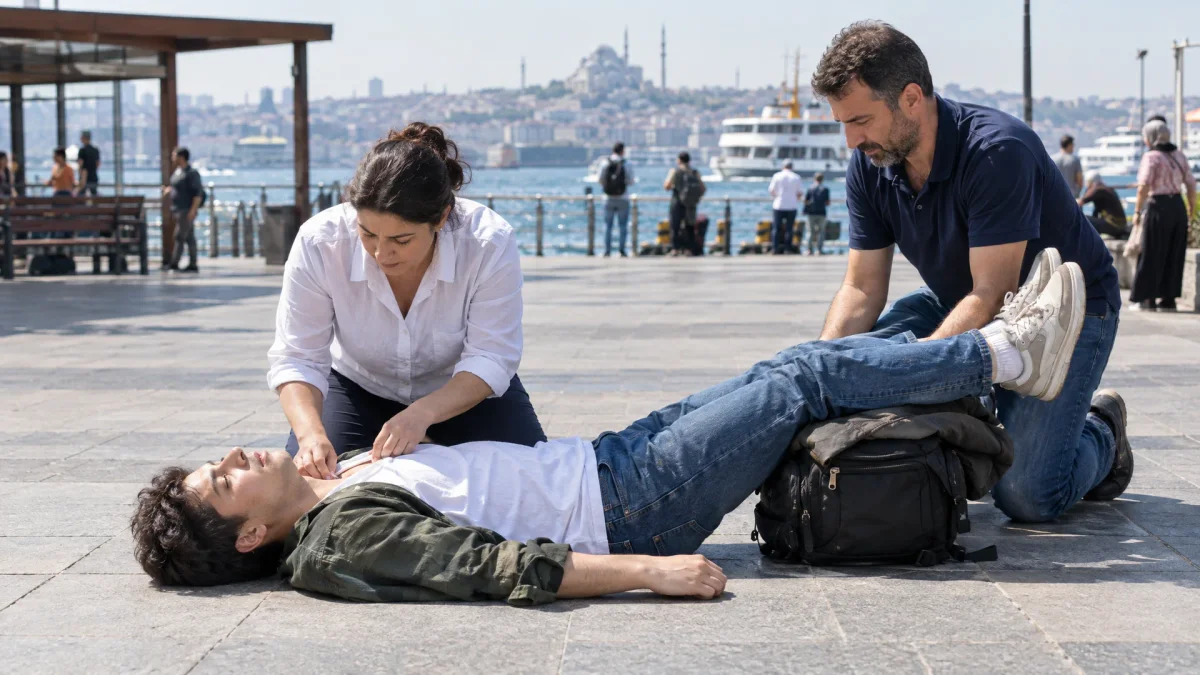
- Syncope (fainting), in the Turkish Ministry of Health (T.C. Sağlık Bakanlığı, SB) May 2025 First-Aid Training Book, is defined as "partial or total loss of consciousness due to a transient reduction in cerebral blood flow"; this definition anchors the Turkish first-aid protocol.
- For the bystander: lay the person supine on a flat surface, loosen tight clothing, raise the legs 30–60° (the Ministry of Health "shock position"), and if there are no vital signs, call 112 and begin Cardiopulmonary Resuscitation (CPR).
- The 2018 European Society of Cardiology (ESC) syncope guideline puts the lifetime prevalence at "nearly 40%"; roughly one in three adults faints at least once, and reflex (vasovagal) syncope is the most common type at every age.
- Cardiac syncope is a separate category: the Turkish Ministry of Health-affiliated Koşuyolu Yüksek İhtisas Education and Research Hospital reports an annual mortality of about 30% in cardiac syncope; chest pain, palpitations, family history of sudden death and exertional fainting are red flags.
- In the 2024 SEED prospective cohort across 14 European countries and 41 emergency departments — including Gazi University in Ankara — syncope accounted for ~1% of all ED visits, hospital admission occurred in 39.8% of cases, and admission climbed from 34.7% (one risk factor) to 67.9% (six or more risk factors).
On a Monday evening on an Istanbul ferry, a student standing in the crowd suddenly turns pale, gets ringing in the ears, sees her vision darken and within a second or two slides to the floor. A passenger reaches for a phone; another shouts "bring water, splash cologne". Both answers are wrong. Fainting — clinically called syncope — is defined in the Turkish Ministry of Health (T.C. Sağlık Bakanlığı, SB) May 2025 First-Aid Training Book as "partial or total loss of consciousness due to a transient reduction in cerebral blood flow" [1]. The only person who can make the right call in the first minutes is the bystander. This guide aligns the Turkish Ministry of Health 2025, Turkish Red Crescent 2025, and 2018 European Society of Cardiology (ESC) syncope playbooks to clarify both what to do and — equally — what not to do.
Quick Answer
For someone who just fainted, the first three actions: (1) lay them supine on a flat surface and loosen tight clothing; (2) raise their legs 30–60° (the Turkish Ministry of Health "shock position"); (3) check vital signs — are they breathing, do they respond to touch? If there are no vital signs, call (or have someone call) 112 and begin Cardiopulmonary Resuscitation (CPR) [1][2]. Don't waft cologne, don't pour water, don't slap, don't give fluids by mouth — the Turkish Red Crescent 2025 Pocket Book explicitly forbids those five actions [2].
When to call 112 immediately? The fainting lasted longer than 1 minute; the person has chest pain, shortness of breath or new palpitations; the faint happened during exertion or while supine; there is a family history of sudden death; the episode repeats; the person is over 65 or has known cardiac disease; there is head trauma from the fall; pregnancy; a seizure; or diabetes with syncope. The 2018 European Society of Cardiology (ESC) syncope guideline puts the lifetime prevalence at "nearly 40%" [5] — about one in three adults in Türkiye has fainted at least once. But you cannot tell on the spot whether it is benign vasovagal syncope or cardiac syncope with an annual mortality of about 30% [3][5]. When in doubt, call 112.
Türkiye Snapshot: How Often Does Syncope Reach the Emergency Department?
Fainting looks ordinary, but its emergency department (ED) footprint is large. The 2024 SEED (Syncope in the Emergency Department) prospective cohort, with the Department of Emergency Medicine at Gazi University Faculty of Medicine in Ankara as a co-investigator center, enrolled n=952 syncope patients during a one-week window between 12–25 September 2022 across 41 EDs in 14 European countries; that was approximately 1% of 98,301 total ED presentations, and 39.8% were admitted [6]. Hospital admission climbed from 34.7% (one risk factor) to 67.9% (six or more risk factors); more than one-third of cases left the first encounter without a definitive diagnosis [6]. A 2024 Journal of Clinical Medicine review by Furlan et al. frames the broader burden: "Syncope accounts for 0.6–3% of all emergency department (ED) visits, affects up to 30% of the general population in their lifetime, and only 50–60% of episodes end up with a definitive diagnosis at the time of the first evaluation in the ED" [7].
Türkiye's mortality picture sets the epidemiological backdrop for why syncope deserves attention. The Turkish Statistical Institute (TÜİK) Press Bulletin No. 54195 dated 19 June 2025 reports that 2024 saw 489,361 deaths in Türkiye, with 36% caused by diseases of the circulatory system as the leading category; ischemic heart disease accounted for 42.9% within the circulatory category [4]. Cardiac syncope is one visible face of this mortality: the Turkish Ministry of Health-affiliated Koşuyolu Yüksek İhtisas Training and Research Hospital, Department of Cardiology, reports that "annual mortality is approximately 30% in cardiac syncope," with aortic stenosis, hypertrophic cardiomyopathy and myocardial infarction as priority differential diagnoses [3]. The same symptom can carry vastly different priorities — a student fainting after long standing and a 65-year-old fainting while climbing stairs both fall under the same word but demand different responses.
What Syncope Is — and Isn't
The Turkish Ministry of Health 2025 First-Aid Training Book defines syncope as a transient loss of consciousness driven by a transient reduction in cerebral blood flow that resolves spontaneously within minutes [1]. The 2018 ESC guideline gives the same definition in clinical language: "transient loss of consciousness due to transient global cerebral hypoperfusion characterized by rapid onset, short duration and spontaneous complete recovery" [5]. These three features — rapid onset, short duration, spontaneous full recovery — separate syncope from epileptic seizure, post-traumatic loss of consciousness and metabolic coma.
Conditions often confused with syncope:
- Pre-syncope ("near-fainting"): No full loss of consciousness, but the imminent feeling — dimming vision, tinnitus, dizziness, nausea — is there. The Turkish Ministry of Health 2025 book (p.96) writes that if recognized in time and physical counter-pressure maneuvers are applied, the faint can be prevented [1].
- Vertigo (true spinning dizziness): The room feels like it spins, but consciousness is intact. It originates in the inner ear or cerebellum and isn't a cerebral perfusion problem.
- Epileptic seizure: Convulsions, jaw locking, tongue bite, urinary incontinence; afterwards minutes-long confusion (post-ictal). Syncope recovery is, by contrast, prompt.
- Hypoglycemic coma (diabetic loss of consciousness): In diabetics from excess insulin, under-eating or heavy exercise; consciousness deepens over minutes to hours and does not resolve spontaneously. The Turkish Ministry of Health 2025 protocol says give sugar to the conscious hypoglycemic patient [1]. We covered the diabetic emergency algorithm — hypoglycemia vs. hyperglycemia — in a dedicated guide.
- Anaphylactic shock with syncope: Within minutes of allergen exposure, facial/tongue swelling, wheeze, urticaria. Treatment is the adrenaline auto-injector, not just the shock position. See our anaphylaxis (allergic shock) and adrenaline auto-injector guide.
Three Mechanisms: Which Syncope Is This?
Both the 2018 ESC guideline and the Turkish Ministry of Health-affiliated Koşuyolu Yüksek İhtisas Training and Research Hospital page divide syncope into three principal mechanisms [3][5]. A detailed diagnosis is not the bystander's job — but a rough estimate sharpens the call to 112.
| Mechanism | Typical trigger | Pre-syncopal warning? | Age group | Risk level |
|---|---|---|---|---|
| Reflex (vasovagal / neurocardiogenic) syncope | Long standing, sight of blood, pain, stuffy room, straining, heat | Yes — dizziness, sweating, pallor, nausea over 10–30 sec [3] | Any age, often young [5] | Low (good prognosis) |
| Orthostatic syncope | Sudden rise to standing, dehydration, diuretics, prolonged bed rest | Vague — sometimes dizziness, visual darkening | Often 60+ years, on medications | Moderate — injury risk from falls |
| Cardiac syncope (arrhythmia, structural heart disease) | Exertion, supine position, with no warning; palpitations | Absent or very brief — "collapses without warning" [3] | Often 60+ years or known cardiac patient | High — annual mortality ~30% [3] |
Vasovagal (reflex) syncope — the most common and most benign
The 2018 European Society of Cardiology (ESC) guideline calls reflex syncope "the most frequent cause of syncope in any setting and at all ages" [5]. The Turkish Ministry of Health-affiliated Koşuyolu Yüksek İhtisas Training and Research Hospital page describes the mechanism: vagal nerve activation slows the heart and dilates blood vessels; the result is a sudden drop in blood pressure and brief inadequate cerebral perfusion [3]. The triggers are familiar: sight of blood or needles, prolonged standing (military ceremonies, bus stops, ferry queues), hot and humid environments, sudden stopping after heavy exercise, straining (cough, urination, defecation). The symptom chain is cold sweating → pallor → nausea → blurred vision → dizziness → brief unconsciousness, with recovery typically under one minute.
Orthostatic syncope — worse in heat and in older adults
Orthostatic syncope reflects the cardiovascular system's failure to raise blood pressure quickly enough on standing. The Turkish Ministry of Health-affiliated Koşuyolu Yüksek İhtisas Training and Research Hospital page describes the mechanism: prolonged standing pools roughly 1 liter of blood in the abdominal and lower-limb veins; blood pressure drops 25–30 mmHg on rising, made worse by dehydration, diuretic use or prolonged heat exposure [3]. This is the most common subtype of summer fainting, and the Turkish Ministry of Health 2025 list of "causes of fainting" places "Heat" and "Sudden rise to standing" back-to-back [1]. We covered the dehydration → heat illness → orthostatic collapse chain in a separate summer heat health guide. In older adults the mechanism is more fragile; for someone on antihypertensives (especially alpha-blockers, diuretics), morning rises from bed can produce fainting.
Cardiac syncope — the red flag
Cardiac syncope differs from vasovagal syncope mainly because annual mortality is about 30% [3]. The Turkish Ministry of Health-affiliated Koşuyolu Yüksek İhtisas Training and Research Hospital page captures the distinguishing feature: cardiac syncope "begins suddenly without preceding symptoms"; aortic stenosis, hypertrophic cardiomyopathy, coronary artery disease and life-threatening arrhythmias are the principal causes [3]. The 2018 European Society of Cardiology (ESC) guideline lists the high-risk features explicitly: syncope during exertion or while supine; preceding chest pain, sudden dyspnea or new palpitations; family history of sudden death below age 40; known structural heart disease; an abnormal electrocardiogram (ECG) [5][7]. If even one of these is present, call 112 immediately; do not drive the person yourself. We covered the silent signs of heart attack — and when not to delay 112 — in a separate guide.
Step-by-Step First Aid for the Bystander
The sequence below is the direct overlap of the Turkish Ministry of Health May 2025 First-Aid Training Book (p.95) and the Turkish Red Crescent 2025 First-Aid Pocket Book (p.21) protocols [1][2]. Don't reorder — each step prepares the next.
- Scene safety. Fainting in traffic, on a staircase, in a crowd or near an emergency exit — secure the scene first. On a ferry or bus, create breathing room and prevent people from stepping on the patient.
- Lay supine on a flat surface. The Turkish Ministry of Health book (p.95) writes: "Help them lie supine on a flat surface (the floor)" [1]. Do not sit the person on a chair or sofa — gravity then works against cerebral perfusion.
- Loosen tight clothing. Collar, belt, tie, brassiere, tight trousers — open or loosen anything that restricts breathing or venous return.
- Apply shock position (raise the legs). The Turkish Ministry of Health May 2025 book defines shock position (p.117): "If there is no injury or evidence of injury (e.g. simple fainting, …) raise the legs to approximately 30–60 degrees. Place support under the legs (sheet, blanket, pillow, folded clothing)." [1] This pushes blood from the legs back to the brain.
- Check for pregnancy — at ≥20 weeks, lay on the left side. The Turkish Red Crescent 2025 Pocket Book (p.21) is explicit: in late pregnancy, the supine position can let the enlarged uterus compress the inferior vena cava and worsen venous return; lay on the left side [2].
- Check vital signs. For 10 seconds, look for breathing, chest movement and response to voice. If absent, call 112 (or have someone else call) and begin Cardiopulmonary Resuscitation (CPR).
- Unconscious but breathing — recovery position. The Turkish Ministry of Health 2025 book (p.92) says if consciousness is fully lost and no injury is suspected, place the person in the recovery (lateral) position; this keeps the tongue clear of the airway and channels any vomit away from the lungs. See our step-by-step recovery position guide.
- Don't get them up the moment they come around. Keep them flat for at least 10–15 minutes. Rushing to standing triggers a second orthostatic faint. Even if the person feels fine, rest at least 30 minutes and don't drive.
- Conscious and not vomiting — slow sips of fluid. Water, plain ayran or an oral rehydration drink. If consciousness is reduced, never give fluids by mouth — aspiration risk is life-threatening.
- Record what happened. How long did the faint last? What were the warning signs? Any trigger? Did the person hit their head on the way down? This information is what the ambulance crew and ED need first; correct trigger reporting shortens the diagnostic path.
Shock Position — The Right Way
The shock position in a single sentence is "supine, legs up" — but the detail matters. The Turkish Ministry of Health May 2025 First-Aid Training Book gives the full definition on page 117 [1]:
- The patient is laid flat on their back.
- The legs are raised to approximately 30–60 degrees.
- Support is placed under the legs (sheet, blanket, pillow, folded clothing).
- If movement or the position causes pain, do not raise the legs — do not use it in suspected hip, pelvic or leg fractures.
- Cover the patient to keep them warm (but don't overheat).
This position is also used in hemorrhagic and traumatic shock, but it is the cornerstone of "simple fainting" first aid too. The point: reverse gravity, channel blood from legs to brain.
Pre-Syncope — Preventing the Faint with Physical Counter-Pressure
The Turkish Ministry of Health May 2025 First-Aid Training Book treats pre-syncope as its own section and notes that physical counter-pressure maneuvers can prevent fainting (p.96) [1]. If the person hasn't fully fainted yet but says "I feel dizzy, my ears are ringing, I feel nauseous," the bystander does this:
Upper-body maneuvers:
- Hand grip: Lock both hands together and pull arms in opposite directions with maximum force.
- Fist clench: With or without an object in the hand, clench fists as hard as possible.
- Neck flexion: Bend the neck forward and try to touch chin to chest.
Lower-body maneuvers:
- Squat down.
- Whether lying or — if necessary — standing, tense the leg, abdominal and gluteal muscles and cross the legs.
The Turkish Ministry of Health book explains the goal: "to raise blood pressure and relieve symptoms by contracting muscles of the legs, arms, abdomen or neck" [1]. Hold each maneuver 30 seconds to 2 minutes. If symptoms don't ease, or the person does faint, move to the recovery position. Warnings: Don't use counter-pressure if the person has chest pain, active bleeding or trauma — the underlying picture may not be benign pre-syncope.
What Not to Do — The Turkish Red Crescent "Five Don'ts"
Turkish Red Crescent 2025 First-Aid Pocket Book on page 22 lists the warnings that run directly counter to the common wrong responses [2]. The Turkish Ministry of Health 2025 book (p.95) repeats the same five [1]:
- Don't sit them on a chair or raised surface. Gravity defeats cerebral perfusion; sitting both prolongs the faint and raises the risk of a second one.
- Don't waft cologne, ammonia or other scented substances. Sudden inhalation can irritate the airway, trigger reflex bronchospasm and rarely cause lung injury. The benefit for recovery is not scientifically demonstrated.
- Don't give food or fluids. In incomplete consciousness, fluids by mouth can be aspirated; aspiration pneumonia and airway obstruction can be fatal.
- Don't pour water over them. A sudden temperature drop can start shivering and hypothermia; wet clothing keeps losing body heat. In heat-stroke suspicion, cool with controlled wet cloths to head, neck, armpits and groin — not a bucket over the chest.
- Don't slap them. Pain in altered consciousness isn't a useful stimulus; slapping an older patient can injure fragile facial bones. A verbal cue ("Can you hear me?") and a gentle shoulder shake is the right stimulus.
When to Call 112 — Red Flag List
Not every faint needs 112 — the 2018 European Society of Cardiology (ESC) syncope guideline scales hospital admission to the count of high-risk features, and the SEED 2024 cohort showed admission reaches 67.9% at six-plus risk factors [5][6]. Call 112 immediately if any of these is present [5][7][8]:
- Faint longer than 1 minute. Brief vasovagal episodes last seconds; long unconsciousness points to a serious underlying cause.
- No full recovery after the faint. Confusion, inability to speak, one-sided weakness — suspect stroke. We covered the Face-Arm-Speech-Time (FAST) test and why it's time-critical in a dedicated guide.
- Chest pain, dyspnea, palpitations before or after the faint. Cardiac syncope is suspected — annual mortality risk ~30% [3]. If the chest pain is typical, heart attack first aid takes priority.
- Syncope during exertion or while supine. A high-risk ESC 2018 criterion [5].
- Family history of sudden death below age 40. Suggests inherited arrhythmic conditions — hypertrophic cardiomyopathy, Brugada syndrome, long QT [5].
- Known structural heart disease, heart failure or prior myocardial infarction. Automatically high-risk.
- Age over 65. Heat regulation and blood-pressure control weaken with age; fall-related head injury and hip fracture risk is high.
- Head, neck or spine trauma from the fall. Injury from the collapse requires 112; cervical-spine protection guides handling.
- Recurrent fainting (≥2 in the last 3 months). Referral is needed to speed diagnosis.
- New or uncontrolled palpitations. Arrhythmia suspicion.
- Fainting in a diabetic. Hypoglycemia versus another cause — blood glucose check and close observation are needed.
- Pregnancy (especially after 20 weeks). Preeclampsia, inferior-vena-cava compression and obstetric emergencies must be ruled out for both mother and fetus.
- Seizure. Distinguish syncope from epilepsy; in children with fever, see our parent's guide to pediatric emergencies.
- Fainting in heat or underwater. Heat-stroke (hyperthermia) and near-drowning suspicions need parallel evaluation.
- Fall with anticoagulant (blood-thinner) use. Intracranial bleeding risk is high.
If it's a first faint in a young, healthy person with a typical vasovagal trigger (long standing, sight of blood, stuffy room), prompt full recovery is present and none of the red flags above apply, the person can rest 30 minutes and then stand again; a family-physician or cardiology-outpatient follow-up within 24 hours may suffice. When in doubt, 112.
Summer-Specific Fainting: Heat, Dehydration, Orthostatic Drop
Last week of June — Istanbul, 75% humidity, 32 °C in the shade — and the summer fainting profile is clinically distinct. The Turkish Ministry of Health 2025 First-Aid Training Book lists "Heat," "Closed environment, polluted air," "Sudden rise to standing" and "Blood-pressure (hypotension) drop" consecutively under "causes of fainting" [1]. The mechanism is simple: sweat-driven fluid and salt loss + heat-induced vasodilation + prolonged standing = inadequate cerebral perfusion. Typical Istanbul summer cases:
- Young adult on a ferry or in a metrobus queue standing long, fainting — classic vasovagal syncope on heat-humidity triggers.
- Older person who just stepped off a bus in Şişli at 15:00 swaying on the sidewalk — orthostatic hypotension + antihypertensive medication + fluid loss.
- Construction worker in Esenyurt mid-afternoon faints, body hot, sweating has stopped — this is no longer simple fainting but suspected heat stroke (hyperthermia); 112 immediately and external cooling started. We covered the heat stroke / heat exhaustion / heat cramp severity grades in our summer heat health guide.
- In Ramadan, half an hour before iftar, a diabetic faints — likely hypoglycemia; per the Turkish Ministry of Health 2025 protocol, give sugar if conscious, recovery position + 112 if unconscious [1]. We addressed risk management for chronic patients in the Ramadan fasting health-risks guide.
Six steps for summer-heat fainting: (a) move to shade with air flow; (b) lay supine and shock position; (c) loosen tight clothing; (d) wet cloths on head, neck, armpits, groin; (e) if conscious, slow sips of water, ayran or oral rehydration; (f) call 112 if symptoms don't ease, body is very hot, or the person is over 65, a child or chronically ill.
Special Groups: Child, Older Adult, Pregnant, Diabetic
There is no average syncope; some groups have a different chain and different risks.
Children
Pediatric fainting is mostly vasovagal or breath-holding spells — benign. The Turkish Ministry of Health May 2025 First-Aid Training Book recommends calling 112 for febrile childhood seizures and placing the child in the recovery position; cooling with room-temperature water and clean cloths to lower body temperature [1]. But if the faint happens during exertion (sport, running), with family history of sudden death below age 40, with a heart-disease diagnosis or with prior convulsions, get to 112 immediately; pediatric-cardiology evaluation is essential. Our parent's guide to pediatric emergencies covers age-appropriate symptom frameworks, seizure vs. fainting distinction and 112 criteria in detail.
Older adults
In the 65+ group, a faint is not assumed benign. The 2018 European Society of Cardiology (ESC) syncope guideline notes that the share of cardiac syncope rises with age, and the risk of fall-related hip fracture, intracranial bleeding and serious injury is many times higher than in young patients [5]. The TÜİK 2024 data showing 36% of deaths from circulatory disease justify always evaluating elderly syncope through a cardiac-risk lens [4]. For an older patient on antihypertensives (especially diuretics, alpha-blockers, calcium-channel blockers) fainting on rising from bed, the orthostatic mechanism dominates; uncontrolled recurrence requires the family physician to revisit drug doses. Our hypertensive emergency thresholds and management guide explains the link between blood pressure and fainting.
Pregnancy
The Turkish Red Crescent 2025 First-Aid Pocket Book (p.21) instructs that in late pregnancy (≥20 weeks) the woman should be turned onto her left side [2]. This prevents the enlarged uterus from compressing the inferior vena cava and improves venous return. Fainting in pregnancy — especially with headache, visual changes or right-upper-quadrant pain — raises preeclampsia or eclampsia suspicion; 112 is called and transport directed to a hospital with active obstetric emergency care.
Diabetics
Fainting in a diabetic spans two distinct pictures: hypoglycemia (low blood sugar) or cardiac/orthostatic syncope. The Turkish Ministry of Health 2025 protocol says, for suspected hypoglycemia with retained consciousness, give sugar, fruit juice, sweetened milk or jam, wait 10–15 minutes, and call 112 if symptoms persist [1]. For the unconscious diabetic, never give fluids by mouth, apply the recovery position and call 112 [1]. We wrote the diabetic emergencies home guide to clarify this distinction.
After the ED: What the Diagnostic Workup Looks Like
For the patient who reaches the ED, the 2018 ESC guideline's "initial evaluation" triad remains standard: (1) detailed history (trigger, duration, post-event symptoms) (2) supine-and-standing blood pressure (3) 12-lead electrocardiogram (ECG) [5]. The 2024 Furlan et al. review reports that the first evaluation reaches a definitive diagnosis only in 50–60% of cases; the remainder go on to risk stratification and either admission or planned outpatient workup [7].
Common in-hospital tests:
- 12-lead electrocardiogram (ECG): The Turkish Ministry of Health-affiliated Koşuyolu Yüksek İhtisas Training and Research Hospital page reports that ECG yields a direct diagnosis in roughly 5% of syncope cases, but is critical for excluding structural heart disease [3].
- Echocardiogram (ECHO): Indicated when physical exam or ECG raises suspicion of structural heart disease [3].
- Tilt-table test: The Turkish Ministry of Health-affiliated Koşuyolu Yüksek İhtisas Training and Research Hospital page gives sensitivity up to 92% for vasovagal syncope; the patient is tilted 60–80 degrees on a monitored table for 30–45 minutes [3]. The 2018 ESC guideline recommends a passive phase of at least 20 and at most 45 minutes, with provocation by sublingual nitroglycerin or intravenous isoproterenol if the passive phase is negative [5].
- Ambulatory ECG (Holter or implantable loop recorder, ILR): The United Kingdom's National Institute for Health and Care Excellence (NICE) Clinical Guideline CG109 advises "an ambulatory ECG as a first-line specialist assessment for suspected cardiac arrhythmic syncope; the type chosen depends on the frequency of transient loss of consciousness — for episodes less frequent than every two weeks, an implantable loop recorder is preferred" [8].
- Electrophysiological study (EPS): When arrhythmic cardiac conduction is suspected; potentially life-saving in patients with known cardiac damage [3].
- Laboratory: Blood glucose, hemoglobin, electrolytes, toxicology where indicated [3].
Life After Syncope: Driving, Occupational Restrictions and the Legal Frame
The Turkish Society of Cardiology (Türk Kardiyoloji Derneği, TKD) 2016 statement on cardiovascular disease and driving, published in Türk Kardiyoloji Derneği Arşivi, frames the legal envelope [9]: "Regulation on the Health Conditions and Examinations of Driving License Candidates and Drivers" published in the Turkish Official Gazette dated 29 December 2015, No. 29577, divides drivers into private (Group 1) and commercial (Group 2). The TKD statement says vasovagal syncope with a clear, controlled trigger may allow driving after brief observation; cardiac syncope, unexplained recurrent syncope and exertional syncope require specialist evaluation and defined waiting periods after treatment [9]. Commercial drivers (buses, trucks, taxis, ambulances) face stricter limits — fatal-collision rates in commercial vehicles are 3–4× higher than in private ones [9].
Operational implication: someone who has just had syncope (especially if over 65 or known cardiac) should not get behind the wheel; until diagnosis and treatment are settled, they should not drive. This is not only a legal requirement but a clinical recommendation for the patient's and others' safety.
After Syncope in Istanbul — Nova Ambulans Practice
A faint on a ferry, in a shopping mall, in an office or at home — once the 112 team has assessed on scene and recommends transport to a specific private clinic or cardiology-specialty center, or once the patient's preferred private hospital isn't on the 112 referral path, Nova Ambulans's private patient-transport network across all 39 Istanbul districts fills this gap. For cardiac-syncope suspicion, cardiac-monitored, defibrillator-equipped, advanced-life-support-stocked ambulance is our standard; the Turkish Ministry of Health "Regulation on Ambulances and Emergency Health Vehicles and Ambulance Services" sets the equipment standard and the audit framework [10]. We covered the mandatory ambulance equipment list in a separate guide.
In practice: your older neighbour collapses in the afternoon, the 112 team arrives, "we've stabilized them here but long-term monitoring and ECG/ECHO with overnight cardiology coverage are needed" — at this point our 7/24 line 0850 244 24 12 can arrange a controlled transfer to the patient's known cardiologist's hospital. The first 24 hours after syncope — per the ESC 2018 and SEED 2024 data — are the most critical diagnostic window [5][6]; rushed transport in a private car is the wrong choice. Our ambulance call and case-reporting process guide covers how to communicate the right information at the right time.
Quick Reminder: 60-Second Checklist for Your Wallet
A 60-second summary to stash in a wallet, on a fridge or in phone notes:
- Safety first, then lay supine, loosen clothing, raise legs 30–60°.
- Pregnant (≥20 weeks)? Left side [2].
- Once awake, don't sit them up immediately; keep flat at least 10–15 minutes.
- Don't: waft cologne, pour water, slap, sit them up, give fluids by mouth [1][2].
- Call 112 immediately — faint longer than 1 minute, chest pain/palpitations/dyspnea, exertional or supine fainting, family sudden-death history below 40, age over 65, pregnancy, head trauma, anticoagulants, seizure [5][6][7].
- At the ED expect: 12-lead ECG, supine-and-standing blood pressure, Holter or tilt-table if needed [3][5][8].
Frequently Asked Questions
Why shouldn't I get the fainted person up?
Fainting is a transient reduction in cerebral blood flow; gravity has pooled blood in the legs. Standing up triggers the pre-syncopal picture again and risks a second faint — with injury from the fall. The Turkish Ministry of Health May 2025 First-Aid Training Book directs: "Help them lie supine on a flat surface" and "Place them in the shock position" [1]; even after consciousness returns, keep them flat 10–15 minutes and verify they truly feel well before sitting them up slowly.
What's the most practical difference between vasovagal and cardiac syncope?
In one sentence: vasovagal "warns" before it comes; cardiac "doesn't warn". The Turkish Ministry of Health-affiliated Koşuyolu Yüksek İhtisas Training and Research Hospital page says reflex syncope is preceded by sweating, pallor and weakness, while cardiac syncope "begins suddenly without preceding symptoms" [3]. If the person you know slowly turns pale in a queue, says "I feel dizzy, I feel awful" and then folds, it's probably reflex syncope. If they collapse out of nowhere, especially during exertion or while supine, cardiac suspicion is high — call 112 immediately [5].
No pulse — do I start CPR?
Yes. The Turkish Ministry of Health 2025 protocol is unambiguous: you've checked consciousness, no response to voice or pain, no breathing — vital signs are absent. Call (or have someone call) 112 and begin Cardiopulmonary Resuscitation (CPR) [1]. If an Automated External Defibrillator (AED) is nearby, get it and follow the device's voice prompts; our step-by-step AED guide is written for first-time users.
After fainting, family doctor, ED or cardiologist?
Two questions: are there red flags (chest pain, palpitations, dyspnea, exertional fainting, family sudden-death below 40, age over 65, head trauma) and did the faint repeat? "Yes" — go to ED or call 112. "No" plus a single, typical vasovagal episode in a young healthy person — family physician within 24 hours, with cardiology referral as directed, can suffice. The 2018 European Society of Cardiology (ESC) guideline requires 12-lead electrocardiogram (ECG) and supine-and-standing blood pressure at the first evaluation [5].
Can I drive a car or motorcycle after syncope?
Not immediately. The Turkish Society of Cardiology (TKD) 2016 statement allows driving after vasovagal syncope with a clear, controlled trigger and brief observation; but cardiac syncope, unexplained recurrent syncope and exertional syncope require specialist evaluation and defined waiting periods [9]. The 29 December 2015 / 29577 Turkish Official Gazette regulation imposes stricter limits on commercial drivers (buses, taxis, trucks, ambulances), and any cardiac-syncope history must be reported during the annual health-report process [9]. Practical advice: don't get back behind the wheel until diagnosis is settled.
My fainting is recurrent but tests come back "normal" — what now?
Definitive diagnosis at a single ED visit is reached in only 50–60% of cases [7]. The United Kingdom's National Institute for Health and Care Excellence (NICE) Guideline CG109 then recommends ambulatory ECG; if episodes are less frequent than every two weeks, an implantable loop recorder (ILR) is preferred [8]. The Turkish Ministry of Health-affiliated Koşuyolu Yüksek İhtisas Training and Research Hospital page reports tilt-table sensitivity up to 92% for vasovagal syncope [3]. Set up planned follow-up with a cardiologist and, if needed, an arrhythmia/electrophysiology specialist — don't accept "it was normal, it'll pass."
Where to transport after syncope in Istanbul by private ambulance?
The medical state decides. The 112 team will refer the patient on scene to the nearest emergency department — covered under public insurance, free at point of use, and is the first option. After stabilization, planned transport to the patient's cardiologist, hospital-to-home transfer or an out-of-city move is where private patient transport (such as Nova Ambulans) fits. Cardiac-monitored transport requires advanced-life-support-equipped ambulance; the Turkish Ministry of Health ambulance regulation defines this standard [10]. We covered the difference between 112 and a private ambulance — by authority, call path and pricing — in a dedicated guide and how interhospital transport is planned in another guide.
Related Posts
- Adult Basic Life Support and CPR: Step-by-Step Bystander Guide — When syncope crosses into cardiac arrest with no vital signs, the CPR protocol begins.
- Recovery Position: How to Place an Unconscious but Breathing Patient — Airway-safety technique for the unconscious-but-breathing fainted patient.
- Automated External Defibrillator (AED): A Step-by-Step Bystander Guide — When syncope progresses to cardiac arrest, public-access AED shock delivery.
- Stroke Symptoms and the FAST Test — One-sided weakness or speech change after a faint? Recognize stroke fast.
- Heart Attack Symptoms and Immediate Actions — Chest pain before the faint raises pre-syncopal myocardial infarction suspicion.
- Common Health Problems in Summer Heat — When summer fainting is actually heat stroke, heat exhaustion or orthostatic drop.
- Hypertensive Crisis: When to Call 112 — Blood-pressure-related fainting thresholds.
- Diabetes Emergencies Home Guide — Hypoglycemia-driven loss of consciousness vs. other causes.
- Anaphylaxis and Adrenaline Auto-Injectors — Critical intervention when anaphylactic shock underlies the faint.
- Intra-City Patient Transport — Planned cardiology-follow-up transport on the Nova Ambulans line once syncope diagnosis is settled.
If help is needed: 112 is the free emergency health service in Türkiye and is the first call when any of the red flags above is present during or after fainting. For a stabilized patient's planned transport to a private cardiologist or for a long-distance transfer, the Nova Ambulans 7/24 line at 0850 244 24 12 is available.
Rapid Emergency Support
24/7 emergency ambulance service across Istanbul. Fast response, fully equipped team.
Average response time: 15 seconds
Related Articles
Mushroom Poisoning Symptoms and First Aid: When Do Symptoms Start, When to Call 112?
If nausea, vomiting, diarrhea, abdominal pain or any other symptom begins after eating foraged mushrooms or mushrooms of unknown origin, call 112, whatever hour it began; do not induce vomiting and give nothing by mouth. People without symptoms, including a child who ate a mushroom in a garden or park, still need hospital assessment; call 112 and explain, because with amatoxin, which damages the liver, the symptom-free interval averages 8-10 hours. The National Poison Information Center (UZEM) on 114 gives advice but does not replace 112.
EducationTick Bite First Aid: Correct Removal Technique and the Crimean-Congo Haemorrhagic Fever (CCHF) Decision
When a tick attaches to the skin, the bystander’s step-by-step response: gloved, fine-tipped tweezers gripping the tick’s head as close to the skin as possible with steady upward traction, no alcohol, petrol, nail polish, matches or lit cigarettes, saving the removed tick in a labelled sealed plastic bag, a 14-day watch schedule for Crimean-Congo Haemorrhagic Fever (CCHF), the 112 decision when a fever, severe muscle pain, bleeding or profound weakness appears, and safe transfer to an infectious-diseases clinic — with primary sources from the Turkish Red Crescent 2025 First-Aid Pocket Book, the Turkish Ministry of Health May 2025 First-Aid Training Manual, the Turkish Red Crescent Esenyurt First-Aid Training Centre 2024 verbatim protocol, the Turkish Ministry of Health CCHF Scientific Council bulletin, Karanfil et al. 2026 (n=7,776 national surveillance), Güllü et al. 2025 (n=1,103 18-hospital cohort), the World Health Organization (WHO) 2025 fact sheet, the European Centre for Disease Prevention and Control (ECDC) factsheet, and Norman et al. 2025 European review.
EducationBee, Wasp, and Hornet Sting First Aid: When a Sting Reaction Needs 112
Step-by-step first aid for honeybee, wasp, and hornet stings — the bystander's 30-second stinger-scrape technique (credit-card scrape, never tweezers), local vs large-local vs systemic reaction decision tree, when to call Türkiye's 112 emergency line, adrenaline auto-injector application to the outer thigh, and what to do until the ambulance arrives — with verbatim protocols from Türk Kızılay Cep Kitabı 2025, T.C. Sağlık Bakanlığı May 2025 First-Aid Training Manual, the Turkish National Society of Allergy and Clinical Immunology (AİİAD), the Society of Pediatric Allergy and Asthma Academy (CAAAD), the 2025 Katran cohort of 194 526 patients at Istanbul Süreyyapaşa Hospital, the 2021 Öziş Baba cohort of 7 904 Trabzon schoolchildren, the American Academy of Allergy, Asthma & Immunology (AAAAI) and the McMurray 2026 Hymenoptera venom anaphylaxis review.
- First-Aid Training Book (May 2025) — Chapter VII: First Aid in Disorders of Consciousness and Severe IllnessRepublic of Türkiye Ministry of Health (T.C. Sağlık Bakanlığı), General Directorate of Emergency Health Services ↗
- First-Aid Pocket Book 2025Turkish Red Crescent (Türk Kızılay) ↗
- Syncope (Fainting) — Diagnosis and TreatmentRepublic of Türkiye Ministry of Health (Koşuyolu Yüksek İhtisas Training and Research Hospital — Department of Cardiology) ↗
- Death and Cause of Death Statistics, 2024 — Press Bulletin 54195Turkish Statistical Institute (TÜİK) ↗
- 2018 ESC Guidelines for the diagnosis and management of syncopeEuropean Society of Cardiology / European Heart Journal (PMID 29562304) ↗
- Management of syncope in the Emergency Department: a European prospective cohort study (SEED)European Journal of Emergency Medicine (peer-reviewed; PMID 38015745) ↗
- Syncope in the Emergency Department: A Practical ApproachJournal of Clinical Medicine (peer-reviewed; PMCID PMC11172976, PMID 38892942) ↗
- Transient loss of consciousness ('blackouts') in over 16s — Clinical Guideline CG109National Institute for Health and Care Excellence (NICE), United Kingdom ↗
- Cardiovascular Diseases and Vehicle Driving: Turkish Society of Cardiology Statement 2016Turkish Society of Cardiology (Türk Kardiyoloji Derneği) / Turk Kardiyol Dern Ars 2016;44(8):706–714 ↗
- First-Aid Training Presentations (15 modules)Republic of Türkiye Ministry of Health (T.C. Sağlık Bakanlığı) — General Directorate of Emergency Health Services ↗
Popular Ambulance Topic Clusters
You may also like
- Private ambulance pricing
- Istanbul private ambulance
- Intercity patient transport
- Doctor-accompanied ambulance
- Dialysis patient transport
- How intercity patient transport works
- Ambulance response time in Istanbul
- Home-to-hospital patient transport
- Modern ambulance equipment and team standards
- Heart attack symptoms and first response
This content is informational only and does not replace professional medical evaluation. In emergencies, call 112 or +90 216 339 00 39.
