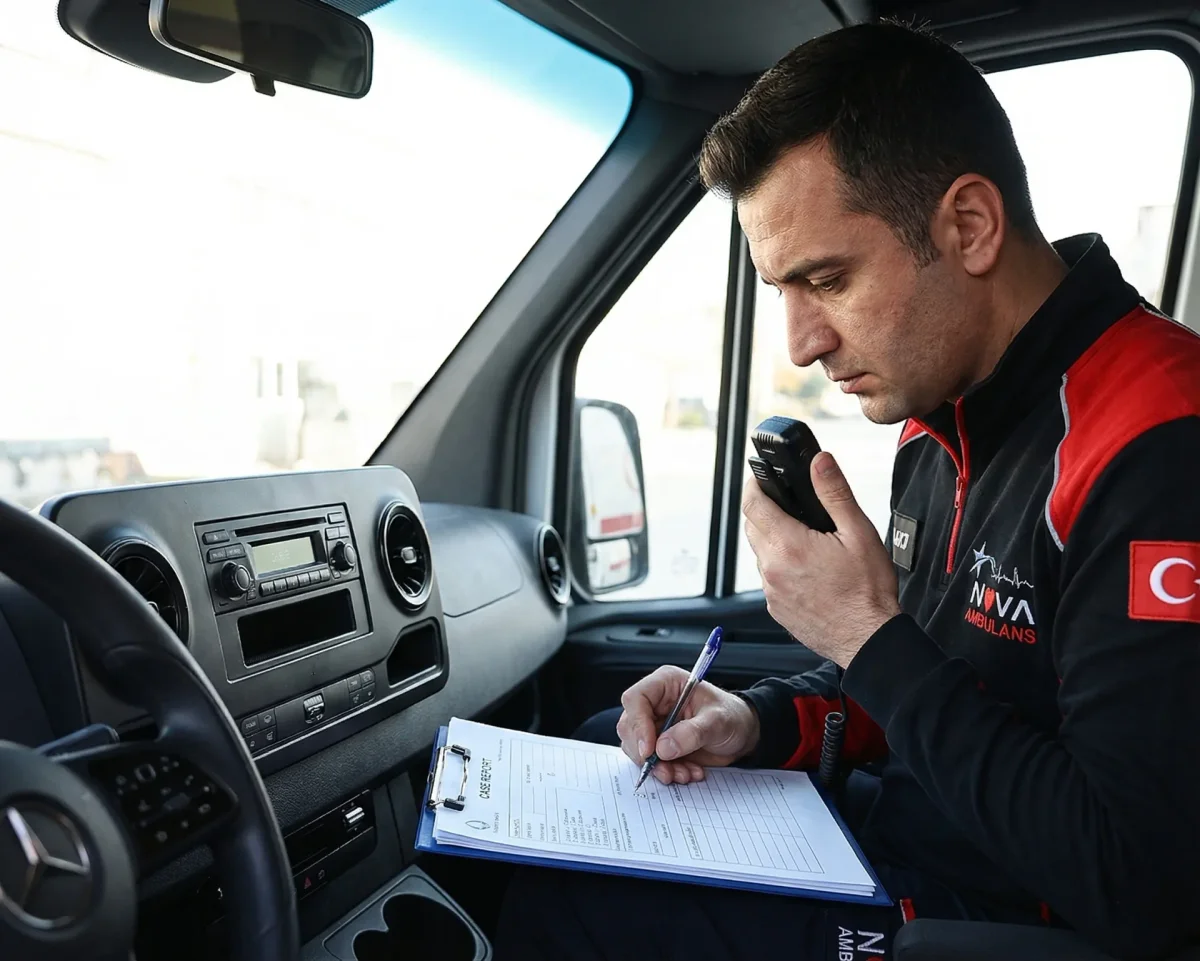
- Every case must be reported to the Health Command and Control Center (SKKM) via the Emergency Health Automation System (ASOS) the moment dispatch is confirmed (Article 17/2).
- The ambulance crew records the complete case form on a mobile device throughout the mission (Article 18).
- If a call is declined, the call handler must tell the caller how their need can be met elsewhere — e.g. 112 or a suitable health facility (Article 17/1).
When someone calls a licensed private ambulance service in Turkey, a regulated workflow begins immediately. Articles 16, 17, and 18 of the 2025 Ambulance Regulation define exactly how calls must be handled, how dispatch works, and what documentation the crew must complete. [1]
Step 1: Receiving the Call (Article 16)
A call can be made by the patient, a family member, or a third party — either in person or by phone. In certain situations, the Health Command and Control Center (SKKM) may also dispatch a private ambulance crew directly.
Step 2: Call Assessment and Accept/Decline (Article 17)
Article 15(3) of the regulation defines the call handler's role explicitly: "The call handler is responsible for evaluating the calls received by the ambulance service and, under the coordination of the consultant physician, dispatching the ambulances to the case." [3] The call handler (çağrı karşılayıcı) evaluates the call against the service's current capacity, crew qualifications, and equipment status:
- If accepted → case opened and dispatch confirmed
- If declined → the call handler must tell the caller how their need can be met elsewhere — for example via 112 or a suitable health facility (Article 17/1) [1]
The regulation does not permit a simple "we can't help" response without redirection guidance.
Step 3: Health Command and Control Center (SKKM) Notification via the Emergency Health Automation System (ASOS) (Article 17/2)
As soon as a call is accepted and dispatch confirmed, the case must be opened in the Emergency Health Automation System (ASOS) and the Health Command and Control Center (SKKM) notified. Case tracking begins here and continues until the mission is closed. The Emergency Health Automation System (ASOS) is defined in the regulation as "the information system used in carrying out pre-hospital emergency health services and patient transport services...where every kind of record and operation is performed." [3] Operationally, the system sits under the Ministry of Health's Directorate General for Emergency Health and Disaster Services. [4]
Step 4: Crew Response (Article 18)
Once the Health Command and Control Center (SKKM) has acknowledged the case, the ambulance crew travels to the patient's location, provides the required emergency care or transport, and ensures the patient's safety throughout. Article 18(1) states: "The ambulance crew that has reached the location of the patient or injured person performs the necessary medical emergency care or transport." [3] The crew member who is not driving remains in the patient compartment at all times during transport.
Step 5: Case Record (Annex-12 Form)
The crew records every action in the ambulance case record form (Annex-12) via the mobile device. This includes:
- Patient demographic and condition data
- All interventions performed
- Timestamps for departure, arrival, and handover
- Destination hospital and receiving team details
If the mobile device is unavailable, the form is completed on paper, then scanned and uploaded within 24 hours. The Emergency Medicine Association of Turkey (TATD) emphasises that pre-hospital programmes must "support the training and development" of the professionals who staff these calls — precise documentation grows directly out of that training pipeline. [5] The World Health Organization (WHO)'s Emergency & Critical Care team also publishes a "prehospital toolkit" of products designed to strengthen pre-hospital systems globally; the Emergency Health Automation System (ASOS) is the Turkish realisation of that direction. [6]
Step 6: Health Command and Control Center (SKKM) Closure (Article 18/4)
The completed case record is submitted to the Health Command and Control Center (SKKM) for approval within 24 hours of the mission. Only after the Health Command and Control Center (SKKM) approves does the case close in the Emergency Health Automation System (ASOS).
Process Summary
| Step | Description | Regulation Article |
|---|---|---|
| Call | Made in person or via communication channels | Article 16 |
| Assessment | The call handler evaluates the request | Article 17 |
| Case notification | Reported to the Health Command and Control Center (SKKM) via the Emergency Health Automation System (ASOS) | Article 17/2 |
| Dispatch | A suitable ambulance is sent to the scene | Article 18 |
| Response | The crew assesses and stabilizes the patient | Article 18 |
| Recording | The Annex-12 form is completed on a mobile device or on paper | Annex-12 |
| Transport and handover | The patient is taken to the most appropriate hospital and handed over | Article 18 |
| Emergency Health Automation System (ASOS) record | Entered into ASOS within 24 hours; approved by the Health Command and Control Center (SKKM) | Article 18/4 |
Frequently Asked Questions
What if Nova Ambulans cannot take my call right now?
If we are at capacity, our call handler will tell you clearly what alternative options are available — including 112 — and how to reach them. We do not simply decline without guidance.
Is the case record accessible to the patient?
Patients have data subject rights under KVKK. You may request access to your case record by contacting our responsible manager.
What is the role of the consultant physician during a call?
During business hours, a consultant physician is present in our call center to advise on case management. Outside business hours, the physician is reachable for consultation (Article 15/1).
Related Posts
Rapid Emergency Support
24/7 emergency ambulance service across Istanbul. Fast response, fully equipped team.
Average response time: 15 seconds
Related Articles
How Ambulance Services Are Audited in Turkey: Process and Sanctions
Licensed ambulance services in Turkey are subject to mandatory regular audits under Article 26 of the 2025 Ambulance Regulation. Learn how the inspection process works and what sanctions can be applied.
EducationHome Medication Use: When to Call an Ambulance?
Learn when to call 112 or Nova Ambulans for dose errors, side effects, and sudden deterioration while using medication at home.
EducationWhat Does a Gray Ambulance Mean? The Patient-Transport Ambulance and Turkey's 2025 Color Regulation
The gray body with a blue stripe you see in traffic or in front of a hospital is a patient-transport ambulance, redefined by Turkey's Official Gazette regulation of 8 January 2025 (RG-8/1/2025-32776). This guide explains where the gray (RAL 7004) color comes from, how it differs from the white emergency ambulance, the restriction on audible warning systems, the detachable blue light restored by the 24 June 2025 amendment, the transition period that closed on 1 January 2026, and how to behave when you see a gray ambulance in traffic — grounded in the T.C. Ministry of Health and World Health Organization (WHO) sources.
Popular Ambulance Topic Clusters
You may also like
- Private ambulance pricing
- Istanbul private ambulance
- Intercity patient transport
- Doctor-accompanied ambulance
- Dialysis patient transport
- How intercity patient transport works
- Ambulance response time in Istanbul
- Home-to-hospital patient transport
- Modern ambulance equipment and team standards
- Heart attack symptoms and first response
This content is informational only and does not replace professional medical evaluation. In emergencies, call 112 or +90 216 339 00 39.
