- The responsible manager is the sole administrative point of contact with the Provincial Health Directorate (Article 14).
- Emergency Ambulances require at least 3 crew: a physician or paramedic, another health professional, and a driver (Article 7).
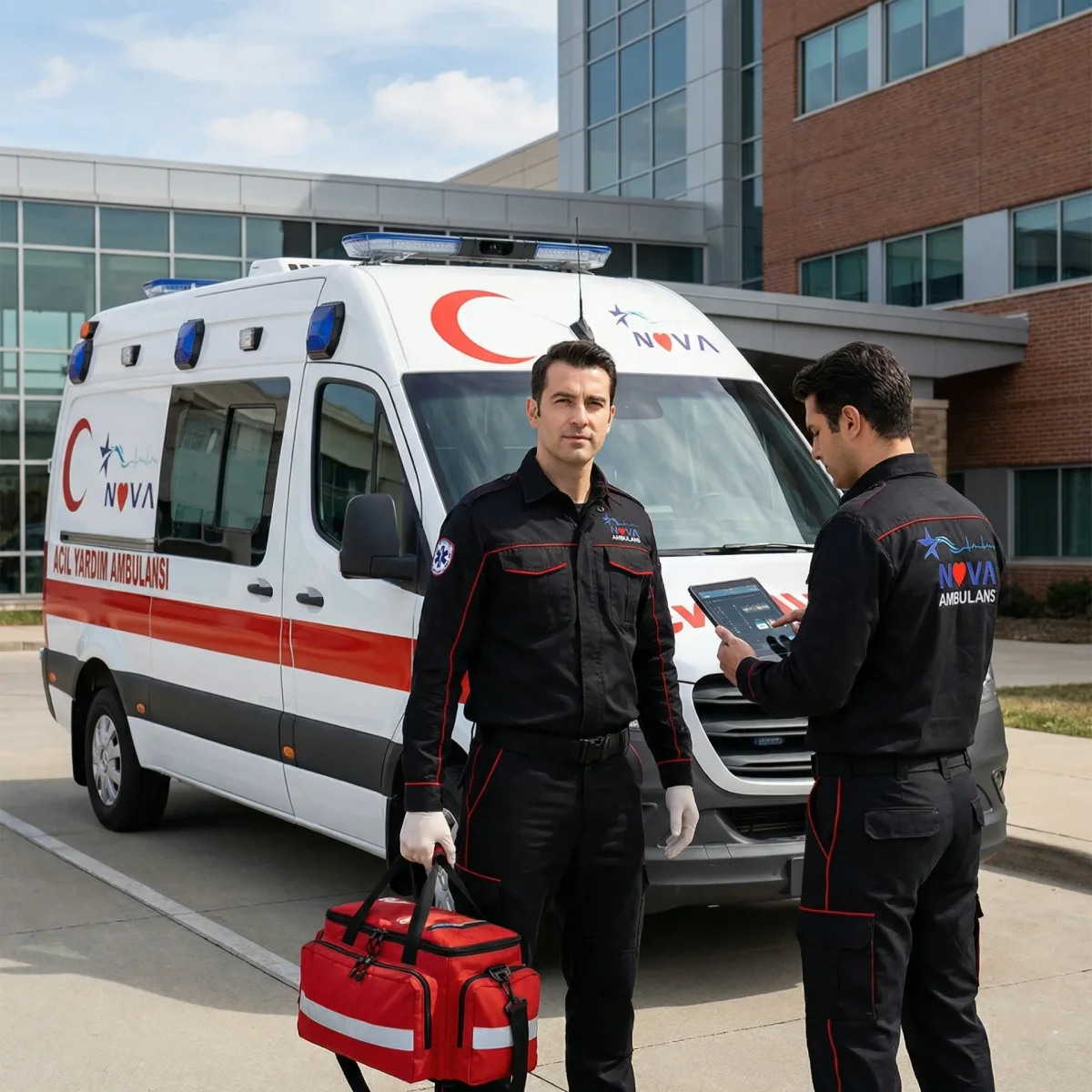
- All personnel must wear uniforms displaying their title, service name, and contact number (Article 21).
A licensed ambulance service in Turkey is not just a vehicle and a crew — it is a structured organization with clearly defined roles and accountability chains. The 2025 Ambulance Regulation (Articles 7, 14, and 15) sets out the specific duties and qualifications for each position, from the responsible manager at the top to the driver behind the wheel. [1]
Responsible Manager (Mesul Müdür) — Article 14
The responsible manager is the primary administrative contact between the ambulance service and the Provincial Health Directorate. This person must be a physician, senior paramedic (acil tıp teknikeri), or senior EMT (acil tıp teknisyeni) (Article 4 definition and Article 14). [1] A responsible manager — and their deputy — may not simultaneously serve as the ambulance physician (Article 14). [1]
Key responsibilities include:
- Maintaining all service certificates, qualification certificates, and personnel work permits
- Ensuring work schedules are entered into the Emergency Health Automation System (ASOS) by the 25th of each month
- Overseeing equipment maintenance, calibration, and sterile storage
- Supervising in-service training for all staff
- Reporting any changes to the Directorate within the first business day
The responsible manager may not work as a crew member on an ambulance (Article 30/p).
Consultant Physician (Danışman Hekim) — Article 15/1
During business hours, a consultant physician must be physically present at the call center. Outside business hours, the physician must remain contactable. The consultant physician shares clinical responsibility for case outcomes together with the ambulance crew.
Team Leader (Ekip Sorumlusu) — Article 15/2
On board the ambulance, a designated team leader is the health professional who coordinates all clinical activity during a mission: documentation in the Emergency Health Automation System (ASOS), patient handover at hospital, and crew communication. Article 18(1) anchors this responsibility: "The ambulance crew that has reached the location of the patient or injured person performs the necessary medical emergency care or transport." [3]
Call Handler (Çağrı Karşılayıcı) — Article 15/3
The call handler evaluates incoming calls and, under consultant physician coordination, dispatches ambulances. The staffing rule: one call handler per up to ten ambulances per shift; an additional handler for each subsequent ten. The Emergency Health Automation System (ASOS) — operated by the Ministry of Health's Directorate General for Emergency Health and Disaster Services — records every call assignment and crew schedule digitally. [5]
Health Personnel — Article 4(s) and Article 7
Turkish law defines health personnel in this context as physicians, nurses, paramedics, anaesthesia technicians, midwives, and EMTs. Article 7(1)(a) of the regulation states verbatim: "an ambulance crew of at least three persons works in emergency-aid ambulances. The crew shall include at least one physician or paramedic or...emergency medical technician, together with another health professional and a driver." [3] The mandatory crew composition varies by ambulance type: [1]
| Ambulance Type | Minimum Health Personnel |
|---|---|
| Emergency Ambulance | 2 (one being a physician/EMT/trained technician) + 1 driver |
| Patient Transport Ambulance | 1 health professional + 1 driver |
| ICU Ambulance | 2 (one being a physician/EMT) + 1 driver |
| Specially Equipped Ambulance | 2 (one being a physician/EMT) + 1 driver |
The June 2025 amendment, Article 7(4), now requires that "all healthcare personnel who will work on ambulances must complete trainings determined by the Ministry." [2] The Emergency Medicine Association of Turkey (TATD) similarly anchors its pre-hospital programme on "supporting the training and development" of these professionals [4]; the World Health Organization (WHO) global prehospital toolkit reinforces the same competency framework. [6]
Driver (Sürücü) — Article 4(ş)
The ambulance driver does more than operate the vehicle — the regulation sets specific requirements: [1]
- A valid driving licence matching the vehicle class is mandatory.
- The driver must also be health personnel or have completed first-aid training. [1]
- The driver is expected to be experienced in safe vehicle operation under emergency-driving conditions.
This ensures the driver has the basic medical knowledge to support the crew when needed.
Uniform and ID Card (Articles 21–22)
All personnel must wear a single-type uniform that displays:
- Professional title
- Service name and emblem
- Call center contact number
- Fluorescent strips
Uniforms must not resemble those worn by Ministry personnel. Every crew member must carry an identification card approved by the responsible manager, visible during service.
Nova Ambulans Personnel Standards
At Nova Ambulans, our crew meets every personnel standard the regulation requires. Our ambulances are staffed by experienced EMTs, nurses, and drivers. All personnel attend regular training programmes, hold current certifications, and wear regulation-compliant uniforms and ID cards.
Frequently Asked Questions
Must a physician always be on board the ambulance?
No. In emergency-aid ambulances, an EMT or a technician who has completed Ministry-approved training may serve in place of a physician. [1] In patient-transport ambulances, a single health professional (nurse, EMT, etc.) is sufficient.
Must the call handler be a health professional?
The regulation requires the call handler to have health-related training, but being a physician is not mandatory. [1] What matters is the competence to assess the call correctly and dispatch the appropriate ambulance.
Does the ambulance driver need medical training?
Yes. Under the regulation, the ambulance driver must be a health professional or, at a minimum, have completed first-aid training (Article 4/ş). [1] This lets the driver support the crew when needed.
Must the responsible manager be a physician?
No. Under the regulation the responsible manager may be a physician, paramedic (acil tıp teknikeri), or EMT (acil tıp teknisyeni). [1] The regulation does not expressly provide for the same person holding both the responsible-manager and consultant-physician roles; the consultant physician must, however, hold a physician's title (Article 15/1). [1]
Can the responsible manager also drive an ambulance?
No. The regulation prohibits the responsible manager and their deputy from working as ambulance crew (Article 30/p).
Related Posts
Rapid Emergency Support
24/7 emergency ambulance service across Istanbul. Fast response, fully equipped team.
Average response time: 15 seconds
Related Articles
Ambulance Personnel Training Standards: 2026 Regulation Update
The 8 January 2025 and 24 June 2025 regulatory amendments made ministry-designated training modules mandatory for every ambulance health worker in Türkiye: hour breakdown, certification cycle, and a family verification checklist.
EducationWhat Does a Gray Ambulance Mean? The Patient-Transport Ambulance and Turkey's 2025 Color Regulation
The gray body with a blue stripe you see in traffic or in front of a hospital is a patient-transport ambulance, redefined by Turkey's Official Gazette regulation of 8 January 2025 (RG-8/1/2025-32776). This guide explains where the gray (RAL 7004) color comes from, how it differs from the white emergency ambulance, the restriction on audible warning systems, the detachable blue light restored by the 24 June 2025 amendment, the transition period that closed on 1 January 2026, and how to behave when you see a gray ambulance in traffic — grounded in the T.C. Ministry of Health and World Health Organization (WHO) sources.
EducationConcussion Symptoms After a Fall or Head Injury: Bystander Guide (2026)
After a fall or head injury, concussion symptoms bystanders must recognize, step-by-step first aid, the CDC HEADS UP danger signs that require calling 112 immediately, age-specific notes for children and elderly patients, and the recovery timeline — grounded in Türk Kızılay 2025 First-Aid Pocket Book pp.19-20 and 47-48, T.C. Ministry of Health May 2025 First-Aid Training Book Chapter X.A and VII.B, Gazi University Pediatric Emergency PECARN application review, Turkish Neurosurgery 2025 national survey (n=1,875 neurosurgeons), JAMA April 2026 pediatric concussion systematic review, and CDC HEADS UP with WHO falls data.
Popular Ambulance Topic Clusters
You may also like
- Private ambulance pricing
- Istanbul private ambulance
- Intercity patient transport
- Doctor-accompanied ambulance
- Dialysis patient transport
- How intercity patient transport works
- Ambulance response time in Istanbul
- Home-to-hospital patient transport
- Modern ambulance equipment and team standards
- Heart attack symptoms and first response
This content is informational only and does not replace professional medical evaluation. In emergencies, call 112 or +90 216 339 00 39.
