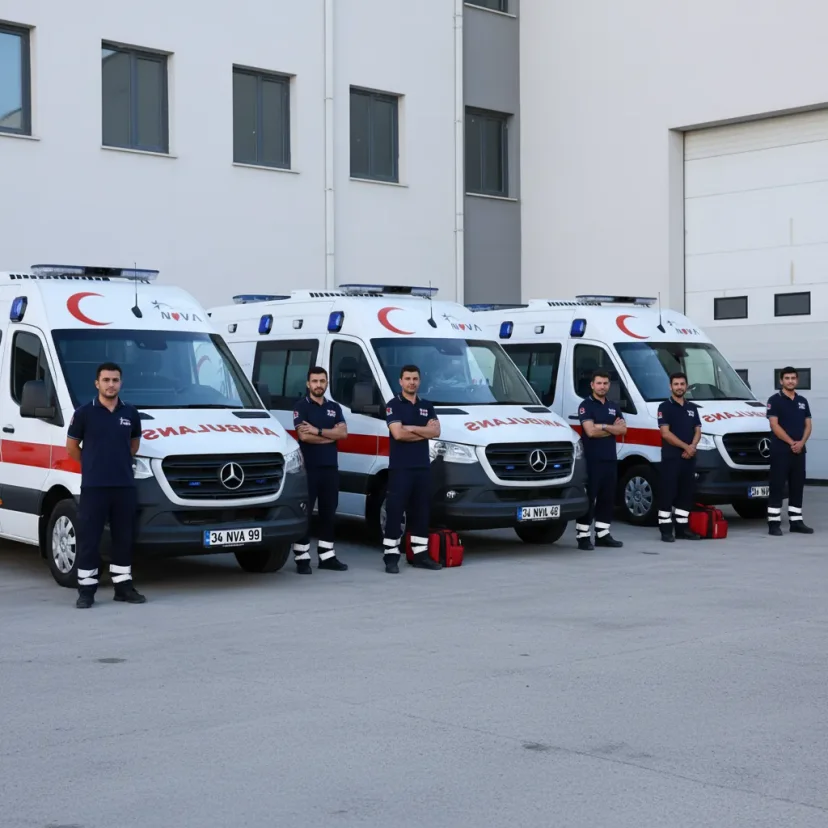
- The 24 June 2025 amendment inserted a fourth paragraph into Article 7 of the parent regulation: making every ambulance health worker complete ministry-designated training is now the employer's legal duty.
- An Ambulance and Emergency Care Technician (AABT / paramedic) cannot be assigned as team leader on a physician-less emergency ambulance without completing all five modules totaling 152 hours (Basic + Adult Advanced Life Support + Pediatric Advanced Life Support + Trauma Advanced Life Support + Ambulance Operation and Maintenance).
- An Emergency Medical Technician (ATT) must complete at least two modules totaling 72 hours (Basic Training + Ambulance Operation and Maintenance); to lead a physician-less emergency ambulance the four advanced modules must also be current, with the certificate renewed within its 3-year validity.
- The 3-year certificate validity (2009 Circular Article 7/2) and the 3-year first-aider certificate cycle (2015 First Aid Regulation Article 23) both sit under the responsible manager's duty defined by Article 14.
- Patient-family right: before hiring an ambulance service you may request in writing the crew's diploma, the mandatory module certificates, and the driver's first-aider certificate.
When you call a private ambulance in Türkiye, a concrete number sits behind every health worker who steps out of that vehicle: 152 hours of five-module mandatory post-graduate training for an Ambulance and Emergency Care Technician (paramedic / AABT), and at minimum 72 hours of two modules for an Emergency Medical Technician (ATT). These figures come from Article 7 of the 26 March 2009 Circular; they were re-anchored during 2025 by two consecutive updates to the parent regulation (RG-8/1/2025-32776 and RG-24/6/2025-32936). [1][2][3] This guide walks through the documents each crew member must carry, the certification cycle, and how you as a patient's family can verify them.
Quick Answer
What you should know: As of 2026, every health worker serving on an ambulance in Türkiye must have completed at least the 40-hour Basic Training module and, by role, the 20 to 32-hour advanced modules; certificates renew every three years. What has changed: The amendment regulation published in the 24 June 2025 Official Gazette (Number 32936) inserted a fourth paragraph into Article 7 of the parent Ambulance Regulation, placing the duty "training determined by the Ministry shall be completed by health personnel serving on ambulances" directly on the employer. [2] How many ambulances are we talking about? According to the T.C. Ministry of Health's Health Statistics Yearbook 2023, by year-end Türkiye operated 3,420 emergency health stations, 5,908 emergency ambulances and 6,819 ambulances in total. [5] Caveat: The 2009 Circular and the 2015 First Aid Regulation remain the foundational framework in force; neither underwent structural changes between 2020 and 2025, so both stand as the "foundational text" for 2026. [3][4]
The 2025 Regulatory Update and the New Face of the Requirement
Ambulance personnel training in Türkiye draws on three separate document sources: the parent Ambulance Regulation (the 2025 version defines team structure), the AABT/ATT Circular (defines module hours and examination criteria), and the First Aid Regulation (touches on drivers and general workplace context). During 2025 the parent regulation was amended twice in succession, and these amendments made the personnel-training requirement concrete.
The parent regulation published in the 8 January 2025 Official Gazette (Number 32776) fixed the emergency-ambulance personnel requirement in Article 7(1)(a) as: "at least one physician, or emergency care technician, or an emergency medical technician who has completed the module training determined by the Ministry." [1] For intensive care and special-purpose ambulances, Article 7(1)(c) states plainly: "The health personnel who will serve on these ambulances must complete the training determined by the Ministry." [1]
Six months later, the amendment regulation dated 24 June 2025 (Number 32936) carried the legal binding onto the employer with a single insertion. Article 3 added a new fourth paragraph to Article 7 of the parent regulation: "Training determined by the Ministry shall be completed by health personnel serving on ambulances." [2] Article 8 of the same amendment regulation updated the deadline in Transitional Article 1 to 1/1/2026 — so throughout 2026, a missing module certificate is an audit finding on the record. [2] For detailed ambulance-type classification and color-stripe differences, see our red and blue-striped ambulance comparison.
Ambulance Personnel in Türkiye: Who, Why, and With Which Document?
Team structure varies by ambulance type, but three main health-worker groups share the workload: Ambulance and Emergency Care Technician (paramedic / AABT), Emergency Medical Technician (ATT), and physician. Driver, responsible manager, and consulting physician roles are added on top.
Ambulance and Emergency Care Technician (AABT / paramedic): A graduate of a two-year associate-degree university program in "First and Emergency Aid." Under the 8 January 2025 regulation Article 7(1)(a), an AABT may serve as team leader on an emergency ambulance without a physician. [1] Under Article 4(1)(a) of the 26 March 2009 Circular, an AABT is authorized to perform intravenous access, endotracheal intubation, defibrillation, advanced airway management, and administer the emergency drugs in the flow chart. [3]
Emergency Medical Technician (ATT): A graduate of a health-vocational-high-school Emergency Medical Technician program. That program has been closed, so no new ATTs are being trained. Existing ATTs work at full authority only on ambulances staffed by a physician or an Ambulance and Emergency Care Technician (AABT); without the physician's or AABT's instruction and approval they cannot deliver advanced interventions — this limit is clear in Circular Article 4(2)(b). [3] For a detailed field-authority comparison of the two groups, see our paramedic vs. Emergency Medical Technician (ATT) article.
Ambulance physician: No specialty is required; a medical doctor's diploma is sufficient. On duty, the physician should not be confused with the medical consultant role defined in Article 5(1) of the 2009 Circular — the Command Control Center consultant is a separate position. [3]
Driver: A crew member serving as driver must carry a first-aider certificate inside the team. The 29 July 2015 First Aid Regulation, Number 29429, Article 19(2), requires that "in courses where first-aid training is mandatorily provided, such as private-security and driver courses, first-aid instruction shall be delivered by instructors authorized under this Regulation"; Article 23(1)(a) sets the certificate's validity at three years. [4]
Responsible manager: The 8 January 2025 regulation Article 14(2)(i) assigns the responsible manager the duty: "Ensuring that periodic in-service training of personnel and other training mandated by the Ministry is carried out." [1] So the legal counterpart of missing module certificates is the responsible manager first — a patient's family's first question should be "who is your responsible manager, and are records being kept?" For the full breakdown of the responsible manager and other roles, see our ambulance personnel duties guide.
The Mandatory Module Trainings for AABTs and ATTs: Hour-by-Hour
Article 7(1) of the 26 March 2009 Circular anchors Türkiye's post-graduate mandatory training programs in a single sentence: "AABT/ATT post-graduate mandatory training programs consist of a 40-hour 'Basic Training,' 20-hour 'Adult Advanced Life Support,' 32-hour 'Trauma Advanced Life Support,' 28-hour 'Pediatric Advanced Life Support,' and 32-hour 'Ambulance Operation and Maintenance Training' programs." [3] The total 152-hour load is bound to a separate certificate per module, and each certificate is valid for 3 years.
| Module | Duration | Mandatory for | Certificate code |
|---|---|---|---|
| Basic Training | 40 hours | Ambulance and Emergency Care Technician (AABT) + Emergency Medical Technician (ATT) | TE |
| Ambulance Operation and Maintenance | 32 hours | Ambulance and Emergency Care Technician (AABT) + Emergency Medical Technician (ATT) | AKB |
| Adult Advanced Life Support | 20 hours | Ambulance and Emergency Care Technician (AABT); also for any Emergency Medical Technician (ATT) who will lead a physician-less emergency ambulance | EİY |
| Pediatric Advanced Life Support | 28 hours | Ambulance and Emergency Care Technician (AABT); also for any Emergency Medical Technician (ATT) who will lead a physician-less emergency ambulance | ÇİY |
| Trauma Advanced Life Support | 32 hours | Ambulance and Emergency Care Technician (AABT); also for any Emergency Medical Technician (ATT) who will lead a physician-less emergency ambulance | TİY |
Beyond just the module codes, the passing criterion is also concrete: Circular Article 7(2) states "certificates issued to those achieving a score of 85 or higher shall be valid for a period of 3 years." Retesting within 6 months is mandatory on failure; where lesson hours cannot be completed, the training must be repeated. [3]
The Basic Training module's 18-heading Annex-1 curriculum covers most of the cases a Türkiye health worker will encounter in the field: Emergency Health Services, Patient Assessment, Basic Life Support (BLS) and Automated External Defibrillator (AED) Use, Approach to Chest-Pain Patient, Respiratory Distress, Neurological Emergencies, Obstetric Emergencies, Diabetic Emergencies, Poisonings, Heat and Cold Emergencies, Approach to Burns, Prehospital Emergency Drugs and Fluid Administration, Approach to Trauma Patient, Ambulance Equipment, Patient and Casualty Transport Techniques, Advanced Airway Applications, ECG (Electrocardiogram), Approach to Cardiac Arrhythmias. [3] For the legal framework around public-access Automated External Defibrillator (AED) use, see our AED use guide.
Arithmetic matters here, because the totals are often confused: for an Ambulance and Emergency Care Technician (AABT), 152 hours total (40 + 20 + 32 + 28 + 32). For an Emergency Medical Technician (ATT), 72 hours minimum (40 + 32). But that same Emergency Medical Technician (ATT), if to serve as team leader on a physician-less emergency ambulance, must under the 8 January 2025 regulation Article 7(1)(a) also complete the four Ministry-designated advanced modules — practically, the full 152 hours. [1][3] That is, at present, the "career ladder" for a Türkiye Emergency Medical Technician (ATT): module trainings.
How Nova Ambulans Applies This
For every Ambulance and Emergency Care Technician (AABT) and Emergency Medical Technician (ATT) on Nova Ambulans crews, documents are archived on day-one of employment in a three-compartment digital file: (1) graduation diploma and Council of Higher Education (YÖK) equivalence certificate (where applicable), (2) current certificates for the five modules of the 2009 Circular (Basic Training, Ambulance Operation and Maintenance, Adult Advanced Life Support, Pediatric Advanced Life Support, Trauma Advanced Life Support), (3) for those who will serve as driver, a first-aider certificate compliant with the 2015 First Aid Regulation, and a Class-E driver license.
This file is subject to two independent audits. First audit: the responsible manager's duty under Article 14(2)(i) of the 8 January 2025 regulation — renewal tracking at least twice a year. [1] Second audit: on written request from a new patient family, anonymized copies of the team-leader Ambulance and Emergency Care Technician (AABT) or Emergency Medical Technician (ATT) and the driver's documents are shared within 24 hours. For families requesting an intensive-care ambulance for intra-Istanbul or intercity transport, the on-board physician's diploma and Turkish Medical Association (TTB) registration confirmation are added to the package. Requests reach Nova Ambulans through the 0850 244 24 12 call center or the web form; the reply lands within four hours during working hours. For the clinical thresholds and crew structure that require an intensive-care ambulance, see our when is an intensive care ambulance needed guide.
Certificate Verification: The Family Checklist
As a patient or a patient's family, six checks can be run before you accept an ambulance service:
- Ask for the ambulance's license. A licensed private ambulance's document is posted inside the cabin; if it's not there, don't accept the service. For details, see our how to recognize a licensed private ambulance guide.
- Ask the team leader's title. The answer should be "paramedic," "Ambulance and Emergency Care Technician (AABT)," or "physician." "Health worker" is not enough.
- Request the module certificate list in writing. At minimum, three certificates must be current: Basic Training, Ambulance Operation and Maintenance, Adult Advanced Life Support. For pediatric or trauma patients, Pediatric Advanced Life Support and Trauma Advanced Life Support are required.
- Check the certificate date. If more than 3 years have passed since issuance (2009 Circular Article 7/2), the certificate is invalid. [3]
- Ask about the driver's first-aider certificate. Under Article 23(1)(a) of the 2015 First Aid Regulation, it must be valid for 3 years and not expired. [4]
- Ask for the responsible manager's identity. The responsible manager is the legal counterpart under Article 14 of the 8 January 2025 regulation; the name and contact information must appear on a written document (invoice, contract). [1] For the audit process and complaint mechanism, see our ambulance audit process guide.
International Comparison: Türkiye and the NHTSA 2021 Standards
Türkiye's 152-hour post-graduate paramedic module load sits at an upper-middle level internationally. The United States (US) reference document, the 2021 National Emergency Medical Services Education Standards, was published by the National Highway Traffic Safety Administration (NHTSA) under the U.S. Department of Transportation (DOT) and introduced two philosophical shifts. [8]
The first shift is philosophical: "Course length should be based on competency, not hours." Even so, NHTSA listed hour-based minima as guidance: at least 150 hours for Emergency Medical Technician (EMT), 200 hours beyond EMT for Advanced Emergency Medical Technician (AEMT), and the accreditation standard of the Committee on Accreditation of Educational Programs for the EMS Professions (CoAEMSP) for full paramedic programs. [8] The second shift: geriatric and pediatric topics are integrated throughout the curriculum rather than isolated in separate modules.
| System | Role | Post-graduate mandatory minimum hours |
|---|---|---|
| Türkiye — 2009 Circular | Ambulance and Emergency Care Technician (AABT / paramedic) | 152 hours (5 modules) [3] |
| Türkiye — 2009 Circular | Emergency Medical Technician (ATT), minimum | 72 hours (2 modules) [3] |
| US — NHTSA 2021 | Emergency Medical Technician (EMT) | 150 hours (four integrated phases) [8] |
| US — NHTSA 2021 | Advanced Emergency Medical Technician (AEMT) | EMT + 200 hours [8] |
| US — NHTSA 2021 | Emergency Medical Responder (EMR) | 48 hours [8] |
Read together, this comparison says two things. One: Türkiye's 152-hour post-graduate paramedic module load is essentially the same size as NHTSA's 150-hour EMT minimum. The Ambulance and Emergency Care Technician (AABT) title maps to a slot between US EMT and US AEMT, because in Türkiye post-graduate modules sit on top of a two-year associate degree. Two: both NHTSA and the 2009 Turkish Circular document competency through examination; NHTSA speaks of "entry-level competency but not readiness for independent practice," while the Turkish text sets the "score of 85 and above" bar — in practice, the same philosophy.
Türkiye's 2025 Data: Capacity and the Training Load
The reason personnel training standards are held tight is buried in the data itself. According to the T.C. Ministry of Health's Health Statistics Yearbook 2023, by year-end Türkiye operated 3,420 emergency health stations, 5,908 emergency ambulances, and 6,819 ambulances in total. [5] That is +3.9% stations and +3.0% emergency ambulances year over year. The fleet also includes 92 intensive-care and bariatric ambulances, 49 neonatal ambulances, 12 helicopters, 3 fixed-wing aircraft, 6 sea ambulances, and specialist vehicles like motorcycle and snow-track units. [5] Emergency-ambulance case load reached 1,119 cases per vehicle in 2023, translating to about 6.6 million field cases system-wide. [5]
On the call-volume side, the T.C. Ministry of Interior's 112 Emergency Call Center 2023 statistics document: 105,618,984 calls received during the year, with 36,756,785 incidents responded to; 13,000 employees provided 24/7 service in 81 provinces. [9] At that scale, no health worker's current module certificate can be left to chance for patient safety. For Nova Ambulans' intra-Istanbul response-time averages and district coverage, see our how many minutes does an ambulance take in Istanbul guide.
Peer-reviewed literature has documented that the practical dimension of Türkiye paramedic education lags theory. The cross-sectional study by Polat and Köse in BMC Medical Education 25(1):1649 (26 November 2025) with 156 paramedics working at Antalya 112 stations arrived at this finding: "Although theoretical instruction was generally considered sufficient, practical skill development was reported as inadequate by many paramedics" — theory adequate, practice not. [6] That shows why post-graduation module training must not be reduced to formality; simulation-driven repeat learning is the only real investment in field safety.
Personnel safety in the field is part of the training frame too. The 501-participant Türkiye study by Ekşi and colleagues in Arch Iran Med 28(9):522-529 (September 2025) shows that 40.1% of prehospital emergency medical services personnel reported physical violence from at least one patient during their career, and 51.9% of participants reported cases where they did not intervene for the patient until law enforcement arrived because of violence risk. [7] The Annex-1 curriculum of the 2009 Circular does not name-cover this violence-risk management — a gap that is a current debate for the 2026 requirement. For cabin and scene safety examples, see our night highway ambulance safety guide.
Frequently Asked Questions
Which documents must ambulance personnel carry?
Every Ambulance and Emergency Care Technician (AABT) or Emergency Medical Technician (ATT) must have three document groups: (1) a First and Emergency Aid associate-degree diploma or Emergency Medical Technician program certificate; (2) Ministry-of-Health-designated module certificates — for a paramedic the full five modules (Basic Training + Adult Advanced Life Support + Pediatric Advanced Life Support + Trauma Advanced Life Support + Ambulance Operation and Maintenance, 152 hours total); for an ATT at minimum Basic Training + Ambulance Operation and Maintenance (72 hours); an ATT who will lead a physician-less emergency ambulance also needs all four advanced modules; (3) if serving as driver, a first-aider certificate compliant with the 2015 First Aid Regulation, valid for 3 years. [1][3][4] Certificates renew every 3 years. Nova Ambulans keeps these documents in the crew file and shares them in writing on request.
What happens if a paramedic (AABT) has not completed the module trainings?
Two consequences arise together. From the regulatory side: the 26 March 2009 Circular on the Working Procedures and Principles of Ambulance and Emergency Care Technicians and Emergency Medical Technicians, Article 8/2, states "AABTs must attend all of these training programs … completing them within three years at the latest and obtaining certification is mandatory." [3] Without completion within that window, an AABT may not act as team leader and may not carry out advanced interventions requiring a medical consultant's approval. Clinically: the missing module directly reduces the patient's protocol-adherence quality — the differences manifest most dramatically in pediatric patients (Pediatric Advanced Life Support) and multi-system trauma (Trauma Advanced Life Support).
Does the ambulance driver also need certification?
Yes, two layers of documentation are required. First layer: the 8 January 2025 Regulation on Ambulances and Emergency Health Vehicles Article 7 requires the driver to be part of the team and, within the team structure, first-aid trained. [1] Second layer: the 29 July 2015 First Aid Regulation Article 19/2 requires that first-aid instruction in driver courses be delivered by ministry-authorized first-aid instructors, and Article 23/1/a limits the certificate's validity to three years. [4] The ambulance driver needs the first-aider certificate, not the instructor certification — but in practice private ambulance companies also select drivers who have completed the Ambulance Operation and Maintenance module.
If there is no physician on board, who makes the call in an ambulance?
The decision chain has two stages. In the field, the Ambulance and Emergency Care Technician (AABT) or a module-trained Emergency Medical Technician (ATT) performs the initial patient assessment and, following the flow charts in Annex-2 of the 2009 Circular, chooses the protocol. [3] For any step marked "KKM" (Command Control Center) — particularly emergency drug administration, complex arrhythmia management, and atypical obstetric scenarios — a spoken approval is obtained directly from the on-call medical consultant physician at the center. That conversation is recorded (Circular Article 5/1). Cardiopulmonary resuscitation and defibrillation, per Article 6/3, begin immediately without waiting for consultant approval — and the sole responsible party is the AABT. [3]
What does the 2026 regulatory update change for patients?
Two concrete changes are felt by patients. One: the amendment regulation published in the 24 June 2025 Official Gazette inserted a fourth paragraph into Article 7 of the parent regulation — completing Ministry-designated training for every ambulance health worker is now the employer's (private ambulance company, hospital, or Ministry-of-Health 112 station) legal duty. [2] Before, this was at recommendation level; from 2025 forward it is an audit item. Two: Article 8 of the amendment regulation updated the deadline in Transitional Article 1 to 1/1/2026, marking the end of the transition period. [2] A patient family can therefore assume that throughout 2026, the excuse "the personnel's module certificate is not yet in place" will not be legally acceptable.
Related Articles
- Ambulance Personnel Duties and Responsibilities — Responsible manager, consulting physician, team leader, and driver roles as defined by the regulation.
- Difference Between Paramedic (AABT) and Emergency Medical Technician (ATT) — Detailed comparison of education, intervention authority, and career paths.
- How to Recognize a Licensed Private Ambulance — A practical checklist for verifying license, plate, and crew documents.
- Ambulance Licensing and Qualification Certification — Map of the ambulance company's operational document chain.
- When Is an Intensive Care Ambulance Required? — Additional training and equipment requirements for critical-patient transport.
- Ambulance Audit Process and Sanctions — How Ministry of Health audits work, and complaint pathways.
Rapid Emergency Support
24/7 emergency ambulance service across Istanbul. Fast response, fully equipped team.
Average response time: 15 seconds
Related Articles
What Does a Gray Ambulance Mean? The Patient-Transport Ambulance and Turkey's 2025 Color Regulation
The gray body with a blue stripe you see in traffic or in front of a hospital is a patient-transport ambulance, redefined by Turkey's Official Gazette regulation of 8 January 2025 (RG-8/1/2025-32776). This guide explains where the gray (RAL 7004) color comes from, how it differs from the white emergency ambulance, the restriction on audible warning systems, the detachable blue light restored by the 24 June 2025 amendment, the transition period that closed on 1 January 2026, and how to behave when you see a gray ambulance in traffic — grounded in the T.C. Ministry of Health and World Health Organization (WHO) sources.
EducationAmbulance Personnel Roles in Turkey: From Responsible Manager to Driver
The 2025 Ambulance Regulation defines every role in a licensed ambulance service — responsible manager, consultant physician, team leader, call handler, health personnel, and driver. Here is what each role requires.
EducationModern Ambulance Equipment and Team Standards
Basic equipment that should be in current ambulances and competencies that the emergency health team should have.
Popular Ambulance Topic Clusters
You may also like
- Private ambulance pricing
- Istanbul private ambulance
- Intercity patient transport
- Doctor-accompanied ambulance
- Dialysis patient transport
- How intercity patient transport works
- Ambulance response time in Istanbul
- Home-to-hospital patient transport
- Modern ambulance equipment and team standards
- Heart attack symptoms and first response
This content is informational only and does not replace professional medical evaluation. In emergencies, call 112 or +90 216 339 00 39.
