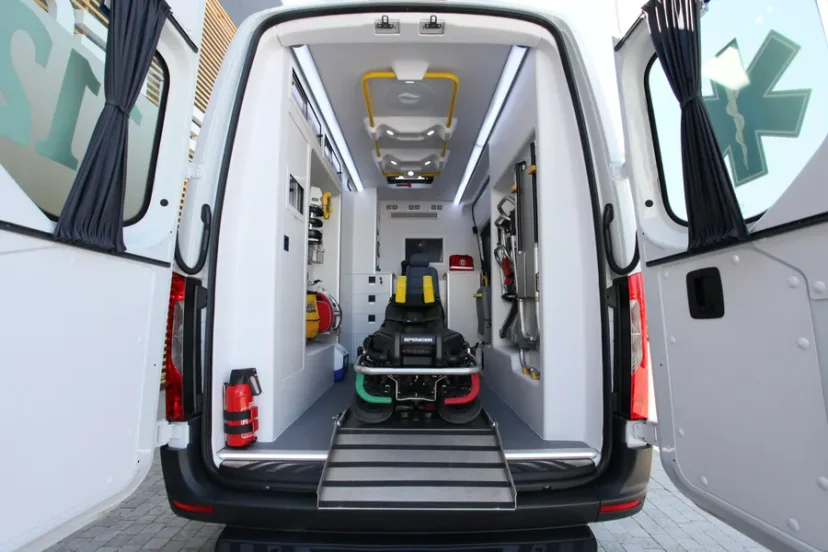
- An Intensive Care Unit (ICU) ambulance is designed for critical patients who need mechanical ventilation, advanced hemodynamic monitoring, or multiple infusion pumps.
- Compared with a standard ambulance, it carries advanced equipment such as a ventilator, 12-lead ECG, capnograph, multiple infusion pumps, and a suction unit.
- Under Regulation Article 7, the ICU ambulance must carry a minimum 3-person crew of at least two health personnel (one being a physician or emergency medical technician) and one driver; a physician is not legally mandatory.
- For unstable patients on long intercity transfers, an ICU ambulance is strongly recommended.
An Intensive Care Unit (ICU) ambulance is a specialized vehicle with equipment and crew capacity beyond a standard emergency or patient-transport ambulance, designed for the safe transfer of critically ill patients. Not every patient needs an ICU ambulance; however, certain clinical conditions make safe transport impossible without this level of equipment and team. [1]
For families in İstanbul, the most important point is to match the ambulance level to the current medical need, not only to travel distance.
What Is an ICU Ambulance?
Classified under the Regulation's Annex-1 and Annex-2 equipment lists, the ICU ambulance is a mobile intensive care unit that brings the core monitoring and treatment capacity of a hospital ICU into the vehicle. [1]
Key Differences From a Standard Ambulance
An ICU ambulance differs from a standard emergency ambulance in equipment, crew, and operational capacity. Understanding the difference is critical for choosing the right ambulance type.
6 Core Indications: When Is an ICU Ambulance Required?
1. Patients Requiring Mechanical Ventilation
The most common indication for an ICU ambulance is the transport of ventilator-dependent patients. [1]
- Invasive mechanical ventilation: Intubated or tracheostomized, ventilator-dependent patients.
- Non-invasive ventilation (NIV): Patients on CPAP or BiPAP support who desaturate when support is withdrawn.
- During weaning: Patients in the process of being weaned off the ventilator who cannot yet breathe fully independently.
Ventilator settings may need to be adjusted during transfer. This is the responsibility of a physician or authorized health personnel certified in advanced life support. Regulation Article 7 does not require a physician on the ICU ambulance crew; a crew of at least two health personnel (one being a physician or emergency medical technician) and one driver is sufficient. [1]
2. Patients Requiring Advanced Oxygen Support
When a standard oxygen mask or nasal cannula is insufficient, ICU-level equipment is needed.
- High-flow nasal cannula (HFNC): Oxygen demand above 15 L/min.
- SpO2 instability: Patients whose saturation drops despite standard oxygen support.
- Acute exacerbation of Chronic Obstructive Pulmonary Disease (COPD): Patients at risk of CO2 retention who require controlled oxygen (target SpO2 88-92%). [3]
- ARDS (Acute Respiratory Distress Syndrome): Patients requiring high PEEP and FiO2.
3. Hemodynamic Instability
Patients whose blood pressure, heart rate, or tissue perfusion is unstable require continuous monitoring and rapid intervention. [2]
- Vasopressor infusion: Patients whose blood pressure is supported with drugs such as norepinephrine, dopamine, or dobutamine.
- Active bleeding control: Patients with ongoing drainage and monitored hemoglobin drop.
- Septic shock: Organ perfusion impairment due to infection.
- Cardiogenic shock: Low output due to cardiac pump failure.
4. Critical Neurological Conditions
Neurological emergencies and subacute conditions require advanced monitoring and rapid intervention capacity.
- Raised intracranial pressure: Patients with cerebral edema, hydrocephalus, or mass effect.
- Status epilepticus: Patients with recurrent or prolonged seizures.
- After acute stroke: Patients at high risk of neurological deterioration.
- After spinal surgery: Patients requiring neurological deficit monitoring.
5. Equipment-Dependent Patients
Patients connected to multiple medical devices simultaneously cannot be transported safely in a standard ambulance.
- Multiple infusion pumps: 3 or more simultaneous IV drug infusions.
- Chest drain + ventilator: Combined respiratory support and drainage.
- After renal replacement therapy (CRRT): Patients requiring a dialysis catheter and hemodynamic monitoring.
- ECMO or IABP: Patients on extracorporeal membrane oxygenation or an intra-aortic balloon pump (transfer between advanced centers).
6. Long-Distance Transfers
On intercity transfers, clinical risk increases as travel time lengthens; this strengthens the need for an ICU ambulance. [1]
- İstanbul - Ankara (~450 km): About 5-6 hours of travel.
- İstanbul - Antalya (~720 km): About 8-9 hours of travel.
- İstanbul - İzmir (~480 km, via the İstanbul-İzmir Motorway): About 5-6 hours of travel. On the classic highway route the distance can reach ~560 km.
On long transfers, operational factors come into play: running out of medication, oxygen cylinder changes, nutrition management, and crew rotation.
Equipment Comparison: Standard vs. ICU Ambulance
| Equipment | Standard Emergency | ICU Ambulance |
|---|---|---|
| Ventilator | Portable (basic) | Advanced mechanical ventilator (multiple modes) |
| Monitor | 3-lead ECG + SpO2 | 12-lead ECG + SpO2 + ETCO2 + IBP |
| Capnograph (ETCO2) | None or basic | Continuous capnography |
| Infusion pump | 1 unit (basic) | 3-4 units (multiple-infusion capacity) |
| Suction unit | Portable | Fixed + portable (high capacity) |
| Defibrillator | Manual + Automated External Defibrillator (AED) | Manual defibrillator + transcutaneous pacing |
| Oxygen capacity | Standard cylinder | High-capacity cylinder + backup |
| Drug variety | Basic emergency drugs | Expanded drug list (vasopressors, sedatives) |
| Syringe pump | None | Yes (precise dose control) |
| Heating/cooling | Blanket | Active heating/cooling system |
These equipment differences are based on the lists in Annex-1 and Annex-2 of the Regulation. [1]
Crew Requirements: Regulation Article 7
Under Regulation Article 7, an ICU ambulance carries a minimum 3-person crew of at least two health personnel (one being a physician or emergency medical technician) and one driver. The regulation does not require a physician on the crew; it expressly allows an emergency medical technician instead of a physician. The crew must hold Ministry-approved adult advanced life support and trauma resuscitation certificates. [1]
Minimum Crew Structure
| Position | Qualification | Role |
|---|---|---|
| Health personnel 1 | Physician or emergency medical technician (EMT) | Clinical decisions, drug management, ventilator settings |
| Health personnel 2 | Paramedic (Ambulance and Emergency Care Technician) or nurse | Monitoring, drug administration, patient care |
| Driver | Licensed ambulance driver | Safe driving, navigation |
In practice, Nova Ambulans may include a physician in the crew for high clinical-risk ICU transfers; however, this is a service choice beyond the regulatory minimum.
Crew Competencies
- Physician or advanced life support–certified health personnel: ECG interpretation, ventilator management, IV drug dose adjustment, sedation/analgesia, emergency intervention (intubation, chest tube, etc.).
- Paramedic/Nurse: Continuous monitoring, drug administration, suction, patient positioning, record keeping.
- Driver: Steady speed, minimizing sudden braking/maneuvers, route optimization.
ICU Ambulance or Doctor-Accompanied Ambulance?
These two concepts are often confused. The key difference is the level of equipment:
| Criterion | Doctor-Accompanied Ambulance | ICU Ambulance |
|---|---|---|
| Physician on crew | Yes | Not legally mandatory (physician or EMT); a physician may be included based on clinical risk |
| Ventilator | Basic/portable | Advanced mechanical ventilator |
| Multiple infusion pumps | 1 unit | 3-4 units |
| Capnography | None/basic | Continuous |
| 12-lead ECG | Yes | Yes + invasive pressure |
| Use case | Medium-to-high clinical risk | High-to-critical clinical risk |
In short: the defining feature of a doctor-accompanied ambulance is having a physician on the crew, while the distinguishing feature of an ICU ambulance is its advanced equipment. A physician on an ICU ambulance is not legally mandatory, but physician accompaniment may be preferred for high clinical-risk transfers. [1]
Ambulance Selection by Clinical Parameter (Operational Assessment Table)
The table below summarizes Nova Ambulans's operational assessment approach. The GCS and SpO2 values are general guidance, not strict clinical thresholds; the final decision rests with the transferring physician. In GCS classification, 13-15 indicates mild, 9-12 moderate, and ≤8 severe impairment of consciousness. The general hypoxemia threshold for SpO2 is <90%; however, in patients at risk of CO2 retention such as those with COPD, the target saturation is 88-92% (see the COPD item above). [3]
| Parameter | Standard Transfer | Doctor-Accompanied Ambulance | ICU Ambulance |
|---|---|---|---|
| GCS 15, SpO2 within normal limits | Suitable | - | - |
| GCS 13-14, mild saturation drop | - | Suitable | - |
| GCS ≤13, refractory hypoxemia (general threshold SpO2 <90%) | - | - | Suitable |
| Ventilator-dependent | - | - | Required |
| Vasopressor infusion | - | - | Required |
| Single IV drug infusion | - | Suitable | - |
| 3+ IV drug infusions | - | - | Suitable |
| Intercity (critical) | - | - | Strongly recommended |
Pre-Transfer Preparation Process
Transfer by ICU ambulance requires careful planning.
What the Discharging Hospital Should Do
- Clinical information transfer: Discharge summary, medication list, latest laboratory results, and imaging reports.
- Medication preparation: Preparing a sufficient quantity of the drugs needed during transfer.
- Equipment compatibility: Transferring the patient's current ventilator/monitor settings to the ambulance equipment.
- Physician-to-physician communication: Clinical handover between the discharging physician and the ambulance physician.
- Patient/relative briefing: Informing about the transfer process, risks, and expectations.
Monitoring Parameters During Transfer
- Continuous: ECG, SpO2, ETCO2 (in ventilated patients)
- Every 15 minutes: Blood pressure, heart rate, respiratory rate
- Every 30 minutes: GCS, pain assessment, drain/catheter check
- As needed: Drug dose adjustment, ventilator parameter change
Related Services
For long-distance critical transfers, ICU ambulance planning is integrated with intercity transport coordination as part of the clinical plan.
Frequently Asked Questions
Is an ICU ambulance required for every hospital transfer?
No. Planned transfers of stable patients can be done by standard ambulance. An ICU ambulance is required for critical patients who fall into one of the 6 indication groups above.
How much does an ICU ambulance cost?
An ICU ambulance costs more than standard transport and a doctor-accompanied ambulance. Advanced equipment, an expanded crew, and operational requirements affect the price. Nova Ambulans provides a clear quote based on patient information.
Will the discharging doctor recommend an ICU ambulance?
Yes. For critical patients discharged from an ICU or referred to another center, the discharging physician writes "transfer by ICU ambulance" in the discharge summary. This recommendation guides the ambulance provider. [1]
Is an ICU ambulance mandatory for intercity transfers?
It is not mandatory; however, clinical risk increases with distance. For ventilator-dependent, hemodynamically unstable, or multiple-infusion patients, an ICU ambulance is strongly recommended for intercity transfer.
Can a patient's relative ride in the ICU ambulance?
It depends on space and safety conditions. Because crew and equipment space is extensive in an ICU ambulance, room for a relative may be limited. Nova Ambulans accommodates the relative in the ambulance or an accompanying vehicle whenever possible.
Is a ground ambulance an alternative to air transfer?
An ICU ambulance is designed for ground transfer. For distances over 1,000 km or when time is critical, an air ambulance should be considered. The two services are not alternatives but complementary, depending on distance and clinical condition. [4]
Intercity Ambulance Transfer Service
Safe and fast intercity patient transport across Turkey. ICU support included.
Average response time: 15 seconds
Related Articles
The History of Ambulance Services in Turkey: From Hilâl-i Ahmer to 077 Hızır Acil and 112 (2026)
A sourced, chronological history of ambulance services in Turkey — from the battlefield medical transport of Hilâl-i Ahmer (founded 1868), to 077 Hızır Acil, the country's first modern ambulance service opened in Ankara on 9 October 1985, through the 112 emergency system, UMKE, air and sea ambulances, and the licensed private-ambulance sector regulated by the 2025 ordinance — built on primary sources and Official Gazette dates, clarifying the public vs private division of labour.
Service UtilitySummer Vacation Ambulance Services in Türkiye: Health Safety in Holiday Regions (2026)
Planning intercity private patient transport at the end of summer vacation, the line between 112 emergency services and private ambulance providers in holiday regions, bystander step-by-step decisions in drowning and heatstroke — with the verbatim text of Türkiye's Ministry of Health 8 January 2025 and 24 June 2025 ambulance regulations, the Turkish Red Crescent First Aid Pocket Book 2025 protocols, the Turkish Statistical Institute's 2025 tourism figures, and the 13-year Sinop coastal drowning series.
Service UtilityAir Ambulance vs Ground Ambulance: When to Use Which?
Indications, contraindications and dispatch process for air ambulances (helicopter and aircraft) versus ground ambulances in Türkiye. The decision table built from the Ministry of Health Circular's blood-pressure, Glasgow Coma Score and distance thresholds.
Popular Ambulance Topic Clusters
You may also like
- Private ambulance pricing
- Istanbul private ambulance
- Intercity patient transport
- Doctor-accompanied ambulance
- Dialysis patient transport
- How intercity patient transport works
- Ambulance response time in Istanbul
- Home-to-hospital patient transport
- Modern ambulance equipment and team standards
- Heart attack symptoms and first response
This content is informational only and does not replace professional medical evaluation. In emergencies, call 112 or +90 216 339 00 39.
