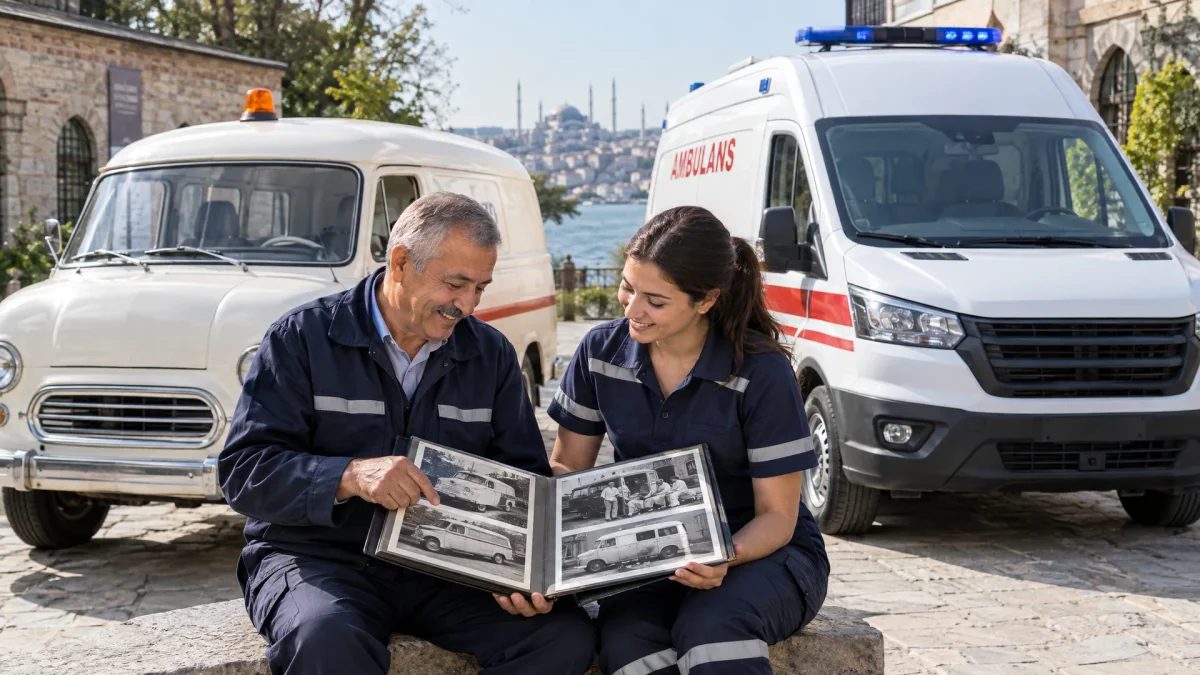
- Turkey's first modern urban emergency ambulance service was "077 Hızır Acil," which entered service on 9 October 1985 at Ankara Numune Hospital; it was extended to İstanbul and İzmir in 1986 [4][5][7].
- Organised medical transport traces back to Hilâl-i Ahmer, founded on 11 June 1868 and the foundation of today's Türk Kızılay (Turkish Red Crescent); the society ran nine mobile field hospitals in the 1877–1878 war [1].
- 112 was recommended as the single European emergency call number by the European Economic Community's Council Decision 91/396/EEC of 29 July 1991; Turkey's legal framework was established by the Emergency Health Services Ordinance of 11 May 2000 [9][10][11].
- Private ambulance services were first regulated in 2001; the current basis is the ordinance of 8 January 2025, which sharply separates patient transport from emergency intervention and raises inspections to at least three per year [12][13][14].
- Air (helicopter) ambulances launched on 28 October 2008 in Ankara, İstanbul and Erzurum; sea ambulances in 2007; and fixed-wing air ambulances in 2010 [17][18][19].
Short answer. Turkey's first modern urban emergency ambulance service was 077 Hızır Acil, which entered service on 9 October 1985 at Ankara Numune Hospital, with then–Prime Minister Turgut Özal attending the opening [4][5]. Before it, hospitals and municipalities ran their ambulances in a scattered way; 077 was the first to unite the call, the physician and the vehicle in a single system [5]. The line spread to İstanbul and İzmir in 1986 [7], its number was redirected to 112 in 1991 [4], and the system acquired its present legal framework with the Emergency Health Services Ordinance of 11 May 2000 [10]. Yet the roots of organised medical transport in Turkey run much deeper — back to Hilâl-i Ahmer, founded in 1868 [1].
Calling an ambulance with a single phone call looks ordinary today. In fact, every link in the chain of "raise the alarm, dispatch the crew, get the patient to the right centre" was built in a separate historical layer in Turkey: first battlefield casualty transport, then urban rescue vehicles, then a single-number call system, and finally air and sea evacuation alongside a licensed private-ambulance sector. Below, we take those layers in order, with Official Gazette dates and primary sources, clarifying the line between public and private along the way.
The Milestones of Ambulance History in Turkey
| Year | Milestone | Source |
|---|---|---|
| 1868 | Hilâl-i Ahmer (today Türk Kızılay) is founded | [1][2] |
| 1877–78 | Nine mobile field hospitals in the Russo-Turkish War; 25,000+ wounded treated | [1] |
| 1912–18 | Casualty evacuation on the Balkan and Gallipoli fronts (150,868 evacuated) | [20][21] |
| 1955 | İstanbul Beyoğlu rescue centre (8 districts, 15 vehicles) | [4] |
| 1985 | 077 Hızır Acil — 9 October 1985, Ankara Numune Hospital | [4][5] |
| 1986 | 077 extended to Ankara, İstanbul and İzmir | [4][7] |
| 1991 | 112 recommended via 91/396/EEC; 077 number redirected to 112 | [4][9] |
| 1993 | Emergency medicine becomes a specialty; first paramedic programme opens | [7][28] |
| 1994 | "112 Emergency Aid and Rescue Services Project" | [7] |
| 2000 | Emergency Health Services Ordinance (Official Gazette 11.05.2000 / 24046) | [10][11] |
| 2001 | First private-ambulance ordinance (OG 08.07.2001 / 24456) | [12] |
| 2003 | UMKE established (Ministerial approval 30.12.2003, 11 provinces) | [15][16] |
| 2006 | Ambulance Services Ordinance (OG 07.12.2006 / 26369) | [12] |
| 2007–2010 | Sea ambulance (2007), helicopter (2008), fixed-wing (2010) | [17][18][19] |
| 2025 | New ordinance (OG 08.01.2025 / 32776) | [13][14] |
From Hilâl-i Ahmer to Kızılay: the Ottoman Roots of Organised Medical Transport
In Turkey, the idea of systematically moving the wounded and the sick was born on the battlefield, long before any civilian emergency service. According to the Encyclopaedia of Islam published by the Turkish Religious Foundation (TDV), the Ottoman government signed its first Geneva Convention on 5 July 1865; a written undertaking on 11 June 1868 then formally established the "Society for Aid and Assistance to Wounded and Sick Soldiers" (Mecrûhîn ve Marzâ-yi Askeriyyeye İmdad ve Muâvenet Cemiyeti) [1]. Türk Kızılay, in its own official history, records the same body as founded on 11 June 1868 under the name "Ottoman Society for Aid to Wounded and Sick Soldiers" [2]. Having adopted a red crescent on a white field as its emblem, the Ottoman Hilâl-i Ahmer Society became operational on 14 April 1877 [1].
The society's first great test was the 1877–1878 Russo-Turkish War, known popularly as the War of '93. According to the Encyclopaedia of Islam, Hilâl-i Ahmer "opened nine mobile hospitals behind the front and four hospitals in İstanbul, treating more than 25,000 wounded and sick soldiers" [1]. The concept of the mobile — that is, travelling — hospital matters: not a fixed building but a movable medical unit that could approach the front and carry the wounded back, an early ancestor of modern field-ambulance logic. The first example of sea evacuation belongs to the same period: in the 1897 Ottoman–Greek War the society chartered two hospital steamers to carry the wounded and sick to İstanbul [1].
From the Balkan Wars to Gallipoli: Casualty Evacuation Behind the Front
Hilâl-i Ahmer's wartime medical-transport capacity was defined from its founding charter onward: the text envisaged preparing, behind the front, "mobile field hospitals and campaign hospitals," "medical (sıhhiye) trains," and "transport and hospital ships by sea" [20]. That infrastructure was severely tested in the Balkan Wars (1912–1913); the society treated more than 36,772 patients and wounded in that conflict — and the true figure is held to be higher, because the records of the hospitals at İşkodra, Yanya, Edirne and Üsküp fell into enemy hands [20]. For sea transport, a steamer fitted to receive and treat 350 wounded — recorded in the source as the "Kembriç" — was equipped with physicians and staff and placed at the society's disposal [22].
The greatest test was the Gallipoli (Çanakkale) front. According to a study published at Süleyman Demirel University, one of the first measures considered for evacuating the wounded from the front was allocating two steamers to Hilâl-i Ahmer; Ayastefanos (Yeşilköy), Tekirdağ, Gelibolu and Çanakkale were designated as embarkation piers, and the target time for moving a casualty from the front to a staging hospital or to İstanbul was forty-eight hours [21]. The first evacuation from the Akbaş transport hospital took place on 30 April 1915, five days after the land operation began; 283 people were carried that day, and the total over the following three days reached 3,556 [21]. From 25 April to the end of November, the wounded, sick and convalescents sent back from the Akbaş and Ağadere transport hospitals totalled 150,868 [21]. On the hospital ship "Reşit Paşa," the nurse Safiye Hanım (Safiye Hüseyin Elbi, a pioneer of Turkish nursing) was awarded a red-ribboned war medal for her service; for the wounded brought to İstanbul, the society converted city buildings into hospitals and, by 15 March 1916, had treated 85,743 wounded and sick in the hospitals under its own management [21].
With the Republic, the institution renewed its name and identity. According to Kızılay's archival sources, the society took the name "Turkish Hilâl-i Ahmer Society" in 1923, "Turkish Kızılay Society" in 1935 and "Turkish Red Crescent Association" in 1947; the name "Kızılay" was given by Mustafa Kemal Atatürk [3]. Through the hospitals it set up behind the front, its patient-transport services and the hospital ships it equipped, the institution provided medical transport and care to tens of thousands of soldiers [3]. All of this, however, served the army and extraordinary circumstances; an everyday urban emergency service that an ordinary citizen could reach by phone did not yet exist.
One of the earliest attempts to fill that gap appears in İstanbul. According to the history of the Emergency, Disaster and Ambulance Physicians' Association (AAHD), a rescue centre was set up in İstanbul's Beyoğlu district in 1955, serving eight districts — Sarıyer, Beşiktaş, Beyoğlu, Eminönü, Fatih, Eyüp, Üsküdar and Kadıköy — with a total of 15 rescue vehicles [4]. It was a valuable but limited example of organised urban transport; a single call number, physician coordination and a nationwide standard were not yet on the agenda.
077 Hızır Acil: Turkey's First Modern Ambulance Service
The first ambulance service in the modern sense had to wait for the 1980s. A study by Hasan Erbay, held in the open archive of Afyonkarahisar Health Sciences University and published in the Türkiye Klinikleri Journal of Medical Ethics, Law and History, describes the turning point plainly: "after 1983 work began within the Ministry of Health and ... on 9 October 1985 the Hızır Acil Service entered operation at Ankara Numune Hospital" [5]. The same source calls this step "the first ambulance service in Turkey in the modern sense" [5]. The AAHD likewise confirms that the opening took place in October 1985 at Ankara Numune Hospital, with then–Prime Minister Turgut Özal in attendance [4].
Two widespread errors in circulation for years should be corrected here. First: 077 was born in Ankara, not İstanbul; it only reached İstanbul in 1986. Second: 077 was not established by the Social Security Institution (SSK), as many older web sources claim. According to Erbay's study, the planning of the system and its physician and medical-supply support were run within the Ministry of Health [5]. Operations relied on a shared model: as the republished text of the article notes, "the driver, the ambulance and the fuel needs of these vehicles were provided by the municipalities," while the Ministry of Health supplied "health personnel and, in part, medical materials" [6].
The fleet, too, started modestly. The same source reports that in 1984, 22 ambulances were prepared for Ankara in the first phase — though the Minister of Health, in a speech to parliament, gave the figure as 21, a small internal inconsistency the source itself notes [6]. The way the system worked was primitive by today's standards: physicians answered calls to the 077 number, and crews often went out with drivers rather than a separate medical team [4]. What mattered, though, was not the number or the equipment of the vehicles but the chain that had been built: a single number, a physician answering it, and a vehicle that could be dispatched. That triad institutionalised the very idea of the "emergency call" in Turkey for the first time.
077 quickly spread to three major cities. According to the history of the Emergency Medical Technicians and Paramedics' Association (ATTDER), "in 1986, ambulance service resembling today's was provided under the name 077 Hızır Acil Service in the provinces of Ankara, İstanbul and İzmir" [7]. A capital-city pilot had become a model operating in three metropolises — and formed the nucleus of the system that would spread nationwide over the following decade.
From 077 to 112: the Birth of the National Emergency Health System
The idea of a single, easily remembered, two-digit emergency number came to Turkey from Europe. The European Economic Community's (EEC) Council Decision 91/396/EEC of 29 July 1991 imposed the following obligation on member states: "Member States shall ensure that the number 112 is introduced in public telephone networks ... as the single European emergency call number ... The single European emergency call number shall be introduced by 31 December 1992 at the latest" [9]. Although Turkey was not a European Union member, it was among the countries that adopted this standard early; according to the Institute of Health Sciences at Sakarya University, "within the framework of the European Union accession process, it was decided to allocate the number 112 as the single national emergency call number" [8].
077's exit from the stage also belongs to this period. According to the AAHD's record, "in 1991 the 077 Hızır Acil Service number was redirected to the 112 emergency call number due to a change in the Telekom infrastructure of the time" [4]. In other words, 077 was not a line "switched off" overnight but a bridge whose calls were carried over to the new European-standard number. The backbone of today's system was built a few years later: as ATTDER reports, the service "acquired its present structure with the '112 Emergency Aid and Rescue Services Project' launched by the Ministry of Health in 1994" [7].
The legal institutionalisation of the number came in 2000. The Emergency Health Services Ordinance was published, as noted in the Presidency's Legislation Information System, in Official Gazette No. 24046 of 11 May 2000; its purpose was defined as "ensuring that emergency health services are carried out throughout the country in an equal, accessible, high-quality, rapid and efficient manner" [10]. Perhaps this regulation's most lasting contribution is that it legally defined the point where the call ends and dispatch begins — the Command Control Centre (KKM). The original text of the ordinance defines the KKM as the centre "established under the branch directorate responsible for carrying out emergency health services and reachable by the telephone number 112" [11]. Thus 112 ceased to be merely a telephone number and became the official name of a system — the command structure that receives the call and routes the most suitable vehicle to the most appropriate hospital. For readers curious about how that command centre works digitally today, our article on what the ASOS emergency health automation system is details the digital side of the command centre.
UMKE and Disaster Medicine
An ambulance goes to a single patient; but an earthquake or a major accident produces hundreds of casualties at once. Turkey's need for a dedicated medical-rescue structure for events of this scale was met in the early 2000s. According to the Ministry of Health's General Directorate of Emergency Health Services, "by the Ministerial approval dated 30.12.2003 and numbered 5442, the 'Health Organisation in Disasters Project' was put into practice and the National Medical Rescue Teams (UMKE) were established" [15]. The "approval numbered 5442" here is the number of the Ministerial approval of 30 December 2003; it should not be confused with Law No. 5442 on Provincial Administration, which carries the same number.
The project began in specific centres. According to the Ministry's record, UMKE was first established in 11 regional provinces where Civil Defence Search and Rescue Units were located — Adana, Afyon, Ankara, Bursa, Diyarbakır, Erzurum, İstanbul, İzmir, Samsun, Sakarya and Van [15]. The teams' task differs from an ordinary ambulance service: to provide, in disasters and emergencies at home and abroad, "medical rescue and emergency health services in the period beginning at the scene until the patient is transferred to an ambulance or a health facility" [15]. UMKE, in other words, is the bridging team that brings medical care to a patient trapped under rubble or at a hard-to-reach point until that patient can be handed to an ambulance. The Ministry, in its announcement marking the unit's 20th anniversary, confirms that the unit "entered service in 2003" [16].
A UMKE medical-rescue team usually consists of 1 physician and 4 health workers (a nurse, a midwife, an ambulance and emergency-care technician, an emergency medical technician and the like) — five people in all; and the teams serve not only in earthquakes but also in chemical-biological-radiological-nuclear (CBRN) incidents, fires and explosions, major traffic accidents, mass migration and epidemics [15]. By a Ministerial approval of 17 May 2023 the unit was expanded from 21 to 30 regional coordinatorships, and today it operates in all 81 provinces [15]. A concrete measure of its scale is the February 2023 Kahramanmaraş earthquakes: according to the Türk Kızılay Academy's yearbook, 245 UMKE medical-rescue vehicles and 15,883 UMKE and healthcare personnel were deployed to the earthquake zone from the first day [27].
Although UMKE's official basis is 2003, the popular account of its origin reaches further back. According to the International Medical Rescue Teams Association (UMKE-DER), the seed was planted after the 1999 Marmara earthquake: members of the Kocaeli Higher Education Association, trained by the Switzerland-based SDC organisation, founded Turkey's first medical-rescue team, and the Ministry of Health encountered this team during the 2003 Bingöl earthquake before launching the project [26]. The official Ministry text does not make this 1999 connection; so it is best read as the story behind the institutionalisation, without conflating it with the official founding date of 2003 [15][26].
From Land to Air and Sea: Helicopter, Fixed-Wing and Sea Ambulances
From the mid-2000s, Turkey stopped thinking of the ambulance only in terms of asphalt. The problem imposed by geography was simple: reaching a mountain village, an island or a distant province by road can take hours — and in stroke, heart attack or severe trauma, time is life itself. The solution came from three new directions.
The sea ambulance was the first step. According to the AAHD, the service began from July 2007, when the Ministry of Health's General Directorate of Border and Coastal Health converted four fast sea boats into ambulances [4]. Today the service is run under a protocol between three institutions — the Coast Guard Command, the General Directorate of Turkish Border and Coastal Health Services, and the General Directorate of Emergency Health Services — and four sea-ambulance boats are stationed at Çanakkale-Gökçeada, Balıkesir-Marmara Island, and İstanbul's Büyükada and Büyükdere [19].
Air transport is the system's most visible leap. According to the Ministry of Health's General Directorate of Emergency Health Services, "our Ministry launched air-ambulance services on 28 October 2008 in the provinces of Ankara, İstanbul and Erzurum"; today the service operates without interruption with a total of 15 ambulance helicopters stationed in 15 provinces [17]. According to the same source, the ambulance helicopters have a range of roughly 400 kilometres and 2 hours 30 minutes of uninterrupted flight time, with a crew of a doctor, an assistant health worker and two pilots [17]. The third strand completing the fleet is fixed-wing air ambulances: the Ministry reports that three air-ambulance aircraft, in use since 2010, serve on a 24-hour basis both domestically and between countries [18]. We examine when air transport is genuinely required and how it differs from a ground ambulance in our comparison of air and ground ambulances.
Ambulance Types: From Emergency Response to Intensive Care
Turkish legislation does not treat the ambulance as a single type; the ordinance of 8 January 2025 classifies vehicles by function. The most basic distinction is between the emergency ambulance and the patient-transport ambulance. An emergency ambulance is a fully equipped ground vehicle in which medical intervention can be performed at the scene and on board "in cases requiring emergency aid" [13]. A patient-transport ambulance is for non-emergency transport and is defined in the ordinance by a distinctive equipment difference: a vehicle "with an audible warning system but without a visual (light) warning system" [13]. In other words, whether or not the roof light flashes marks a legal class difference; we cover the meaning of ambulances' red and blue stripe colour codes in a separate article.
Beyond these two main types, the ordinance defines the intensive-care ambulance, designed for advanced monitoring and treatment, and specially equipped ambulances tailored to a region's geography or a patient's condition: off-road, multi-stretcher, neonatal, bariatric (obesity) and medical-rescue ambulances, among others [13]. Even the fine wording of the definitions shifted from 2006 to 2025; the emergency ambulance, for instance, was described in 2006 as being for "any emergency," rewritten in 2025 as being for "cases requiring emergency aid" [12][13]. The ordinance also lists non-ambulance emergency health vehicles: organ-transport vehicles, mobile command-and-control vehicles, UMKE vehicles, motorcycles and even unmanned aerial vehicles [13]. We detail the current state of these vehicles' interior equipment and crew standards in our article on modern ambulance equipment and crew standards.
The Birth of the Private-Ambulance Sector: from 2001 to the 2025 Ordinance
The least-known half of this history — yet the one that concerns hundreds of vehicles in Turkey today — is the story of the private sector. As the public 112 system was being institutionalised, a separate field of service emerged for non-emergency transport such as planned patient transfer, intercity transport and hospital-to-home discharge — and this field was framed by regulation from the outset.
Private ambulances gained their first dedicated regulation in 2001. The repeal clause of the 2006 ordinance explicitly records that it was preceded by the "Ordinance on Ambulances, Private Ambulance Services and Ambulance Services, published in Official Gazette No. 24456 of 8 July 2001" [12]. The sector's truly long-lived framework, however, is the next step: the "Ordinance on Ambulances and Emergency Health Vehicles and Ambulance Services," published in Official Gazette No. 26369 of 7 December 2006. The purpose of the ordinance, in its own words, is "to regulate the procedures and principles concerning the establishment, operation and inspection of ambulance services and providers, and the medical and technical equipment of ambulances and emergency health vehicles" [12]. This regulation subjected ambulance services to inspection by a commission "at least twice a year" [12]. How the licensing and qualification process for a private ambulance works today is covered in our article on licensing and the qualification certificate.
That basis changed in 2025. The new ordinance published in Official Gazette No. 32776 of 8 January 2025 repealed the 2006 text in full and entered into force on the date of its publication [13]. Its most concrete innovation is more frequent inspection: the new text provides that ambulance services and vehicles shall be subject to "routine inspection at least three times a year at regular intervals," using the Annex-10/A and Annex-10/B inspection forms [13] — up from two inspections in 2006. The operational rules reported by Anadolu Agency from the Official Gazette text also sharpened the division of labour between public and private: patient-transport ambulances will bear only the phrase "patient transport" and "may not be used to carry patients or injured people requiring emergency medical intervention"; ground ambulances must operate within the boundaries of the province where they obtained their qualification certificate; and ambulance services must keep a consulting physician at the call centre throughout service hours [14]. For readers who wonder how inspection and sanctions work in practice, our article on the ambulance audit process and sanctions is a detailed guide.
The Division of Labour Between Public 112 and Private Ambulances
This long history has arrived at a dual but complementary structure. On one side stands the public 112 Emergency Health Services, grown from the 077 nucleus of 1985: it is free, runs through the Command Control Centres of the Provincial Health Directorates, and is the first channel for sudden, life-threatening emergencies [10][11]. On the other side are the private ambulance services licensed under the legislation stretching from 2001 to 2025; within the boundary drawn by the 2025 ordinance, these operate mainly in planned, non-emergency transport — hospital-to-home discharge, inter-hospital transfer, transport for a doctor's appointment, and planned intercity patient transfer [13][14].
The practical rule is simple: in any situation where time means life — sudden chest pain, stroke signs, loss of consciousness, a serious accident — you call 112 first; no private service replaces this free public channel. Conversely, when you need to move a medically stable relative in a planned way after discharge, to home or to a centre in another city, a licensed private service such as intercity patient transport is the appropriate option. Nova Ambulans, too, works precisely in this second field — planned transport and non-emergency carriage with vehicles and crews licensed by the Provincial Health Directorate — while in a genuine emergency the correct address, before any emergency ambulance process, is always 112. Our article on the difference between 112 and a private ambulance explains, with examples, which door to knock on in which situation.
Today in Numbers: The Scale of the 112 System
Starting from a handful of vehicles in Ankara in 1985, the system is today a vast network spread across the country. According to the Ministry of Health's Health Statistics Yearbook, in 2024 the number of emergency aid stations in Turkey rose from 3,420 to 3,498; in the same year the number of emergency aid ambulances in service was recorded as 5,664 [23]. A year earlier, in 2023, those figures were 3,420 stations and 5,908 ambulances, with 24,963 people per station and 14,450 people per ambulance [24]. (The 2023–2024 fluctuation in ambulance numbers stems from fleet renewal and reclassification, so each figure should be read together with its year.)
Alongside the ground fleet, the air and sea arms grew too: in 2024, besides 15 ambulance helicopters, 1 fixed-wing air ambulance and 6 sea ambulances, there were 230 snow-track, 92 intensive-care-and-bariatric and 50 neonatal ambulances in service [23]. And how fast does this network aim to arrive? According to the Ministry's standard, the target time to reach the scene is 10 minutes in urban areas and 30 minutes in rural areas [25]. This is a target/standard time and should not be confused with the actual average, which varies with geography, traffic and case load.
Who Equips the Ambulance? The Birth of the Paramedic and Emergency Medicine
The history of the ambulance is the history not only of vehicles but of the professions that staff them — and in Turkey those professions are surprisingly young. According to the history of the Emergency Medicine Association of Türkiye, emergency medicine (İlk ve Acil Yardım) became an independent medical specialty by a regulation published in the Official Gazette on 30 April 1993; Turkey's first emergency department opened at Dokuz Eylül University in April 1994, and the first emergency-medicine residents began training there [28]. The field's professional body, the Emergency Medicine Association of Türkiye, was founded on 25 May 1995 in İzmir [28].
Front-line staff took shape in the same period. According to the Emergency Medical Technicians and Paramedics' Association, in 1993 departments of First and Emergency Aid were established at Dokuz Eylül and Fırat Universities, and in the same year Turkey's first Ambulance and Emergency Care Technician (paramedic) associate-degree programme opened at Dokuz Eylül [7]. Today an ambulance crew is made up of Emergency Medical Technicians (EMT / ATT), graduates of the Emergency Medical Technician track at health vocational high schools, and Ambulance and Emergency Care Technicians (paramedics / AABT), graduates of two-year associate-degree programmes at universities [29]. We cover these crews' duties and responsibilities on the ambulance in our article on ambulance personnel's duties.
In short, the history of ambulances in Turkey is the history of a chain, not a vehicle: a chain of responsibility that began with the mobile field hospital of 1868, was tied together in the single number of 077 in 1985, and is today shared between the command centre of 112 and the licensed transport network of the private sector. Knowing every link of that chain is useful even for an ordinary citizen — because dialling the right number at the right moment is often the decision itself.
Frequently Asked Questions
What was Turkey's first ambulance service?
Turkey's first urban emergency ambulance service in the modern sense was "077 Hızır Acil," which entered service on 9 October 1985 at Ankara Numune Hospital; then–Prime Minister Turgut Özal attended the opening [4][5]. Hospitals and municipalities had scattered ambulance practices before it, but 077 was the first structure to unite the call–physician–vehicle chain in a single system [5]. The service was extended to İstanbul and İzmir in 1986 [7]. Note: the roots of organised medical transport reach much further back, to Hilâl-i Ahmer (today Türk Kızılay), founded in 1868 [1].
Why and when did 077 Hızır Acil become 112?
The 077 number was not "shut down" by a policy decision; according to the AAHD, in 1991 the 077 calls were redirected to the 112 emergency call number owing to a change in the Telekom infrastructure of the time [4]. Behind the choice of 112 lies the European Economic Community's Council Decision 91/396/EEC of 29 July 1991, recommending 112 as the single European emergency call number [9].
When did the 112 number start being used in Turkey?
112 effectively came into service in 1991 with the redirection of the 077 calls [4]; the system's present structure took shape with the "112 Emergency Aid and Rescue Services Project" launched by the Ministry of Health in 1994 [7]. The legal framework for the number and the command structure was established by the Emergency Health Services Ordinance published in Official Gazette No. 24046 of 11 May 2000, which defines the Command Control Centre as the centre "reachable by the telephone number 112" [10][11].
Is private ambulance service legal, and which regulation governs it?
Yes. Private ambulance services were first regulated by the ordinance No. 24456 of 8 July 2001; then came the ordinance No. 26369 of 7 December 2006 [12]. The current basis is the new ordinance published in Official Gazette No. 32776 of 8 January 2025 [13]. Under this regulation, private ambulances are licensed by the Provincial Health Directorate, inspected at least three times a year, and patient-transport ambulances may not be used for transport requiring emergency medical intervention [13][14].
When did air ambulances start in Turkey?
According to the Ministry of Health, air (helicopter) ambulance service was launched on 28 October 2008 in the provinces of Ankara, İstanbul and Erzurum; today the service operates with 15 ambulance helicopters stationed in 15 provinces [17]. The sea ambulance began in 2007 with four boats [4][19], and the fixed-wing air ambulance came into service in 2010 [18].
What is UMKE and when was it established?
The National Medical Rescue Teams (UMKE) were established under the "Health Organisation in Disasters Project," put into practice by the Ministry of Health's approval of 30 December 2003, and were first set up in 11 regional provinces [15]. Their task is to provide medical rescue and emergency health services in disasters and emergencies, beginning at the scene until the patient reaches an ambulance or a health facility [15]. The Ministry states that the unit entered service in 2003 [16].
In an emergency, should I call 112 or a private ambulance?
In any sudden, life-threatening situation — chest pain, stroke signs, loss of consciousness, a serious accident — you call the free public line 112 first; no private service replaces this channel [10]. A private ambulance is mainly suitable for planned, non-emergency transport (post-discharge transport home, inter-hospital transfer, planned intercity transport), and the 2025 ordinance has clarified this division of labour in law as well [13][14].
How many ambulances and 112 emergency aid stations does Turkey have?
According to the Ministry of Health's Health Statistics Yearbook, in 2024 the number of emergency aid stations in Turkey was recorded as 3,498 and the number of emergency aid ambulances in service as 5,664 [23]. In addition, in 2024 there were 15 helicopter, 1 fixed-wing and 6 sea ambulances along with various specially equipped vehicles in service [23]. According to the Ministry's standard, the target time to reach the scene is 10 minutes in urban areas and 30 minutes in rural areas [25].
What are the types of ambulance?
Under the ordinance of 8 January 2025, ground ambulances are divided mainly into the emergency ambulance (a fully equipped vehicle in which medical intervention can be performed at the scene), the patient-transport ambulance (for non-emergency transport; a vehicle with an audible warning but no light warning) and the intensive-care ambulance; specially equipped ambulances such as off-road, multi-stretcher, neonatal, bariatric and medical-rescue types are also defined [13].
Intercity Ambulance Transfer Service
Safe and fast intercity patient transport across Turkey. ICU support included.
Average response time: 15 seconds
Related Articles
Summer Vacation Ambulance Services in Türkiye: Health Safety in Holiday Regions (2026)
Planning intercity private patient transport at the end of summer vacation, the line between 112 emergency services and private ambulance providers in holiday regions, bystander step-by-step decisions in drowning and heatstroke — with the verbatim text of Türkiye's Ministry of Health 8 January 2025 and 24 June 2025 ambulance regulations, the Turkish Red Crescent First Aid Pocket Book 2025 protocols, the Turkish Statistical Institute's 2025 tourism figures, and the 13-year Sinop coastal drowning series.
Service UtilityAir Ambulance vs Ground Ambulance: When to Use Which?
Indications, contraindications and dispatch process for air ambulances (helicopter and aircraft) versus ground ambulances in Türkiye. The decision table built from the Ministry of Health Circular's blood-pressure, Glasgow Coma Score and distance thresholds.
Service UtilityHow to Arrange a Planned Ambulance Transfer
How to arrange a planned ambulance transfer: difference from 112 emergency calls, 7 essential information items, stretcher vs wheelchair selection, doctor-led ambulance criteria, SGK and insurance info, timing tips, and common planning mistakes.
Popular Ambulance Topic Clusters
You may also like
- Private ambulance pricing
- Istanbul private ambulance
- Intercity patient transport
- Doctor-accompanied ambulance
- Dialysis patient transport
- How intercity patient transport works
- Ambulance response time in Istanbul
- Home-to-hospital patient transport
- Modern ambulance equipment and team standards
- Heart attack symptoms and first response
This content is informational only and does not replace professional medical evaluation. In emergencies, call 112 or +90 216 339 00 39.
