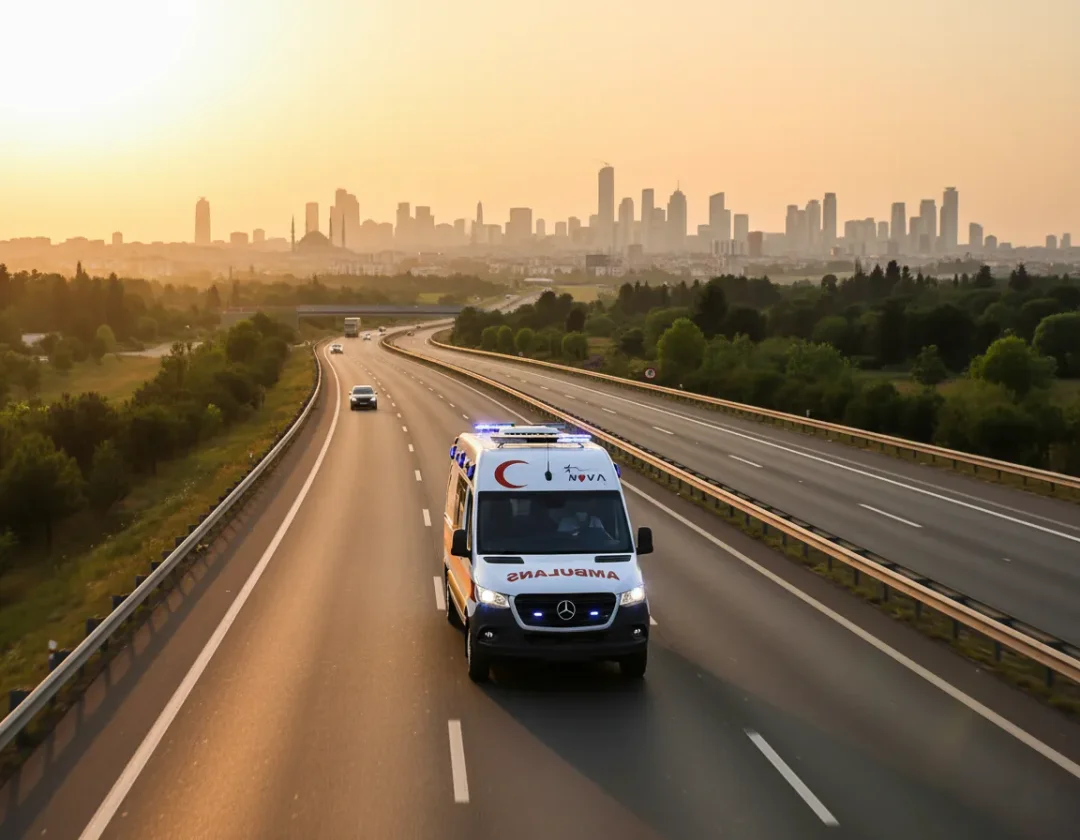
- The emergency number in any Türkiye holiday region remains 112; private ambulance companies operate for non-emergency, scheduled and intercity transports under Article 27 of the Ambulances and Emergency Health Vehicles Regulation, published in Official Gazette No. 32776 on 8 January 2025, which sets minimum and maximum tariffs through a commission chaired by the provincial health director.
- According to the Turkish Statistical Institute (TÜİK) bulletin of 30 January 2026, Türkiye registered 63,917,057 departing visitors in 2025 (up 2.7%) and reached USD 65,230,749,000 in tourism revenue (up 6.8%); this volume defines the physical scale of private patient transport demand each summer along the Mediterranean and Aegean coasts, led by Antalya and Muğla.
- A 13-year retrospective series of 198 seawater drowning admissions in Sinop, on Türkiye's Black Sea coast, reports that more than 82% of cases occurred in July and August, 51% involved tourists, and 35.9% of all fatal cases involved individuals who drowned while attempting to rescue others — this is the empirical foundation for the Turkish Red Crescent First Aid Pocket Book 2025 rule "do not put yourself in danger".
- For heatstroke, the Turkish Red Crescent First Aid Pocket Book 2025 protocol is move the person to a cool place, sponge with a clean damp cloth or have them take a lukewarm shower, and stop cooling when core temperature reaches 38–39 °C; if consciousness is impaired, cooling must start without waiting to measure temperature and 112 is called immediately.
- The amendment regulation published in Official Gazette No. 32936 on 24 June 2025 introduced a removable blue-light warning device on patient transport ambulances and added Article 7 paragraph 4 making Ministry-determined training mandatory for all ambulance health personnel — the licence of the company you contract for summer transport must comply with these amendments.
Quick answer. In any Türkiye holiday region the 112 Emergency Line is the first and only correct channel for any acute medical emergency — altered consciousness, chest pain, drowning, severe bleeding, suspected stroke, serious road collision; private ambulance companies operate for scheduled intercity transport, post-discharge return home and pre-arranged transfers, and they bill within the minimum and maximum tariffs set by a commission chaired by the provincial health director under Article 27 of the Republic of Türkiye Ministry of Health's Ambulances and Emergency Health Vehicles Regulation, published in Official Gazette No. 32776 on 8 January 2025 [1]. According to the Turkish Statistical Institute (TÜİK) bulletin of 30 January 2026, Türkiye recorded 63,917,057 departing visitors and USD 65,230,749,000 in tourism revenue in 2025 [5]; that volume puts the drowning, heatstroke and sting protocols in the Turkish Red Crescent First Aid Pocket Book 2025 on the duty list of every traveller, hotel staff member and family helper across the summer [4]. Caveat: the guide below is general health information, not personal medical advice; if you have an existing diagnosis, your own physician's summer-season medication and activity guidance always takes priority.
Türkiye's summer health scale: who, where, when
Planning summer-season healthcare starts with the size of demand. The Turkish Statistical Institute (TÜİK) publication of 30 January 2026 reports that Türkiye's departing visitor count rose 2.7% to 63,917,057 and tourism revenue rose 6.8% to USD 65,230,749,000 in 2025 [5]. The same bulletin records Q4 2025 tourism revenue of USD 15,151,842,000 [5]; quarterly summer-month detail is not separately published, but this seasonal weight defines the critical weeks for healthcare demand on Türkiye's Mediterranean and Aegean coasts.
In the same period the Republic of Türkiye Ministry of Health's Health Statistics Yearbook 2024 News Bulletin, dated 30 September 2025, reports that the number of 112 emergency health service stations rose from 3,420 in 2023 to 3,498 in 2024 and the population per station fell from 24,963 to 24,490 (a 1.9% reduction); the same bulletin records 230 tracked ambulances, 92 intensive-care and bariatric ambulances, and 50 neonatal ambulances in the fleet [6]. Coverage remains city-centred; coastal villages, small holiday coves and Türkiye's islands objectively see longer response times — clarifying what private patient transport ambulances do not fill, and what they do fill, in that gap is the spine of this guide.
112 versus private ambulance: the holiday-region division of labour
For any acute medical emergency — altered consciousness, chest pain, severe bleeding, post-drowning loss of consciousness or breathing, suspected stroke, anaphylaxis, breathlessness worsening within minutes — 112 is the first and only correct call. Article 4 of the Republic of Türkiye Ministry of Health's Ambulances and Emergency Health Vehicles Regulation closes the grey area: an emergency ambulance is defined as a vehicle "for patients or injured persons requiring urgent assistance, where necessary urgent medical intervention can be performed at the scene and inside the ambulance"; a patient transport ambulance is "used for the transport of patients or injured persons not requiring urgent medical intervention" [1]. Calling a private operator in a holiday region during an acute event burns minutes that cannot be recovered.
A private patient transport ambulance has a different summer role. Its main workload is post-discharge planned transfer of a treated patient from a holiday region back to the patient's home or referring hospital, escorted bedridden or chronic-patient holiday returns, hospital-to-home transfers, scheduled long-distance transfers for transplant candidates, regular dialysis transfers from holiday dialysis units, and long-distance intercity operations in which the cushioning, position changes and equipment checks described in our bedridden patient transport guide become decisive. Our step-by-step intercity patient transfer guide details the hour-by-hour sequence of this chain.
A simple decision rule helps: if delaying the patient changes the medical outcome, the case is for 112. If the patient is already medically stable, requires escorted stretchered transport with appropriate equipment, but a one-hour delay does not change the medical outcome, the situation is the subject of our planned ambulance booking guide.
Common acute health scenarios in Türkiye holiday regions during summer
Summer-season epidemiology differs from other seasons. Non-traffic injuries, drowning, heatstroke, food poisoning, scorpion and jellyfish stings, sunburn and dehydration top the clinical mix.
Drowning clusters dramatically into the summer months. A 13-year retrospective study at Sinop Atatürk State Hospital emergency department on Türkiye's Black Sea coast — analysing 198 seawater drowning admissions between July 2011 and July 2024 — reports that over 82% occurred in July and August, 51% involved tourists, mortality reached 19.7%, and 22.2% required intensive care unit (ICU) admission; the most striking finding is that 35.9% of fatal cases (n=14) involved individuals who drowned while attempting to rescue others [7]. The same study performed Basic Life Support (BLS, cardiopulmonary resuscitation, CPR) on 17.7% of patients [7]. Across Türkiye, a separate review compiled from the Turkish Statistical Institute's mortality data records 709 drowning deaths in 2019, 657 in 2020, 603 in 2021, 613 in 2022 and 572 in 2023; in the first nine and a half months of 2024 (1 January to 5 October) 167 deaths had already been registered [10].
Heatstroke and dehydration form the other quiet risk pool of coastal tourism — particularly in hypertensive, coronary, paediatric, pregnant and elderly travellers. Our summer heat common health problems guide details the Turkish Red Crescent First Aid Pocket Book 2025 thresholds. Road trauma, scooter and motorcycle collisions on coastal roads, jellyfish and scorpion stings, bilateral ankle sprains and food poisoning from beachfront restaurants happen in environments most family kits never anticipated; in each, the bystander's correctly sequenced first decisions own the 7–15 minute golden window before a 112 team reaches the scene. Our waiting-for-the-ambulance guide walks through scene safety, on-site triage and handover to the 112 crew step by step.
First minutes at the scene: the Turkish Red Crescent 2025 and Ministry of Health 2025 protocols
The first-minute rules — coast, hotel or roadside — are standardised in the annually updated Turkish Red Crescent First Aid Pocket Book 2025 and the Republic of Türkiye Ministry of Health May 2025 First Aid Training Book.
Drowning. The bystander first secures their own safety. The Turkish Red Crescent First Aid Pocket Book 2025 gives this exact sequence: "make sure the scene is safe. Remove the drowning person from the water quickly and safely, but do not put yourself in danger in any way. If possible, attempt the rescue without entering the water. ... Have someone at the scene call 112 Emergency" [4]. The without-entering-the-water rescue rule means reaching from a pier or shore with a life buoy, life jacket, rope or any long object. Once out of the water, check breathing; if absent, start Basic Life Support (BLS, cardiopulmonary resuscitation, CPR) — the correct step-by-step technique is in our CPR guide. Even with consciousness preserved after a drowning, water aspiration creates a 4–24-hour risk of delayed deterioration (secondary drowning); every case warrants 112 transport and in-hospital observation.
Heatstroke. The Turkish Red Crescent First Aid Pocket Book 2025 protocol is precise. Move the heat-affected person to a cool place, check breathing and consciousness, lay them down with legs slightly elevated and let them rest. For cooling: "sponge the person with a clean cloth or have them take a lukewarm shower to cool down; for persons with altered consciousness, cooling must be initiated promptly — do not delay treatment by measuring temperature. Stop cooling when core body temperature reaches 38–39 °C" [4]. The Pocket Book 2025 notes the exception to the standard "no food or fluids" first-aid rule: in heat exhaustion, abundant water intake is encouraged [4]. If breathing stops, begin Basic Life Support; if the patient is unconscious but breathing, place them in the recovery position — our recovery position guide shows the step-by-step technique.
Jellyfish, scorpion and insect stings. The Turkish Red Crescent First Aid Pocket Book 2025 jellyfish entry says "do not rub the affected area; if tentacles remain, remove them with tweezers" and adds "if allergic symptoms appear, call 112 immediately" [4]. For scorpion stings the rule is "do not move the affected area" and "if pain and symptoms extend beyond the sting area, call 112" [4]. Our anaphylaxis and adrenaline auto-injector guide covers post-sting systemic-reaction signs and auto-injector timing separately.
Food poisoning. The Turkish Red Crescent First Aid Pocket Book 2025 places Basic Life Support as the first step if breathing has stopped or consciousness is lost; otherwise place the person in a comfortable position with loose clothing, observe and call 112 [4]. Hotel kitchens, beachfront restaurants and roadside vendors can produce clusters of diarrhoea-vomiting-fever; per person at least 50 mL/hour of oral rehydration salts is required and any other people who shared the source must be monitored.
Planned intercity private ambulance transport at the end of the holiday
End-of-holiday return — to home or the referring hospital — is private ambulance's busiest summer channel. The decision rests on four axes: ambulance class (patient transport, emergency, intensive care), escort profile (lone health professional, accompanying physician, family escort), medical equipment (oxygen, monitor, infusion pump, mechanical ventilator, incubator) and distance (Antalya–Istanbul approximately 725 km; Bodrum–Istanbul approximately 850 km).
The regulation frames the price. Article 27 mandates that the fee be set by a commission chaired by the provincial health director, taking into account cost, price indices, local conditions and comparable rates, as minimum and maximum tariffs, with intercity and intracity tariffs determined separately [1][9]. In practice a dispatch fee + per-kilometre base rate + waiting fee + night surcharge + equipment surcharge matrix is used. Private operators' quotes must not exceed the same provincial commission's maximum tariff; otherwise the administrative penalties, licence suspension and traffic seizure measures detailed in our ambulance audit process and sanctions guide take effect.
An amendment regulation, published in Official Gazette No. 32936 on 24 June 2025, wrote a blue-light warning device requirement into the patient-transport class and added Article 7 paragraph 4: "the Ministry-determined training programmes shall be completed by health personnel working in ambulances" [2]. When contracting for end-of-holiday transport, the firm's crew roster, the driver's emergency-driving training and the health personnel's Ministry mandatory-training records must be available in writing. Our how to identify a licensed private ambulance guide lists those checks one by one.
Transporting an ICU patient differs from a stable transport. Per Article 7 of the regulation, an intensive care ambulance requires "a team of at least three persons" including "at least two health personnel, one of whom shall be a physician or paramedic, and one driver", while a patient transport ambulance requires "a team of at least two persons" including "at least one health personnel member and one driver" [9]. Our when an ICU ambulance is required guide opens this borderline decision with the clinical indicators.
Foreign tourists: the 112 + HSSGM + private chain
Foreign visitors made up 82.5% of Türkiye's 2025 visitor count, with the remaining 17.5% being Türkiye citizens resident abroad [5]. When a foreign tourist falls ill in a holiday region, the chain has three layers: 112 Emergency at the scene; the Travel Health Advisory Line at 444 77 34, operated by the Republic of Türkiye Ministry of Health's General Directorate of Border and Coastal Health (HSSGM), for pre-travel and pre-discharge planning [8]; a private ambulance company contracted with international travel insurance for the return leg.
Coordination is tight. Passport, insurance policy number, discharge summary and current medication list must reach the operator at admission. The clinical indicators that move a patient from ground to air ambulance, pre-flight stabilisation duration and the choice of departure airport are listed point by point in our air vs ground ambulance comparison guide. Repatriation chains for European Union visitors typically use insurer assistance + Türkiye in-country partner + flight clearance, and complete in 24–72 hours.
A return-day checklist (before you leave the hotel)
- Carry your existing diagnoses on a written card (Turkish + English) and your current medication list with drug name, dose and daily times — this list reaches the 112 crew's triage decision in the first ten seconds on the scene.
- If you are on chronic treatment, carry the full vacation duration plus seven days of reserve medication and keep a written prescription image on your phone covering any gap between scheduled check-ups.
- If you are hypertensive, coronary, diabetic or chronic-airway, get a written summer-season fluid, electrolyte, heat-exposure and glycaemic-control plan from your own physician — our diabetes and emergencies guide provides the hypo- and hyperglycaemia decision flow.
- Read the in-country emergency cover of your insurance policy; some policies cover holiday-region private hospital costs but separate the intercity transport fee onto a different line.
- If you plan a return-day private intercity transfer, sign a written quote with the operator at least 48 hours before departure; patient-transport class, crew composition, equipment list and final invoice approval must be in writing.
- Keep a Türkiye-edition copy of the Turkish Red Crescent First Aid Pocket Book 2025 in the hotel room and the car [4]; read our ambulance call and case reporting guide for how to operate the 112 mobile-notification system on your phone.
Nova Ambulans summer-season private ambulance line
Nova Ambulans keeps an open summer-season line for planned intercity private patient transport, post-discharge holiday region → Istanbul corridors, scheduled coastal-to-home-city transfers and coordinated ground + air repatriation for visitors covered by international insurance. If you want to plan an Antalya, Bodrum, Marmaris, Çeşme or Black Sea coast → Istanbul transfer at the end of summer, call the Nova Ambulans dispatch line and request a written quote against the Article 27 maximum tariff with crew, equipment and distance matrix; once you share the patient's latest discharge summary, medication list and escort preference, the ambulance class (patient transport or intensive care) and departure time are confirmed in writing within 24 hours. A summer-end transfer that begins with a planned phone call returns to you the peaceful last hours your family deserves.
Related blog posts
- Stroke symptoms and the FAST test: face–arm–speech–time
- Summer heat common health problems and first aid
- Air vs ground ambulance: when to use which
- How intercity patient transfer works
- When is an ICU ambulance required
- How to identify a licensed private ambulance
- Ambulance call and case reporting process
Intercity Ambulance Transfer Service
Safe and fast intercity patient transport across Turkey. ICU support included.
Average response time: 15 seconds
Related Articles
The History of Ambulance Services in Turkey: From Hilâl-i Ahmer to 077 Hızır Acil and 112 (2026)
A sourced, chronological history of ambulance services in Turkey — from the battlefield medical transport of Hilâl-i Ahmer (founded 1868), to 077 Hızır Acil, the country's first modern ambulance service opened in Ankara on 9 October 1985, through the 112 emergency system, UMKE, air and sea ambulances, and the licensed private-ambulance sector regulated by the 2025 ordinance — built on primary sources and Official Gazette dates, clarifying the public vs private division of labour.
Service UtilityAir Ambulance vs Ground Ambulance: When to Use Which?
Indications, contraindications and dispatch process for air ambulances (helicopter and aircraft) versus ground ambulances in Türkiye. The decision table built from the Ministry of Health Circular's blood-pressure, Glasgow Coma Score and distance thresholds.
Service UtilityHow to Arrange a Planned Ambulance Transfer
How to arrange a planned ambulance transfer: difference from 112 emergency calls, 7 essential information items, stretcher vs wheelchair selection, doctor-led ambulance criteria, SGK and insurance info, timing tips, and common planning mistakes.
- Ambulances and Emergency Health Vehicles with Ambulance Services Regulation (official full text)Republic of Türkiye Ministry of Health, Public Hospitals General Directorate, Health Services Branch — text of Official Gazette No. 32776 dated 8 January 2025 ↗
- Amendment Regulation to the Ambulances and Emergency Health Vehicles with Ambulance Services RegulationRepublic of Türkiye Presidency — Official Gazette (24 June 2025, No. 32936; alomaliye.com full-text mirror) ↗
- First Aid Training Book (May 2025 edition)Republic of Türkiye Ministry of Health, General Directorate of Emergency Health Services (Ministry Publication No. 1293) ↗
- First Aid Pocket Book 2025Türk Kızılay (Turkish Red Crescent Society) ↗
- Tourism Statistics IV. Quarter: October-December and Annual, 2025 (Bulletin No. 54158)Republic of Türkiye, Turkish Statistical Institute (TÜİK) ↗
- Health Statistics Yearbook 2024 News BulletinRepublic of Türkiye Ministry of Health, General Directorate of Health Information Systems ↗
- Epidemiological and clinical characteristics of seawater drowning cases in Sinop, a Turkish coastal city: a 13-year retrospective studyBMC Emergency Medicine 2025; 25(1):210 — PubMed (PMID 41120947; DOI 10.1186/s12873-025-01365-y) — Erşen T, Öncü K, Özcan Ö, Kara ŞŞ, Sağlam M, Orhun E, Sağlam DÖ, Cabar HD ↗
- Travel Health Advisory Line 444 77 34Republic of Türkiye Ministry of Health — General Directorate of Border and Coastal Health (HSSGM) ↗
- Ambulances and Emergency Health Vehicles with Ambulance Services Regulation (consolidated legal text with all amendments)Lexpera Legal Database — consolidated text of Official Gazette No. 32776 dated 8 January 2025 with amendments through No. 32936 dated 24 June 2025 ↗
- Drowning Cases: A Review of Water Area Safety and Preventive MeasuresDergiPark — Türkiye academic journal platform (compilation from TÜİK death statistics) ↗
Popular Ambulance Topic Clusters
You may also like
- Private ambulance pricing
- Istanbul private ambulance
- Intercity patient transport
- Doctor-accompanied ambulance
- Dialysis patient transport
- How intercity patient transport works
- Ambulance response time in Istanbul
- Home-to-hospital patient transport
- Modern ambulance equipment and team standards
- Heart attack symptoms and first response
This content is informational only and does not replace professional medical evaluation. In emergencies, call 112 or +90 216 339 00 39.
