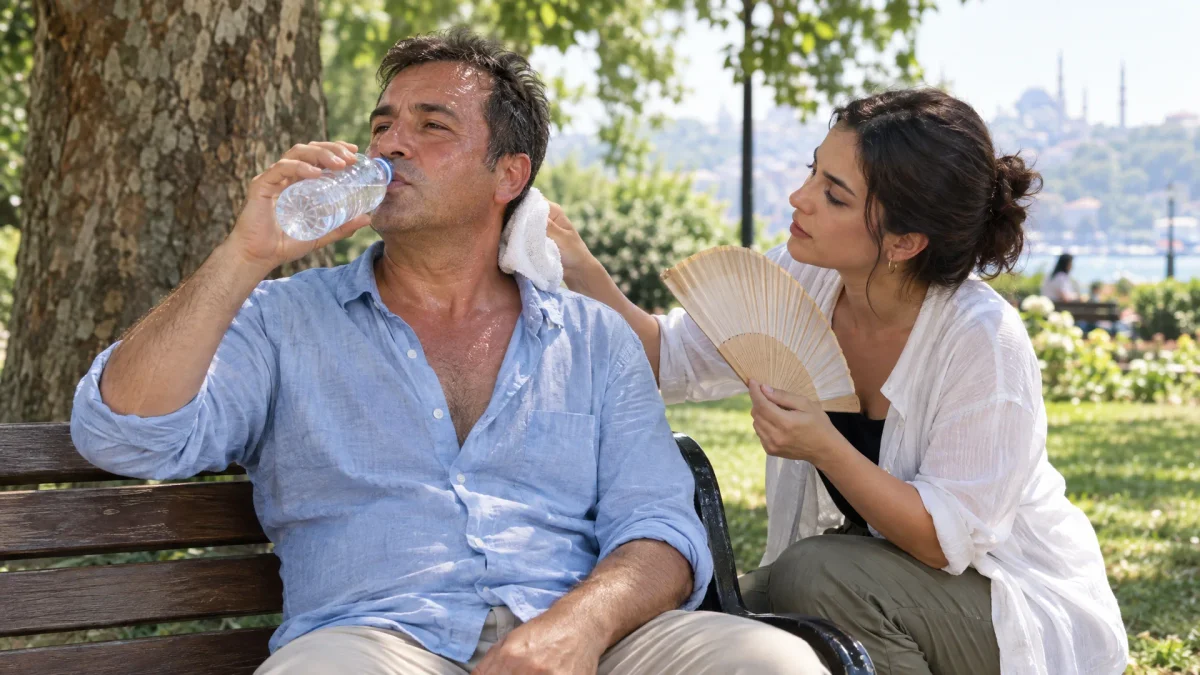
- Heat stroke is a medical emergency in which body temperature can rise to 40–41°C within 10–15 minutes; the Turkish Ministry of Health's bystander guidance warns it can cause permanent damage or death if not treated urgently.
- The bystander moves the patient to a cool, ventilated space, loosens tight clothing, cools the head, neck, armpits, and groin with water or wet compresses, and calls 112 without giving any fluid by mouth if consciousness is altered — cooling continues until the ambulance arrives.
- A 2025 European Journal of Medical Research review reports that on-scene rapid cooling — especially cold-water immersion — at greater than 0.15°C/minute significantly improves survival and lowers case fatality.
- Three extreme heat waves in Istanbul between 2013 and 2017 caused 419 excess deaths during 23 days of exposure; the Turkish State Meteorological Service's 7 May 2026 seasonal forecast projects 0.5–1°C above-normal temperatures across Marmara for summer 2026.
- The elderly, children under four, patients with chronic disease (diabetes, cardiovascular, kidney, psychiatric), pregnant people, outdoor workers, and those living alone are high-risk groups; the Turkish Ministry of Health recommends face-to-face checks at least twice a day during heat waves.
Summer heat arrives in western Türkiye every year in late May; for Marmara, the Turkish State Meteorological Service (MGM)'s seasonal forecast of 7 May 2026 projects temperatures 0.5–1°C above seasonal normals [4]. Last summer Türkiye broke its all-time record at 50.5°C in the Silopi district of Şırnak on 25 July 2025 [6]. These numbers are not just headlines: three weeks later, in Istanbul, they translate into a 65-plus neighbor losing consciousness and someone reaching not for a family physician's phone but for 112. The article ahead explains, in line with the Turkish Red Crescent 2025 and Turkish Ministry of Health 2025 protocols, what the bystander — you, the person beside your child, mother, or neighbor — will see, what to do step by step, and at which sign to hand the phone to 112.
Quick Answer
Three acute presentations of summer heat occur in sequence: first heat cramps, then heat exhaustion, and at the extreme heat stroke (hyperthermia). The Turkish Ministry of Health's bystander guidance warns that in heat stroke "body temperature can rise above 40–41°C within 10–15 minutes" and that the condition "can cause permanent damage or death if not treated urgently" [1]. As the bystander your steps are simple: move the patient to a cool, ventilated space, loosen tight clothing, wet the head, neck, armpits, and groin with cool water, give slow sips of fluid if consciousness is intact, give nothing by mouth if consciousness is altered, call 112, and continue cooling until the ambulance arrives [1][2].
When to call 112? Body temperature 40°C or higher, sweating has stopped, consciousness is altered or lost, seizure, child or person aged 65+, chronic disease (diabetes, heart, kidney) — do not wait. According to PubMed, Cong et al.'s 2025 review in the European Journal of Medical Research shows that on-scene cooling faster than 0.15°C/minute significantly improves survival and lowers case fatality [10]. Calling for help and starting cooling are simultaneous tasks; one does not wait for the other.
Türkiye's Summer Picture: 2025 Behind Us, 2026 Ahead
Türkiye's summers now make the word "record" almost annual. Per Anadolu Agency's Yeşilhat desk on 23 December 2025, the 50.5°C reading in Silopi on 25 July 2025 is "an all-time temperature record" [6]. Across Europe the same summer, an Imperial College London and London School of Hygiene & Tropical Medicine study estimated about 24,400 heat-related deaths across 854 cities, with roughly 16,500 of them attributable to climate change [6]. The Turkish State Meteorological Service (MGM)'s 7 May 2026 seasonal forecast — built on the European Centre for Medium-Range Weather Forecasts (ECMWF) model — projects, for July 2026, "temperatures 1–2°C above seasonal normals in inner Aegean, inland western Mediterranean, southern and western Inner Anatolia, western and southeastern Eastern Anatolia, and Southeastern Anatolia, and 0.5–1°C above normals in other regions" [4]. Marmara — meaning Istanbul — sits in that "other regions" band of 0.5–1°C.
The cost to Istanbul of these numbers is documented by an academic study. A 2019 paper from the Istanbul University-Cerrahpaşa Department of Public Health in International Journal of Environmental Research and Public Health, co-authored with the Quebec National Public Health Institute (INSPQ), reported that the three extreme heat waves in the summers of 2015, 2016, and 2017 — 14 days of peak exposure in total — "significantly increased the mortality rate and caused 419 excess deaths in 23 days of exposure" [9]. That is the annual mortality of a small county hospital, concentrated by urban heat-island effect in the 65-plus, cardiovascular, and respiratory cohorts [9].
Globally the backdrop is just as clear. The World Health Organization (WHO)'s fact sheet, updated 28 April 2026, reports that from 2000 to 2019 the world saw about 489,000 heat-related deaths per year, "45% of them in Asia and 36% in Europe" [7]. The same fact sheet describes heat stroke as "a medical emergency with a high case-fatality rate"; for air conditioning it advises "set air conditioning to 27°C and run a fan to make the room feel up to 4°C cooler" [7].
Three Acute Heat Conditions: Severity Ladder
Inside the body, the heat-regulating machinery — sweat, skin vasodilation, increased heart rate — sends its signals along three levels of severity when it loses the race. Holding this ladder in mind is what tells the bystander when to call 112.
| Level | Body temperature | Hallmark sign | What to do on scene | 112 required? |
|---|---|---|---|---|
| Heat cramps | Normal to 37.5°C | Painful muscle spasms in arms, legs, or abdomen; heavy sweating | Cool space, lightly salted drink (ayran / oral rehydration), gentle stretching | Usually no — yes if the patient does not improve or starts vomiting |
| Heat exhaustion (heat fatigue) | 38–40°C | Heavy sweating, dizziness, weakness, nausea, headache, rapid pulse | Cool environment, loosen tight clothing, wet compresses, sips of fluid | Yes if no improvement in 30 minutes, consciousness shifts, or vomiting prevents fluid intake |
| Heat stroke (hyperthermia) | ≥40°C, often 40–41°C [1] | Dry-red-hot skin, no sweating, confusion or coma, seizure, rapid breathing | Immediate external cooling: wet compresses, cool water, air flow; nothing by mouth if consciousness is altered | Always 112 |
Transition between levels is fast. The Turkish Ministry of Health's bystander guidance reports that in heat stroke "body temperature can rise above 40–41°C within 10–15 minutes" — an hour-long "let's just lie down" wait is not a luxury this clinical picture allows [1].
Heat Stroke (Hyperthermia) — A Medical Emergency
The Turkish Ministry of Health's bystander guidance opens its description with: "Heat stroke is a clinical picture characterized by the body's inability to lower its core temperature, due to the breakdown of the sweating mechanism that regulates body heat, after exposure to excessive heat" [1]. What sets it apart is dry, red, hot skin — the sweating mechanism has collapsed; this is where heat stroke parts ways from heat exhaustion. The guidance summarizes the condition with: untreated, "it can cause permanent damage or death" [1].
Symptoms follow a sequence and deepen quickly: fever above 39.4°C; dry, red, hot skin; sweating stops; nausea, vomiting, headache, dizziness; eye sockets becoming prominent; vision blurring; finally consciousness clouding to the depth of coma [1]. The Turkish Red Crescent's 2025 First Aid Pocket Book confirms the same picture and specifically instructs the bystander to start external cooling without delay [3].
Heat Exhaustion — The Early Warning
In heat exhaustion the system is still working but losing the race: the patient sweats heavily, skin is moist and often pale, body temperature ranges 38–40°C, consciousness is preserved but the person is weak, nauseated, and dazed. The United States Centers for Disease Control and Prevention (CDC) lists the early signs of heat illness as "muscle cramping, unusually heavy sweating, shortness of breath, dizziness, headaches, weakness, nausea" [8]. At this level, shade, wet compresses, air flow, and small sips of fluid are usually enough; but if there is no improvement in 30 minutes or persistent vomiting blocks oral fluid, the next step toward heat stroke is imminent — do not delay 112.
Heat Cramps — The Mildest Link
The mildest link in the ladder, heat cramps appear as painful spasms — most often in leg or abdominal muscles — driven by sodium/potassium loss with heavy sweating. Heat cramps alone do not require 112; shade, a lightly salted drink (the Turkish Ministry of Health Public Health General Directorate (HSGM) recommends "ayran with salt preferred" [1]), and rest are enough. But if cramps come with vomiting, dizziness, or altered consciousness, the underlying picture has moved on to heat exhaustion.
Step-by-Step Bystander First Aid for Heat Stroke
Below is the common core of the Turkish Ministry of Health's bystander guidance, the Turkish Red Crescent 2025 First Aid Pocket Book, and the European Journal of Medical Research's 2025 review [1][3][10].
- Scene safety. If you are in direct sun, get the patient out of it. If there is a crowd, create breathing room.
- Move to a cool, ventilated space. Indoor air-conditioned space if possible; tree shade otherwise. The World Health Organization (WHO) recommends air conditioning at 27°C combined with a fan [7].
- Loosen tight clothing. Belt, shirt collar, shoelaces, restrictive garments — lift or loosen.
- Start rapid external cooling. The mainline method in the Turkish Red Crescent 2025 and Turkish Ministry of Health protocols is to cool the head, neck, armpits, and groin with wet towels or compresses and spray the skin with water while moving air over it [1][3]. The European Journal of Medical Research's 2025 review flags cold-water immersion as the gold standard for lowering case fatality and stresses that cooling faster than 0.15°C per minute is critical to survival [10]. If a tub or basin is on hand and the patient is breathing and able to sit, the limbs can be immersed in cold water.
- Add a fan. Air flow speeds evaporative cooling. The United States Centers for Disease Control and Prevention (CDC) notes that when indoor temperature climbs above 32°C (90°F) a fan alone is no longer enough; above that threshold cooling must combine water and air flow [8].
- Assess consciousness. We detail the bystander's 10-second breathing-and-consciousness check, and how to place an unconscious-but-breathing patient on their side, in our recovery-position guide.
- Give fluids if consciousness is intact and there is no vomiting. Slow sips of water, room-temperature ayran without ice, or an oral rehydration solution. The Turkish Ministry of Health publication says "very cold drinks should not be consumed" [1].
- If consciousness is altered or lost, NEVER give anything by mouth. The Turkish Ministry of Health protocol is sharp on this point: "If consciousness is lost, fluid must not be given by mouth under any circumstance" [1]. Aspiration risk creates a life-threatening complication.
- Call 112. Report the scene address, the patient's age, level of consciousness, an estimate of body temperature, and what you have done so far. How a correct 112 call reaches the command center and which questions you will be asked is detailed in our call-process article.
- Continue cooling until the ambulance arrives. Cooling is not "done and dusted"; even if body temperature drops to around 38°C and the patient regains consciousness, at least another 30 minutes of monitoring is needed. If the patient starts shivering, reduce cooling — shivering produces heat.
112 Call Criteria: Which Signs Mean Don't Wait?
If any one of the signs below is present, the bystander's only job is to call 112 without delay. The list is the convergence of the Turkish Ministry of Health 2025 protocol, the Turkish Red Crescent 2025 Pocket Book, and the European Journal of Medical Research's 2025 recommendation [1][2][3][10].
- Body temperature 40°C or higher, or skin that feels very hot, red, and dry [1].
- Sweating has stopped. A person who was sweating heavily and suddenly stops is a bad sign.
- Confusion, disorientation, slurred speech, drowsiness, or loss of consciousness.
- Seizure (convulsion). See our recovery-position guide for what to do during and after a seizure.
- Severe vomiting — a patient who cannot swallow loses ground in minutes.
- A child or infant. The Turkish Ministry of Health flags children under 4 as a high-risk group [1]. We covered pediatric summer emergencies and how to intervene in the heat in our parents' guide.
- Age 65 and older, especially living alone. Our article on home care and ambulance support for the elderly explains how age and chronic disease together bend and steepen the risk curve.
- History of chronic disease — diabetes, heart failure, kidney disease, COPD (Chronic Obstructive Pulmonary Disease), psychiatric treatment, anticholinergic or diuretic use [1].
- Chest pain or shortness of breath in heat. Hot weather strains the heart and lungs. We collected the "silent" signs that point chest pain at heart attack in our heart-attack symptom article; if there is asymmetry of face, arm, or speech the FAST test and 112 call are time-critical.
- Blood pressure swinging high or low in heat. Our hypertensive crisis guide carries threshold tables for this scenario.
- No response to 30 minutes of external cooling.
When in doubt, 112. The Turkish Ministry of Health protocol is emphatic that untreated heat stroke "can cause permanent damage or death" [1]; the condition does not improve on its own.
High-Risk Groups: Who Is the Picture Tilted Against?
The Turkish Ministry of Health's bystander guidance lists six high-risk groups [1]:
- Age 65 and older, especially living alone. Thermoregulation weakens with age, thirst sense declines, and beta-blocker and diuretic use disturbs fluid balance.
- Children under four. Body surface area-to-mass ratio is high; they equilibrate to ambient temperature faster.
- Chronic disease: diabetes, cardiovascular disease, cerebrovascular disease, psychiatric diagnosis, kidney disease.
- Obesity. Thermoregulation runs against volume, not surface.
- Pregnancy. High body-fluid volume and a more demanding heat-dissipation budget.
- Outdoor workers. Shade, water, and rest protocols on construction, agriculture, and logistics sites are a legal obligation in many workplaces.
For these groups the Turkish Ministry of Health publication gives a clear observation frequency: "Vulnerable adults and elderly should be checked at least twice a day; infants more often" [1]. The World Health Organization (WHO) likewise carves out those living alone — alongside "low income / inadequate housing" — as a distinct risk pool [7]. Patients with diabetes or heart failure should review medication doses with their family physician before summer — diuretics and antihypertensives behave differently in heat.
Prevention Protocol: Before the Heat Wave Hits
About 80% of heat-related emergencies are averted by a decision made before the countdown starts. The Turkish Ministry of Health Public Health General Directorate (HSGM) publication recommends four pillars [1]:
Fluid and nutrition. "At least 2–2.5 liters of fluid per day; salted ayran preferred; very cold drinks should not be consumed" [1]. The World Health Organization (WHO) gives a similar dose: "1 cup of water per hour and at least 2–3 litres per day" [7]. Coffee and alcohol amplify fluid loss through their diuretic effect; very cold drinks can shock the stomach-cardiac axis. Soup, yogurt, and water-rich fruit also work as electrolyte sources.
Room temperature. Keep the room at 24–27°C; ventilate naturally in morning and evening, close shutters and curtains by day. The World Health Organization (WHO) sets the AC threshold at 27°C and adds: "use a fan to make the room feel up to 4°C cooler" [7]. The United States Centers for Disease Control and Prevention (CDC) caps fan use: above 32°C indoor a fan alone is not enough [8].
Outdoor timing. The Turkish Ministry of Health recommends staying indoors between 10:00 and 16:00 [1]; during a heat wave this means suspending the Turkish "afternoon" rhythm. Playgrounds, shopping, and sports activities shift to before 9 a.m. or after 5 p.m.
Clothing and skin. Light colors, loose cotton; hat, sunglasses, sun umbrella. Dark and synthetic clothing traps heat and obstructs sweating.
Observation frequency. People in the risk pool — elderly living alone, chronic patients, infants — should be checked face-to-face or via video by relatives at least twice a day [1]. The World Health Organization (WHO) counts neighbor checks during a heat wave as a core public-health measure [7].
Hospital vs Home: After Heat Stroke
The patient's "recovery" from heat stroke does not end at the scene. The European Journal of Medical Research's 2025 review notes that on-scene rapid cooling lowers case fatality significantly, but that multi-organ involvement requires 12–24 hours of clinical observation [10]. Liver, kidney, coagulation, and central nervous system effects can appear later. For that reason, even a patient who looks "recovered" at the scene is taken to a health facility for evaluation as standard.
That same review positions cold-water immersion started at the scene as the gold standard and reports that under prepared conditions — for example, scene-based cooling at athletic events — fatality approaches zero; community-acquired heat stroke, by contrast, sees higher mortality because of delay and equipment shortages [10]. That makes coordinating the scene-to-hospital leg cleanly — route, nearest hospital, pre-arrival notification — a step that precedes hospital care in importance.
112 vs Private Ambulance: Which One in Summer Heat?
If you think a heat-stroke picture has developed on scene, the choice is clear: the Turkish Ministry of Health's emergency system — 112. Heat stroke is a life-threatening medical emergency and the public system is designed for it: free of charge for citizens, with the shortest possible response time. A private ambulance's role is different: planned intercity transport, hospital-to-home discharge, long-distance scheduled transfers during summer holidays, event-venue medical standby. We covered the differences between 112 and a private ambulance by authority, dispatch path, and pricing in our service-comparison article.
Nova Ambulans plays three main roles during summer: first, as the on-site medical team for heat-related emergencies at outdoor events and construction sites; second, transporting a heat-stroke patient stabilized at hospital to home or hometown with an ICU-equipped ground ambulance; third, providing regular ground transport to non-negotiable appointments — dialysis, chemotherapy, cardiology follow-up — for chronic patients during summer holidays. None of these substitute for 112; they fill the planned gap that 112 was not designed for.
Quick Reminder: A Refrigerator-Door List for the Summer
For the bystander, for the carer ready for a daily check on a neighbor living alone, for the parent keeping a list for a child's summer camp — a short note to tape to the refrigerator door:
- 2–2.5 liters of fluid per day; salted ayran is good, very cold drinks are not [1].
- Room 24–27°C, AC at 27°C plus fan [1][7].
- No outdoor activity 10:00–16:00; during a heat wave shift programs to the evening [1].
- Living alone elderly / infant: face-to-face checks twice a day [1].
- Signs — dry red skin, no sweating, altered consciousness, 40°C: call 112 [1].
- While waiting for 112: cool space + loosen tight clothing + wet compresses on head/neck/armpits/groin + sips of fluid if consciousness is intact, nothing by mouth if it is not [1][3][10].
Frequently Asked Questions
Is cold-water immersion preferable to air conditioning in heat stroke?
According to PubMed, the European Journal of Medical Research's 2025 review points to cold-water immersion as the most clinically effective cooling method and states that rapid cooling faster than 0.15°C per minute significantly increases survival [10]. If a tub or large basin is on hand at the scene and the patient is breathing, able to sit, and conscious, the limbs can be immersed in cold water. But do not try to put a patient with altered consciousness into a tub on your own — drowning risk. The mainline method in the Turkish Ministry of Health's bystander guidance is wet compresses plus air flow; this can always be applied on scene [1].
Is opening windows enough if I do not turn on AC in heat?
No, especially not by day. The Turkish Ministry of Health publication recommends natural ventilation in morning and evening and closing shutters/curtains by day [1]. The World Health Organization (WHO) reports that AC at 27°C combined with a fan can make the room feel up to 4°C cooler [7]; the United States Centers for Disease Control and Prevention (CDC) notes that when indoor temperature climbs above 32°C a fan alone is insufficient [8]. Above 32°C indoor and without AC, a cool center (mall, library, an air-conditioned relative's home) is the only safe option.
I take diabetes and blood pressure medication — do doses change in summer?
They can change in summer. Heat-driven sweating and fluid loss lower blood pressure, and combined with diuretic medication this raises the risk of orthostatic hypotension; insulin absorption can accelerate in heat and produce hypoglycemia. The dose decision belongs to the family physician, not the patient alone. Schedule an appointment at the start of summer. We covered the thresholds for home medication use and when to call an ambulance in a separate article.
My child is cranky in the heat — just tired, or heat stroke?
The Turkish Ministry of Health classifies children under 4 as a high-risk group [1]. Mild irritability, weakness, less sweating, cool or pale skin, vomiting, refusing fluid, drowsiness — even one of these should raise pediatric heat-stroke suspicion, and the threshold is low. For a child, err on the side of calling 112 early. We collected the range of pediatric summer emergencies for parents in a separate guide.
I have an elderly mother living alone — how do I plan for a heat wave?
Set up the plan in three layers in advance: (1) face-to-face or video checks twice a day, morning and evening — this is the Turkish Ministry of Health protocol [1]. (2) Room temperature 24–27°C via AC and shutters; if needed, stay with an air-conditioned relative through the heat wave. (3) A pre-prepared "112 document bag" at the door — insurance number, medication list, allergy info, the nearest relative's phone. Our home care and ambulance support article for the elderly walks through these three layers in depth.
Do ambulances actually arrive later in Istanbul during heat waves?
We detail Istanbul Provincial Health Directorate's annual 112 response-time figures and the way heat-wave periods shift call volume in our piece on Istanbul ambulance response time, 2025 data. Heat waves increase call volume; that is why the external cooling the bystander starts on the scene is the cushion for the precious minutes until a ground ambulance arrives.
Rapid Emergency Support
24/7 emergency ambulance service across Istanbul. Fast response, fully equipped team.
Average response time: 15 seconds
Related Articles
Sepsis Symptoms: Flu or Sepsis? How to Spot It at Home and When to Call 112
Sepsis is an emergency in which the body responds to an infection in an extreme, uncontrolled way, and it can worsen within hours. If someone with a fever or an infection becomes confused, breathes very fast, has pale or blotchy skin, a rash that does not fade when pressed, or a very high or very low temperature, call 112 without waiting. Until the ambulance arrives, do not leave them alone, give them nothing by mouth and check their consciousness every 2-3 minutes.
EducationWhat to Do When an Older Person Falls at Home: 4 Checks Before Lifting and the 112 Decision
When an older relative falls at home, do not lift them straight away. First check consciousness and breathing, then whether they hit their head, then for pain, deformity or shortening in the hip or leg. If there is a suspected fracture, a head injury or they cannot get up on their own, call 112; if there is no injury, help them get up slowly under their own power and have a doctor see them the same week.
EducationDog and Cat Bite First Aid: Rabies Risk, the 15-Minute Wash and When to Call 112
If a dog or cat bites or scratches you, wash the wound at once with plenty of soap and water for at least 15 minutes, press directly on it if it bleeds, cover it with a clean cloth and go to a health facility the same day. Rabies cannot be treated once symptoms begin; a doctor decides whether you need the vaccine. Call 112 for bleeding that pressure does not stop or for any threat to life.
- Aşırı Sıcakların Sağlık Üzerine Etkileri ve Alınması Gereken ÖnlemlerTurkish Ministry of Health (Erenköy Mental and Neurological Diseases EAH — HSGM content mirror) ↗
- 14. First Aid in Burns, Cold and Heat Emergencies (Training Presentation — Module 14)Turkish Ministry of Health — General Directorate of Emergency Health Services ↗
- First Aid Pocket Book 2025 (İlk Yardım Cep Kitabı 2025)Turkish Red Crescent (Türk Kızılay — Türkiye Kızılay Derneği) ↗
- Long-Range Forecasts — July 2026 Seasonal OutlookTurkish Ministry of Environment, Urbanization and Climate Change — Turkish State Meteorological Service (MGM) ↗
- Türkiye 2025 Annual Climate AssessmentTurkish Ministry of Environment, Urbanization and Climate Change — Turkish State Meteorological Service (MGM) ↗
- 2025 saw global temperatures hit record levels; many regions began experiencing droughtAnadolu Agency (Yeşilhat desk) ↗
- Climate change, heat and health (fact sheet)World Health Organization (WHO) ↗
- About Heat & HealthUnited States Centers for Disease Control and Prevention (CDC) ↗
- Excess Mortality in Istanbul during Extreme Heat Waves between 2013 and 2017International Journal of Environmental Research and Public Health (peer-reviewed; PMID 31703402) ↗
- Pre-hospital cooling in community-acquired heat stroke (CAHS): evidence, challenges, and strategiesEuropean Journal of Medical Research (peer-reviewed; PMID 40495243) ↗
Popular Ambulance Topic Clusters
You may also like
- Private ambulance pricing
- Istanbul private ambulance
- Intercity patient transport
- Doctor-accompanied ambulance
- Dialysis patient transport
- How intercity patient transport works
- Ambulance response time in Istanbul
- Home-to-hospital patient transport
- Modern ambulance equipment and team standards
- Heart attack symptoms and first response
This content is informational only and does not replace professional medical evaluation. In emergencies, call 112 or +90 216 339 00 39.
