- First-degree burns show redness and pain only; second-degree burns have fluid-filled blisters (bullae) and are painful; third-degree burns damage all skin layers and are painless because the nerves are destroyed — this distinction is the anchor of the Turkish Ministry of National Education (MEB) 2024 first-aid protocol.
- Griffin et al.'s 2022 systematic review and meta-analysis showed that 20 minutes of cool running water within the first three hours of a burn significantly reduces the odds of needing a skin graft or surgical wound management; MEB and Marmara University protocols also set at least 20 minutes of cool running water as the standard.
- Do NOT apply toothpaste, butter, vinegar, tomato, egg white or ice to a burn; do NOT pop the blisters; do NOT pull clothing that has adhered to burned skin — the MEB and Marmara University protocols explicitly forbid these.
- Per the American Burn Association (ABA) 2025 referral criteria, partial-thickness burns above 10% Total Body Surface Area (TBSA), full-thickness (3rd degree) burns of any size, face–hand–foot– genital–joint burns, chemical, electrical and smoke-inhalation injuries should be referred to a burn center.
- Turkey's Regulation on Burn Treatment Units, published in the Official Gazette on 8 October 2019 (no. 30912), defines a three- tier network — burn center, burn unit and burn room; in İstanbul, the Kartal Dr. Lütfi Kırdar City Hospital Wound and Burn Center and the Başakşehir Çam ve Sakura City Hospital Burn Center are the two reference anchor institutions.
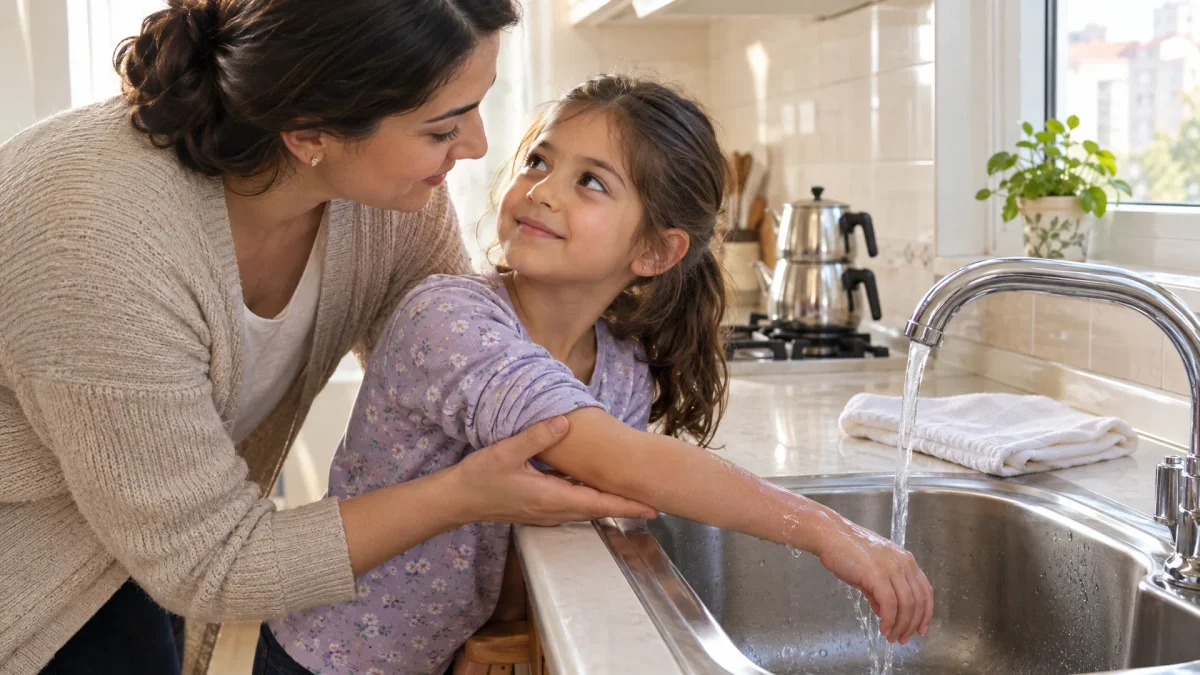
Early July, a humid İstanbul afternoon. In a kitchen apartment, a six-year-old reaches for the handle of a boiling kettle on the stove; hot water traces a line from wrist to elbow. The mother, drawing on a childhood memory, freezes between two folk choices: "toothpaste or ice?" Neither is correct. That first-three-hour decision window is exactly the one Griffin and colleagues' 2022 systematic review and meta-analysis identified as directly determining the odds of needing a skin graft and surgical wound management [9]. A burn, when correctly graded and correctly cooled, is an emergency that can change both the scar and the length of a hospital stay. This guide sits at the intersection of the Turkish Ministry of National Education (MEB) 2024 first-aid protocol, the Marmara University public guide, Turkey's Regulation on Burn Treatment Units (Official Gazette 8 October 2019 no. 30912) and the American Burn Association (ABA) 2025 referral criteria; it makes clear what a bystander does in the first 20 minutes, which burns can be managed at home, and which signs mean 112 cannot be delayed.
Quick Answer
The first 20 minutes after a burn are the most critical: get the burned area under a running tap (roughly 15–20 °C water) and cool for at least 20 uninterrupted minutes — this duration is the shared standard in the Turkish Ministry of National Education (MEB) 2024 protocol, the Marmara University public guide and Griffin et al.'s 2022 international systematic review [1][2][9]. Do not delay cooling — call 112 after cooling has started, or have someone else make the call. Remove tight jewelry (rings, watch, belt, bracelet) and reachable clothing; do not pull skin-adherent fabric. Do not pop blisters, do not apply toothpaste, butter, egg white, vinegar, tomato or ice (the MEB and Marmara University protocols explicitly forbid these) [1][2]. Then cover loosely with a clean, lint-free damp cloth.
When to call 112. Per the American Burn Association (ABA) 2025 referral criteria, refer to a burn center for third-degree (full-thickness) burns of any size; second-degree burns greater than 10% Total Body Surface Area (TBSA); burns on the face, hand, foot, genital area or a major joint; chemical or high-voltage (≥1000 V) electrical burns; suspected smoke inhalation; and any burn in a child under 14 years or under 30 kilograms [10]. In İstanbul, Kartal Dr. Lütfi Kırdar City Hospital Wound and Burn Center (Anatolian side) and Başakşehir Çam ve Sakura City Hospital Burn Center (European side) are the Ministry of Health reference burn institutions [5][7].
Turkey Context: Why the Burn Burden Matters
The World Health Organization (WHO) burn fact sheet, dated 13 October 2023, gives the global scale: 180,000 deaths a year are caused by burns, the vast majority in low- and middle-income countries, and roughly 80–90% of burns occur in the home or workplace [11]. Turkey's mortality context comes from Turkish Statistical Institute (TÜİK) news bulletin 54195, dated 19 June 2025: total deaths in 2024 were 489,361, and external causes (accidents, burns, poisonings, suicides and homicides) accounted for 3.6% of all deaths [4]. Burns are among the most preventable of these external causes.
Turkey's pediatric burn data makes this concrete. In a retrospective cohort of n=1442 children hospitalized at Adana City Hospital Burn Center between 1 January 2015 and 30 June 2019, the mean burned Total Body Surface Area (TBSA) was 11.23±10.70% and the mean length of stay was 14.38±18.1 days [8]. Özlü and Başaran's 2022 paper in Ulusal Travma ve Acil Cerrahi Dergisi (PubMed ID 34967435, DOI 10.14744/tjtes.2020.69447) reports the most striking findings: 89.18% of the injuries occurred indoors, the most common etiology across all age groups was scalding with hot water and tea, and 10 patients (0.69%) died — 7 of them delayed referrals from other hospitals [8]. That last sentence is the clinical bill of the "let's wait, it will pass" trap: correct grading and timely referral are directly linked to mortality.
Burn Grading: What Are First, Second and Third Degree?
The Turkish Ministry of National Education (MEB) 2024 first-aid protocol anchors Turkey's public-health grading and defines the three degrees by depth [1]. Clinical practice also recognizes 4th-degree — burns to muscle, tendon, bone — but in the bystander's decision tree the 1st/2nd/3rd degree distinction is sufficient.
First-Degree Burn (Superficial — Epidermis)
Per the Turkish Ministry of National Education protocol, first-degree burns show "redness, pain and swelling on the skin" [1]. Only the outermost layer (the epidermis) is affected; there is no blister, and healing occurs within 3–7 days without scarring. The most familiar example is sunburn; brief exposure to hot steam and brief contact with a warm liquid can also cause first-degree burns. Home care is usually sufficient: 20 minutes of cool running water, moisturizer (aloe-vera-containing lotion, etc.), paracetamol or ibuprofen for pain when needed (with clinician guidance). If fever, chills or fatigue are present, heat exhaustion may have joined the picture; that requires emergency assessment rather than home care.
Second-Degree Burn (Superficial/Deep Dermis — Blisters, Bullae)
MEB's 2024 protocol defines the second-degree burn verbatim: "the skin has fluid-filled blisters (bullae) and it is painful" [1]. Clinical practice splits it in two: superficial 2nd-degree — blisters full, moist, pink, very painful, healing in 10–21 days; deep 2nd-degree — blisters full but whitish at the base, pain reduced, healing beyond 3 weeks and high scar risk. The most common domestic causes are boiling water/tea (scald), oil splatter, flame contact, hot metal (car bodywork, kettle handle, boiler surface), certain chemical contacts and prolonged sun. Do not pop the blister — the Marmara University public guide explicitly forbids this [2]; the blister is a natural barrier that delays infection. Per the American Burn Association (ABA) 2025 referral criteria, a superficial-deep 2nd-degree burn should be referred to a burn center when it exceeds 10% of Total Body Surface Area (TBSA) or is on the face, hand, foot, genital area or a joint [10].
Third-Degree Burn (Full Thickness — No Pain)
The MEB 2024 protocol names the distinguishing feature clearly: "all skin layers are affected. Because the nerves have been damaged there is no pain" [1]. The skin appears white, yellowish, brown or charred; its texture is dry and waxy; a pinprick test does not evoke pain. Flames, prolonged hot contact, electricity and concentrated chemicals are the most common causes. Every third-degree burn — regardless of size — should be referred to a burn center — the ABA 2025 criteria recommend transfer for full-thickness burns of any size [10]. Because the skin cannot regenerate itself, a graft (skin transplant) is required. On scene, cooling continues, no substance is applied, adherent clothing is not pulled off, and 112 is called.
Burn Depth Comparison Table
| Feature | 1st Degree | 2nd Degree (superficial/deep) | 3rd Degree |
|---|---|---|---|
| Layers affected | Epidermis | Epidermis + dermis | All layers + subcutaneous tissue |
| Appearance | Red, swollen, dry | Fluid-filled blister (bulla), moist, pink/red | White–brown–charred, dry, waxy |
| Pain | Present, tenderness | Severe pain | Absent (nerves destroyed) |
| Healing | 3–7 days, no scar | 10–21 days (superficial), 3+ weeks (deep) | Skin graft required; no spontaneous healing |
| Blister | No | Yes (do not pop) | No (skin destroyed) |
| ABA 2025 referral threshold [10] | Wide area or systemic sign | ≥10% TBSA or face/hand/foot/genital/joint | Any size |
| Example | Sunburn | Boiling water, oil splatter | Flame, electricity, prolonged contact |
First 3 Hours: Why 20 Minutes of Cool Running Water Matters
Among all burn first-aid interventions, the single strongest evidence base is "20 minutes of cool running water." Griffin et al.'s 2022 systematic review and meta-analysis in Australasian Emergency Care (PubMed ID 35688782, DOI 10.1016/j.auec.2022.05.004) pooled seven studies and concluded: "Twenty minutes of cool running water within the first three hours of burn injury significantly decreased the odds of patients requiring skin grafting and surgical intervention for wound management" [9]. The same duration is the official protocol in Turkey: the Turkish Ministry of National Education (MEB) 2024 first-aid guide states "the area should be gently rinsed with plenty of low-pressure water for at least 15–20 minutes"; the Marmara University public guide uses "the burned area is placed in low-pressure cool water for at least 20 minutes" [1][2].
"How Cold?" — Not Iced Water
Griffin 2022 emphasizes the condition as "cool running water" — around 15–20 °C tap water [9]. Ice and ice-water are not used: they constrict surface blood vessels, stop blood flow to the tissue and deepen the underlying damage; in a wide burn they can also trigger hypothermia (a dangerous drop in body temperature). Hot or warm water preserves heat rather than cooling. The water should flow — not stagnant; the pressure should be gentle — a garden hose jet is too much; a steady tap gives the right pressure.
"Where?" — Only the Burned Area
Cooling is applied to the burned area only; the whole body is not put into cool water. In children and in wide burns the risk of hypothermia means the rest of the body is kept covered. The Marmara University public guide emphasizes that cooling is regional, not systemic [2].
"How Long?" — The First 3 Hours Are Most Valuable, but Later Still Helps
Griffin 2022 defines the three-hour window as the highest-benefit period [9]. Beyond three hours, cooling is still useful — it still lowers the surface temperature and eases pain. "It's too late, no point" is wrong; cooling is always the first intervention. Do not delay: start at the tap before you reach for the phone; have someone else call 112 while cooling continues, or hold the tap with one arm and dial with the other.
Step-by-Step Thermal Burn First Aid
The sequence below is where the Turkish Ministry of National Education (MEB) 2024 first-aid protocol and the Marmara University public guide agree exactly [1][2]. Do not change the order.
- Scene safety. If the flame, hot-liquid source or electrical source is still active, secure yourself and the scene first. Roll a person whose clothing is on fire on the ground (stop-drop-roll); wrap in a damp blanket.
- Cut the heat source. Turn off the stove, unplug, move the kettle. The Marmara University public guide emphasizes that in an electrical burn "the patient must not be touched until contact with the current has been broken" [2] — see the electrical burn section below.
- Get to a tap immediately. Cooling is 20 minutes of running cool water in the first 3 hours [1][2][9]. Small burn: tap; wide burn: shower; not tub immersion. Water low-pressure, lukewarm-cool (around 15–20 °C).
- Remove tight jewelry and clothing. Edema sets in fast; rings, watches, belts and bracelets can choke circulation. Do not pull skin-adherent fabric — cut around it with scissors and leave the adherent piece alone.
- Do not pop blisters; apply nothing. Toothpaste, butter, vinegar, tomato, egg white, cologne, ice — the MEB and Marmara University protocols forbid these [1][2]. The blister protects its own barrier; anything applied stops cooling and invites infection.
- Cover loosely with a clean, lint-free damp cloth. Sterile gauze is ideal; if none, a clean cotton cloth, a pillowcase, or even a surgical-mask wrapper can be a temporary cover. Do not leave a linty towel — fibers stick to the wound.
- If awake and not vomiting, give oral fluid. The Marmara University public guide's formula is precise: "1 L water + 1 tsp baking soda + 1 tsp salt" — a home oral rehydration recipe [2]. If consciousness is impaired or the person is vomiting, do not give fluid orally — aspiration risk is life-threatening.
- Preserve body heat. While cooling the burn, do not chill the rest of the body; a blanket or thermal cover goes over the torso. This is critical especially in wide burns, children and the elderly.
- Call 112. If even one referral criterion is met, call 112 — we cover the ambulance-call and case-report process in a separate guide. On the call give three facts: the burn cause (boiling water, flame, chemical, electrical), approximate area (TBSA estimate), and the patient's age and level of consciousness.
- Prepare for transport. If life signs are absent, start Cardiopulmonary Resuscitation (CPR). We cover what relatives should do while waiting for the ambulance in a separate guide.
How to Estimate Total Body Surface Area (TBSA)
Area estimation is central to the referral decision. Two practical methods exist.
Rule of Nines (Wallace Rule, adults)
In an adult the body surface is divided into multiples of 9 (rough estimate — precise measurement happens at the hospital):
- Head and neck → 9%
- Each entire arm (front + back) → 9% (both arms together: 18%)
- Front of the torso → 18%
- Back of the torso → 18%
- Each entire leg (front + back) → 18% (both legs together: 36%)
- Genital area → 1%
Total: 9 + 18 + 18 + 18 + 36 + 1 = 100%. Sum the burned areas. For example, in an adult the whole chest (18%) + a right arm (9%) burned comes to roughly 27% TBSA; this clearly exceeds the American Burn Association (ABA) 10% threshold and requires burn-center referral [10].
Palm Method
For small or scattered burns the Rule of Nines is imprecise; the patient's own palm (fingers included) equals roughly 1% TBSA. If three palm-widths of scattered burn are visible on a forearm, that is roughly 3% TBSA. This method is particularly useful in children because the child's own palm auto-corrects for body proportion.
Difference for Children
In children the body proportions differ from adults'. Infants and small children have a proportionally larger head and smaller legs — the Lund-Browder chart gives precise measurements in clinical practice. In practice the one thing a parent needs to remember on scene: in a child, even 10% TBSA is serious. The American Burn Association (ABA) 2025 criteria recommend burn-center consultation for any burn in a child under 14 years or under 30 kilograms [10].
Chemical, Electrical and Smoke Burns — Special Protocols
Not all burns are equal. Three non-thermal types require special protocols.
Chemical Burn
The Turkish Ministry of National Education (MEB) 2024 protocol states that in chemical burns "the area should be gently rinsed with plenty of low-pressure water for at least 15–20 minutes" [1]. The Marmara University public guide uses a slightly longer window: 20–25 minutes [2]. Action:
- Move the person away from the chemical source; do not contaminate yourself (wear gloves if available).
- Remove contaminated clothing immediately (cut with paper scissors — do not pull off the skin).
- Rinse with plenty of running water for at least 15–20 minutes; do not use a neutralizer on acid or acid on alkali — the reaction produces heat and deepens the injury.
- For powder chemicals (lime, cement etc.) brush the powder off dry first, then rinse — water can activate powder and burn.
- Hand the packaging, product name and, where possible, the Safety Data Sheet (SDS) to the 112 team.
For chemical burns to the eye the rinse time is longer: 20 minutes minimum of continuous running tap water; turn the head to the side and prevent runoff to the unaffected eye.
Electrical Burn
The Marmara University public guide gives the one-sentence safety rule: "do not touch the patient until contact with the current has been broken; do not use water" [2]. The American Burn Association (ABA) 2025 criteria require burn-center referral for every high-voltage (≥1000 V) injury and every lightning strike [10]. Action:
- Cut the power. Trip the fuse, unplug the appliance, or use a dry wooden pole or dry cloth to move the person away from the source.
- Do not use water — an electrical burn may look small on the surface but cause deep-tissue damage inside; water can conduct persisting current.
- Call 112 immediately; cardiac rhythm disturbances (arrhythmia) are common and a pulseless arrest can develop — in that case an Automated External Defibrillator (AED) can save life.
- Look for entry and exit wounds (the two points where the current entered and exited the body) — these mark the dead-tissue zone.
After a low-voltage shock the patient may look fine, but an arrhythmia can appear during rest; observation for 24 hours is advisable.
Smoke and Airway Burn
Everyone who was in a closed-space fire is assessed for smoke inhalation. The American Burn Association (ABA) 2025 referral criteria list "facial flash burns, singed facial hair, smoke exposure" as indicators of airway injury [10]. Symptoms: hoarse voice or voice loss, neck/face redness, sooty sputum, wheezing, singed nose or mouth hair. Action: move the person to fresh air, keep upright (a raised head eases breathing), call 112; do not delay even if consciousness is clear and breathing is stable — airway edema can develop over hours and make intubation difficult.
Sunburn and Summer Burn Risk
In July–August the mix of burn causes changes: barbecues, grills, hot car parts, boiling tea/water, sunburns and hot-water paddling-pool accidents rise. The World Health Organization (WHO) 2023 burn fact sheet states that 80–90% of burns occur in the home and workplace [11]; Turkey's Adana pediatric data puts the indoor share at 89.18% at the same level [8]. "It won't happen — I'm safe at home" is statistically wrong.
Practical sunburn recipe:
- Move out of direct sun; find a cool, shaded area.
- Drink plenty of fluid — the Marmara University public guide's oral-rehydration formula is 1 L water + 1 tsp baking soda + 1 tsp salt [2]; lightly salted ayran is an alternative.
- 15–20 minute lukewarm-cool shower or a cool damp compress (dampen a towel and apply to the burned area).
- Paracetamol or ibuprofen for pain; aspirin is not used in infants without clinician guidance (Reye syndrome risk).
- If blistering covers a wide area, if the patient is an infant or small child, or if fever/nausea/dizziness accompany, both heat exhaustion and a wide 2nd-degree burn are possibilities — we cover the summer heat, dehydration and bystander response chain in a separate guide.
Barbecue and grill burns combine two mechanisms: direct flame contact (usually 2nd–3rd degree) and hot oil splatter (superficial 2nd degree). Action is the thermal-burn protocol: 20 minutes of cool running water, remove tight jewelry, apply nothing to the wound, cover with a clean damp cloth.
Things Not to Do — The Seven Most Common Burn Mistakes
The Turkish Ministry of National Education (MEB) 2024 first-aid protocol and the Marmara University public guide list bystander don'ts for burns explicitly [1][2]. The seven items below are the interventions most frequently applied — and clinically harmful — in Turkish households:
- Applying toothpaste. Placing toothpaste on the burn stops cooling, traps heat and deepens damage to the underlying layers. The hardened film also slows hospital assessment; painful washing is required to remove it.
- Butter, margarine, olive oil. Fat preserves heat and creates a perfect medium for infection. The same reasoning applies to any ointment — even antibiotic ointment does not replace 20 minutes of cooling.
- Egg white, tomato, vinegar. Non-sterile organic material invites salmonella, staphylococcus and E. coli into the wound. No biochemically useful effect on the tissue has been demonstrated.
- Ice or iced water contact. Surface vessels constrict, blood flow stops and deep damage worsens; hypothermia can be triggered. The correct cooling is not ice but running cool tap water for 20 minutes [9].
- Popping the blister (bulla). The blister is a natural sterile barrier; popping multiplies infection risk and lengthens healing. The Marmara University public guide explicitly forbids this [2].
- Pulling adherent clothing. This peels the skin layer beneath; the depth increases. Leave the adherent piece, cut around it, and let the 112 team perform gentle debridement in hospital.
- Leaving the wound uncovered "so it breathes." A clean, lint-free, damp cloth is applied loosely. An open wound means infection risk, insect and dust contact, and mechanical trauma. The cover must not be tight — no restriction of blood flow, only protection from friction.
When to Call 112? When to Refer to a Burn Center?
The referral decision combines three axes: depth, area and location (+ the patient's age and comorbidities). The American Burn Association (ABA) 2025 revision lists these criteria (Turkish adaptation) [10]:
- Every 3rd-degree (full-thickness) burn regardless of size.
- Second-degree (superficial-deep) burn above 10% Total Body Surface Area (TBSA).
- Deep 2nd- or 3rd-degree burns on the face, hand, foot, genital area, perineum or a major joint (regardless of size).
- All chemical burns (any size, any type).
- High-voltage (≥1000 V) electrical burn and lightning strike.
- Suspected smoke inhalation (facial flash burn, singed hair, closed-space exposure).
- Any burn in a child under 14 or under 30 kilograms for burn-center consultation.
- Concurrent serious trauma (fracture, internal bleeding) or concurrent serious chronic disease (diabetes, heart failure, immunosuppression).
- Failed pain control.
In Turkey the framework around these criteria is the Regulation on Burn Treatment Units. Per Anadolu Agency's 8 October 2019 announcement, the regulation is applied "in a binding manner across public, university and private hospitals" and defines three types of treatment unit — "burn center, burn unit and burn room"; the "no-time-lost" referral of burn patients to the appropriate unit binds all health-service providers [3]. Referral delay is not merely a clinical issue — it is a legal one.
Burn Centers in İstanbul — Anatolian and European Side Anchors
Turkey has 32 burn treatment units (13 centers + 19 units) in 24 provinces [6]. İstanbul's two anchor institutions:
- Anatolian side: Kartal Dr. Lütfi Kırdar City Hospital Wound and Burn Center — the Turkish Ministry of Health's Anatolian-side reference burn center [5].
- European side: Başakşehir Çam ve Sakura City Hospital Burn Center — the Turkish Ministry of Health's European-side reference institution [7].
The choice between the two is made by the 112 Command Control Center based on distance, patient age (adult/pediatric) and the receiving center's current bed availability. At Nova Ambulans, we operate planned burn follow-up transport, post-discharge home transfer and inter-burn-center inter-hospital patient transfers across İstanbul's 39 districts around the clock.
Special Age Groups
Pediatric Burns — One Lesson From Turkey's Data
Özlü and Başaran's n=1442 pediatric burn cohort at Adana City Hospital between 2015 and 2019 delivers two clear messages to Turkish practice [8]. First: the home is the most dangerous place — 89.18% of injuries occurred indoors. Second: boiling water and tea are the most common cause — the dominant etiology in all age groups. This shapes prevention:
- Turn kettle and pot handles to the back burner; do not leave them within a child's reach at the front.
- Keep irons, hair straighteners and hot cooking oil away from children.
- Set the water heater below 49 °C (about 120 °F) — a child's skin is thinner than an adult's and more sensitive to scalds.
- A 90 cm distance from barbecue or fireplace is not safe; the child play area should be strictly separated.
- The heat of microwaved bottle contents does not distribute evenly; check by dripping on the inside of your wrist — we cover the full pediatric emergency checklist in a separate parent guide.
The referral threshold for pediatric burns is low — the American Burn Association (ABA) 2025 criteria recommend burn-center consultation for any child under 14 years or under 30 kilograms [10]. When in doubt, call 112.
Elderly Burns — Thinner Skin and Chronic Disease
After age 65 the skin thins and the capillary network weakens; even minor heat contact can produce a deep burn. Chronic diseases (diabetes, heart failure, immunosuppression) slow healing; infection risk is high. Hot tea, hot showers, boiler-plate contact, irons, boiling pans are the most common causes. In the elderly even 5% TBSA is taken seriously; if the patient lives in a nursing home, engaging home care and ambulance support is helpful. The referral threshold is kept low.
Pregnancy Burns
Burns in pregnancy threaten both mother and fetus. Shock and fluid loss directly affect fetal perfusion. In chemical burns absorbed substances cross the placenta. Late in pregnancy the supine position is avoided (inferior vena cava compression). The referral threshold is kept low.
Home-Care Decision Tree: Which Burns Can Be Cared For at Home?
The tree below is a Turkish adaptation of the ABA 2025 referral criteria [10]. Keep this table at hand during a burn event.
Burns that can be cared for at home — every condition must be met:
- Only 1st-degree (redness, pain, no blister) or a small superficial 2nd-degree burn,
- Area below 10% TBSA (in an adult, ~one palm ≈ 1%),
- Not on the face, hand, foot, genital area or a major joint,
- Cause is thermal (boiling water, flame, hot surface) — not chemical, electrical or smoke,
- Patient over 2 and under 65,
- No serious comorbidities such as diabetes, immunosuppression or heart failure,
- Pain manageable with basic analgesic (paracetamol/ibuprofen).
If all these are met, home care is safe: 20 minutes of cool running water, cover loosely with a clean lint-free damp cloth, daily dressing change, simple analgesic for pain, plenty of fluid, rest. Expected healing is 3–7 days for 1st degree, 10–21 days for superficial 2nd degree. During that window, if fever, spreading redness, purulent discharge, increasing pain, odor or expanding surrounding red rim develop — these are infection signs; contact a physician immediately.
If any one condition fails, call 112. If a private ambulance transfer is needed for a burn, our Nova Ambulans line is open 24/7 and we cover what relatives should do while waiting for the ambulance in a separate guide.
Nova Ambulans Burn Transport — We Are Ready to Help
In a burn, time is critical: the first 20 minutes of cooling, and safe transport to the right burn center, both shape the outcome. Nova Ambulans provides 24/7 patient transport and emergency medical service across İstanbul's 39 districts; we can help you arrange transport between burn centers (Kartal Dr. Lütfi Kırdar City Hospital ↔ Başakşehir Çam ve Sakura City Hospital), post-discharge return home, planned follow-up dressing-change visits, and intercity inter-hospital patient transfers. You can reach us on 0850 244 24 12. Our crews meet the requirements of the Turkish Ministry of Health's Regulation on Ambulances and Emergency Medical Vehicles and Ambulance Services, staffed by certified Ambulance and Emergency Care Technicians (AABT) and Emergency Medical Technicians (ATT); we follow special monitoring protocols for pediatric and elderly burn patients.
Rapid Emergency Support
24/7 emergency ambulance service across Istanbul. Fast response, fully equipped team.
Average response time: 15 seconds
Related Articles
Home Care and Ambulance Support for Elderly Individuals
How can you plan ambulance support for safe transport, check-ups, and emergencies in your elderly relative's home care process?
EducationWhat to Do When an Older Person Falls at Home: 4 Checks Before Lifting and the 112 Decision
When an older relative falls at home, do not lift them straight away. First check consciousness and breathing, then whether they hit their head, then for pain, deformity or shortening in the hip or leg. If there is a suspected fracture, a head injury or they cannot get up on their own, call 112; if there is no injury, help them get up slowly under their own power and have a doctor see them the same week.
EducationConcussion Symptoms After a Fall or Head Injury: Bystander Guide (2026)
After a fall or head injury, concussion symptoms bystanders must recognize, step-by-step first aid, the CDC HEADS UP danger signs that require calling 112 immediately, age-specific notes for children and elderly patients, and the recovery timeline — grounded in Türk Kızılay 2025 First-Aid Pocket Book pp.19-20 and 47-48, T.C. Ministry of Health May 2025 First-Aid Training Book Chapter X.A and VII.B, Gazi University Pediatric Emergency PECARN application review, Turkish Neurosurgery 2025 national survey (n=1,875 neurosurgeons), JAMA April 2026 pediatric concussion systematic review, and CDC HEADS UP with WHO falls data.
- First-Aid Practice — Burn, Heat Stroke and FrostbiteTurkish Ministry of National Education (MEB) — First-Aid Portal ↗
- Regulation on Burn Treatment Units published (Official Gazette 8 October 2019, no. 30912)Anadolu Agency — Official Gazette announcement (Ministry of Health, General Directorate of Health Services) ↗
- Death and Cause of Death Statistics, 2024 — News Bulletin 54195Turkish Statistical Institute (TÜİK), Republic of Türkiye ↗
- TİSK Microsurgery Foundation contributes to renovation of Türkiye's most-equipped burn center (Kartal Dr. Lütfi Kırdar City Hospital Burn Center)Anadolu Agency — Turkish Ministry of Health Kartal Dr. Lütfi Kırdar City Hospital Burn Center news announcement (İstanbul Anatolian side) ↗
- Hospitals with Burn Units and Centers (Turkish Ministry of Health circular no. 306 compilation)Acil Çalışanları — compilation of the Turkish Ministry of Health circular no. 306 on burn units and centers ↗
- Burn center opens at Başakşehir Çam ve Sakura City HospitalAnadolu Agency — Turkish Ministry of Health Başakşehir Çam ve Sakura City Hospital Burn Center opening announcement (İstanbul European side) ↗
- Epidemiology and outcome of 1442 pediatric burn patients: A single-center experienceTurkish Journal of Trauma & Emergency Surgery; Özlü Ö, Başaran A. Ulus Travma Acil Cerrahi Derg 2022;28(1):57-61. PMID 34967435, DOI 10.14744/tjtes.2020.69447 ↗
- The effect of 20 minutes of cool running water first aid within three hours of thermal burn injury on patient outcomes: A systematic review and meta-analysisAustralasian Emergency Care 2022;25(4):367-376; Griffin B, Cabilan CJ, Ayoub B et al. PMID 35688782, DOI 10.1016/j.auec.2022.05.004 ↗
- Guidelines for Burn Patient ReferralAmerican Burn Association (ABA) — 2025 revision ↗
- Burns — Fact SheetWorld Health Organization (WHO) ↗
Popular Ambulance Topic Clusters
You may also like
- Private ambulance pricing
- Istanbul private ambulance
- Intercity patient transport
- Doctor-accompanied ambulance
- Dialysis patient transport
- How intercity patient transport works
- Ambulance response time in Istanbul
- Home-to-hospital patient transport
- Modern ambulance equipment and team standards
- Heart attack symptoms and first response
This content is informational only and does not replace professional medical evaluation. In emergencies, call 112 or +90 216 339 00 39.
