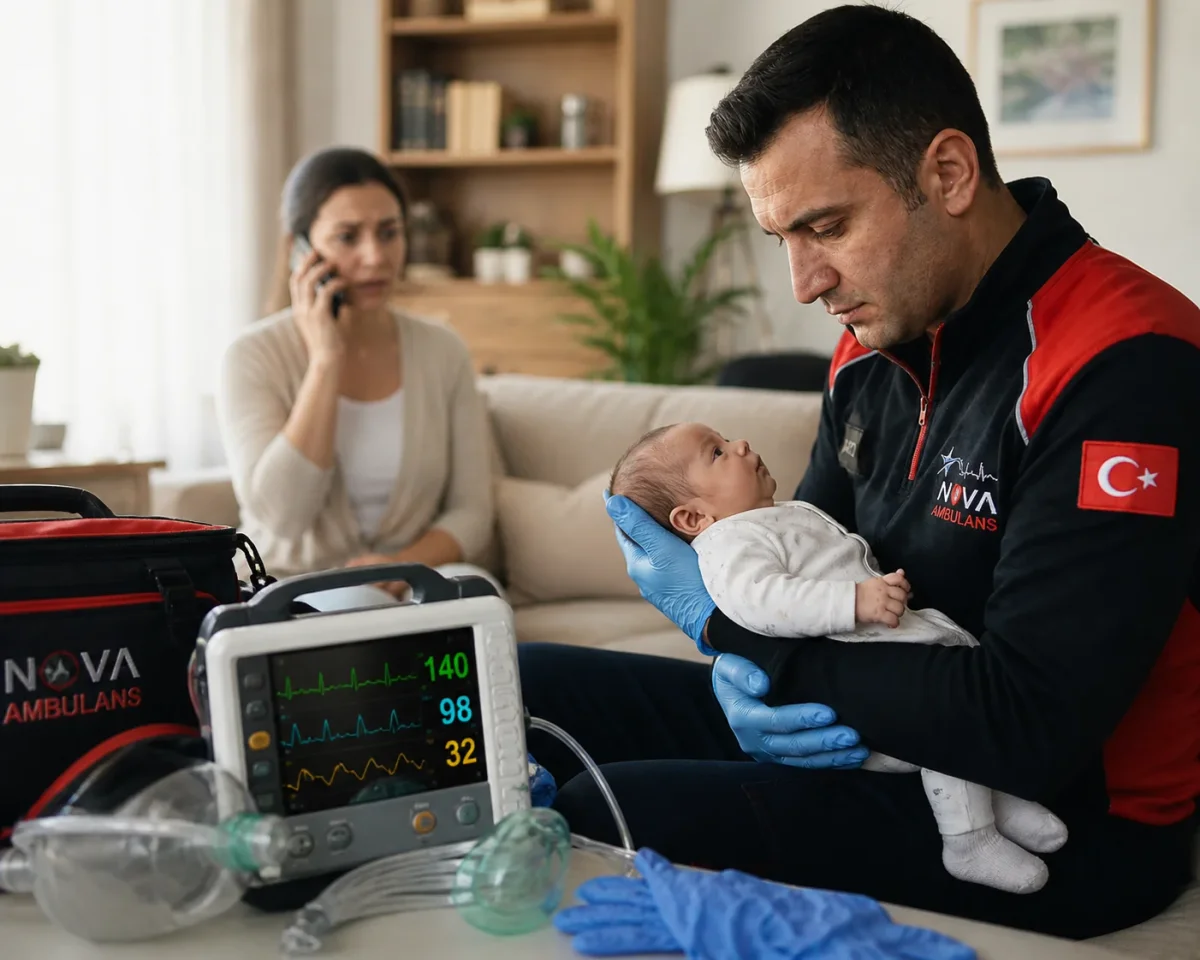
- According to the Turkish Statistical Institute (Türkiye İstatistik Kurumu, TÜİK) "Statistics on Children, 2024" bulletin, the leading cause of death in children aged 1–17 is external injuries and poisoning; 1,538 children died from these causes in the latest reported year.
- For an infant who is choking, the American Heart Association 2025 guidelines recommend cycles of 5 back blows alternating with 5 chest thrusts; the Heimlich maneuver is used for children older than 1 year.
- Drowning is the leading cause of death for children aged 1–4 in the United States per the Centers for Disease Control and Prevention (CDC) 2026 update, and recovery is measured in seconds.
- For suspected poisoning, call Türkiye's National Poison Information Center (Ulusal Zehir Danışma Merkezi, UZEM — short code 114) first; if the child shows altered consciousness or breathing difficulty, call 112 or Nova Ambulans simultaneously.
- A first-ever seizure, a seizure lasting more than 5 minutes, and cyanosis are always emergency-call thresholds.
Quick answer: In a pediatric emergency the critical decision compresses to one sentence — has the threshold been crossed for calling 112 (or Nova Ambulans for a private-hospital preference) without losing seconds? According to the Turkish Statistical Institute (Türkiye İstatistik Kurumu, TÜİK) "Statistics on Children, 2024" bulletin, the leading cause of death in children aged 1–17 is external injuries and poisoning; 1,538 children died from these causes in the latest reported year [5]. Correct first aid in the first 5–10 minutes at home transforms the outcome; but no single rule fits every clinical picture — this guide summarizes eight absolute call thresholds, five common pediatric clinical pictures, and the wait-for-ambulance protocol, anchored to 2025–2026 guidelines.
Why Pediatric Emergencies Differ From Adult Emergencies
The European Resuscitation Council (ERC) 2025 Paediatric Life Support (PLS) guideline clarifies age definitions: infant covers 0–1 years, child 1–12 years, and adolescent 13–18 years [4]. The classification matters because airway diameter, heart rate, fluid distribution, and rescue technique all differ by age. In the American Heart Association (AHA) 2025 Pediatric Basic Life Support (PBLS) announcement, Pediatric Advanced Life Support (PALS) co-chair Dr. Javier Lasa captures the principle: "Children are not little adults, and these guidelines offer specific recommendations that reflect the unique needs of children" [3].
In practice the difference shows in three places:
- Rapid deterioration: an infant has a tiny oxygen reserve and can become cyanotic in seconds.
- Narrow airway: a grape, a peanut, or a small toy part that an adult would simply swallow can fully obstruct an infant's airway.
- Dose sensitivity: medications and fluids are calculated by weight; the ambulance team needs the child's accurate weight on arrival.
The next section converts these differences into action a parent can take at home.
Calling 112 (or Nova Ambulans) — Eight Absolute Thresholds
If any one of the eight pictures below is present, do not wait — call 112 or Nova Ambulans on speakerphone:
- Loss of consciousness — the child cannot be roused.
- Breathing has stopped or has slowed sharply; cyanosis is visible.
- Choking maneuvers have not cleared the airway after several cycles.
- A seizure lasts more than 5 minutes, recurs back-to-back, or is the first-ever seizure.
- Fall from height combined with altered consciousness, vomiting, or one-sided weakness.
- Severe, uncontrolled bleeding (especially head, neck, or abdominal injury).
- Suspected anaphylaxis: facial/tongue swelling, generalized hives, wheezing, or hypotension.
- Poisoning combined with altered consciousness, convulsion, or breathing difficulty (for contact/ingestion alone, call 114 — the National Poison Information Center (Ulusal Zehir Danışma Merkezi, UZEM) — first; for any added sign call 112 simultaneously).
If none of these thresholds are met, home observation and a call to your family physician is usually enough. Decision-support hotlines simplify the choice: in poisoning, 114, the National Poison Information Center (UZEM), is a national center handling roughly 1,000 calls per day; the General Directorate of Public Health (Halk Sağlığı Genel Müdürlüğü, HSGM) physician Dr. Hamdi Küçük confirmed this load to Anadolu Agency, stating they "receive approximately one thousand calls per day" [6].
The Five Most Common Clinical Pictures and the Right First Aid
1. Choking (Foreign Body Airway Obstruction, FBAO)
Grapes, peanuts, sausage slices, and small plastic parts are the classic triggers. Technique varies by age:
- Infant (0–1 year, ineffective cough): the American Heart Association (AHA) 2025 guidelines specify "5 back blows alternating with 5 chest thrusts" [3]. In practice place the infant face-down on your forearm with the head lower than the trunk; deliver 5 back blows between the shoulder blades with the heel of your hand. If unsuccessful, turn the infant face-up and deliver 5 chest thrusts with two fingers just below the nipple line. Repeat the cycle until the object is expelled or the infant becomes unconscious.
- Child (over 1 year, ineffective cough): 5 back blows first, then 5 abdominal thrusts (Heimlich). Stand behind the child, wrap your arms around the trunk, place your fist above the navel, and pull sharply inward and upward.
- Effective cough: do not intervene; encourage continued coughing. Forcing maneuvers when the child can still breathe can drive the foreign body deeper.
A 2024 systematic narrative review published in Medicina (Kaunas) concludes — despite limited evidence — that "back blows remain one of the safer and more effective techniques for managing FBAO [Foreign Body Airway Obstruction], particularly in paediatric cases" [8]. If the object does not clear, or the child loses consciousness, switch to pediatric basic life support — that is, the chest-compression and rescue-breath cycle described in the next section — and call 112 / Nova Ambulans. The Look-Listen-Feel breathing check and the Hands-Only Cardiopulmonary Resuscitation (CPR) option for untrained bystanders are summarized in Until the Ambulance Arrives, citing the Turkish Red Crescent, American Heart Association, and European Resuscitation Council.
2. Febrile Seizure
Most often seen in infants and children 6 months – 5 years during a rapidly rising fever. Most simple febrile seizures end spontaneously within 1–3 minutes; however, a seizure that exceeds 5 minutes, recurs in succession, or is one-sided requires emergency drug treatment. Ambulance-call thresholds and the home-care framework — stay calm, secure a safe area, place the child on the side — are covered in our When to Call an Ambulance for Seizures article with full clinical references.
A short action checklist:
- Place the child on a soft surface, in the recovery position.
- Move sharp objects out of reach; support the head.
- Never put fingers, a spoon, or cloth into the mouth.
- Start your stopwatch; note the start–end time (record video if possible).
- If 5 minutes elapse, or it is a first-ever seizure, call 112 / Nova Ambulans.
3. Poisoning
Most pediatric poisoning is 0–4 years household exposure: cleaning products, the medicine cabinet, lamp fuel, cosmetics, or vitamin overdoses. Steps:
- Call 114, the National Poison Information Center (UZEM), first. The on-call physician will ask the substance, amount, and the child's age and weight, and tell you whether home observation is sufficient or hospital referral is required. Anadolu Agency reports the National Poison Information Center (UZEM) physician saying they "receive approximately one thousand calls per day," with 70 percent of cases human-caused [6].
- Do not induce vomiting unless the National Poison Information Center (UZEM) tells you to — it is contraindicated, especially with corrosives (bleach, drain cleaner) and hydrocarbons (kerosene, lamp oil), where vomiting worsens lung injury.
- Bring the substance with you: the original packaging, label, or remaining quantity helps the hospital decide on the antidote.
- If there is altered consciousness, convulsion, cyanosis, or breathing difficulty, call 112 in parallel with 114; the child needs rapid pediatric-equipped transport.
4. Burns (Hot Liquid, Stove, Electric Heater, Boiling Milk)
The kitchen and bathroom are the most common settings; relative to body-surface area children lose fluid and heat faster than adults. Correct first aid:
- Remove burned clothing if it does not stick; never tear off adherent fabric.
- Cool the burn under running cool–lukewarm water for at least 20 minutes. Do not use ice — it freezes tissue and adds injury.
- Do not apply toothpaste, oil, tomato paste, or other home remedies; they cause infection and obscure assessment.
- Cover with a clean, lint-free cloth to limit heat loss.
- Call 112 / Nova Ambulans for burns to the face, hands, feet, genitals, joints; surface area >10%; or any electrical or chemical burn.
Our Winter Burn Accidents at Home article shares additional protocols for stove and electric-heater injuries.
5. Drowning (Bathtub, Pool, Swimming)
Drowning, in the Centers for Disease Control and Prevention (CDC) January 2026 update, "More children ages 1–4 die from drowning than any other cause of death" — i.e., the leading cause [2]. The World Health Organization (WHO) 2026 Drowning Fact Sheet adds a global view: "Drowning is the fourth leading cause of death for children aged 1–4 years and the third leading cause of death for children aged 5–14 years" [1]. In water, recovery is measured in seconds:
- Get the child out of the water immediately; do not hold them face-down.
- If the child is silent and not breathing, call 112 / Nova Ambulans and start Cardiopulmonary Resuscitation (CPR) — the combined chest-compression and rescue-breath cycle that delivers basic life support. The cycle ratio depends on the number of rescuers (helping adults): with one rescuer use 30 chest compressions + 2 rescue breaths; with two rescuers use 15 chest compressions + 2 rescue breaths. For step-by-step adult Cardiopulmonary Resuscitation (CPR) using the Look-Listen-Feel assessment see our Until the Ambulance Arrives guide. For an infant (0–1 year), the American Heart Association (AHA) 2025 guidelines recommend the two-thumb–encircling-hands technique: place the infant on the back, position both thumbs side-by-side on the breastbone just below the nipple line, encircle the chest with your fingers supporting the back, and compress the chest about 4 cm at a rate of 100–120/minute [3].
- Do not wait out swallowed water; even after the Return of Spontaneous Circulation (ROSC) the child needs hospital observation for "secondary drowning" risk.
Prevention is by far the strongest single strategy: a 0–4-year-old child can become motionless in the bathtub in less than a moment; supervision must be uninterrupted.
Three Things to Do While Waiting for the Ambulance
The 5–15 minutes after the call are when your data accelerates the team's hospital decision. The three pieces of information our crew asks first are:
- Time of onset: "She started choking at 11:42; I began chest thrusts at 11:44."
- Substance, dose, amount: in poisoning, the product container and estimated volume/count; in burns, the fluid type and approximate temperature.
- Past medical history and medications: allergies, current treatments, immunization status, birth history (preterm, cardiac anomaly, etc.).
Spend that interval at the child's side — keeping the recovery position, airway, and warmth — rather than running back and forth to the door. For a deeper checklist see Guide for Relatives Waiting for the Ambulance.
112 vs Private Ambulance (Nova Ambulans) — The Pediatric Decision
Both systems answer the same human-life priority. The practical differences are hospital choice, on-board pediatric-ready equipment, and physician escort:
- 112 has wide station coverage and typically reaches the nearest public pediatric emergency department quickly.
- Nova Ambulans offers flexibility when you prefer a specific private hospital; the team carries pediatric-dose-calibrated oxygen, a monitor, a glucometer, and — when needed — a physician. The full mandatory equipment list and the Turkish regulatory framework is covered in Required Equipment in Ambulances — Turkey Regulation. The Communiqué on Implementation Procedures of Inpatient Healthcare Facility Emergency Services (Official Gazette 13/9/2022, Issue 31952) requires pediatric emergency departments to "assign a pediatric emergency medicine specialist if available, otherwise a pediatrician" [7] — meaning the destination hospital changes the receiving environment substantially.
For the full comparison see Difference Between 112 and a Private Ambulance; for long-distance or higher-acuity pediatric transports see When Is an Intensive Care Ambulance Required?.
Important note: Private hospitals may decline a patient based on capacity. If that happens, Nova Ambulans either finds an alternative private hospital or transports the patient to the nearest public hospital.
Prevention: The Single Most Life-Saving Step
The vast majority of the 1,538 deaths reported in the Turkish Statistical Institute (TÜİK) "Statistics on Children, 2024" bulletin stem from preventable external causes [5]. The Turkish Red Crescent First Aid Unit's pediatric reference prioritizes four points for the home: medication and cleaning-product locks, outlet covers and a hot-water temperature limit, a safe play area, and uninterrupted pool/bath supervision [9]. Add to this:
- A child under 12 must travel in the rear seat of the car, in an age- and weight-appropriate child seat.
- When hot liquid is on the kitchen counter, restrict small-child access to the kitchen.
- At least one adult per household should be certified in pediatric basic life support (BLS); certification should be renewed every three years [9].
Frequently Asked Questions
My infant suddenly turned blue and is silent — what do I do?
Without counting seconds, call 112 (or Nova Ambulans if you prefer a private hospital) on speakerphone, and at the same time place the infant face-down on your forearm and deliver 5 back blows between the shoulder blades. If the airway does not clear, turn the infant face-up and deliver 5 chest thrusts with two fingers on the breastbone. The American Heart Association 2025 guidelines describe this cycle for infant foreign body airway obstruction (FBAO) [3]. If consciousness is lost, switch to pediatric basic life support — depending on the number of rescuers (helping adults), use a 30 chest compressions + 2 rescue breaths cycle with one rescuer or 15 + 2 with two rescuers.
Is there an ambulance category specifically for children?
Turkish regulation does not define a separate "child ambulance" type; however, the Communiqué on Implementation Procedures of Inpatient Healthcare Facility Emergency Services (Official Gazette 13/9/2022, No. 31952) states that pediatric emergency departments must assign a pediatric emergency medicine specialist if available, otherwise a pediatrician [7]. For long-distance pediatric transport Nova Ambulans dispatches a team experienced in pediatrics with pediatric-dose-calibrated equipment.
For suspected poisoning, do I call 112 or 114 first?
If the child is conscious, breathing, and the substance is identified, call 114 — the Turkish National Poison Information Center (Ulusal Zehir Danışma Merkezi, UZEM) — first; the on-call physician will assess whether home observation suffices or hospital referral is needed. The General Directorate of Public Health (Halk Sağlığı Genel Müdürlüğü, HSGM) physician Dr. Hamdi Küçük told Anadolu Agency that the center receives "approximately one thousand calls per day" [6]. If there is any altered consciousness, convulsion, vomiting with breathing difficulty, or an unknown substance, call 112 simultaneously.
How should I transport my child to the hospital after a febrile seizure?
A first-ever seizure always warrants medical evaluation; for seizures that last more than 5 minutes or recur in succession, call 112 or Nova Ambulans. While waiting, place the child in the recovery position, never put any object in the mouth, and note the start time of the seizure. For the full clinical protocol see our When to Call an Ambulance for Seizures article.
How often should I refresh my pediatric first-aid certification?
The Turkish Red Crescent First Aid Unit recommends renewing first-aid certificates every three years [9]. The European Resuscitation Council 2025 Paediatric Life Support guideline recommends that all parents and caregivers be encouraged to learn to recognize critical illness and injury and to perform basic life-saving first aid [4]. Because resuscitation skills decay over time, the ERC 2025 Education for Resuscitation guideline emphasizes spaced learning and regular refresher training [10].
Related Articles
- When to Call an Ambulance for Seizures — Clinical thresholds for febrile seizures and first-ever seizures in children.
- Heart Attack Symptoms and Immediate Actions — Adult-emergency analogue for the same "when to call" decision logic.
- Difference Between 112 and a Private Ambulance — Hospital-choice comparison applied to pediatric transport.
- When Is an Intensive Care Ambulance Required? — Higher-acuity pediatric transport.
- Guide for Relatives Waiting for the Ambulance — Practical steps until the team arrives.
- Until the Ambulance Arrives — Step-by-step adult Cardiopulmonary Resuscitation (CPR) and Look-Listen-Feel assessment.
Rapid Emergency Support
24/7 emergency ambulance service across Istanbul. Fast response, fully equipped team.
Average response time: 15 seconds
Related Articles
What Does a Gray Ambulance Mean? The Patient-Transport Ambulance and Turkey's 2025 Color Regulation
The gray body with a blue stripe you see in traffic or in front of a hospital is a patient-transport ambulance, redefined by Turkey's Official Gazette regulation of 8 January 2025 (RG-8/1/2025-32776). This guide explains where the gray (RAL 7004) color comes from, how it differs from the white emergency ambulance, the restriction on audible warning systems, the detachable blue light restored by the 24 June 2025 amendment, the transition period that closed on 1 January 2026, and how to behave when you see a gray ambulance in traffic — grounded in the T.C. Ministry of Health and World Health Organization (WHO) sources.
EducationTick Bite First Aid: Correct Removal Technique and the Crimean-Congo Haemorrhagic Fever (CCHF) Decision
When a tick attaches to the skin, the bystander’s step-by-step response: gloved, fine-tipped tweezers gripping the tick’s head as close to the skin as possible with steady upward traction, no alcohol, petrol, nail polish, matches or lit cigarettes, saving the removed tick in a labelled sealed plastic bag, a 14-day watch schedule for Crimean-Congo Haemorrhagic Fever (CCHF), the 112 decision when a fever, severe muscle pain, bleeding or profound weakness appears, and safe transfer to an infectious-diseases clinic — with primary sources from the Turkish Red Crescent 2025 First-Aid Pocket Book, the Turkish Ministry of Health May 2025 First-Aid Training Manual, the Turkish Red Crescent Esenyurt First-Aid Training Centre 2024 verbatim protocol, the Turkish Ministry of Health CCHF Scientific Council bulletin, Karanfil et al. 2026 (n=7,776 national surveillance), Güllü et al. 2025 (n=1,103 18-hospital cohort), the World Health Organization (WHO) 2025 fact sheet, the European Centre for Disease Prevention and Control (ECDC) factsheet, and Norman et al. 2025 European review.
EducationBee, Wasp, and Hornet Sting First Aid: When a Sting Reaction Needs 112
Step-by-step first aid for honeybee, wasp, and hornet stings — the bystander's 30-second stinger-scrape technique (credit-card scrape, never tweezers), local vs large-local vs systemic reaction decision tree, when to call Türkiye's 112 emergency line, adrenaline auto-injector application to the outer thigh, and what to do until the ambulance arrives — with verbatim protocols from Türk Kızılay Cep Kitabı 2025, T.C. Sağlık Bakanlığı May 2025 First-Aid Training Manual, the Turkish National Society of Allergy and Clinical Immunology (AİİAD), the Society of Pediatric Allergy and Asthma Academy (CAAAD), the 2025 Katran cohort of 194 526 patients at Istanbul Süreyyapaşa Hospital, the 2021 Öziş Baba cohort of 7 904 Trabzon schoolchildren, the American Academy of Allergy, Asthma & Immunology (AAAAI) and the McMurray 2026 Hymenoptera venom anaphylaxis review.
Popular Ambulance Topic Clusters
You may also like
- Private ambulance pricing
- Istanbul private ambulance
- Intercity patient transport
- Doctor-accompanied ambulance
- Dialysis patient transport
- How intercity patient transport works
- Ambulance response time in Istanbul
- Home-to-hospital patient transport
- Modern ambulance equipment and team standards
- Heart attack symptoms and first response
This content is informational only and does not replace professional medical evaluation. In emergencies, call 112 or +90 216 339 00 39.
