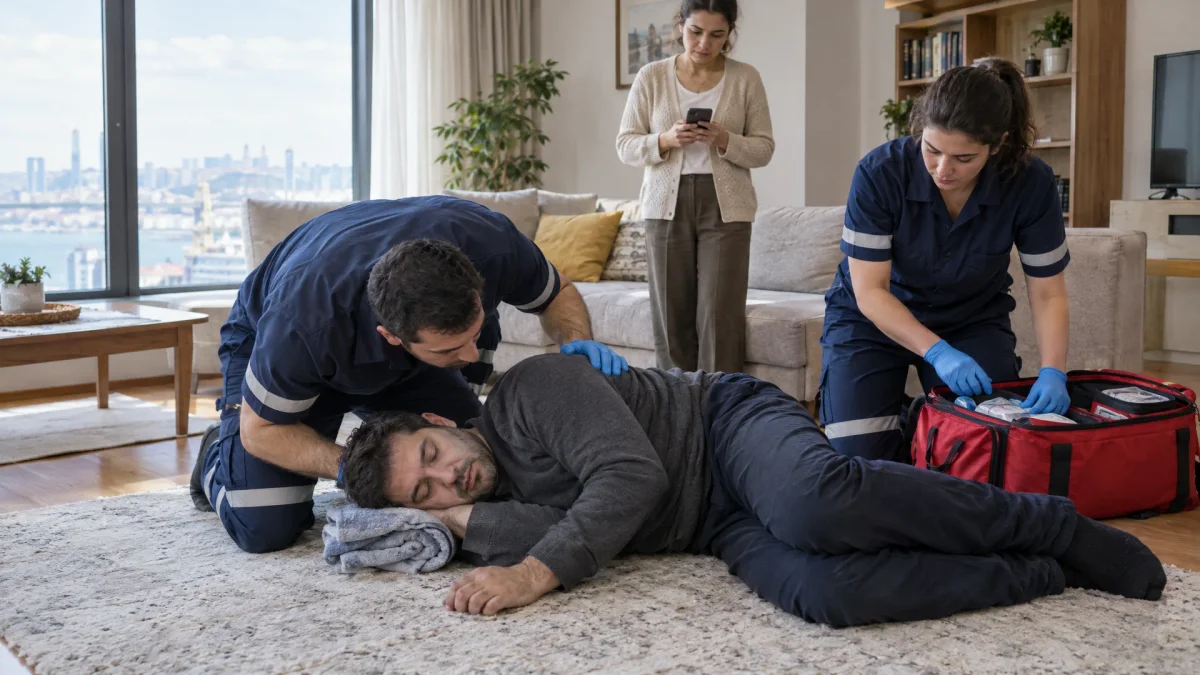
- Emergency: Call 112 or Nova Ambulans if the seizure lasts longer than 5 minutes or breathing stops.
- First Aid: Turn the patient to the side, protect their head, and do not put objects in their mouth.
- Observation: Note the duration and form of the seizure and report to the physician.
- Private Ambulance: Can be preferred for safe and supervised transport after seizure.
Seizure or convulsion as frequently used among the public is an extremely frightening picture for families, especially in children. The World Health Organization (WHO) reports that "around 50 million people worldwide have epilepsy, making it one of the most common neurological diseases globally" [3]. While some short-lasting seizures can be simple and benign, some can carry life risk. The guide below helps you tell seizure types apart, time the 5-minute threshold accurately, and decide when 112 or Nova Ambulans is the right call.
Seizure Types: Clinical Distinctions Parents Should Know
- Generalised tonic-clonic seizure: Whole-body stiffening then jerking, loss of consciousness, often urinary incontinence, postictal sleep. The most recognisable type in the ILAE (International League Against Epilepsy) classification and the most frightening for families at home.
- Absence seizure (typically paediatric): Seconds-long staring spells, blank gaze, halted activity — no jerking, no fall. Families often dismiss this as "daydreaming"; recurrent episodes need paediatric neurology referral.
- Focal seizure: Rhythmic jerking limited to one limb, face, or extremity; consciousness can be preserved or altered.
- Febrile convulsion: Typically in children 6 months – 5 years old, during rapidly rising fever. World Health Organization (WHO) notes that "the use of drugs and other methods to lower the body temperature of a feverish child can reduce the chance of febrile seizures" [3]. A first febrile seizure always warrants medical evaluation; recurrent simple febrile seizures shift the focus to family fever-management education [2].
- Prolonged seizure and status epilepticus: Per Cross JH (Epileptic Disorders, 2014), a seizure lasting longer than 5 minutes (a prolonged seizure) is the operational threshold that requires urgent drug intervention; if left untreated it can progress to status epilepticus (≥30 minutes) [5].
Even if every seizure does not necessarily mean life risk, it should be taken seriously if it is experienced for the first time or lasts long [2][3].
When Should You Call 112 or Nova Ambulans?
If even one of the following situations exists, call 112 or Nova Ambulans without delay:
- If the seizure lasts longer than 5 minutes or seizures come one after another. The Centers for Disease Control and Prevention (CDC)'s seizure first-aid page is explicit: "Time the seizure to track if it lasts more than 5 minutes. If it does, seek immediate medical attention or call 911." [6]
- If the patient still does not wake up after the seizure, breathing is irregular or very slow [1][2]
- If the patient turns blue or seems not breathing during the seizure [1][4]
- If the seizure started after a blow to the head, falling from a height, or an accident
- If having a seizure for the first time (especially in children) — Centers for Disease Control and Prevention (CDC) lists first seizures as an automatic emergency-call criterion [6]
- Any seizure in an infant under 6 months; or atypical features in a child older than 5 (one-sided, longer than 15 minutes, or recurring within 24 hours)
- If a seizure developed in a pregnant person or someone with known serious heart/diabetes disease [2][3]
- A seizure occurring in water (bath, pool) [6]
This picture requires professional emergency medical evaluation.
While Waiting: The Centers for Disease Control and Prevention (CDC) Stay–Safe–Side Sequence
The Centers for Disease Control and Prevention (CDC)'s "Stay – Safe – Side" framework is the simplest protocol families can run at home [6]:
- Stay: Stay with the person and remain calm; mark the start time on your phone.
- Safe: Remove hard and sharp objects nearby; place a soft support under their head [4].
- Side: Turn them onto their side so the tongue cannot fall back and vomit cannot enter the airway [1][4][6].
- Loosen clothing around the throat.
- Never place an object in their mouth. The Centers for Disease Control and Prevention (CDC) rule is unambiguous: "Don't hold the person down or stop their movements." [1][6]
Video recording: the most useful evidence for the physician
If possible, take a phone video of the seizure. Onset pattern (one-arm vs generalised), direction of eye deviation, the stiffening–jerking rhythm, and total duration can be as informative as an EEG when the neurologist later classifies the seizure.
Once the seizure ends, the patient may be sleepy; watch breathing and skin colour in a calm environment.
What is the Role of Private Ambulance?
In suspicion of life risk, 112 or Nova Ambulans can be called. 112 generally provides fast transport to the nearest public hospital with its wide station network. Nova Ambulans offers a more flexible solution for your private hospital preferences.
Note: Private hospitals may not accept patients according to capacity status. In such a case, Nova Ambulans finds an alternative private hospital or transports the patient to the nearest public hospital.
Also, private ambulance can come into play if:
- Planned transport is required for advanced tests and follow-up after seizure,
- Your doctor says "supervised transport would be safer",
- Especially transport to distant centers or intercity is planned.
Private ambulance teams become prepared with medication and equipment against possible re-seizure on the way.
Frequently Asked Questions
Can I understand the difference between simple febrile convulsion and epileptic seizure at home?
It is often not possible to make this distinction definitely at home just by looking at the picture. Therefore, emergency medical evaluation is definitely required especially in first seizure, long-lasting seizure, or situations where recovery is delayed afterwards.
Is it right to put something in the patient's mouth during a seizure?
No; putting a spoon, cloth, finger, or any object can lead to tooth fracture, airway obstruction, and additional injuries. The most correct thing is to put the patient in side position, protect their head, and ensure the airway remains open.
Should I try to wake the patient after the seizure?
Short-term sleep and dizziness are frequently seen after a seizure and are not a bad sign alone. However, if there is deterioration in breathing, significant asymmetry, re-seizure, or very long unconsciousness, it is necessary to call 112 or Nova Ambulans without delay.
Rapid Emergency Support
24/7 emergency ambulance service across Istanbul. Fast response, fully equipped team.
Average response time: 15 seconds
Related Articles
Mushroom Poisoning Symptoms and First Aid: When Do Symptoms Start, When to Call 112?
If nausea, vomiting, diarrhea, abdominal pain or any other symptom begins after eating foraged mushrooms or mushrooms of unknown origin, call 112, whatever hour it began; do not induce vomiting and give nothing by mouth. People without symptoms, including a child who ate a mushroom in a garden or park, still need hospital assessment; call 112 and explain, because with amatoxin, which damages the liver, the symptom-free interval averages 8-10 hours. The National Poison Information Center (UZEM) on 114 gives advice but does not replace 112.
EducationBee, Wasp, and Hornet Sting First Aid: When a Sting Reaction Needs 112
Step-by-step first aid for honeybee, wasp, and hornet stings — the bystander's 30-second stinger-scrape technique (credit-card scrape, never tweezers), local vs large-local vs systemic reaction decision tree, when to call Türkiye's 112 emergency line, adrenaline auto-injector application to the outer thigh, and what to do until the ambulance arrives — with verbatim protocols from Türk Kızılay Cep Kitabı 2025, T.C. Sağlık Bakanlığı May 2025 First-Aid Training Manual, the Turkish National Society of Allergy and Clinical Immunology (AİİAD), the Society of Pediatric Allergy and Asthma Academy (CAAAD), the 2025 Katran cohort of 194 526 patients at Istanbul Süreyyapaşa Hospital, the 2021 Öziş Baba cohort of 7 904 Trabzon schoolchildren, the American Academy of Allergy, Asthma & Immunology (AAAAI) and the McMurray 2026 Hymenoptera venom anaphylaxis review.
EducationWaiting for the Ambulance: A Guide for Relatives
Learn step-by-step what patient relatives should and should not do in the critical minutes until the ambulance arrives, and how to help the team.
Popular Ambulance Topic Clusters
You may also like
- Private ambulance pricing
- Istanbul private ambulance
- Intercity patient transport
- Doctor-accompanied ambulance
- Dialysis patient transport
- How intercity patient transport works
- Ambulance response time in Istanbul
- Home-to-hospital patient transport
- Modern ambulance equipment and team standards
- Heart attack symptoms and first response
This content is informational only and does not replace professional medical evaluation. In emergencies, call 112 or +90 216 339 00 39.
