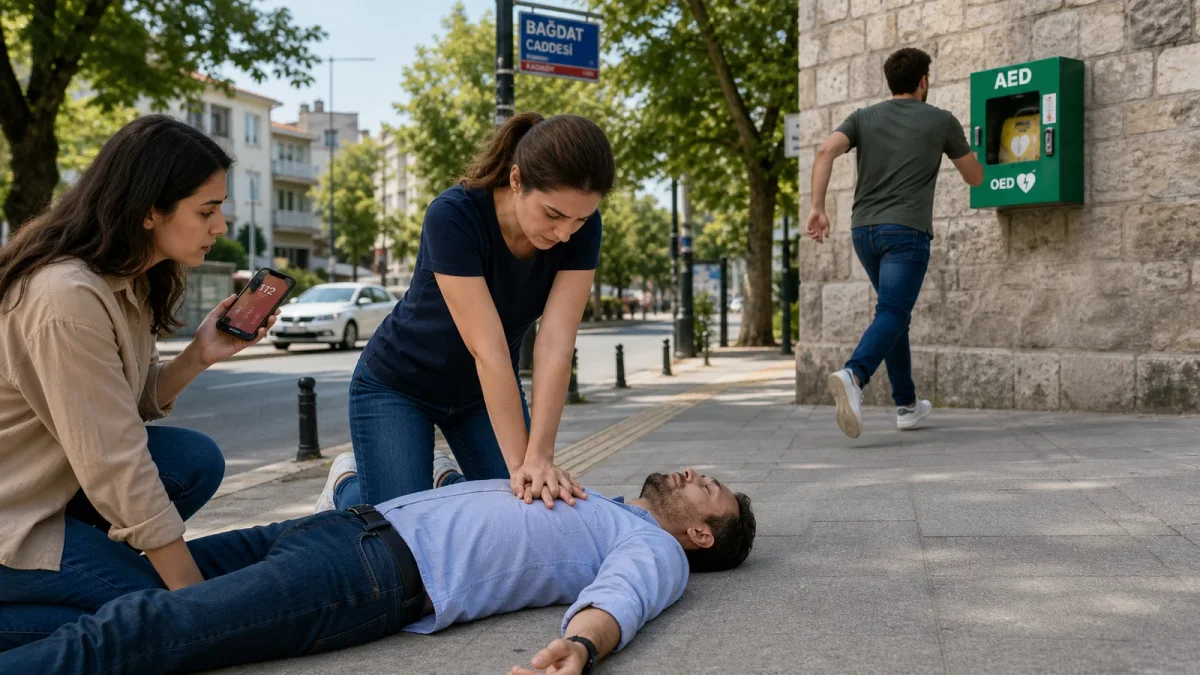
- According to the Turkish Statistical Institute (TÜİK) 2024 mortality data, circulatory system diseases ranked first at 36% of all deaths, and ischemic heart disease accounted for 42.9% of that group — meaning correct bystander first response makes a measurable difference for tens of thousands every year.
- For the untrained bystander the American Heart Association recommends Hands-Only, compression-only Cardiopulmonary Resuscitation (CPR); in the 2010 JAMA Arizona cohort, survival to hospital discharge was 13.3% with this method, versus 7.8% with conventional 30 chest compressions + 2 rescue breaths and 5.2% with no bystander Cardiopulmonary Resuscitation (CPR) at all.
- For the trained rescuer the European Resuscitation Council 2025 guidelines and Türk Kızılay both call for chest compressions at 100–120 per minute, 5–6 cm deep, in a 30 chest compressions + 2 rescue breaths cycle.
- The decision compresses to one sentence — if there is no response and no breathing (or only agonal gasping), call 112 (or Nova Ambulans for a private-hospital preference) on speakerphone and start chest compressions immediately.
- If an Automated External Defibrillator (AED) is available, switch it on and follow the voice prompts; if it advises a shock, ensure no one is touching the patient and deliver the shock, then resume chest compressions.
Quick answer: When an adult collapses, the decision compresses to one sentence — if they are unresponsive and not breathing (or only gasping with agonal breaths), call 112 on speakerphone and start chest compressions in parallel. According to the Turkish Statistical Institute (TÜİK) 2024 data, 36% of Türkiye's 489,361 deaths were caused by circulatory-system disease, and 42.9% of that group by ischemic heart disease [9]. This guide covers the Hands-Only Cardiopulmonary Resuscitation (CPR) option for the untrained bystander and the 30 chest compressions + 2 rescue breaths cycle for the trained rescuer, framed by the American Heart Association 2025 and European Resuscitation Council 2025 guidelines — because when the person collapsing is someone you love, seconds save lives.
Chain of Survival: Five Links That Save a Cardiac Arrest
In an adult out-of-hospital cardiac arrest, survival depends on a chain measured in seconds, not minutes. The American Heart Association (AHA) 2025 update phrases it directly: "A single chain of survival is intended to apply to adult and pediatric in- and out-of-hospital cardiac arrest" [2]. The links are:
- Early recognition and call for help: the moment unresponsiveness + absence of breathing is recognized, call 112 without losing seconds.
- Early high-quality chest compressions: 100–120/min, 5–6 cm deep, continuous.
- Early defibrillation: stop a shockable rhythm with an Automated External Defibrillator (AED).
- Early advanced life support: ambulance team takes over with airway, IV access, and medications.
- Post-resuscitation care and recovery: Intensive Care Unit (ICU)-level targeted temperature management, neurological protection, rehabilitation.
The first three links are in the bystander's hands. That's why, although TÜİK's 2024 mortality data shows circulatory diseases producing 36% of Türkiye's 489,361 total deaths and ischemic heart disease accounting for 42.9% of that bucket [9], the bystander response started at home, on the street, or in the workplace bends the curve. Anadolu Agency, citing T.C. Ministry of Health data, reports that "approximately 300,000 people experience a heart attack in Türkiye each year" [8]; a substantial share of these begin outside hospitals, in front of family members and colleagues.
A more granular picture comes from a four-year out-of-hospital cardiac arrest dataset published in the Anatolian Journal of Emergency Medicine in 2025: survival to the emergency department was 52.2% but survival to discharge was just 6.4%, and bystander chest compressions correlated strongly with ED survival in univariate analysis [7]. The trajectory is set by the bystander's first minutes — by the time the team arrives, much has already been decided.
Look-Listen-Feel: A 10-Second Bystander Assessment
The first tool the public reaches for is a simple breathing check that should never exceed 10 seconds: Look-Listen-Feel. These three steps let an untrained bystander recognize cardiac arrest with confidence.
- Make the scene safe. Traffic, live electricity, smoke, scattered medication, a crowd. Check before you approach.
- Check responsiveness. Tap the shoulders firmly and ask "Are you okay?" loudly. If there is no response, call out for help and dial 112 (or Nova Ambulans if you prefer a private hospital) on speakerphone.
- Open the airway. Place one hand on the forehead and two fingers of the other hand under the chin; tilt the head back gently and lift the chin upward.
- Look-Listen-Feel: Look at the chest for movement, listen at the mouth and nose for breath sounds, feel for warm breath on your cheek. Total time: 10 seconds maximum.
If there is no breathing or if breathing is agonal — irregular, gasping, "gulp" sounds with long pauses — assume cardiac arrest and start chest compressions. The European Resuscitation Council (ERC) 2025 Adult Basic Life Support (BLS) guideline highlights that "mistaking agonal breathing for normal breathing is among the most common bystander pitfalls" [3]. When uncertain, act: the cost of acting and being wrong is much smaller than the cost of inaction.
The same Look-Listen-Feel framework applies in pediatrics, but children and infants need additional age-specific maneuvers; for that protocol see our Pediatric Emergencies: A Parent's Guide.
Calling 112: Spending Seconds Wisely
Once the decision is clear, one number suffices: 112, Türkiye's national emergency call center, coordinated by the Ministry of Health; if you prefer a specific private hospital, you can call Nova Ambulans in parallel. Keep the conversation tight and convey three things:
- Location: street address + building/entrance details. If possible, put the phone on speakerphone so a second bystander can begin compressions.
- Type of event: "Unresponsive, not breathing" is enough — the dispatcher activates the cardiac arrest protocol immediately.
- What you have started: "I am doing chest compressions" or "An automated external defibrillator is being brought."
If the dispatcher gives instructions, do not hang up; you can keep the call active while continuing compressions. For the operational and clinical differences between 112 and a private ambulance see our Difference Between 112 and a Private Ambulance guide; for how the dispatch chain works behind the scenes see What Is the SKKM Health Command Control Center?. For a do-and-don't checklist while the team is en route see Guide for Relatives Waiting for the Ambulance.
For the Untrained Bystander: Hands-Only Cardiopulmonary Resuscitation (CPR)
If you are untrained and an adult collapses, you do not need to give rescue breaths — in fact, you should focus on chest compressions only. The American Heart Association (AHA) 2025 Adult Basic Life Support guideline says it plainly: "All lay rescuers should provide chest compressions for adults with presumed cardiac arrest" [1]. The method reduces to two steps:
- Call 112 (or Nova Ambulans in parallel if you prefer a private hospital).
- Push hard and fast in the center of the chest — 100 to 120 per minute, without interruption.
Three practical advantages follow: bystander hesitation drops (no mouth-to-mouth barrier), interruptions between compressions are minimized, and compression quality stays focused on a single goal. The evidence is strong. In the JAMA prospective Arizona cohort of 4,415 out-of-hospital cardiac arrests, survival to hospital discharge was 5.2% with no bystander Cardiopulmonary Resuscitation (CPR), 7.8% with conventional 30 chest compressions + 2 rescue breaths, and 13.3% with compression-only Cardiopulmonary Resuscitation (CPR) [5]. A 2010 meta-analysis of three randomized trials reached the same conclusion: "Available evidence strongly supports the superiority of bystander compression-only CPR" [6]; survival to discharge was 11.5% in the compression-only arm and 9.4% in the conventional arm.
Correct chest-compression technique
Walking through this once in front of a mirror builds the muscle memory you need in a crisis:
- Lay the patient supine on a hard, flat surface. Beds and couches are too soft; if possible, lower the patient to the floor or place a board underneath.
- Place the heel of one hand on the lower half of the breastbone and stack the other hand on top, fingers interlocked.
- Lock your elbows; keep your shoulders directly over your hands.
- Use your whole upper-body weight to push at 100–120/min to a depth of 5–6 cm.
- Allow full chest recoil between compressions.
- Do not pause; if you tire, switch with another bystander every 1–2 minutes.
Need a tempo cue? Many common songs are 100–120 BPM (e.g. "Stayin' Alive"). Türk Kızılay's adult guide makes the limits explicit: "Chest compressions are delivered at 100–120/min, 5–6 cm deep; the cycle is 30 chest compressions to 2 rescue breaths (30:2)" [4].
For the Trained Rescuer: 30 Chest Compressions + 2 Rescue Breaths
If you are first-aid certified and a barrier device is available, switch to the classic cycle: 30 chest compressions, then 2 rescue breaths, repeating with a reassessment after about five cycles (about 2 minutes). The American Heart Association (AHA) 2025 guideline puts it this way: "It is reasonable for lay rescuers and health care professionals to perform CPR with cycles of 30 compressions followed by 2 breaths before placement of an advanced airway" [1]. In practice:
- 30 chest compressions: as above, at 100–120/min, 5–6 cm deep.
- 2 rescue breaths: keeping the airway open (head back, chin up), pinch the nose, seal the mouth, and deliver breaths of about 1 second each — just enough to make the chest visibly rise. Avoid hyperventilation; excessive air causes gastric distention and regurgitation.
- Repeat the cycle. Activate the Automated External Defibrillator (AED) as soon as it arrives; hand off to advanced life support when the ambulance team is on scene.
The European Resuscitation Council (ERC) 2025 Adult Basic Life Support (BLS) guideline covers the same essentials: "Topics addressed include how to recognise cardiac arrest, alerting the emergency services, delivering chest compressions, performing rescue breaths, how to use an automated external defibrillator (AED) and safety considerations for rescuers" [3]. The whole chain — from dialing 112 to using the Automated External Defibrillator (AED) — fits in one guideline, and delay in its early links is costly: in witnessed cardiac arrest, survival falls by roughly 7–10% per minute when no CPR or defibrillation is given, but bystander chest compressions limit that decline to about 3–4% per minute [11]. In other words, starting compressions early nearly halves the cost of every minute lost.
Rescue-breath safety
If the patient is unknown to you and you would rather avoid direct mouth-to-mouth contact, use a pocket mask or face shield, as Türk Kızılay's adult guide also recommends [4]. If a barrier is unavailable and the trained bystander hesitates, defaulting to the untrained-bystander mode — focusing on compressions only — is acceptable.
Handing Off to an Automated External Defibrillator (AED)
The third link of the chain is the public-access Automated External Defibrillator (AED). An Automated External Defibrillator (AED) is a device that walks the bystander through the steps with voice prompts and only delivers a shock if it detects a shockable rhythm (ventricular fibrillation or pulseless ventricular tachycardia); no certification is required to operate it. The practical flow:
- Have a second bystander fetch the nearest device while you continue compressions without interruption.
- Open the lid; most devices begin speaking immediately.
- Place the pads on the bare, dry chest — one below the right collarbone, the other below the left armpit. Dry the chest if it is wet; do not place pads over patches or pacemaker scars.
- During the device's analysis, ensure no one is touching the patient.
- If "Shock advised," confirm aloud that everyone is clear and press the shock button; resume compressions immediately afterward.
- If "No shock advised," continue compressions; the device will reanalyze every two minutes.
Step-by-step Automated External Defibrillator (AED) operation, alternative pad placements (e.g., pacemaker patient, wet chest, pediatric mode for adolescents), and an updated map of public-access cabinets across Istanbul are covered separately in Automated External Defibrillator (AED) Use Guide.
Five Common Bystander Mistakes
Trained eyes see the same handful of errors over and over:
- Treating agonal breathing as normal breathing. Irregular gasping is not breathing; start compressions [3].
- Compressing on a soft surface. Bed-surface compressions are ineffective; move the patient to a hard surface.
- Compressing too shallow or too deep. Less than 5 cm is ineffective, more than 6 cm risks injury [1]. Use full body weight, not just the arms.
- Long pauses between compressions. Pauses for breaths, Automated External Defibrillator (AED) analysis, and rescuer changeovers should not exceed 10 seconds.
- Hyperventilating during rescue breaths. Excessive ventilation distends the stomach and reduces venous return; aim for breaths that make the chest just visibly rise in about a second.
Recognizing the symptoms of a heart attack — pain radiating from chest to arm/jaw/back, sweating, nausea, shortness of breath — is the link before cardiac arrest; for decision logic while the patient is still conscious see Heart Attack Symptoms and Immediate Actions. Three additional bystander tools complement this guide and are being published across April–May 2026: the Heimlich Maneuver for adult choking, the Recovery Position for the unresponsive but breathing patient, and the FAST Test for suspected stroke.
Choosing Between Cardiopulmonary Resuscitation (CPR), Heimlich, Recovery Position, and FAST
These four bystander tools do not substitute for one another; each answers a different clinical picture. The decision matrix is:
- Unresponsive + no breathing (or agonal) ⇒ Basic Life Support / Cardiopulmonary Resuscitation (CPR). This guide's core: chest compressions + (if trained) rescue breaths.
- Conscious but choking on a swallow ⇒ Heimlich Maneuver. Ineffective cough + inability to speak/breathe — back blows + abdominal thrusts in the adult.
- Unresponsive but breathing ⇒ Recovery Position. No cardiac arrest; turn the patient on the side and keep the airway open until the team arrives.
- Conscious but face/arm/speech is abnormal ⇒ FAST Test. In suspected stroke every minute costs neurons; Cardiopulmonary Resuscitation (CPR) is not indicated, but 112 must be dialed and the patient protected.
Together this cluster covers the four scenarios any home/street/workplace bystander is most likely to encounter; each gets its own step-by-step protocol in the linked posts.
What Happens After Nova Ambulans Is Dispatched
After a 112 call or a direct call to Nova Ambulans, the minutes you spend at the patient's side shape the team's plan. On arrival, three pieces of information are taken first:
- Time of onset: "He collapsed at 14:32; I started compressions at 14:33." A clean onset time anchors the advanced-life-support plan.
- Interventions performed: Hands-Only Cardiopulmonary Resuscitation (CPR) or conventional 30 chest compressions + 2 rescue breaths; if an Automated External Defibrillator (AED) was placed, whether shock(s) were delivered, and how many.
- Chronic conditions and medications: known coronary disease, arrhythmia, anticoagulants, renal failure, allergies.
The team takes over with a manual defibrillator/monitor, oxygen, an advanced airway kit, and field-appropriate medications. The full mandatory equipment list and the regulatory framework appear in Required Equipment in Ambulances — Turkey Regulation; the modern equipment-and-team standard appears in Modern Ambulance Equipment and Team Standards. If you have a private-hospital preference, Nova Ambulans routes to that hospital when capacity allows; if not, to the nearest public emergency department.
Important note: Bystander chest compressions do not always restore circulation; but never starting brings survival close to zero in nearly every case. The clinical literature has no place for "What if I make it worse?" — what is proven is that starting is substantially better than not starting [5][6].
Prevention and Preparation
Even the best bystander response is downstream of prevention. In Türkiye, ischemic heart disease is largely driven by modifiable risk factors; the Anadolu Agency report citing the Ministry of Health notes that "approximately 80% of cardiovascular deaths are tied to controllable risks such as tobacco use, unhealthy diet, and inactivity" [8]. A practical home and workplace plan:
- Certified training. The First Aid Regulation (Resmî Gazete 29/7/2015, Issue 29429) requires first-aid certificates to be refreshed every three years [10]. Having at least one adult per household certified in basic life support converts a hesitant bystander into a confident rescuer at the moment that matters.
- Pocket mask and gloves. Keep one pocket mask (face shield), one pair of gloves, and an Automated External Defibrillator (AED) map in your emergency kit. For the kit contents see Emergency Kit Guide.
- Know the Automated External Defibrillator (AED) location. At work, in shopping centers, gyms — find the nearest device in advance; it shaves seconds off the clock.
- Drill. Run a 10-minute family or team drill at least twice a year: response check, calling 112, hand placement on the chest. In a crisis, the automated motion is more valuable than the time used to think.
Frequently Asked Questions
An adult collapsed in front of me — how do I begin?
First make the scene safe; then check for response by tapping the shoulders firmly and asking "Are you okay?" loudly. If there is no response, call 112 immediately (or Nova Ambulans if you prefer a private hospital) on speakerphone. Open the airway and use the Look-Listen-Feel check (look at the chest for movement, listen at the mouth and nose, feel for breath on your cheek) — for no longer than 10 seconds. If there is no breathing or only agonal gasping, treat this as cardiac arrest and start chest compressions on the lower half of the breastbone at 100–120/min and 5–6 cm depth [1][3].
I am untrained — do I have to give rescue breaths?
No. The American Heart Association 2025 Adult Basic Life Support guideline tells the untrained rescuer to do chest compressions only: "All lay rescuers should provide chest compressions for adults with presumed cardiac arrest" [1]. In the prospective Arizona cohort of 4,415 out-of-hospital cardiac arrests reported in JAMA (Bobrow et al., 2010), survival to hospital discharge was 13.3% with compression-only Cardiopulmonary Resuscitation (CPR), 7.8% with conventional 30 chest compressions + 2 rescue breaths, and 5.2% with no bystander Cardiopulmonary Resuscitation (CPR) [5]. So if you are untrained, Hands-Only Cardiopulmonary Resuscitation (CPR) is the best option.
What does the 30 chest compressions + 2 rescue breaths ratio mean in practice?
30 chest compressions + 2 rescue breaths means a trained rescuer performs 30 consecutive chest compressions and then delivers 2 rescue breaths (mouth-to-mouth or via a pocket mask) of about 1 second each; the cycle repeats continuously. Türk Kızılay's adult first-aid guide defines compressions as "at a rate of 100–120 per minute, 5–6 cm deep," and the cycle as "30 chest compressions to 2 rescue breaths (30:2)" [4].
Can I harm someone by using an Automated External Defibrillator (AED) wrong?
An Automated External Defibrillator (AED) walks the bystander through the steps with voice prompts and only recommends a shock when it detects a shockable rhythm (ventricular fibrillation or pulseless ventricular tachycardia); if the rhythm is not shockable, the device does not deliver a shock. The European Resuscitation Council 2025 Adult Basic Life Support guideline lists Automated External Defibrillator (AED) use as a core step [3]. Practical steps: open the lid → the device starts speaking → place the pads on the dry chest → keep everyone clear during analysis → if "shock advised," confirm no one is touching the patient and press the shock button, then resume compressions immediately. No prior certification is required to use the device because it talks the user through the steps; for pad placement and safe-shock technique, see our Automated External Defibrillator Use Guide.
How often should I renew my first-aid certificate?
Türkiye's Ministry of Health First Aid Regulation (Resmî Gazete 29/7/2015, Issue 29429) requires first-aid certificate refresher training every three years [10]. Türk Kızılay applies the same rule in its adult and pediatric modules [4]. The European Resuscitation Council 2025 guideline likewise recommends regular refresher training given the cycle of guideline updates [3].
Related Articles
- Heimlich Maneuver Step by Step — Sister post in the bystander resuscitation cluster; choking protocol step by step.
- Recovery Position Step by Step — Keeping the airway open when the patient is unresponsive but breathing.
- Automated External Defibrillator (AED) Use Guide — Step-by-step AED operation and pad placement options.
- Stroke Symptoms and the FAST Test — Face-arm-speech-time bystander assessment.
- Heart Attack Symptoms and Immediate Actions — The picture that often precedes cardiac arrest.
- Pediatric Emergencies: A Parent's Guide — Age-specific techniques in pediatric basic life support.
Rapid Emergency Support
24/7 emergency ambulance service across Istanbul. Fast response, fully equipped team.
Average response time: 15 seconds
Related Articles
What Does a Gray Ambulance Mean? The Patient-Transport Ambulance and Turkey's 2025 Color Regulation
The gray body with a blue stripe you see in traffic or in front of a hospital is a patient-transport ambulance, redefined by Turkey's Official Gazette regulation of 8 January 2025 (RG-8/1/2025-32776). This guide explains where the gray (RAL 7004) color comes from, how it differs from the white emergency ambulance, the restriction on audible warning systems, the detachable blue light restored by the 24 June 2025 amendment, the transition period that closed on 1 January 2026, and how to behave when you see a gray ambulance in traffic — grounded in the T.C. Ministry of Health and World Health Organization (WHO) sources.
EducationTick Bite First Aid: Correct Removal Technique and the Crimean-Congo Haemorrhagic Fever (CCHF) Decision
When a tick attaches to the skin, the bystander’s step-by-step response: gloved, fine-tipped tweezers gripping the tick’s head as close to the skin as possible with steady upward traction, no alcohol, petrol, nail polish, matches or lit cigarettes, saving the removed tick in a labelled sealed plastic bag, a 14-day watch schedule for Crimean-Congo Haemorrhagic Fever (CCHF), the 112 decision when a fever, severe muscle pain, bleeding or profound weakness appears, and safe transfer to an infectious-diseases clinic — with primary sources from the Turkish Red Crescent 2025 First-Aid Pocket Book, the Turkish Ministry of Health May 2025 First-Aid Training Manual, the Turkish Red Crescent Esenyurt First-Aid Training Centre 2024 verbatim protocol, the Turkish Ministry of Health CCHF Scientific Council bulletin, Karanfil et al. 2026 (n=7,776 national surveillance), Güllü et al. 2025 (n=1,103 18-hospital cohort), the World Health Organization (WHO) 2025 fact sheet, the European Centre for Disease Prevention and Control (ECDC) factsheet, and Norman et al. 2025 European review.
EducationBee, Wasp, and Hornet Sting First Aid: When a Sting Reaction Needs 112
Step-by-step first aid for honeybee, wasp, and hornet stings — the bystander's 30-second stinger-scrape technique (credit-card scrape, never tweezers), local vs large-local vs systemic reaction decision tree, when to call Türkiye's 112 emergency line, adrenaline auto-injector application to the outer thigh, and what to do until the ambulance arrives — with verbatim protocols from Türk Kızılay Cep Kitabı 2025, T.C. Sağlık Bakanlığı May 2025 First-Aid Training Manual, the Turkish National Society of Allergy and Clinical Immunology (AİİAD), the Society of Pediatric Allergy and Asthma Academy (CAAAD), the 2025 Katran cohort of 194 526 patients at Istanbul Süreyyapaşa Hospital, the 2021 Öziş Baba cohort of 7 904 Trabzon schoolchildren, the American Academy of Allergy, Asthma & Immunology (AAAAI) and the McMurray 2026 Hymenoptera venom anaphylaxis review.
Popular Ambulance Topic Clusters
You may also like
- Private ambulance pricing
- Istanbul private ambulance
- Intercity patient transport
- Doctor-accompanied ambulance
- Dialysis patient transport
- How intercity patient transport works
- Ambulance response time in Istanbul
- Home-to-hospital patient transport
- Modern ambulance equipment and team standards
- Heart attack symptoms and first response
This content is informational only and does not replace professional medical evaluation. In emergencies, call 112 or +90 216 339 00 39.
