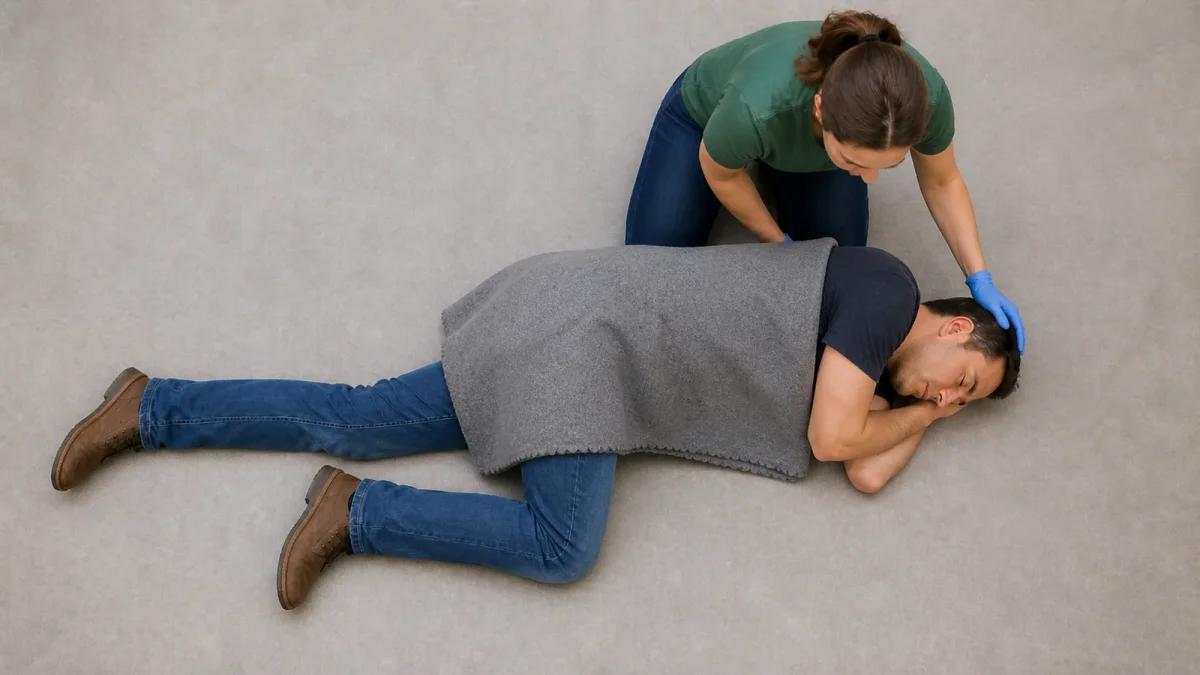
- The recovery position is used only for a patient who is unconscious but breathing normally; if breathing stops, switch immediately to cardiopulmonary resuscitation.
- The European Resuscitation Council 2025 First Aid Guidelines recommend the recovery position for an unresponsive person of nontraumatic aetiology with normal breathing who does not require immediate resuscitation.
- For a pregnant patient the left lateral position is mandatory; right lateral compresses the inferior vena cava and reduces blood flow to mother and baby.
- Do not place a patient in the recovery position when spinal, head, or pelvic injury is suspected; keep the patient in their current position with the airway protected and wait for professionals.
- The Turkish Red Crescent First Aid Unit recommends regular reassessment of breathing and pulse for the patient in the recovery position and uninterrupted continuation of the 112 medical alert.
Quick answer: The recovery position — also called the lateral position, semiprone, or three-quarters prone — is used only for a patient who is unconscious but breathing; its purpose is to keep the tongue from falling backward and to prevent vomit or saliva from entering the airway. The European Resuscitation Council (ERC) 2025 First Aid Guidelines specify that the recovery position is for "a person with a decreased level of responsiveness of nontraumatic aetiology, who is breathing normally and does not require immediate resuscitation interventions" [2]. If breathing has stopped, what is needed is not a position change but cardiopulmonary resuscitation — the chest compression and rescue breath cycle that delivers basic life support; if a spinal injury is suspected the patient is not moved at all. This guide summarizes the correct technique, contraindications, and the wait-for-ambulance protocol for adults, children, infants, and pregnant patients, anchored to 2024–2025 guidelines.
When Is the Recovery Position Used?
The decision is a three-second checklist: (1) Is the patient unrousable? (2) Is the chest rising with normal breathing? (3) Is the scene safe and is spinal injury unsuspected? If you can answer "yes" to all three, the recovery position is the right choice. The American Heart Association (AHA) and American Red Cross (ARC) 2024 First Aid Guidelines describe the position with multiple synonyms — "semiprone, lateral recumbent, side lying, and three-quarters prone" — referring to the same maneuver [1]. The Republic of Türkiye Ministry of Health uses the term "coma" for "prolonged loss of consciousness with reduced or absent responses to external stimuli, including swallowing and cough reflexes" [7] — that is, the patient cannot speak with you, does not respond to painful stimulus, but the chest is still rising and falling.
In practice the clinical pictures where you will most often need the recovery position are:
- A fainting (syncope) patient who has not regained consciousness.
- A patient still in the postictal phase after an epileptic seizure. The Turkish League Against Epilepsy first-aid guide instructs that, after the convulsions stop, "place them stably and comfortably onto one side and let the saliva drain out" [8].
- High-dose alcohol, drug, or substance overdose with loss of consciousness.
- A diabetic patient unrousable from hypoglycemia (never give sugar or fluid by mouth to an unconscious patient).
- A patient who has cleared after a Heimlich maneuver but is still unconscious — for the post-maneuver protocol see How to Perform the Heimlich Maneuver.
If the patient is unconscious and not breathing, position is the wrong intervention — every second counts. The European Resuscitation Council 2025 Adult Basic Life Support (BLS) guideline summarizes the cardiac arrest pathway as "how to recognise cardiac arrest, alerting the emergency services, delivering chest compressions, performing rescue breaths, how to use an automated external defibrillator (AED) and safety considerations for rescuers" [3]. Step-by-step adult chest compression, airway opening, and the Hands-Only Cardiopulmonary Resuscitation (CPR) option for untrained bystanders are covered with clinical references in our Adult Basic Life Support and Cardiopulmonary Resuscitation (CPR) Guide and Until the Ambulance Arrives articles.
When Is the Recovery Position Not Used?
There are three absolute contraindications:
- No breathing, or only agonal gasping (irregular sighing breaths). This is cardiac arrest. Place the patient supine on a firm surface, start chest compressions immediately, call 112 / Nova Ambulans, and have an automated external defibrillator readied if available. For the public-access Automated External Defibrillator (AED) workflow see our Automated External Defibrillator (AED) Guide.
- Suspected spinal, head, or pelvic injury. Do not perform a standard side-roll on your own; the head-neck-torso is kept aligned in a single line and the patient is moved only if there is a life-threatening danger such as fire or traffic. The Turkish Red Crescent First Aid Unit's adult guide states that neck and spinal injuries are "extremely important because they can cause permanent disability and death" and that a casualty with suspected spinal injury "should not be moved unless there is danger" [5]. The European Resuscitation Council 2025 First Aid Guidelines likewise advise that a person who is not breathing normally or has trauma should not be moved into the recovery position [2]. Leave these patients in the position you found them, keep the head-neck-torso aligned in a single line, attempt to open the airway with a jaw-thrust manoeuvre rather than head-tilt, and wait for the team. If vomit threatens the airway, the patient may be carefully rolled to the side while keeping the head, neck, and spine in line.
- Open abdominal wound, open chest wound, or unstabilized extremity fracture where lateral rotation would cause harm. In these patients airway protection is still the priority, but instead of full body rotation you support the head laterally while keeping the trunk supine, reducing aspiration risk.
A special group: the late-pregnancy patient. In an unconscious pregnant patient the choice is always the left lateral position. The supine position lets the enlarged uterus compress the inferior vena cava and drop cardiac preload. Left lateral relieves this compression, preserving blood flow to both mother and fetus. Right lateral is acceptable but the first choice is always left.
Step-by-Step Recovery Position in Adults
The following sequence summarizes the classic single-rescuer (one helping adult) method described by the Turkish Red Crescent First Aid Unit and the European Resuscitation Council 2025 First Aid Guidelines [2][5]. The patient is supine and you are kneeling beside them.
1. Assess the scene and the patient
- Confirm the scene is safe (traffic, electricity, gas).
- Gently shake the patient's shoulder and ask "are you OK?". If there is no response, call for help and dial 112 (or Nova Ambulans if you prefer a private hospital) on speakerphone.
- Use the "Look-Listen-Feel" technique for 10 seconds: watch the chest rise, listen for breath sounds at the mouth, feel for breath on your cheek. If breathing is normal, the recovery position is appropriate.
2. Prepare the surroundings
- Remove the patient's glasses, move sharp objects away.
- Straighten the patient's legs.
3. Position the lower arm
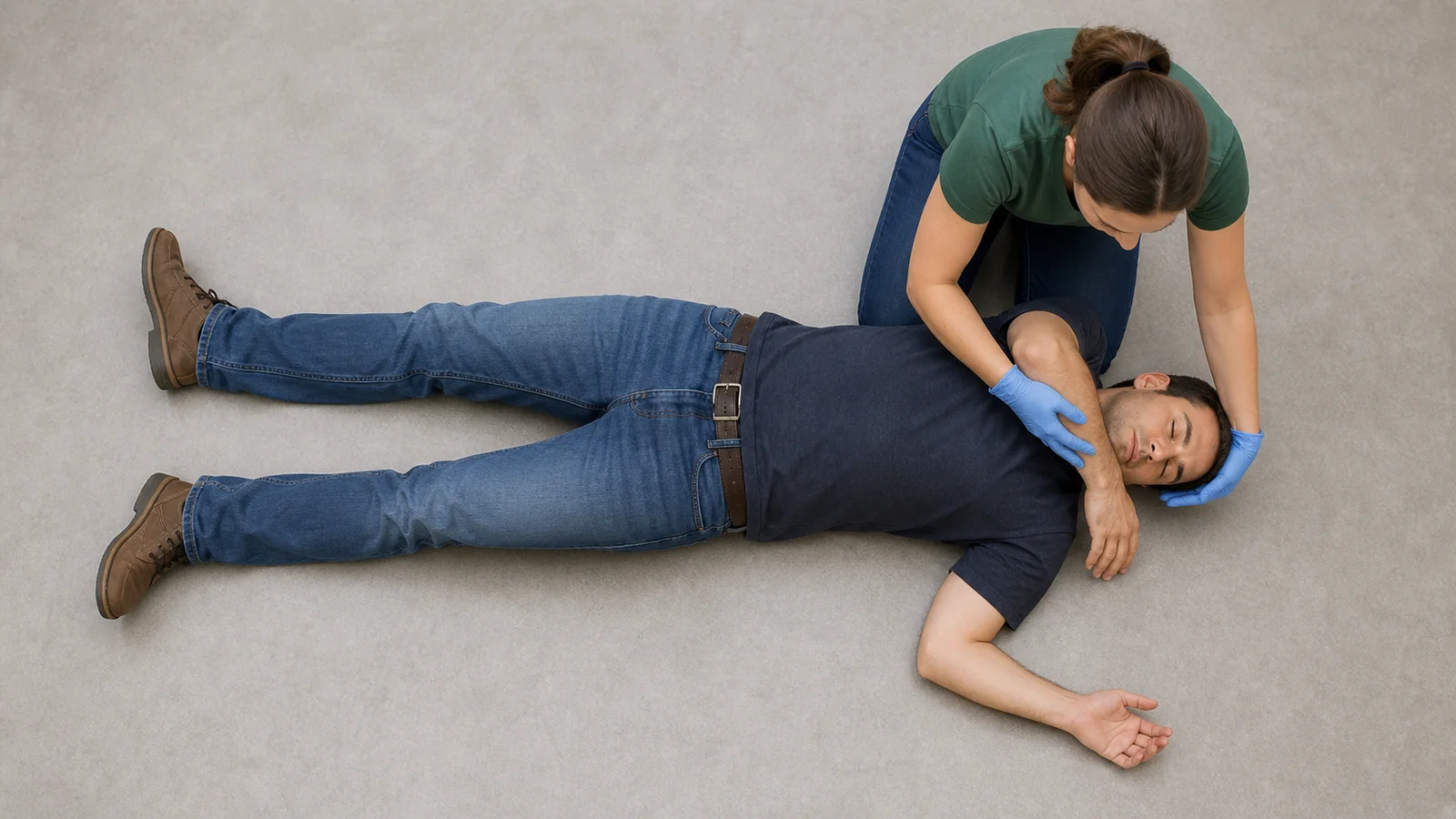
- Take the patient's arm nearest to you, extend it at a right angle to the body with the elbow bent and palm facing up. This arm becomes the support under the head.
4. Bring the upper arm across the chest
- Take the patient's far arm across the chest; place the back of that hand against the cheek nearest you. The hand will gently support the head as you turn.
5. Bend the upper leg at the knee and roll the patient
- Bend the far knee to about 90 degrees; with gentle pressure on the mid-thigh and the same-side shoulder, roll the patient toward you. The motion should be a single smooth turn, not a jerk.
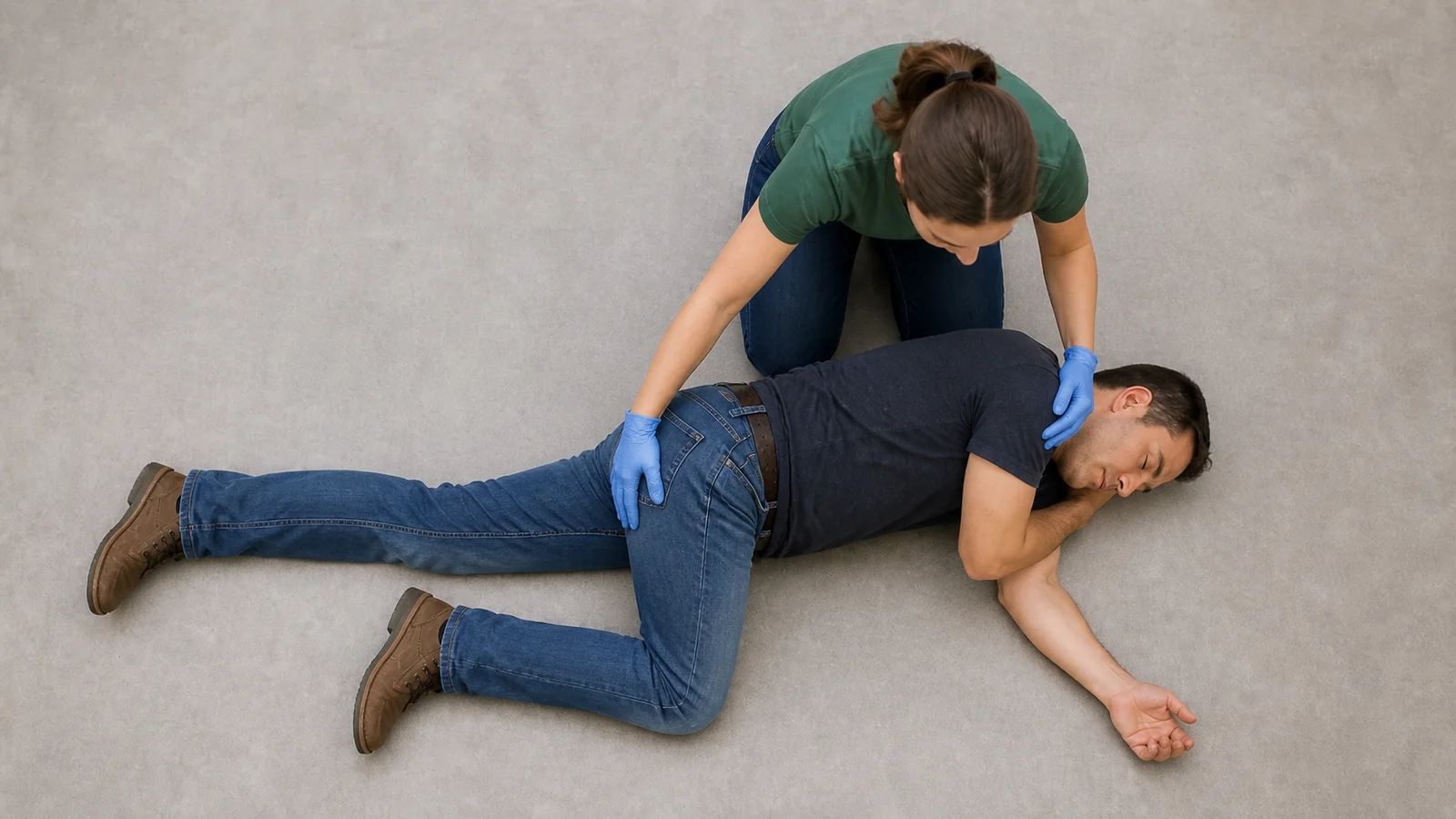
6. Stabilize the position
- Leave the upper leg flexed at the hip and knee, tucked forward as a brace.
- Place the head on the lower arm in a slight head-tilt-chin-lift position. The Turkish Red Crescent guide instructs you to "make sure the mouth is angled toward the floor" [5] — this allows vomit or saliva to drain outward, which is critical.
- Cover the body with a blanket or sheet to prevent heat loss.
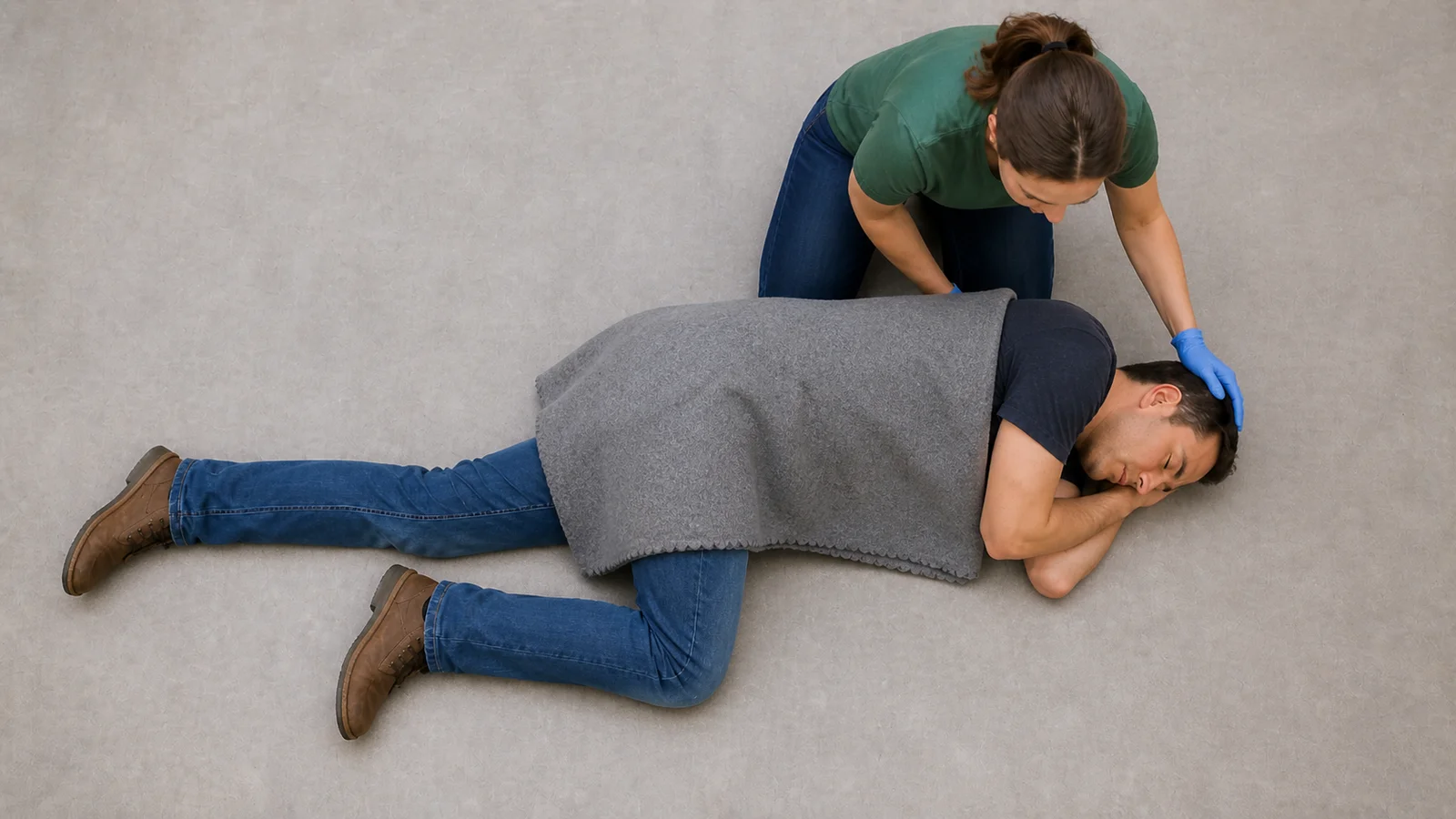
7. Monitor continuously
- Visually check chest rise every 30 seconds to 1 minute. The Turkish Red Crescent training center protocol sets the minimum standard at "breathing and pulse every 3–5 minutes" [6].
- If the patient will be in the position for an extended time, switch sides every 30 minutes; pressure points (shoulder, hip) should be protected from ischemic injury.
- The instant breathing stops or becomes irregular, roll the patient supine and start cardiopulmonary resuscitation; re-alert 112 simultaneously.
Pregnancy, Infants, Children: Three Important Adaptations
Left lateral position in pregnancy
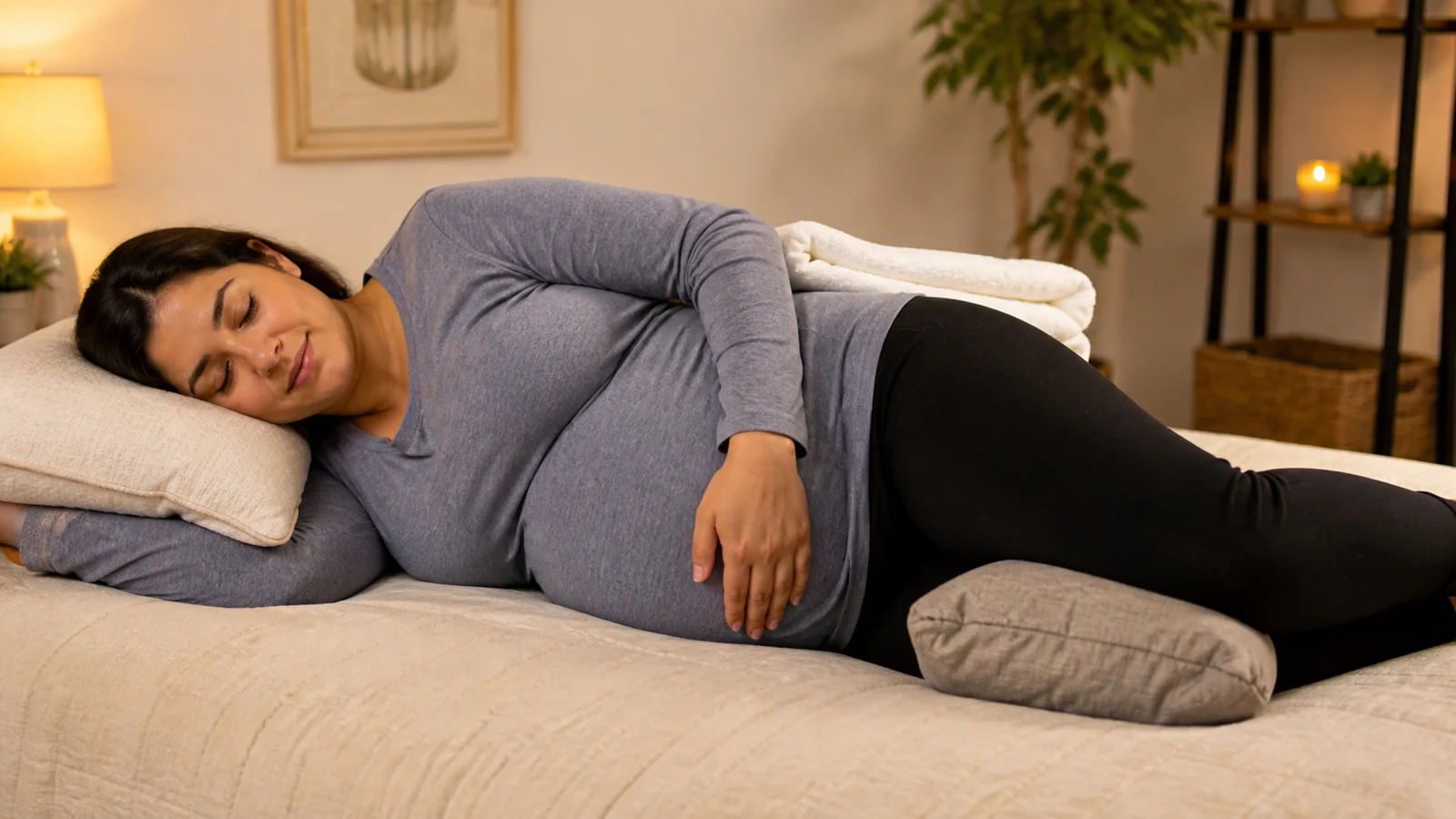
In late pregnancy the only choice is the left lateral position. The technique is identical to the adult method except that the patient is always rolled to her left side. Right lateral compresses the inferior vena cava, reducing venous return and harming both maternal blood pressure and fetal oxygenation. After rolling the patient left, place a folded towel or pillow behind her back to achieve a lean of "almost 30 degrees" — this is consistent with the European Resuscitation Council 2025 First Aid Guidelines [2].
In a child older than 1 year
In a child over 1 year the technique mirrors the adult sequence; because the child's body is smaller, arms and legs are placed proportionally. The pediatric monitoring interval is shorter: small children breathe faster than adults and have a smaller oxygen reserve. The European Resuscitation Council 2025 Paediatric Life Support (PLS) guideline provides 0–18-year recommendations on "prevention of cardiac arrest, basic life support, advanced life support, resuscitation in special circumstances, post-resuscitation care, prognostication, and post-discharge care" [9]. The home first-aid framework for pediatric pictures is synthesized in our Pediatric Emergencies — Parent's Guide, which references the 2025–2026 guidelines.
Modified position in infants (0–1 year)
The classic floor-based recovery position is not safe for an infant under 1 year — the infant is small, the airway is narrow, and the head is disproportionately large. The European Resuscitation Council 2025 Paediatric Life Support guideline notes that holding the infant in your arms with the face turned slightly to the side and downward is an acceptable alternative [9]. Support the infant with both arms, keep the head slightly lower than the trunk, and let the mouth angle downward so saliva drains outward. Continuously watch chest movement; if breathing stops, switch to infant basic life support — for chest compressions use the two-thumb–encircling-hands technique: place the infant supine, position both thumbs side-by-side on the breastbone just below the nipple line, encircle the chest with your fingers supporting the back, and compress the chest about 4 cm at a rate of 100–120 per minute.
Recovery Position After Seizure, Drowning, and Heimlich
In three typical clinical scenarios the recovery position serves as the closing manoeuvre:
Following a seizure. In a generalized tonic-clonic seizure, once the convulsions stop the recovery position prevents tongue posterior displacement and aspiration if the patient is still unconscious. The Turkish League Against Epilepsy first-aid page describes this step clearly; a seizure exceeding 5 minutes, recurrent seizures, or failure of consciousness to return are direct emergency-call thresholds [8]. Our When to Call an Ambulance for Seizures article walks through the full seizure first-aid framework with ambulance-call thresholds.
In near-drowning. Once the patient is out of the water, if Return of Spontaneous Circulation (ROSC — the heart's spontaneous resumption of pumping) and breathing have returned but the patient is still unresponsive, the recovery position helps drain pulmonary fluid. World Health Organization (WHO) 2026 Drowning Fact Sheet data give a global perspective: drowning is "the fourth leading cause of death for children aged 1–4 years and the third leading cause of death for children aged 5–14 years" [4]; pediatric recovery-position decisions reduce a preventable risk in exactly this scenario.
Right after a Heimlich maneuver. Once the foreign body has cleared, if the patient is still unconscious but breathing, the recovery position is your closing move: it prevents further aspiration and keeps the airway open until the team arrives. Step-by-step adult, child, and infant Heimlich technique is detailed in How to Perform the Heimlich Maneuver.
While Waiting for the Ambulance: Three Things
In the 5–15 minutes after calling 112 or Nova Ambulans, prepare the three pieces of information our crew asks first:
- Time and mechanism of the event: "She fainted at 14:25; I placed her in the recovery position at 14:26."
- Concurrent context: epilepsy history, diabetes, drug overdose, alcohol, gestational week, last food or medication.
- Breathing trend: the breath count you noted every 3–5 minutes (normal adult: 12–20 per minute).
Spend that interval at the patient's side — maintaining position, airway, and warmth — rather than running back and forth to the door. For a deeper checklist see Guide for Relatives Waiting for the Ambulance. The Republic of Türkiye Ministry of Health's First Aid Regulation (Resmî Gazete 29/7/2015, Issue 29429) requires a defined number of certified first-aid responders in workplaces and group-living settings [10] — meaning correct execution of the recovery position outside the home is a competence the regulation explicitly protects.
112 vs Private Ambulance (Nova Ambulans) — The Decision
The transport decision for a patient in the recovery position depends on hospital preference and clinical urgency:
- 112, with its national emergency-health network, reaches the nearest public emergency department fastest; in any traffic crash or scene-care case, calling it is the first and required step.
- Nova Ambulans offers flexibility when you prefer a specific private hospital; the team carries airway equipment, oxygen, monitor, glucometer, and — when needed — a physician. For the full comparison see Difference Between 112 and a Private Ambulance; for higher-acuity patients see When Is an Intensive Care Ambulance Required?.
Important note: Private hospitals may decline a patient based on capacity. If that happens, Nova Ambulans either finds an alternative private hospital or transports the patient to the nearest public hospital.
In Istanbul, our 24-hour Emergency Ambulance team provides simultaneous phone-guided first aid while the unit is en route; the protocol does not deviate from the 112 framework.
Frequently Asked Questions
Which patient should be placed in the recovery position?
The recovery position is used for a patient who is unconscious (unrousable) but breathing normally and whose condition is not of suspected traumatic origin. A person who has fainted and not regained awareness, a patient still unresponsive after a seizure, someone unconscious from alcohol or drug overdose, and any unconscious patient whose answer to "are they breathing?" is a clear "yes" all qualify. The European Resuscitation Council 2025 First Aid Guidelines specify the recovery position for "a person with a decreased level of responsiveness of nontraumatic aetiology, who is breathing normally and does not require immediate resuscitation interventions" [2]. If breathing has stopped or is only irregular agonal gasping, what is needed is not a position change but Cardiopulmonary Resuscitation (CPR) — the chest compression and rescue breath cycle that delivers basic life support.
Why is the left lateral position recommended in pregnancy?
In advanced pregnancy the enlarged uterus compresses the inferior vena cava in the supine position; this reduces venous return to the heart and therefore the oxygenated blood reaching both mother and baby. The left lateral position relieves this compression. For that reason the first choice in any unconscious pregnant patient is always the left lateral position. The same logic applies in any transport — on a stretcher, in an ambulance, at the scene — for the late-pregnancy patient.
What if I suspect a spinal injury?
Do not perform a standard side-roll on an unconscious patient by yourself after a road traffic crash, a fall from height, a diving accident, or blunt cervical trauma; keep the head-neck-torso aligned in a single line and move the patient only if there is a life-threatening danger such as fire or traffic. The Turkish Red Crescent First Aid Unit adult guide states that neck and spinal injuries are "extremely important because they can cause permanent disability and death" and that a casualty with suspected spinal injury "should not be moved unless there is danger" [5]. If fluid or vomit threatens the airway, the patient may be carefully rolled to the side while keeping the head, neck, and spine in line; a coordinated log-roll with at least four trained rescuers is required, and this is a task for an experienced medical team. Call 112 / Nova Ambulans and keep the patient's head, neck, and torso aligned in a single line.
Is the recovery position different in infants and small children?
The European Resuscitation Council 2025 Paediatric Life Support guideline states that placing an unconscious but normally breathing infant or child in the recovery position is appropriate, but for small infants holding the baby in the arms with the face turned slightly to the side is also an acceptable alternative [9]. In children over 1 year a lateral position similar to the adult technique is used; in infants the chest and abdominal movement must remain continuously visible and body warmth maintained. For the full pediatric framework see our Pediatric Emergencies — Parent's Guide, which synthesizes 2025–2026 guidelines.
How often should I reassess a patient in the recovery position?
Turkish Red Crescent training centers recommend rechecking breathing and pulse "every 3–5 minutes" for a patient in the recovery position [6]. In practice, until the ambulance arrives, monitor the chest visually every 30 seconds to 1 minute; check the radial pulse every 3–5 minutes; and protect pressure points by switching sides every 30 minutes during long waits. The moment breathing stops or becomes irregular, roll the patient onto their back, start cardiopulmonary resuscitation, and re-alert 112 / Nova Ambulans.
Related Articles
- Adult Basic Life Support and Cardiopulmonary Resuscitation (CPR) — Switching from the recovery position to Cardiopulmonary Resuscitation (CPR) when breathing stops.
- How to Perform the Heimlich Maneuver — Recovery-position monitoring after the airway clears.
- Automated External Defibrillator (AED) Guide — Device-assisted intervention when there is no breathing.
- Stroke Symptoms and the FAST (Face–Arm–Speech–Time) Test — Another condition presenting with altered consciousness.
- When to Call an Ambulance for Seizures — Recovery-position thresholds after a seizure.
- Pediatric Emergencies — Parent's Guide — Pediatric recovery position and other emergencies.
- Guide for Relatives Waiting for the Ambulance — Practical steps during the wait.
Rapid Emergency Support
24/7 emergency ambulance service across Istanbul. Fast response, fully equipped team.
Average response time: 15 seconds
Related Articles
How to Stop a Nosebleed: Step-by-Step Correct Technique (2026)
How to stop a nosebleed, which way to tilt the head, how many minutes to pinch, when to call 112: the Turkish Red Crescent 2025 First Aid Pocket Book, the Turkish Ministry of Health May 2025 First Aid Training Book, the American Academy of Otolaryngology-Head and Neck Surgery (AAO-HNS) 2020 Tunkel guideline, and the Özbay 2025 multi-center Türkiye cohort (n=2300) applied to the correct technique at home and on scene.
EducationHow to Perform the Heimlich Maneuver: Adult, Child, and Infant Steps (2026)
Step-by-step Heimlich maneuver, back blows, chest thrusts, and self-administered technique for adults, children, infants, pregnant and obese patients — aligned with the American Heart Association 2025 and European Resuscitation Council 2025 guidelines plus Türk Kızılay protocol, with 112 and Nova Ambulans call thresholds.
EducationWhat Does a Gray Ambulance Mean? The Patient-Transport Ambulance and Turkey's 2025 Color Regulation
The gray body with a blue stripe you see in traffic or in front of a hospital is a patient-transport ambulance, redefined by Turkey's Official Gazette regulation of 8 January 2025 (RG-8/1/2025-32776). This guide explains where the gray (RAL 7004) color comes from, how it differs from the white emergency ambulance, the restriction on audible warning systems, the detachable blue light restored by the 24 June 2025 amendment, the transition period that closed on 1 January 2026, and how to behave when you see a gray ambulance in traffic — grounded in the T.C. Ministry of Health and World Health Organization (WHO) sources.
Popular Ambulance Topic Clusters
You may also like
- Private ambulance pricing
- Istanbul private ambulance
- Intercity patient transport
- Doctor-accompanied ambulance
- Dialysis patient transport
- How intercity patient transport works
- Ambulance response time in Istanbul
- Home-to-hospital patient transport
- Modern ambulance equipment and team standards
- Heart attack symptoms and first response
This content is informational only and does not replace professional medical evaluation. In emergencies, call 112 or +90 216 339 00 39.
