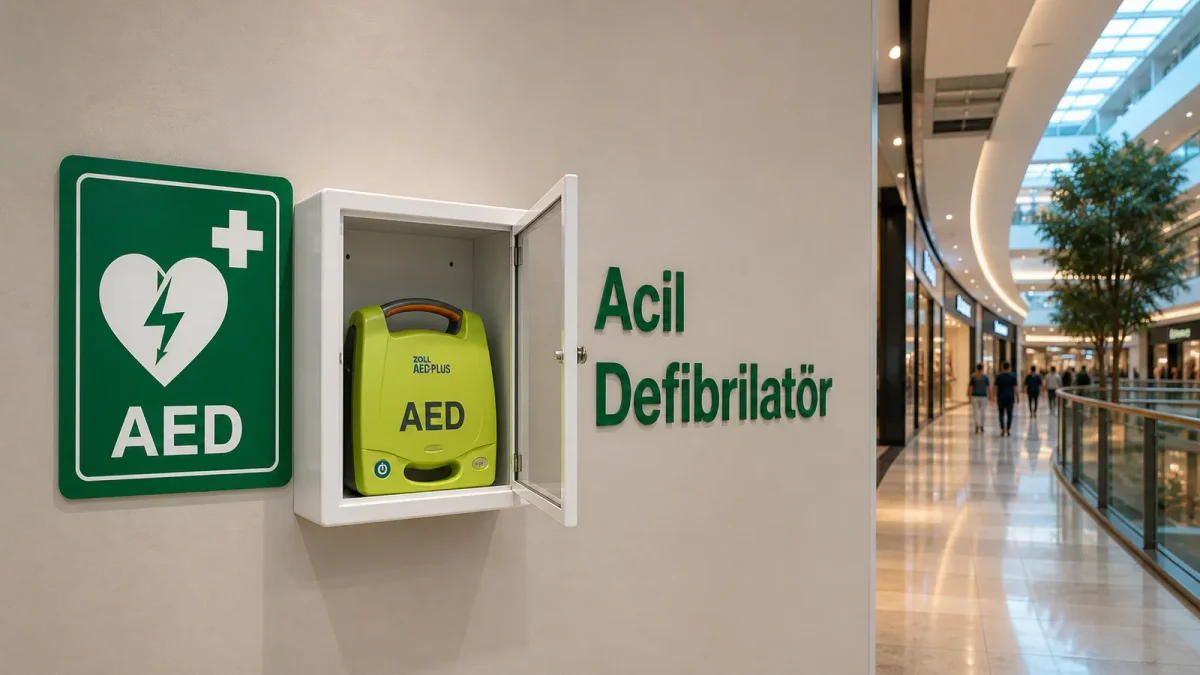
- The Turkish "Regulation on Portable Automated Shock Devices" (Resmî Gazete 9 December 2025, Issue 33102) makes Automated External Defibrillator (AED) placement mandatory in airports, malls, stadiums, and large workplaces from 2026 to 2028 and explicitly permits use by a "halktan kurtarıcı" (lay rescuer).
- Each minute of defibrillation delay drops witnessed ventricular fibrillation cardiac arrest survival by 7–10%.
- The Automated External Defibrillator (AED) only diagnoses shockable rhythms (ventricular fibrillation and pulseless ventricular tachycardia) and never delivers an inappropriate shock — the device decides.
- Five universal steps — turn on, place pads, hands-off analyze, shock if advised, resume Cardiopulmonary Resuscitation (CPR) — are sufficient for any bystander.
- Without an Automated External Defibrillator (AED) on scene, do not delay action — high-quality bystander chest compressions substitute for the heart's pump until professionals arrive.
Quick answer: An Automated External Defibrillator (AED) is the only device a bystander can apply within 60 seconds of a sudden cardiac arrest to multiply survival — turn it on, place the pads, stay hands-off during analysis, push the shock button if the device advises it, then resume chest compressions immediately. Each minute of defibrillation delay drops witnessed ventricular fibrillation survival by 7–10% [5]. Türkiye's Regulation on Portable Automated Shock Devices, published in Resmî Gazete on 9 December 2025 (Issue 33102), makes Automated External Defibrillators (AED) mandatory by the end of 2026 in airports, shopping malls over 5,000 m², stadiums with more than 10,000 seats, and workplaces with 500 or more employees, and legally codifies the lay rescuer ("halktan kurtarıcı") as an authorized user [1][2]. This guide pairs the device with Cardiopulmonary Resuscitation (CPR) the way it is taught in real bystander scenarios.
What an Automated External Defibrillator (AED) Is — and Is Not
An Automated External Defibrillator (AED) detects whether a sudden cardiac arrest is being driven by a rhythm the heart can be reset out of — ventricular fibrillation (a disorganized, ineffective trembling of the heart muscle) or pulseless ventricular tachycardia — and delivers a controlled electric shock to the chest wall, hoping the sinus node reclaims command. The Turkish Red Crescent training reference describes it plainly: "OED is a lightweight, easy-to-use, portable device that delivers a shock to the heart through pads applied to the chest during sudden cardiac arrest" [4].
The European Resuscitation Council 2025 Adult Basic Life Support guideline frames the device for the lay rescuer: "The topics addressed include how to recognise cardiac arrest, alerting the emergency services, delivering chest compressions, performing rescue breaths, how to use an automated external defibrillator (AED) and safety considerations for rescuers" [3]. Crucially, the device decides, not the user: an Automated External Defibrillator (AED) only prepares a shock when it detects a shockable rhythm. For asystole (a flat line) or pulseless electrical activity (PEA), it announces "no shock advised, continue chest compressions." Even if you misread the situation and attach pads to a fainting passenger who is breathing, the Automated External Defibrillator (AED) will not shock.
This mechanism distinguishes sudden cardiac arrest from a heart attack: a heart attack is an arterial blockage; the patient is usually conscious. Sudden cardiac arrest is electrical; the patient drops within seconds. For chest pain, sweating, and arm-radiating discomfort patterns, see Heart Attack Symptoms and Immediate Actions — that scenario does not call for an Automated External Defibrillator (AED), but the time-to-cath-lab window is just as unforgiving.
Why Defibrillation Races Seconds
The World Health Organization's 2025 Fact Sheet sets the global stakes: "An estimated 19.8 million people died from CVDs in 2022, representing approximately 32% of all global deaths" [6]. A meaningful share of that load is out-of-hospital cardiac arrest, and the intervention window is brutally narrow. A widely cited Postgraduate Medical Journal review puts the number plainly: "For every minute without CPR, survival from witnessed ventricular fibrillation (VF) cardiac arrest decreases by 7–10%" [5]. The same source adds that bystander chest compressions cushion the slope: "When bystander CPR is provided, the decrease in survival is more gradual and averages 3–4% per minute from collapse to defibrillation" [5].
In practice: in Istanbul, response times vary with traffic and location but typically fall within a range of a few to about ten minutes — an expected range, not a guarantee. Without bystander action, the survival window may largely close within that interval. With bystander chest compressions plus an Automated External Defibrillator (AED) shock in the first 3–5 minutes, survival multiplies. The American Heart Association's 2025 update states it cleanly: "By giving someone CPR you can double or even triple their chances of survival" [7] — and that multiplier increases when an Automated External Defibrillator (AED) is added, because chest compressions alone preserve perfusion but cannot correct the underlying rhythm. Only defibrillation does.
The takeaway: while the team is en route, you must be the first responder, not the bystander. Our Guide for Relatives Waiting for the Ambulance breaks down what to do in the 5–15 minutes after the call; an Automated External Defibrillator (AED), when available, joins that list.
The 2026 Regulation: Automated External Defibrillators (AED) Now Mandatory in Malls, Airports, Stadiums
On 9 December 2025, T.C. Sağlık Bakanlığı published the Regulation on Portable Automated Shock Devices in Resmî Gazete Issue 33102. The purpose article is exact: "to reduce the risk of death and disability arising in sudden cardiac arrests outside of healthcare settings, by enabling early and effective intervention on scene until emergency medical responders arrive" [1].
Three substantive changes:
- Lay-rescuer definition (Article 4). The regulation legally defines a "halktan kurtarıcı" (lay rescuer) as "a person who is not a healthcare professional but is present at the scene of an emergency and provides first-aid actions with Health Command Control Center (Sağlık Komuta Kontrol Merkezi, SKKM) support until medical help arrives." This formalizes the authority of an untrained bystander to operate an Automated External Defibrillator (AED), which prior to the regulation was nominally restricted to certified first-aiders [9].
- Phased deployment (Annex EK-1). By end-2026: airports and aircraft; stadiums of more than 10,000 m² or 10,000 seats; shopping malls over 5,000 m² in retail area; intercity passenger terminals in provincial centers and districts of 100,000+ population; fitness facilities over 800 m²; workplaces with 500 or more employees on a single campus or shift. By end-2027: lodgings with 100+ beds, campuses with 200+ employees, places of worship over 10,000 m². By end-2028: gas stations, workplaces with 100+ employees, and event venues with capacity for 1,000+ [2].
- OED-Net registry. The Ministry mandates devices that report operational status, battery level, location, and electrocardiography (ECG) data to a central OED-Net registry, preventing the "mounted but dead" failure mode [9].
Signage is the international standard: a green square with a heart-and-lightning pictogram, "AED / OED" lettering, and an unlocked cabinet. Devices may not be hidden or locked. Major Istanbul venues — İstanbul and Sabiha Gökçen airports, Marmaray, M2 metro, large malls — already housed devices voluntarily; the regulation now anchors them in a legal duty-of-care framework.
The Five Universal Automated External Defibrillator (AED) Steps
Brand-agnostic — Philips HeartStart, Zoll AED Plus, Stryker LIFEPAK CR2, Defibtech Lifeline — every Automated External Defibrillator (AED) follows the same five steps articulated in the European Resuscitation Council 2025 protocol [3]:
1. Turn the Device On
Lift the lid or press the green/yellow button. Voice prompts begin immediately and walk you through each step in plain language (Turkish on devices sold in Türkiye).
2. Apply the Pads
Each pad shows a diagram of where to stick it. The standard adult layout is anterior-anterior:
- Right pad: below the right collarbone, on the upper-right chest.
- Left pad: along the left side of the ribcage, just below and lateral to the left armpit.
Wipe the chest dry if the patient is sweating or wet — pads will not adhere otherwise, and shock energy bleeds across the surface. On a hairy chest, use a second pad set: rip the first pair off (they take the hair with them) and apply the second pair. Remove metal jewelry, bras with underwire.
3. "Stand Clear — Analyzing"
The device reads the heart rhythm through the adhesive electrodes. While it analyzes, no one — including you — touches the patient, or the device may pick up the rescuer's pulse. Analysis takes 5–10 seconds.
4. If "Shock Advised," Shout "Clear" and Press the Button
An orange/red button blinks. Visually sweep the patient and shout "Stand clear!" before pressing — the patient may twitch slightly, which is normal.
If the device says "No shock advised," there is no shock; go directly to step 5.
5. Resume Chest Compressions Immediately
After the shock, or after a no-shock-advised analysis, immediately restart 30 chest compressions + 2 rescue breaths. Do not turn the device off; do not remove the pads. The Automated External Defibrillator (AED) reanalyzes every two minutes and recommends additional shocks as appropriate. Hands-Only Cardiopulmonary Resuscitation (CPR) is acceptable. The full chest-compression depth, rate, and airway-management mechanics are detailed in our Basic Life Support and CPR Step-by-Step guide.
The Automated External Defibrillator (AED) + Cardiopulmonary Resuscitation (CPR) loop continues uninterrupted until professional rescuers take over. If the patient achieves Return of Spontaneous Circulation (ROSC) — they begin breathing or moving — still leave the pads on, and the device should keep monitoring.
Pad-Placement Variations
Standard anterior-anterior placement covers most adults. Four exceptions deserve attention:
Children (1–8 Years)
Use pediatric pads or a pediatric-mode key when available; the device automatically lowers the dose (about 50 J versus 150–200 J for adults). If pediatric pads are unavailable, adult pads work, but the pads must not touch — switch to anterior-posterior placement: one pad on the center of the chest, the other on the back between the shoulder blades. The Turkish Red Crescent reference: "Use pediatric pads and AEDs with pediatric features for children 1–8 years; for children older than 8, use standard adult AEDs and pads" [4].
For an infant (0–1 year), pediatric advanced life support is required; still apply the Automated External Defibrillator (AED) — it will advise a shock if a shockable rhythm is present. The pediatric Basic Life Support (BLS) cycle (one rescuer 30:2 — 30 chest compressions + 2 rescue breaths) and infant compression technique are covered in Pediatric Emergencies: A Parent's Guide. If a foreign body airway obstruction (a choking patient who lost consciousness during a Heimlich maneuver) is the cause, the protocol shifts: lay them flat, call 112 plus Automated External Defibrillator (AED), start compressions. Our Heimlich Maneuver Step-by-Step guide covers that decision point.
Pacemaker or Implantable Defibrillator
If you see a 5–6 cm subcutaneous bump in the upper-left chest, a pacemaker or Implantable Cardioverter-Defibrillator (ICD) is present. Place the pad at least 2.5 cm away from the device — not on top of it; switch to anterior-posterior if needed. The shock may damage the implanted device but will not harm the patient; defibrillation is the priority.
Pregnancy
Defibrillation is absolutely indicated in pregnancy — saving the mother is the only chance for the fetus. Use standard placement; with enlarged breast tissue, ensure the pad sits below the breast in full skin contact. Place a 10–15° rolled towel under the right hip to relieve pressure on the inferior vena cava and improve venous return.
Wet Surface or Rain
Pull the patient onto a dry surface (a one-second adjustment) and wipe the chest. Once pads are on, light rain is fine — the device is insulated. Do not deliver a shock while the patient is lying directly in standing water; it can transmit to the rescuer.
Without an Automated External Defibrillator (AED): Cardiopulmonary Resuscitation (CPR) Alone Saves Lives
If no Automated External Defibrillator (AED) is reachable — at home, in a taxi, in a small business, in a rural setting — high-quality chest compressions are the single most powerful tool. The European Resuscitation Council 2025 protocol is explicit: in witnessed cardiac arrest, continue high-quality Cardiopulmonary Resuscitation (CPR) until an Automated External Defibrillator (AED) arrives or professional rescuers take over [3]. The Hands-Only technique is a complete answer for the lay rescuer who cannot or will not deliver rescue breaths; this should never reduce the bystander rate.
Practical rules:
- Rate: 100–120 chest compressions per minute (the Bee Gees' "Stayin' Alive").
- Depth: at least 5 cm (not exceeding 6 cm) of sternal compression in an adult.
- Recoil: allow full chest recoil between compressions; hands stay on the chest.
- Rotation: swap rescuers every two minutes — fatigue makes compressions ineffective.
If certified, run the 30 compressions + 2 rescue breaths cycle. Do not confuse this with the recovery position: the recovery position is for unconscious patients who are breathing; placing a pulseless patient on their side is categorically wrong. Our Recovery Position Step-by-Step article distinguishes the two indications cleanly.
When Automated External Defibrillators (AED) Apply — and When They Do Not
A simple decision matrix:
| Scenario | Automated External Defibrillator (AED)? | Reasoning |
|---|---|---|
| Unresponsive + no breathing / gasping | Yes | Likely ventricular fibrillation |
| Faint + breathing | No | Recovery position; Automated External Defibrillator (AED) would not advise a shock anyway |
| Lost consciousness during choking maneuver | Yes | Possible hypoxic cardiac arrest |
| High-voltage electrocution (after isolation) | Yes | Often ventricular fibrillation |
| Heart attack with palpable pulse | No | MI protocol; 911/112, aspirin |
| Suspected stroke | No | Not an Automated External Defibrillator (AED) indication; FAST test and rapid transport |
In suspected stroke — facial droop, arm weakness, slurred speech — the priority is rapid neuroimaging within the thrombolysis window, not defibrillation; see Stroke Symptoms and the FAST Test for the full protocol. Automated External Defibrillators (AED) play no role there.
In Istanbul: Where to Find an Automated External Defibrillator (AED), How Nova Ambulans Hands Over
Even before the regulation, Istanbul's major airports, Marmaray and metro stations, large mall information desks, and major sports facilities housed Automated External Defibrillators (AED) voluntarily. The regulation now puts these locations into the OED-Net registry, accessible to the public via the Ministry of Health. Practical step: memorize the position of the nearest Automated External Defibrillator (AED) in your most-visited mall, metro station, fitness facility, and airport. A two-second delay reshapes the survival curve.
On the operational side, every Nova Ambulans vehicle carries a manual monitor/defibrillator — a device that requires team interpretation rather than automated logic. In the field, the Automated External Defibrillator (AED) a bystander pulled off the wall hands over to our team seamlessly: the same pad placement is preserved, monitor leads are added, and the manual defibrillator takes over. That is why "keep the Automated External Defibrillator (AED) running until the team arrives" is the only correct posture — do not power off, do not remove the pads, do not stop compressions.
Legal Coverage in Türkiye
Two frames protect a Turkish bystander acting in good faith:
- Negotiorum gestio — Türk Borçlar Kanunu Article 527/2 (general framework Art. 526–531). Where a person acts in good faith to protect the patient (the principal) from harm, the law provides that liability for their fault "may be mitigated or entirely waived by the judge" [10]. Note that the often-cited Article 49 does not grant this protection; it is the general tort provision that holds anyone who unlawfully and culpably causes harm liable. Türkiye has no U.S.-style named "Good Samaritan law"; protection for a good-faith rescuer flows from these provisions and judicial discretion, and is not a guaranteed blanket immunity.
- The 9 December 2025 regulation, Article 4. The legal definition of "lay rescuer" expressly authorizes the use of an Automated External Defibrillator (AED) [1]. The previously contested question — "is the certificate-less use of the device legally exposed?" — is now settled in favor of the rescuer.
The receiving end of the chain — hospital emergency services — is governed by the Communiqué on Implementation Procedures of Inpatient Healthcare Facility Emergency Services (Resmî Gazete 13/9/2022, Issue 31952), which specifies how a hospital takes over a patient with ongoing resuscitation [8]. Lay rescuer + Nova Ambulans + emergency department therefore operates as a sequential chain.
Certification and Refreshers
Türk Kızılay's First Aid Unit recommends renewing first-aid certificates every three years. Automated External Defibrillator (AED)-specific 2-hour courses are offered by Türk Kızılay, AKUT, and licensed private first-aid centers; AKUT's Ministry-approved Automated External Defibrillator (AED) program runs hands-on with manikin practice. If your workplace has 500+ employees, the device is mandatory from end-2026 — having at least two trained lay rescuers per shift is sound human-resources practice.
Family Preparedness Checklist
- Save the location of the nearest public Automated External Defibrillator (AED) to your phone (mall, metro, gym, airport).
- Keep one adult per household trained in basic Cardiopulmonary Resuscitation (CPR) + Automated External Defibrillator (AED) use (renewed every three years).
- Visually register the Automated External Defibrillator (AED) pictogram during routine outings — malls, airports, stadiums.
- If a family member has a pacemaker, ICD, or known arrhythmia, discuss home Automated External Defibrillator (AED) purchase with a cardiologist (the unit needs annual maintenance and battery replacement).
Frequently Asked Questions
Can I hurt someone by using an Automated External Defibrillator (AED) on the wrong patient?
No. Automated External Defibrillator (AED) devices only prepare a shock when they detect a shockable rhythm — ventricular fibrillation (a chaotic, ineffective trembling of the heart muscle) or pulseless ventricular tachycardia. The device decides; the user cannot. The European Resuscitation Council (ERC) 2025 Adult Basic Life Support guideline states the Automated External Defibrillator (AED) is designed for use by laypeople, with voice prompts throughout [3]. If an adult collapsed, is unresponsive, and not breathing normally, attach the device without hesitation.
Can I use an Automated External Defibrillator (AED) on someone with a pacemaker or who is pregnant?
Yes — but adjust pad placement. If a pacemaker (a visible bump in the upper-left chest) is present, place the pad at least 2.5 cm below the device, not on top of it; switch to anterior-posterior placement (chest front + mid-back) if needed. In pregnancy defibrillation is absolutely indicated — saving the mother is the only chance for the baby — and the standard adult protocol applies; ensure pads sit below enlarged breast tissue with full skin contact. The Turkish Red Crescent first-aid reference notes that adult pads are appropriate for anyone older than 8 [4].
Is it safe to use an Automated External Defibrillator (AED) on a child?
Yes. Per the Turkish Red Crescent guidance, use pediatric pads or a pediatric-mode key for children aged 1–8; these reduce the energy dose automatically. If pediatric pads are not available, adult pads can be used, but the pads must not touch each other — switch to anterior-posterior placement (one on the chest, one on the back). For children older than 8, use standard adult pads [4]. For an infant (0–1 year), pediatric advanced life support is required; still apply the Automated External Defibrillator (AED) — the device will recommend a shock if appropriate.
Should I stop chest compressions to fetch the Automated External Defibrillator (AED)?
If two rescuers are present, no — one continues compressions while the other retrieves the Automated External Defibrillator (AED). If you are alone, the European Resuscitation Council 2025 adult protocol prioritizes reaching the nearest Automated External Defibrillator (AED) for a witnessed collapse; for an unwitnessed collapse, perform two minutes of Cardiopulmonary Resuscitation (CPR) first and then fetch the device [3]. For the full bystander decision tree see our Basic Life Support and CPR Step-by-Step guide.
Where can I find an Automated External Defibrillator (AED) in Türkiye?
Under the Ministry of Health regulation published in Resmî Gazete on 9 December 2025 (Issue 33102), by the end of 2026 airports, shopping malls over 5,000 m², stadiums with more than 10,000 seats, intercity passenger terminals, fitness facilities over 800 m², and workplaces with 500 or more employees must keep an Automated External Defibrillator (AED) on site; the scope expands in 2027 and 2028 [2]. Devices sit in unlocked, visible cabinets marked with the international green-square heart-and-lightning pictogram.
Related Articles
- Basic Life Support and CPR Step-by-Step — Bystander chest compressions, airway, and rescue-breath ratio.
- Heimlich Maneuver Step-by-Step — Foreign body airway obstruction and the Automated External Defibrillator (AED) transition when the patient becomes unresponsive.
- Recovery Position Step-by-Step — Safe positioning for the unconscious-but-breathing patient (where the Automated External Defibrillator (AED) is not used).
- Stroke Symptoms and the FAST Test — Time-critical neurological emergency where the Automated External Defibrillator (AED) does not apply.
- Heart Attack Symptoms and Immediate Actions — Recognizing a cardiac emergency that does not require defibrillation.
- Pediatric Emergencies: A Parent's Guide — Pediatric basic life support cycle and infant compression technique.
- Guide for Relatives Waiting for the Ambulance — Managing the 5–15-minute window after the call.
Rapid Emergency Support
24/7 emergency ambulance service across Istanbul. Fast response, fully equipped team.
Average response time: 15 seconds
Related Articles
What Does a Gray Ambulance Mean? The Patient-Transport Ambulance and Turkey's 2025 Color Regulation
The gray body with a blue stripe you see in traffic or in front of a hospital is a patient-transport ambulance, redefined by Turkey's Official Gazette regulation of 8 January 2025 (RG-8/1/2025-32776). This guide explains where the gray (RAL 7004) color comes from, how it differs from the white emergency ambulance, the restriction on audible warning systems, the detachable blue light restored by the 24 June 2025 amendment, the transition period that closed on 1 January 2026, and how to behave when you see a gray ambulance in traffic — grounded in the T.C. Ministry of Health and World Health Organization (WHO) sources.
EducationTick Bite First Aid: Correct Removal Technique and the Crimean-Congo Haemorrhagic Fever (CCHF) Decision
When a tick attaches to the skin, the bystander’s step-by-step response: gloved, fine-tipped tweezers gripping the tick’s head as close to the skin as possible with steady upward traction, no alcohol, petrol, nail polish, matches or lit cigarettes, saving the removed tick in a labelled sealed plastic bag, a 14-day watch schedule for Crimean-Congo Haemorrhagic Fever (CCHF), the 112 decision when a fever, severe muscle pain, bleeding or profound weakness appears, and safe transfer to an infectious-diseases clinic — with primary sources from the Turkish Red Crescent 2025 First-Aid Pocket Book, the Turkish Ministry of Health May 2025 First-Aid Training Manual, the Turkish Red Crescent Esenyurt First-Aid Training Centre 2024 verbatim protocol, the Turkish Ministry of Health CCHF Scientific Council bulletin, Karanfil et al. 2026 (n=7,776 national surveillance), Güllü et al. 2025 (n=1,103 18-hospital cohort), the World Health Organization (WHO) 2025 fact sheet, the European Centre for Disease Prevention and Control (ECDC) factsheet, and Norman et al. 2025 European review.
EducationBee, Wasp, and Hornet Sting First Aid: When a Sting Reaction Needs 112
Step-by-step first aid for honeybee, wasp, and hornet stings — the bystander's 30-second stinger-scrape technique (credit-card scrape, never tweezers), local vs large-local vs systemic reaction decision tree, when to call Türkiye's 112 emergency line, adrenaline auto-injector application to the outer thigh, and what to do until the ambulance arrives — with verbatim protocols from Türk Kızılay Cep Kitabı 2025, T.C. Sağlık Bakanlığı May 2025 First-Aid Training Manual, the Turkish National Society of Allergy and Clinical Immunology (AİİAD), the Society of Pediatric Allergy and Asthma Academy (CAAAD), the 2025 Katran cohort of 194 526 patients at Istanbul Süreyyapaşa Hospital, the 2021 Öziş Baba cohort of 7 904 Trabzon schoolchildren, the American Academy of Allergy, Asthma & Immunology (AAAAI) and the McMurray 2026 Hymenoptera venom anaphylaxis review.
Popular Ambulance Topic Clusters
You may also like
- Private ambulance pricing
- Istanbul private ambulance
- Intercity patient transport
- Doctor-accompanied ambulance
- Dialysis patient transport
- How intercity patient transport works
- Ambulance response time in Istanbul
- Home-to-hospital patient transport
- Modern ambulance equipment and team standards
- Heart attack symptoms and first response
This content is informational only and does not replace professional medical evaluation. In emergencies, call 112 or +90 216 339 00 39.
