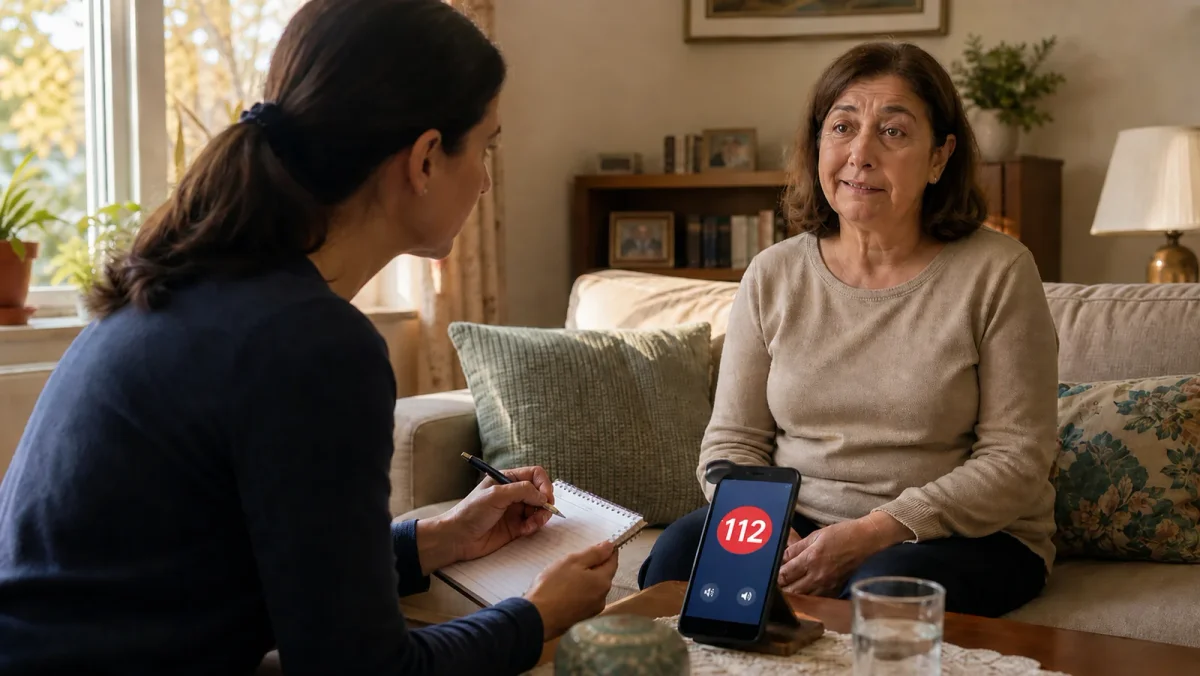
- The FAST test (Face–Arm–Speech–Time) catches most anterior-circulation strokes within minutes; the "T" means write the onset time and dial 112.
- In untreated ischemic stroke roughly 1.9 million neurons are lost each minute (Saver, Stroke 2006); "let's wait it out" leads to permanent deficit.
- Per the Turkish Statistical Institute (Türkiye İstatistik Kurumu, TÜİK) 2024 mortality bulletin, 18.3 percent of circulatory-system deaths are cerebrovascular — i.e., stroke.
- The American Heart Association / American Stroke Association 2026 guideline extends the mechanical thrombectomy window to 24 hours in selected patients; that is why driving the patient yourself defeats the correct hospital choice.
- Unconscious + breathing — recovery position. Unconscious + not breathing — chest compressions. A late-stage stroke can blur into cardiac arrest.
Quick answer: When you suspect a stroke, run the four-step FAST (Face–Arm–Speech–Time) test — F Face: ask for a smile, look for asymmetry; A Arm: ask the person to raise both arms, watch for one drifting down; S Speech: ask them to repeat a simple sentence, listen for slurring; T Time: write the onset time and call 112 (or Nova Ambulans if you prefer a specific private hospital) on speakerphone. According to the Turkish Statistical Institute (Türkiye İstatistik Kurumu, TÜİK) 19 June 2025 release of 2024 Death and Cause of Death Statistics, circulatory-system diseases account for 36 percent of all deaths, and 18.3 percent of those circulatory deaths are cerebrovascular — i.e., stroke [5]. Treatment is decided in minutes, not hours; "let's wait, maybe it passes" is the leading cause of permanent disability.
What Is a Stroke and Why Seconds Matter
A stroke is the sudden interruption of blood flow to a region of the brain — either from a clot occluding an artery (ischemic stroke) or from a vessel rupturing (hemorrhagic stroke). The anterior circulation — middle cerebral artery and its branches feeding the right and left hemispheres — produces the classic FAST (Face–Arm–Speech–Time) picture, while the posterior circulation — basilar and vertebral arteries feeding the brainstem, cerebellum, and occipital lobe — produces balance, vision, and swallowing problems. The widely cited ratio is roughly 85 percent ischemic and 15 percent hemorrhagic; however, looking at Turkish data, Prof. Mehmet Akif Topçuoğlu's 2022 review in the Turkish Journal of Neurology reports a Turkish ischemic share of 65.1 percent, intracerebral hemorrhage 24 percent, and subarachnoid hemorrhage 10.9 percent [7].
Why is the treatment window so narrow? In a 2006 quantitative analysis in the Stroke journal that still anchors the "golden hours" concept, Jeffrey L. Saver wrote: "In each minute, 1.9 million neurons, 14 billion synapses, and 12 km (7.5 miles) of myelinated fibers are destroyed" [2]. Translated into practice — just as the heart-attack chest "weight of an elephant" comes with a minute-by-minute clock (sister coverage at our Heart Attack Symptoms and Immediate Actions post), the brain has its own hourly damage tempo, roughly 3.6 times faster than healthy aging.
Treatment windows mirror this clock. The European Stroke Organisation (European Stroke Organisation, ESO) 2021 intravenous thrombolysis guideline states: "We recommend intravenous thrombolysis with alteplase (0.9 mg/kg, max 90 mg) for adults with acute ischaemic stroke within 4.5 hours of onset" [4]. The American Heart Association / American Stroke Association (AHA/ASA) 2026 Guideline for the Early Management of Acute Ischemic Stroke, published 26 January 2026, extends the window further: a Class 1 recommendation now covers "mechanical thrombectomy in patients with acute ischemic stroke caused by anterior circulation large vessel occlusion presenting 6 to 24 hours after symptom onset" [1]. Practically: ischemic stroke has a 0–4.5-hour thrombolysis window and, in selected large-vessel-occlusion patients, a 24-hour thrombectomy window. The single decision that translates that window into door-to-needle minutes is calling 112 without delay.
The FAST (Face–Arm–Speech–Time) Test: Stroke Recognition in 4 Steps
The FAST mnemonic is Face, Arm, Speech, Time. In the American Heart Association's 30 January 2025 newsroom release of International Stroke Conference 2025 data, lead author Dr. Opeolu Adeoye summarized FAST's (Face–Arm–Speech–Time) edge in lay education: "Adding two extra letters made it more challenging to recall the stroke warning signs" [8]. Run these four steps in 60 seconds:
1. Face — Smile Test
Say "please smile at me." A healthy person's mouth lifts symmetrically; in stroke one corner sags, the cheek droops, the lip pulls to one side. If the person wears glasses, ask them to remove them — eyes may also deviate to one side.
2. Arm — Drift Test
Ask the person to extend both arms to shoulder height with palms up and hold them there for 10 seconds. If one arm drifts downward, rotates, or cannot be held, the opposite hemisphere is suspect. The same drift test can be applied to a leg with the patient supine, raising one leg about 30 degrees.
3. Speech — Sentence Repeat Test
Have them repeat an unfamiliar simple sentence: "The sky is clear and very blue today." Score positive if syllables are slurred, words are mixed, grammar is broken, or the speech is incoherent. Even if the person seems not to understand the sentence at all, score positive — receptive aphasia is itself a stroke sign.
4. Time — Clock and Call
If any one of the three tests is positive, start the clock. Three things to do: (1) write down the symptom-onset time — this is the single most important data point for the thrombolysis decision; (2) call 112 on speakerphone; if you prefer a private hospital, call Nova Ambulans in parallel; (3) do not try to move the patient — lay them down or place them in a semi-sitting position to prevent a fall.
Important: Do not cancel the call even if symptoms resolve in minutes. A transient ischemic attack (TIA) carries a high risk of progressing to full stroke within 48 hours — per the European Stroke Organisation's 2021 TIA management guideline, roughly half of the 7-day post-TIA stroke risk occurs within the first 48 hours [10]; the patient must be assessed in a stroke unit.
BE-FAST: Extending the Mnemonic for Posterior-Circulation Strokes
Classic FAST (Face–Arm–Speech–Time) misses three important findings: sudden balance loss, sudden visual loss, and severe headache. Many stroke centers therefore use the BE-FAST mnemonic: B Balance, E Eyes, then the classic FAST (Face–Arm–Speech–Time). A 2024 Journal of Clinical Medicine study comparing the two in patients with confirmed posterior-circulation stroke reports: "BE-FAST demonstrated a higher sensitivity compared to FAST in identifying posterior circulation strokes (97.8 vs. 58.7)" [9]. Although anterior-circulation strokes account for around 80 percent of all ischemic strokes, missed posterior-circulation strokes carry higher disability and mortality.
In practice, BE-FAST adds two questions:
- Balance: Can the person stand or walk unaided? Or do they list to one side? Sudden onset vertigo plus loss of balance is a warning sign.
- Eyes: Visual loss in one or both eyes, double vision, or one-sided field loss? Ask whether the person can see your fingers held up to either side of their gaze.
Sudden balance or vision loss alone is enough to call 112. Anterior-circulation tools — like classic FAST (Face–Arm–Speech–Time) — miss a meaningful share of posterior-circulation strokes; that is why a household carer should know BE-FAST, especially for relatives over 65 or those with atrial fibrillation (an irregular rhythm of the heart's upper chambers that promotes clot formation).
Beyond FAST (Face–Arm–Speech–Time): Quiet Presentations and Pitfalls
Not every stroke arrives with a textbook FAST (Face–Arm–Speech–Time) picture. Anyone in a household-carer role should also recognize the "secondary" signs:
- Sudden one-sided numbness (arm, leg, face, or one whole side) — often dismissed as "it's gone numb, it'll pass."
- The worst headache of one's life — a classic finding in hemorrhagic stroke, including subarachnoid hemorrhage. Neck stiffness may accompany it.
- Sudden vision loss — a "curtain coming down" in one eye (amaurosis fugax) or sudden double vision.
- Difficulty swallowing or feeling like choking — drooling, coughing while drinking water.
- Confusion, sudden memory loss, disorientation about time and place — particularly in older adults, often misread as "the dementia is acting up."
- Sudden incontinence — often dismissed as a sub-threshold sign.
The Turkish Red Crescent (Türk Kızılay) first-aid framing for the "T" step in FAST summarizes the rule for household carers: "If the person cannot perform any one of the three commands, treat it as stroke and arrange transport to a healthcare facility without delay (T = Transfer)."
8 Steps — What to Do, What Not to Do
Bystander steps, in order:
- Call 112 on speakerphone. Describe symptoms briefly: "My mother is 80; 5 minutes ago her face fell, her right arm dropped, she can't speak." Give the address clearly the first time.
- Note the symptom-onset time. If the person woke from sleep with stroke symptoms, write the last-known-well time — that is what drives the thrombolysis decision.
- Do not move the patient. Leave them where they are on the sofa or bed; only support the head and neck with a soft pillow for safety.
- Do not give food, drink, or medication. Not even aspirin: in hemorrhagic stroke aspirin worsens bleeding. The American Heart Association / American Stroke Association (AHA/ASA) 2026 guideline leaves antiplatelet and anticoagulant decisions to the hospital team after brain imaging [1].
- Conscious — semi-sitting; unconscious + breathing — recovery position. The recovery-position technique — neck open, upper leg and upper arm bent at 90 degrees — prevents vomit and tongue from blocking the airway. Step-by-step coverage adapted from Turkish Red Crescent first-aid sources is in our Until the Ambulance Arrives guide.
- Unconscious + not breathing — start basic life support. Chest compressions (in adults, 30 compressions + 2 rescue breaths; for an untrained bystander, hands-only Cardiopulmonary Resuscitation (CPR) is sufficient) is indicated when a late-stage stroke evolves into cardiac arrest. Between "stroke" and "arrest," Cardiopulmonary Resuscitation (CPR) takes priority.
- Prepare the patient's medication list and ID. Anticoagulant (blood-thinner) use, last dose time, allergies, prior conditions — a slip of paper with this saves minutes at triage.
- No relative drives. The Centers for Disease Control and Prevention (CDC) is explicit: "Do not drive to the hospital or let someone else drive you. Call 9-1-1 for an ambulance so that medical personnel can begin life-saving treatment on the way to the emergency room." [3] In Turkish: the team starts an IV line, monitors blood pressure and glucose, and tracks the rhythm en route — none of that happens in a private car.
Stroke Types: A Bystander Does Not Need to Differentiate
Ischemic stroke — a brain artery occluded by a clot — accounts for about 85 percent of strokes. Treatment is to dissolve the clot (intravenous thrombolysis) or remove it (mechanical thrombectomy). Hemorrhagic stroke — a brain artery rupturing — accounts for the remaining ~15 percent; treatment focuses on blood-pressure control and, where indicated, neurosurgical intervention. A household carer does not need to answer "ischemic or hemorrhagic" — the answer comes from a brain CT in the emergency department. The carer's only task is the same: fast suspicion + 112.
That is exactly why you should not "rule out" hemorrhagic stroke in your head and give a clot-prevention drug like aspirin "just in case." The classic hemorrhagic picture — sudden, "worst-of-my-life" headache, loss of consciousness, vomiting — is also a 112 threshold.
What Is a Stroke Center? Where Does 112 Take the Patient?
The Turkish Ministry of Health's "Directive on Health Services for Acute Stroke Patients" of 18 July 2019 standardized stroke management in Turkey. The directive defines authorized "Stroke Centers" and "Stroke Units" that operate 24/7 in coordination with the 112 Command Center, providing IV thrombolysis and — where qualified — mechanical thrombectomy (interventional neuroradiology) [6]. The directive limits neurointervention to specialists in Neurology, Radiology, Neurosurgery, and Cardiology.
A bystander does not need to know the center's name. The 112 Command Center:
- Captures the geographic location of the patient.
- Performs a pre-evaluation by symptom duration and severity — anterior vs posterior circulation, thrombectomy candidate vs not.
- Routes to the nearest authorized stroke center, or — when large vessel occlusion is suspected — to a more distant comprehensive stroke center.
For families with a private-hospital preference, Nova Ambulans takes the patient to the preferred private center — provided that center is licensed for stroke care; if capacity is unavailable, we route to the nearest public stroke center. The detailed 112-vs-private comparison is in our Difference Between 112 and a Private Ambulance post; for the call-and-wait practical checklist see Guide for Relatives Waiting for the Ambulance.
Prevention: Seven Modifiable Risks
The annual ~125,000 incident strokes that the Turkey Stroke Epidemiology study (Topçuoğlu, Turkish Journal of Neurology 2022) reports are largely driven by modifiable risk factors [7]. The seven items below are the minimum yearly checklist for any adult over 40:
- Blood pressure: Personal targets vary; large trials support a 130/80 mmHg threshold.
- Atrial fibrillation: Detected on an ECG; in eligible patients oral anticoagulation reduces stroke risk by more than half.
- Diabetes: Annual HbA1c follow-up; poor control increases small-vessel strokes.
- Smoking: Cessation brings stroke risk close to never-smoker levels within 5 years.
- Cholesterol: LDL targets are lower in high-risk patients; statin decisions are taken with a clinician.
- Obesity and inactivity: 150 minutes per week of moderate physical activity is recommended.
- Excess alcohol: An independent risk factor for hemorrhagic stroke.
By far the strongest single step is owning a digital home blood-pressure monitor and keeping a weekly log. In every household with an adult over 60, at least one relative should know the FAST (Face–Arm–Speech–Time) test.
Related Articles
- Heart Attack Symptoms and Immediate Actions — Same "recognize + call 112" decision logic on the cardiac side; companion to FAST (Face–Arm–Speech–Time).
- Until the Ambulance Arrives — Recovery position, Look-Listen-Feel, and hands-only Cardiopulmonary Resuscitation (CPR) for the untrained bystander.
- Guide for Relatives Waiting for the Ambulance — What to do in the 5–15 minutes after the call.
- Difference Between 112 and a Private Ambulance — System comparison from the angle of stroke-center routing.
- Pediatric Emergencies: A Parent's Guide — Pediatric emergencies; childhood stroke is rare but follows the same "suspicion + 112" logic.
- Nova Ambulans Medical Board — Medical oversight of our content.
Frequently Asked Questions
What is a transient ischemic attack (TIA), and can it be ignored?
A transient ischemic attack (Transient Ischemic Attack, TIA) is the classic name for stroke-like symptoms that resolve within 24 hours; however, the European Stroke Organisation (ESO) 2021 TIA management guideline notes that TIA carries a high risk of progressing to full stroke within 48 hours — roughly half of the 7-day post-TIA stroke risk occurs within the first 48 hours [10]. Even if symptoms have cleared, call 112 or Nova Ambulans; the patient must undergo neurology imaging and risk assessment.
Should I give aspirin if I suspect a stroke?
No. As a bystander you must not give aspirin: roughly one in five strokes is hemorrhagic (bleeding) — and aspirin worsens bleeding. The American Heart Association 2026 acute ischemic stroke guideline leaves antiplatelet and anticoagulant decisions to the hospital team after brain imaging [1]. Do not give the patient food, drink, or any medication.
Should I call 112 or 114?
Always 112 for suspected stroke. 114 is the Turkish National Poison Information Center, used only for poisoning. The 112 Command Center routes the patient to the nearest authorized stroke center; if you prefer a private hospital, call Nova Ambulans in parallel.
Wouldn't it be faster if I drive my relative myself?
No. First, 112 and a private ambulance route the patient to the correct stroke center — i.e., a hospital that can perform thrombectomy — and the nearest hospital is not always the right hospital. Second, the team starts an IV line and begins blood-pressure, glucose, and rhythm monitoring on the road; that saves minutes at the hospital door. The Centers for Disease Control and Prevention's stroke page states: "Do not drive to the hospital or let someone else drive you. Call 9-1-1 for an ambulance so that medical personnel can begin life-saving treatment on the way to the emergency room." [3]
How do I know which stroke center to use?
The Turkish Ministry of Health "Directive on Health Services for Acute Stroke Patients" of 18 July 2019 defines authorized "Stroke Centers" and "Comprehensive Stroke Centers" that operate 24/7, providing IV thrombolysis and — where available — mechanical thrombectomy [6]. As a bystander you do not need to know addresses or names — the 112 Command Center handles routing to the nearest authorized center.
Rapid Emergency Support
24/7 emergency ambulance service across Istanbul. Fast response, fully equipped team.
Average response time: 15 seconds
Related Articles
Concussion Symptoms After a Fall or Head Injury: Bystander Guide (2026)
After a fall or head injury, concussion symptoms bystanders must recognize, step-by-step first aid, the CDC HEADS UP danger signs that require calling 112 immediately, age-specific notes for children and elderly patients, and the recovery timeline — grounded in Türk Kızılay 2025 First-Aid Pocket Book pp.19-20 and 47-48, T.C. Ministry of Health May 2025 First-Aid Training Book Chapter X.A and VII.B, Gazi University Pediatric Emergency PECARN application review, Turkish Neurosurgery 2025 national survey (n=1,875 neurosurgeons), JAMA April 2026 pediatric concussion systematic review, and CDC HEADS UP with WHO falls data.
EducationWhat Does a Gray Ambulance Mean? The Patient-Transport Ambulance and Turkey's 2025 Color Regulation
The gray body with a blue stripe you see in traffic or in front of a hospital is a patient-transport ambulance, redefined by Turkey's Official Gazette regulation of 8 January 2025 (RG-8/1/2025-32776). This guide explains where the gray (RAL 7004) color comes from, how it differs from the white emergency ambulance, the restriction on audible warning systems, the detachable blue light restored by the 24 June 2025 amendment, the transition period that closed on 1 January 2026, and how to behave when you see a gray ambulance in traffic — grounded in the T.C. Ministry of Health and World Health Organization (WHO) sources.
EducationTick Bite First Aid: Correct Removal Technique and the Crimean-Congo Haemorrhagic Fever (CCHF) Decision
When a tick attaches to the skin, the bystander’s step-by-step response: gloved, fine-tipped tweezers gripping the tick’s head as close to the skin as possible with steady upward traction, no alcohol, petrol, nail polish, matches or lit cigarettes, saving the removed tick in a labelled sealed plastic bag, a 14-day watch schedule for Crimean-Congo Haemorrhagic Fever (CCHF), the 112 decision when a fever, severe muscle pain, bleeding or profound weakness appears, and safe transfer to an infectious-diseases clinic — with primary sources from the Turkish Red Crescent 2025 First-Aid Pocket Book, the Turkish Ministry of Health May 2025 First-Aid Training Manual, the Turkish Red Crescent Esenyurt First-Aid Training Centre 2024 verbatim protocol, the Turkish Ministry of Health CCHF Scientific Council bulletin, Karanfil et al. 2026 (n=7,776 national surveillance), Güllü et al. 2025 (n=1,103 18-hospital cohort), the World Health Organization (WHO) 2025 fact sheet, the European Centre for Disease Prevention and Control (ECDC) factsheet, and Norman et al. 2025 European review.
Popular Ambulance Topic Clusters
You may also like
- Private ambulance pricing
- Istanbul private ambulance
- Intercity patient transport
- Doctor-accompanied ambulance
- Dialysis patient transport
- How intercity patient transport works
- Ambulance response time in Istanbul
- Home-to-hospital patient transport
- Modern ambulance equipment and team standards
- Heart attack symptoms and first response
This content is informational only and does not replace professional medical evaluation. In emergencies, call 112 or +90 216 339 00 39.
