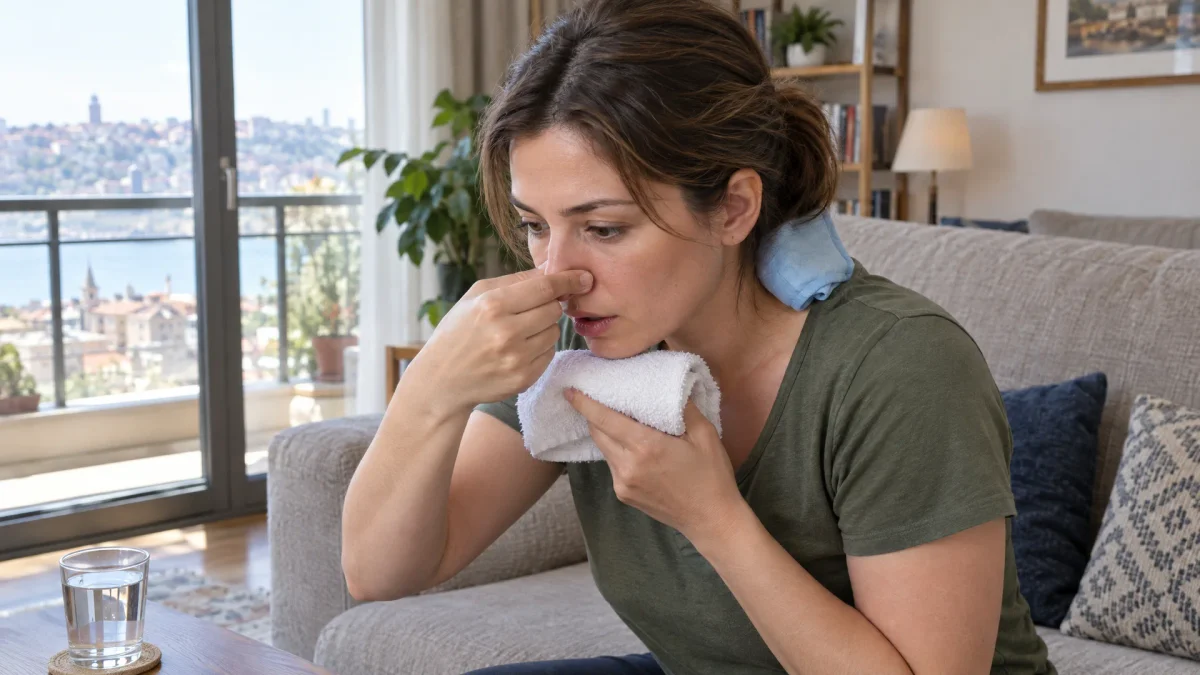
- The correct technique: seat the patient, tilt the head slightly **forward** (never back), and pinch the nostrils continuously for 10–15 minutes at the level of the soft lower third of the nose just below the bony bridge — using thumb and index finger. The Turkish Red Crescent 2025 First Aid Pocket Book and the Turkish Ministry of Health May 2025 First Aid Training Book set this sequence verbatim.
- The American Academy of Otolaryngology-Head and Neck Surgery (AAO-HNS) 2020 Tunkel guideline reports that nosebleeds occur at some point in at least 60% of adults, 6% seek medical attention, and epistaxis accounts for 0.5% of all emergency department visits; in the Turkish multi-center Özbay 2025 cohort (n=2300) anterior (front) bleeds accounted for 95% and posterior (back) bleeds for 5%.
- Per the Turkish Red Crescent 2025 protocol, 112 Emergency Health Services should be called if bleeding continues after 15 minutes, dizziness starts, there is a face or head injury, the patient uses aspirin or another anticoagulant/antiplatelet drug, or has a bleeding disorder — these four situations mark the firm boundary of home care.
- Never do these: tilt the head back (blood is swallowed, causing nausea and aspiration), push cotton/tissue/plug into the nose (hides the cautery point and re-bleeds on removal), place ice on the bridge of the nose (evidence is weak and effect is small), or talk-swallow-cough-spit (the Turkish Ministry of Health May 2025 Section F explicitly forbids this).
- Most pediatric nosebleeds run a benign course — in the n=452 series from Gazi University Faculty of Medicine Pediatric Emergency in Ankara reported by Güneysu and colleagues in 2019, bleeding stopped spontaneously in 96% of cases with no additional treatment required. Hot weather and low humidity increase pediatric nosebleeds (5-year Konya cohort, n=1559).
Mid-July, İstanbul. In a flat where the air-conditioning has been running through the night, a nine-year-old who has just sat down for breakfast notices a thin line of blood tracing down her right cheek after a small sneeze. Her mother, reflexively drawing on how she herself was raised, says "tilt your head back." That one-second, wrong instruction is in fact a maneuver that the Turkish Red Crescent 2025 First Aid Pocket Book and the Turkish Ministry of Health (Sağlık Bakanlığı, SB) May 2025 First Aid Training Book explicitly forbid, verbatim [1][2]. The correct move: seat the patient, tilt the head slightly forward, and pinch the soft lower third of the nose between thumb and index finger for 10–15 uninterrupted minutes. This guide sits at the intersection of the two Turkish official protocols, the American Academy of Otolaryngology-Head and Neck Surgery (AAO-HNS) 2020 Tunkel guideline, and the Özbay et al. 2025 multi-center Türkiye cohort (n=2300 emergency department presentations including Istanbul Bağcılar) alongside the Gazi University Faculty of Medicine Pediatric Emergency cohort (n=452); it clarifies exactly what the bystander should do in the first 15 minutes, which mistake prolongs the bleed, and in which sign 112 Emergency Health Services must not be delayed.
Quick Answer
Seat the person with a nosebleed immediately; standing up or lying supine causes blood swallowing and dizziness. Tilt the head slightly forward — not back — so blood flows out through the mouth rather than into the stomach. Tell the person to breathe through the mouth. Pinch the nostrils together between thumb and index finger at the level of the soft lower third just below where the hard nasal bone ends; the time is 10–15 uninterrupted minutes. The full source for these three steps is page 28 of the Turkish Red Crescent 2025 First Aid Pocket Book and Section F, page 122 of the Turkish Ministry of Health May 2025 First Aid Training Book [1][2]. Uninterrupted means — do not release the pinch every so often to "check if it has stopped"; every release dislodges the clot and resets the clock. During compression the patient must not talk, spit, swallow, cough or sniff — these five actions dislodge the newly formed clot [2].
When to call 112? The Turkish Red Crescent 2025 and SB May 2025 protocols set two core thresholds: (1) bleeding continues after 15 minutes of correct pressure; (2) dizziness begins (a sign of blood loss). To these, add four high-risk groups — call 112 immediately, without waiting: (a) face or head injury; (b) the patient uses aspirin or another anticoagulant or antiplatelet drug (clopidogrel, warfarin, apixaban, rivaroxaban, dabigatran); (c) there is a bleeding disorder (hemophilia, von Willebrand disease, thrombocytopenia); (d) bleeding is coming from both nostrils simultaneously or draining down the throat (suspected posterior bleed) [1][2][6]. Correct technique + correct threshold are the two decision tools in the bystander's hands.
Türkiye Picture: What Do the Numbers Say?
How common is a nosebleed, how dangerous? The American Academy of Otolaryngology-Head and Neck Surgery (AAO-HNS) 2020 Tunkel guideline lays out the prevalence clearly: at least 60% of adults have a nosebleed at some point in life, of these 6% seek medical attention; nosebleeds make up 0.5% of all emergency department visits and 0.2% of cases require hospitalization [9]. On the Türkiye side, the most current multi-center data are the EPISTAXIS cohort published by Özbay et al. in 2025 in The Journal of Craniofacial Surgery (n=2300 emergency department presentations; sites in Sivas, Eskişehir, Malatya, Bilecik, İzmir and Kırıkkale plus Istanbul Bağcılar Training and Research Hospital and Biruni University in Istanbul). Findings from this cohort [6]:
- Anterior (front) nosebleeds 95.0% — the most common source, Little's area (Kiesselbach plexus), is the dense capillary web at the anterior lower septum.
- Posterior (back) nosebleeds only 5.0% — yet this small group is clinically dominant in serious blood loss, intubation and posterior packing needs.
- Idiopathic (cause not identified) 80.0%.
- Home accidents 7.7%; finger trauma (nose picking) 3.9%; rhinosinusitis 2.8%; foreign body 2.4%.
- Hypertension (high blood pressure) was the most frequent accompanying condition: 39.0%.
- Diabetes 17.9%; bleeding disorders 6.1%; malignancy 5.9%.
- Emergency department intervention: finger pressure 48.3%; anterior or posterior packing 73.86%; silver nitrate cautery 22.86%; oxymetazoline (Afrin) spray 40.34%; tranexamic acid 17.0%; ENT consultation 11.3%.
Türkiye's pediatric data are equally clear. In the n=452 series evaluated between 1 January and 31 December 2019 at Gazi University Faculty of Medicine Pediatric Emergency Service, the annual admission incidence was 1.23%, the median age was 5.25 years, and 57.1% of cases were boys; bleeding lasted less than 5 minutes in 75.2% of cases, 84.4% were unilateral, and bleeding stopped spontaneously in 96% of cases [5]. That final figure is the single most important statistic for parents to learn: the great majority of pediatric nosebleeds are resolved at home with correct technique. In the series of adults aged 65 and over conducted by Yıldırım et al. in the Otorhinolaryngology Department of Ankara University Faculty of Medicine (April 2017 – April 2018; 12,780 emergency department presentations, 195 ENT consultations), nosebleed emerged as the second-most-common ENT emergency in the elderly — 18.7%, after maxillofacial trauma (31.7%) [8]. The architecture is simple: usually mild in children, more often serious in the elderly and intertwined with comorbidity.
For the national mortality context, the Turkish Statistical Institute (Türkiye İstatistik Kurumu, TÜİK) News Bulletin no. 54195, dated 19 June 2025: total deaths in Türkiye in 2024 were 489,361; external causes of death made up 3.6% of all deaths [4]. Nosebleed alone is a rare cause of death; however, massive posterior bleeding, a bleeding disorder, and hypovolemic shock in a patient on anticoagulants are possible pathways, and the SB May 2025 First Aid Book notes them with the sentence "Nosebleeds may rarely be serious and may lead to death" [2].
Nose Anatomy in 60 Seconds: Where Is Anterior and Posterior?
To understand the correct pinch site, remember the vascular map of the nose. The nose is supplied from two zones:
- The anterior vascular network — the Little's area (Kiesselbach plexus) on the anterior lower part of the nasal septum. It is the dense capillary web where five small arteries meet; it is easily damaged and is the first site to bleed in dryness or finger trauma. In the Türkiye multi-center Özbay 2025 cohort 95.0% of all nosebleeds were of anterior origin [6]. The good news: external finger pressure works in this area because Little's area receives external pressure applied to the nostril directly.
- The posterior vascular network — Woodruff's plexus and branches of the sphenopalatine artery. Anatomically deeper, out of reach of external compression. Blood does not appear at the nostril but drips to the back of the throat — the patient senses a metallic-salty taste and coughs or vomits blood. In the Özbay 2025 cohort posterior bleeds were only 5.0% of all cases, but this group dominated the need for packing, endoscopy and ENT consultation [6].
Typical warnings for posterior bleeding: blood from both nostrils simultaneously, a sense of flow to the throat, bloody sputum or gastric content on coughing or vomiting, bleeding that does not stop within 15 minutes of external pressure. In this picture, attempting home care is not safe — call 112 directly, and confine first aid to keeping the patient calm, seated and in the head-forward position.
Step-by-Step Nosebleed First Aid
The order below is the verbatim overlap of the Turkish Red Crescent 2025 First Aid Pocket Book page 28 and the SB May 2025 First Aid Training Book Section F page 122 [1][2]. Follow the steps in order.
- Calm and seat. Panic raises the pulse, raises blood pressure and prolongs the bleed. The patient should sit on a flat surface; do not allow standing or lying supine. In a supine patient, blood may pass down the pharynx (throat) into the stomach or into the airway.
- Tilt the head slightly forward. If there is no neck injury, bring the chin toward the chest. The Turkish Red Crescent 2025 protocol gives the reason directly: "This prevents the patient/casualty from swallowing blood." [1] Tilting the head back is a common but physiologically wrong move — it can cause nausea, vomiting, aspiration and, hours later, bloody vomiting (hematemesis).
- Instruct mouth breathing. With the nose pinched, the mouth stays open to meet the oxygen requirement; this is the mechanism that keeps consciousness during compression. Panic and a sense of suffocation are frequent in children — give a calm, steady breathing command.
- Pinch the nostrils with thumb and index finger. The SB 2025 book defines the site verbatim: "Ask the patient/casualty to pinch the nostrils with the thumb and index finger starting from the nasal bone" [2]. The correct spot is the soft lower third just below the line where the hard nasal bone ends. The 2nd Key Action Statement of the American Academy of Otolaryngology-Head and Neck Surgery (AAO-HNS) 2020 Tunkel guideline confirms the same area: "firm sustained compression to the lower third of the nose" [9]. The pinch should be moderately firm; the fingers press the tip of the nose inward without collapsing the nostril.
- Duration: uninterrupted 10–15 minutes. The Turkish Red Crescent 2025 and SB 2025 protocols give the duration verbatim identically [1][2]. Track the time by a watch or phone stopwatch; do not peek to check — the clot is fragile early and any shake restarts the bleed. The AAO-HNS guideline gives a minimum of 5 minutes in a clinical setting; 10–15 minutes on scene is a safer bracket [9].
- Silence rule. The SB 2025 book verbatim lists the five actions forbidden during compression: "warn the patient/casualty not to talk, swallow, cough, spit or sniff." [2] All five actions shake the newly formed clot. Let the patient simply breathe slowly and quietly through the mouth.
- Assessment. After 10–15 minutes lift the fingers. If bleeding has stopped keep the patient away from intense activity, hot showers, bending forward, heavy lifting and nose cleaning for one hour — the clot is still fragile. If bleeding continues: (a) apply the correct pressure for another 10–15 minutes; (b) if that too is unsuccessful, call 112.
Adjunct maneuvers (moderate evidence level): Placing a cool cloth, gel ice pack or bag of ice on the nape or forehead may reduce bleeding by triggering reflex vasoconstriction (blood-vessel tightening) in the nasal mucosa. This maneuver does not replace the main compression technique — it is an adjunct. If blood pools in the mouth with saliva, spit slowly into a bowl; do not swallow.
The Correct Head Position — Why Forward, Why Not Back
The most common nosebleed mistake in Türkiye is the "tilt the head back" reflex; it still turns up in the street, at school, and — most unfortunately — in some older first-aid courses. Physiology says the opposite: the head must be tilted forward. Three lines gather the reasons:
- Preventing blood swallowing. The Turkish Red Crescent 2025 Pocket Book gives this reason directly [1]. Swallowed blood forms a clot in the stomach; the acid environment of the stomach breaks up the clot and can produce hematemesis (bloody vomiting). Hours later the parent brings the child to the ED with the fear of "a new bleed" when the source is the nose.
- Reducing aspiration risk. With the head back, the angle between the pharynx (throat) and the trachea (windpipe) shifts; particularly in a patient with reduced consciousness, or a child or elderly patient, blood may drop into the airway. This picture causes coughing, choking and, in more severe cases, aspiration pneumonia.
- True visibility of the bleeding volume. With the head tilted forward, blood flows out of the nostril and the bystander can judge the amount accurately. With the head back, blood flows into the throat and the outward appearance gives the impression "the bleeding has slowed," when in fact it continues at the same rate. This visual illusion leads to telling 112 "the bleeding has slowed, let's wait."
If there is a suspected neck injury (traffic accident, sports blow, fall), do not tilt the head forward — keep the neck stable, lie the person down and call 112 directly; apply manual spine stabilization on scene. This is the exception preserved by the phrase "if there is no neck injury, tilt the head slightly forward" in the Turkish Red Crescent 2025 Pocket Book [1].
Never Do These — The 8 Most Common Nosebleed Mistakes in Türkiye
The Turkish Ministry of Health (SB) May 2025 First Aid Training Book Section F and the Turkish Red Crescent 2025 First Aid Pocket Book list the actions forbidden during compression explicitly [1][2]. The eight items below are the most frequently applied and clinically harmful moves in Türkiye:
- Tilting the head back. Explained above with three separate reasons — blood is swallowed, aspiration risk arises, and the flow hides the true amount. Correct position: seated, head slightly forward.
- Lying down. Lying supine is the most dangerous version of tilting the head back; the same three mechanisms operate both more strongly and more difficult to correct. If the patient has reduced consciousness and lying down is unavoidable, turn to lateral position (recovery position) — this minimizes blood entering the airway; see the detailed steps in our recovery position guide.
- Placing cotton, tissue or a plug into the nose. This is a practice not recommended by the Turkish Red Crescent 2025 and SB 2025 protocols [1][2]. Home-made packing: (a) hides the cautery point (makes endoscopic evaluation in hospital harder); (b) tears the clot on removal and re-bleeds; (c) if the material is dirty, carries an infection risk. Anterior packing soaked in oxymetazoline and tranexamic-acid packing used in hospital are a different technology; home-made cotton is not that.
- Releasing the pinch every so often to "check." The clot matures over 10–15 minutes; every release shakes the clot and resets the clock. Time the pressure with a phone and keep it uninterrupted.
- Talking, swallowing, coughing, spitting, sniffing. SB May 2025 Section F verbatim forbids all five actions [2]. All five change the pressure inside the nose and dislodge the clot. The patient must breathe quietly through the mouth.
- Applying ice — but where? Ice on the bridge of the nose is controversial and evidence is weak; it does not show major benefit. A cool cloth or gel ice pack on the nape or forehead may help through reflex vasoconstriction; none of this replaces the main compression technique.
- Taking aspirin or ibuprofen. Taking an antiplatelet painkiller (aspirin, ibuprofen) while bleeding is ongoing prolongs the bleed. Paracetamol is preferred for pain. In a patient on chronic anticoagulant/antiplatelet therapy, the decision to stop the drug lies with the physician alone — do not stop it on your own.
- Looking at the blood-stained tissue and saying "this will pass." In the Türkiye multi-center Özbay 2025 data, hypertension was an accompanying condition in 39.0% of the 2300 patients presenting to the ED [6]. That is: "frequent nosebleeds" are sometimes the first warning of uncontrolled hypertension. If there are more than 3 spontaneous, bilateral or non-traumatic nosebleeds per month, both have your blood pressure measured and schedule an ENT visit.
Pediatric Nosebleed
The most important message for parents comes from the Gazi University data: bleeding stops spontaneously with no additional treatment in 96% of n=452 children; bleeding duration is under 5 minutes in 75.2% of cases [5]. Knowing this statistic is the most effective dam against panic-driven intervention. Even so, technique matters:
How to apply it to a child:
- Seat the child on the parent's lap; the back rests on the parent's chest. This posture both provides reassurance and keeps the head tilted forward.
- The parent pinches the child's nostrils on the lower third with their own thumb and index finger for 10 minutes; the child cannot maintain it — the small hand slips and the time is broken.
- Distraction: play a favorite cartoon on the phone, draw pictures, tell a story. Sitting still for ten minutes is hard for a child; an activity that diverts attention is the key to completing the time.
- Place a cool cloth on the nape; it is an extra comfort.
- Once bleeding stops, forbid nose cleaning, blowing the nose, running and hot showers for one hour.
Prevention in children:
- Keep nails short; gently remind the child not to pick the nose.
- An isotonic saline (sea-water) spray humidifies the inner nasal mucosa 2–3 times a day; even more important in air-conditioned and heated environments.
- Allergy seasons (spring-autumn pollen, winter indoor environments) increase nasal itching — the child constantly rubs the nose, which opens the door to bleeding. See a pediatrician for allergy treatment.
- Central heating in winter and air-conditioning in summer lower humidity — a bowl of water on the windowsill, a humidifier or hanging washing on a rack helps.
Pediatric 112 threshold: The general threshold in the Turkish Red Crescent 2025 and SB 2025 protocols applies — if bleeding lasts 15 minutes, if there is dizziness, if there is head/face trauma, if there is a known bleeding disorder. If the child is under 2 and bleeding recurs, always attend a pediatric emergency service; posterior bleeding is rare but dangerous when the diagnosis is delayed. If the bleeding exceeded 20 minutes, is bilateral, or is accompanied by coughing or vomiting, review the pediatric emergency signs in our parent guide and call 112.
Elderly and Anticoagulant-Using Patients
For the Türkiye population aged over 65, the data from the Otorhinolaryngology Department of Ankara University Faculty of Medicine paint a clear picture: over one year (April 2017 – April 2018) 195 of 12,780 elderly ED presentations (1.5%) requested an ENT consultation; 18.7% of these 195 presentations were nosebleeds — the second-most-frequent ENT emergency after maxillofacial trauma (31.7%) [8]. Nosebleeds run more seriously in the elderly through two mechanisms:
- Mucosal thinning and capillary fragility. With age, mucus production in the nasal mucosa decreases; capillaries tear more easily.
- Comorbidity and drug substrate. Hypertension, atrial fibrillation, coronary artery disease and prior stroke are frequent in the elderly. Most of these patients use blood-thinning drugs such as aspirin, clopidogrel, apixaban, rivaroxaban, dabigatran, warfarin. The Turkish Red Crescent 2025 and SB 2025 protocols advise correct compression first, but earlier 112 call in an anticoagulant/antiplatelet-using patient [1][2].
Practical approach in the anticoagulant-using patient:
- The correct position and correct compression are the same; drug use does not change the technique.
- The duration may be extended to 15 minutes.
- Never stop the drug on your own — because of stroke, pulmonary embolism and heart-attack risk, the decision is the physician's. When calling 112, report the drug name, dose and last dose time; the emergency clinician can, if needed, use a specific antidote (idarucizumab for dabigatran, andexanet-alfa for factor Xa inhibitors, vitamin K for warfarin, protamine for heparin).
- If there is chronic recurrence, cardiology and ENT should evaluate together; a change in dose, drug type or concurrent-drug interaction may be needed.
In an elderly patient with frequent recurrence, investigate: blood pressure control, complete blood count (anemia screening), coagulation panel (prothrombin time, INR, aPTT), ENT examination and if needed nasal endoscopy (the 7th Key Action Statement of the American Academy of Otolaryngology-Head and Neck Surgery — AAO-HNS — 2020 Tunkel guideline recommends endoscopy in recurrent or unilateral cases [9]). An elderly patient with reduced consciousness or significant blood loss should be monitored with the check-list we cover in our guide for relatives waiting for an ambulance.
Why Are Nosebleeds Common in Summer? — Climate and Mucosa
Why do nosebleeds rise in the summer months (particularly July and August)? Data presenting to the clinic in this season have been documented by a Türkiye-based study. In the 5-year pediatric series at Başkent University Konya Research and Application Center between 1 July 2009 and 30 June 2014 (n=1559 children), Akdoğan et al. showed the following relationships between meteorological variables and nosebleed frequency [7]:
- High daily average temperature and nosebleed frequency → positive correlation.
- Intraday maximum-minimum temperature swing and nosebleed frequency → positive correlation.
- Daily average humidity and nosebleed frequency → negative correlation.
- Significant relationships were also detected with particulate matter and sulfur dioxide.
The mechanism chain is this: hot and dry air + indoor air-conditioning use → rapid evaporation of nasal mucosal fluid → thinning of the mucosa → increased sensitivity of the capillaries in Little's area (Kiesselbach plexus) to external contact → spontaneous bleeding with a small sneeze or nose blow. "Dryness inside the nose" and "a dry environment" are listed among the causes of spontaneous nosebleeds in the Turkish Red Crescent 2025 Pocket Book and the SB May 2025 First Aid Book [1][2].
Summer prevention pack:
- Keep air-conditioning humidity in the 40–60% band (breathing is easier in humid air, and the mucosa is protected).
- Isotonic saline (sea-water) spray 2–3 times a day.
- Spread a thin layer of petroleum-jelly-based ointment or a vitamin-A-containing nasal cream inside the nostril with your fingertip; applying before bed is effective.
- Do not expose the nose directly to sunlight and hot dry wind (car window, beach, long walk).
- Have plenty of water — the moisture balance of the mucosa depends on the general fluid balance. Read our summer fluid loss, dehydration and heat-illness intervention guide alongside as a companion during the same month.
When to Call 112? When to Refer — Not to a Burn Center, but ENT Emergency
The referral decision rests on two axes: duration + risk profile. Combining the decision tree in the Turkish Red Crescent 2025 and SB May 2025 protocols [1][2] with the Türkiye multi-center Özbay 2025 data [6] and the Ankara University geriatric data [8], the firm thresholds for 112 crystallize:
Call 112 immediately (do not wait out the pressure time):
- Face or head trauma — road traffic collision, sports blow, fall, high-voltage electrical injury.
- Anticoagulant or antiplatelet drug use — aspirin, clopidogrel, warfarin, apixaban, rivaroxaban, dabigatran, heparin.
- Bleeding disorder — hemophilia, von Willebrand disease, severe thrombocytopenia, chronic liver disease.
- Suspected posterior bleeding — blood from both nostrils at once, flow to the throat, bloody content on coughing or vomiting.
- Signs of shock — weakness, dizziness, sweating, pallor, fast pulse, low blood pressure, reduced consciousness.
- Recurrent or prolonged nosebleeds in a child under 2.
- Foreign body — particularly a unilateral, foul-smelling discharge or non-traumatic bleed in a child.
After 15 minutes of pressure, call 112 if:
- Bleeding continues despite 15 minutes of correctly applied uninterrupted pressure.
- Dizziness begins (an early sign of blood loss).
Outpatient referral (not same-day emergency but within 24–48 hours):
- More than 3 recurrent nosebleeds per month.
- Bleeding always from the same nostril (a Little's-area vascular point may be present; definitive treatment with silver nitrate cautery in hospital is possible).
- Bleeding accompanied by allergy, rhinitis or sinusitis symptoms.
- Suspicion of newly starting hypertension (39.0% of Özbay 2025 presenters had hypertension [6]).
- Recurrence within a week after bleeding.
In Türkiye, 11.3% of every adult presenting to the emergency department with a nosebleed receives an ENT consultation (Özbay 2025) [6]. That is, most cases are resolved by the emergency physician's first intervention (finger pressure 48.3%, anterior packing 73.86%, oxymetazoline 40.34%, silver nitrate cautery 22.86%, tranexamic acid 17.0%). Rare posterior bleeds and refractory cases are handed to an ENT specialist.
The ENT Emergency Referral Network in Istanbul
There is no separate "nose center" network for nosebleeds in Türkiye — referral is to state, university and private hospitals with an ENT clinic. Leading tertiary-level centers on 24-hour ENT duty in Istanbul include Kartal Dr. Lütfi Kırdar City Hospital (Anatolian Side), Başakşehir Çam and Sakura City Hospital (European Side), Istanbul University-Cerrahpaşa Cerrahpaşa Faculty of Medicine, Istanbul University Faculty of Medicine (Çapa), and Şişli Hamidiye Etfal Training and Research Hospital. Center selection is coordinated by the 112 Health Command and Control Center (Sağlık Komuta Kontrol Merkezi, SKKM) by distance, patient age, drug and bleeding-disorder profile; the bystander does not need to choose the center.
A Frequent Mistake: Opening the Nose to "See What's Happening"
The most stubborn reflex during the stopping process is opening the nose to check "has it stopped?" This creates four problems:
- The clot shakes; bleeding restarts.
- The 15-minute clock resets.
- The touch with a dirty finger/tissue raises the infection risk.
- The patient's panic rises; the heart rate and blood pressure climb; the bleeding intensifies.
A better practice: the hands stay in place, and a separate person (a phone stopwatch) tracks the time. The patient must not talk; the bystander should place a stopwatch (a phone positioned near the wall) so the patient can see it easily. Only when the 10–15 minutes are up are the fingers released together and gently. If the bleeding has stopped, keep the patient still; if it continues, try a second 10–15-minute series of pressure. If the bleeding still continues at the end of the second series, 112 is called.
After Bleeding Stops: A Quiet One-Hour Period
A fresh clot has just formed and is not yet strong. The following are forbidden in the first hour:
- Blowing the nose (the most common relapse cause).
- Hot showers, saunas, hammam (vasodilation → bleeding).
- Heavy lifting, running, sports, bending.
- Nose picking, finger contact.
- Consuming alcohol (vasodilation + platelet-function inhibition).
- Heavy effort, sex, straining (Valsalva maneuver — raises intranasal pressure).
- Hot and very spicy food.
In the next 24 hours: the inside of the nose is moistened gently with an isotonic saline spray; a thin layer of petroleum jelly is spread with the fingertip. If a second bleed starts again within 24 hours, the patient should be directed to an ENT outpatient clinic for a cautery procedure.
Nova Ambulans Nosebleed Transport — 24/7 at Your Service
Most nosebleeds are resolved at home with the correct technique; however, the high-risk group — the anticoagulant patient, the patient with a bleeding disorder, the geriatric case, the case with suspected posterior bleeding — may need a planned or emergency ENT transport. Nova Ambulans provides 24/7 patient transport and emergency health service in 39 districts of Istanbul; our teams equipped with oxymetazoline spray, cautery sets and monitoring devices plan the tertiary-level ENT-on-call chain in a recurrent nosebleed in an elderly patient between Kartal Dr. Lütfi Kırdar City Hospital and Başakşehir Çam and Sakura City Hospital, and offer fixed-price planning for post-discharge return home and to-and-from outpatient control from our 0850 244 24 12 line. Our teams comprise certified Ambulance and Emergency Care Technicians (Ambulans ve Acil Bakım Teknikeri, AABT) and Emergency Medical Technicians (Acil Tıp Teknisyeni, ATT) under the Turkish Ministry of Health Regulation on Ambulances and Emergency Health Vehicles and Ambulance Services; during transport, the head-forward position, continuous compression technique and airway protection are applied without gap.
Rapid Emergency Support
24/7 emergency ambulance service across Istanbul. Fast response, fully equipped team.
Average response time: 15 seconds
Related Articles
Recovery Position: How to Place an Unconscious but Breathing Patient (2026)
How to place an unconscious but breathing adult, child, infant, or pregnant patient in the recovery position; based on the European Resuscitation Council 2025 First Aid Guidelines, American Heart Association (AHA) / American Red Cross 2024 First Aid Guidelines, Turkish Red Crescent and Ministry of Health protocols, with contraindications and 112 / Nova Ambulans call thresholds.
EducationHow to Perform the Heimlich Maneuver: Adult, Child, and Infant Steps (2026)
Step-by-step Heimlich maneuver, back blows, chest thrusts, and self-administered technique for adults, children, infants, pregnant and obese patients — aligned with the American Heart Association 2025 and European Resuscitation Council 2025 guidelines plus Türk Kızılay protocol, with 112 and Nova Ambulans call thresholds.
EducationWhat to Do When an Older Person Falls at Home: 4 Checks Before Lifting and the 112 Decision
When an older relative falls at home, do not lift them straight away. First check consciousness and breathing, then whether they hit their head, then for pain, deformity or shortening in the hip or leg. If there is a suspected fracture, a head injury or they cannot get up on their own, call 112; if there is no injury, help them get up slowly under their own power and have a doctor see them the same week.
- First Aid Pocket Book 2025 — First Aid in NosebleedTürk Kızılay (Turkish Red Crescent) — First Aid Publications ↗
- First Aid Training Book (May 2025) — Section F. First Aid in Nosebleed, p.122Turkish Ministry of Health — Directorate General of Emergency Health Services ↗
- First Aid Training Presentations — 15 Modules (June 2025 update)Turkish Ministry of Health — Directorate General of Emergency Health Services ↗
- Death and Cause of Death Statistics, 2024 — News Bulletin 54195Turkish Statistical Institute (Türkiye İstatistik Kurumu, TÜİK) ↗
- Are laboratory evaluations required in every case admitted to the pediatric emergency department with epistaxis?International Journal of Clinical Practice 2021;75(11):e14749; Güneysu ST, Güleryüz OD, Ceylan E, Çağlar AA, Çolak Ö — Gazi University Faculty of Medicine Pediatric Emergency, Ankara. PMID 34428321, DOI 10.1111/ijcp.14749 ↗
- Overview of Etiology and Management of Epistaxis: Through the Mnemonic EPISTAXISThe Journal of Craniofacial Surgery 2025;37(5):e307–e310; Özbay S, Bayar Muluk N, Yagci T, Ercan V, Özakin E, Yazir M, Coskun A (Istanbul Bağcılar Training and Research Hospital), Özsoy O, Pepele MS, Arikan E, Sünnetci G, Özdemir E, Arslanoğlu A, Gallegos M, Cingi C — Türkiye multi-center. PMID 41066649, DOI 10.1097/SCS.0000000000012040 ↗
- The role of meteorologic factors and air pollution on the frequency of pediatric epistaxisEar, Nose & Throat Journal 2018;97(9):E1–E5; Akdoğan MV, Hızal E, Semiz M, Topal Ö, Akkaş H, Kabataş A, Erbek SS — Başkent University Konya Research and Application Center. PMID 30273433, DOI 10.1177/014556131809700901 ↗
- Characteristics of Otorhinolaryngological Emergencies in the ElderlyTurkish Archives of Otorhinolaryngology 2021;59(1):8–13; Yıldırım S, Çiler Büyükatalay Z, Agha Oghali AMN, Kılıç R, Dursun G — Ankara University Faculty of Medicine, Department of Otorhinolaryngology. PMID 33912855, PMCID PMC8054935, DOI 10.4274/tao.2021.6193 ↗
- Clinical Practice Guideline: Nosebleed (Epistaxis) Executive SummaryOtolaryngology–Head and Neck Surgery 2020;162(1):8–25; Tunkel DE, Anne S, Payne SC et al. — American Academy of Otolaryngology–Head and Neck Surgery Foundation. PMID 31910122, DOI 10.1177/0194599819889955 ↗
Popular Ambulance Topic Clusters
You may also like
- Private ambulance pricing
- Istanbul private ambulance
- Intercity patient transport
- Doctor-accompanied ambulance
- Dialysis patient transport
- How intercity patient transport works
- Ambulance response time in Istanbul
- Home-to-hospital patient transport
- Modern ambulance equipment and team standards
- Heart attack symptoms and first response
This content is informational only and does not replace professional medical evaluation. In emergencies, call 112 or +90 216 339 00 39.
