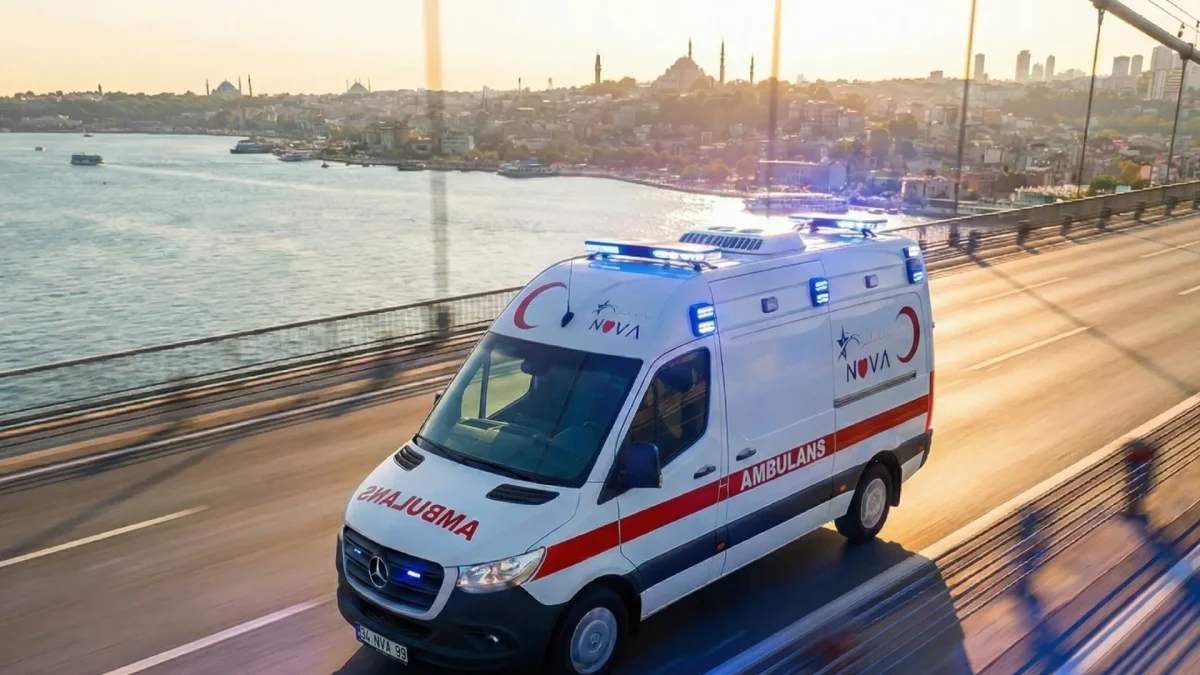
- White body, red stripe: emergency or intensive care ambulance, with a minimum crew of 3.
- Gray (RAL 7004) body, blue stripe: patient transport ambulance, minimum crew of 2; not for emergency patients.
- A gray vehicle reads "Hasta Nakil" (Patient Transport), never "Ambulans"; the color deadline was 1 January 2026.
- On 9 February 2026 the Council of State stayed the patient transport definition; Article 8's color rule carries no such note.
- Every Nova Ambulans vehicle is a white-bodied, intensive-care-equipped Emergency Ambulance.
While driving in Turkey, you may have noticed that some ambulances have red stripes while others have blue. Since 2025 there are also gray-bodied ambulances on the road. Turkey classifies land ambulances by purpose into four types: Emergency Ambulance, Patient Transport Ambulance, Intensive Care Unit (ICU) Ambulance, and Special-Purpose Ambulances. [1] This four-way classification is not new: the previous 2006 regulation had listed the same four types since its 2013 amendment. [5][6] The most visible change in traffic under the Ambulances and Emergency Health Vehicles and Ambulance Services Regulation of 8 January 2025 is color: the patient transport ambulance now has a gray body and a blue stripe. [1] The execution of the sub-paragraph that defines the patient transport ambulance, however, was stayed by a Council of State (Danıştay) decision on 9 February 2026; Article 8, which sets the color rule, carries no such note. [7] Below we cover the features, staffing, and use cases for each type, together with how to tell them apart in traffic.
Red-Striped Ambulance: Emergency Ambulance
Under the regulation, red-striped, white-bodied ambulances are either emergency or intensive care ambulances; both classes share the white body and red stripe. [1] This section covers the Emergency Ambulance class. They respond to emergencies on scene, stabilize the patient, and transport them to the nearest appropriate hospital. [1]
Vehicle Features:
- Body Color: White, with a red phosphorescent and microprismatic reflective stripe. Labels and markings on these vehicles may not use any color other than red. [1]
- Crew: Minimum three persons: one physician or paramedic (associate-degree), or an emergency medical technician (EMT) who has completed Ministry-mandated module training, plus one additional health worker, plus one driver. [1]
- Equipment: A monitoring defibrillator that shows the heart rhythm on screen, a transport ventilator for mechanical breathing support, an emergency delivery kit, a burn kit, and trauma supplies such as a traction splint that stabilizes a broken leg by pulling it straight; in other words, advanced life support equipment. [3] For the detailed mandatory list, see our guide to required equipment in Turkish ambulances.
- Use Cases: Life-threatening emergencies such as heart attacks, severe traffic accidents, stroke, and respiratory arrest; the emergency ambulance is designed for on-scene intervention and stabilization. [1]
Intensive Care Unit (ICU) Ambulance (Red Stripe)
The Intensive Care Unit (ICU) ambulance is a specialized red-striped ambulance type designed for transporting patients who require advanced monitoring and treatment during transit. [1]
Vehicle Features:
- Body Color: White, with a red phosphorescent and microprismatic reflective stripe (same appearance as emergency ambulances). [1] Under the previous regulation, Intensive Care Unit (ICU) ambulances carried two stripes, one red and one blue; the 2025 regulation moved them to the same look as emergency ambulances. [1][5]
- Crew: Minimum three persons: at least two health workers (one of whom must be a physician or paramedic), plus one driver. [1]
- Equipment: On top of the emergency ambulance equipment, the Intensive Care Unit (ICU) ambulance must carry a capnometer (measures exhaled carbon dioxide), an external pacemaker (regulates the heart rhythm from outside the body), and a chest drainage kit (drains air or fluid collected in the chest cavity), among other devices for Intensive Care Unit (ICU)-level treatment. [3]
- Use Cases: Transfer of critical patients from Intensive Care Unit (ICU) units, post-operative patients requiring advanced monitoring, and intercity critical care transports. The clinical criteria are covered in when is an Intensive Care Unit (ICU) ambulance required.
What Does a Gray Ambulance Mean? The Blue-Striped Patient Transport Ambulance
A gray-bodied, blue-striped vehicle is a Patient Transport Ambulance: under Article 8 of the regulation, patient transport ambulances are gray (RAL 7004). [1] Article 5 of the regulation defines this class as a land vehicle "used for transporting patients or injured persons who do not require emergency medical intervention"; however, the execution of the sub-paragraph containing this definition has been stayed since 9 February 2026 (details below). [1][7] Under the previous regulation, all land ambulances were white and a navy-blue stripe marked the patient transport ambulance. [5] The regulation of 8 January 2025 redefined these ambulances' appearance as a gray body with a blue stripe, and the June 2025 amendment further updated the warning-light, equipment list (Annex 2), training, and compliance-deadline requirements. [1][2]
Council of State ruling (9 February 2026): According to the current consolidated text on the Mevzuat Bilgi Sistemi (Turkey's official legislation database), the execution of the sub-paragraph that defines the patient transport ambulance, Article 5(1)(a)(2), has been stayed by decision E.:2025/4300 of the Tenth Chamber of the Council of State (Danıştay), dated 9/2/2026, "due to incomplete regulation" (eksik düzenleme nedeniyle). [7] The stayed provision contains the class definition and the phrase added to it on 24 June 2025, "an audible warning system and a blue light warning device that can be immediately removed and reinstalled". [2][7] In the same text and its annexes, this note appears only on that sub-paragraph: there is no such note on Article 8 (gray body and blue stripe), Article 7 (crew size), Article 30/ğ (the ban on carrying emergency patients), Provisional Article 1 (the 1 January 2026 compliance deadline), or Annex 1 (the "Hasta Nakil" lettering). [7] Because the official text does not explain the decision further, this article presents the Article 5 definition and light rule as a stayed provision, not as settled law in force.
Vehicle Features:
- Body Color: Gray (RAL 7004). This color is set by the 8 January 2025 Ambulances and Emergency Health Vehicles and Ambulance Services Regulation (OG-8/1/2025-32776, Article 8). The vehicle is bordered by a phosphorescent, blue, microprismatic reflective stripe at least 200 mm wide, and labels and markings on it may not use any color other than blue. [1] In the RAL color catalog, RAL 7004 is the shade named "Signal grey" (German: Signalgrau). [8]
- Lettering: A patient transport ambulance may not carry the word "Ambulans" (Ambulance); it carries the words "Hasta Nakil" (Patient Transport) instead (Regulation Annex 1). [3] The lettering that shows the ambulance class appears on the right and left sides of the vehicle. [1]
- Light System: The original 8 January 2025 text defined the patient transport ambulance as a vehicle "with an audible warning system but without a light warning system". [1] The 24 June 2025 amendment (Article 2) replaced that wording with "an audible warning system and a blue light warning device that can be immediately removed and reinstalled". [2] Because the execution of the sub-paragraph containing this wording was stayed by the Council of State on 9 February 2026, the detachable blue light provision should not be read as settled law today. [7] Annex 1, for its part, requires the audible warning systems and light warning device on patient transport ambulances to comply with national regulations. [3]
- Crew: Minimum two persons: one health worker and one driver. The regulation does not require a physician for this class. [1]
- Equipment: Under the regulation's Annex 2, a patient transport ambulance also carries a stretcher, an oxygen system, a suction unit that clears secretions from the mouth and airway, a fingertip pulse oximeter that measures blood oxygen, and a resuscitation kit with a bag-valve mask for manual ventilation and intubation tubes placed in the windpipe. A ventilator (mechanical breathing support) and a defibrillator (delivers an electric shock to the heart) are mandatory too; a single-use automatic ventilator and an automated external defibrillator may be used instead. [3] The difference from an emergency ambulance is that some on-scene intervention equipment is not mandatory for this class, such as an infusion pump that delivers fluids and drugs at a set rate, an emergency delivery kit, a burn kit, and a traction splint that stabilizes a broken leg by pulling it straight. [3]
- Use Cases: Transfer of stable patients between hospitals, transport to dialysis or physiotherapy appointments, and discharges from hospital to home. Patient transport ambulances cannot be used for cases requiring emergency medical intervention (Article 30/ğ). Nor can they be used for health-precaution (sağlık tedbiri) service, in which an ambulance stands by at concerts, matches and similar events in case of an emergency (Article 30/ö); we explain which ambulance an event needs in our guide to event medical coverage. [1]
Regulatory Restriction (Article 30/ğ): Patient transport ambulances cannot be used for transporting patients requiring emergency medical intervention. If an emergency develops during transport, flashers are activated and audio warning systems may be used with Health Command Control Center (SKKM) approval. [1]
Compliance Deadline (1 January 2026): The regulation originally gave ambulance operators that were already active six months to comply with its rules, including the color and marking rules of Article 8; the 24 June 2025 amendment extended this to "by 1/1/2026". [1][2] Ambulances that do not comply within the period have their conformity certificates cancelled, so any blue-striped patient transport ambulance on the road since 1 January 2026 should have a gray body. [1]
Telling White and Gray Ambulances Apart in Traffic
The table below sets the two appearances side by side, based on Articles 5, 7, 8, and 30 of the regulation and its Annex 1; note that the execution of the Article 5 patient transport definition has been stayed since 9 February 2026. [1][2][3][7]
| Property | White body + red stripe | Gray (RAL 7004) body + blue stripe |
|---|---|---|
| Ambulance class | Emergency or intensive care ambulance | Patient transport ambulance |
| Role | Emergency medical intervention; advanced monitoring and treatment in transit | Transport of patients who do not need emergency intervention |
| Lettering and markings | Red only | Blue only; reads "Hasta Nakil" (Patient Transport), not "Ambulans" |
| Minimum crew | 3 persons | 2 persons (one health worker + driver) |
| Warning systems | Light and audible warning systems | Audible warning system + detachable blue light warning device (execution of the sub-paragraph containing this rule stayed on 9 February 2026) |
| Class-specific usage ban (Article 30) | None | Cannot carry patients or injured persons needing emergency medical intervention (30/ğ) or provide event health-precaution coverage (30/ö) |
Only bans specific to one class appear in the last row of the table. Article 30's other bans apply to both appearances: ambulances may not be used for funeral transport except in disasters (30/i) or for purposes other than their intended use (30/r), and land ambulances serve and are based within the province where they received their qualification certificate, leaving it for patient referrals and transfers (30/k). [1]
What should drivers do? Turkey's Highway Traffic Law ties right-of-way to a vehicle's task, not its color: Article 71 lists "ambulances and vehicles carrying injured or emergency patients" first in order of priority and states that the right is exercised "on condition of giving an audible and visible right-of-way signal". [4] Article 55 requires drivers who receive the audible or visible signal of such a vehicle to make way and, if necessary, stop. [4] In practice:
- Siren and warning light off: the gray vehicle is on a planned transfer and is not exercising right-of-way; it follows normal traffic rules.
- Siren or warning light on: make way exactly as you would for a white ambulance. When an emergency develops during transport, the gray vehicle turns on its flashers, and the siren may be used only with Health Command Control Center (SKKM) approval. [1]
For lane-clearing and intersection rules, see what to do when you hear an ambulance siren in traffic. You can also see who operates the vehicle: except for public-sector ambulances, the operator's name, emblem, and contact details appear above the windshield on the driver's side, on both sides, and at the rear, each no larger than 50x50 cm. [1][2] To check the operator's license, follow the steps in how to verify a licensed private ambulance.
Ambulances themselves are certified too. Under Annex 1, every newly registered ambulance needs a certificate of conformity with the TS EN 1789 standard, and ambulances are checked and inspected against that standard. [3] The Turkish Standards Institution (TSE) carries out the first inspection of vehicles newly converted into ambulances and the periodic inspections of registered ambulances; inspections take place at Vehicle Inspection Centers, or at the institution's own units in provinces without such a center. [10] On the operator side, the provincial health directorate issues the ambulance service conformity certificate. [1] The private ambulance unit of the Istanbul Provincial Health Directorate publishes separate medical device and supply lists for emergency ambulances and patient transport ambulances for this certificate. [9]
Special-Purpose Ambulances
The fourth type covers ambulances specially designed based on the geographical and architectural characteristics of the service area and the physical and medical conditions of patients. Under the 2025 regulation, these belong to the Ministry and public institutions. [1]
Examples:
- Terrain Ambulance: For access in mountainous and rough terrain.
- Multi-Stretcher Ambulance: For transporting multiple patients in mass casualty situations.
- Neonatal Ambulance: Equipped with incubators and neonatal equipment.
- Bariatric Ambulance: Features wide stretchers and specialized transport systems for larger patients.
- Medical Rescue Ambulance: Carries specialized intervention equipment for trapped patients.
A minimum crew of three (at least two health workers, one of whom must be a physician or paramedic, plus one driver) serves in these ambulances. Colors and markings are determined separately by the Ministry. [1]
Mandatory Training: New Regulation
The June 2025 amendment made it mandatory for all health personnel working in ambulances to complete Ministry-determined training programs (Article 7/4). [2] This ensures consistent quality of personnel across all ambulance types. For each crew role's duties, see ambulance personnel roles in Turkey.
Nova Ambulans vehicles: Every vehicle in our fleet is a white-bodied, red-striped, intensive-care-equipped Emergency Ambulance; there is no gray patient transport vehicle in our fleet. Non-emergency trips such as dialysis appointments, going home after discharge, or a planned home-to-hospital transfer use the same vehicle.
Frequently Asked Questions
Which ambulance type should I call in an emergency?
For life-threatening emergencies such as heart attacks, stroke, severe trauma, or respiratory arrest, call 112 or Nova Ambulans (0216 339 00 39). Red-stripe emergency ambulances carry advanced life support equipment and specialized medical teams, while intensive care ambulances with the same livery are used mainly for inter-hospital critical care transfers; every Nova Ambulans vehicle is of this type.
Note: Private hospitals may not be able to admit patients due to capacity limitations. In such cases, Nova Ambulans arranges the most suitable alternative private hospital or safely transports the patient to the nearest public hospital.
Can a blue-stripe ambulance be used in emergencies?
No. Per Article 30(1)(ğ) of the 2025 regulation, patient transport ambulances cannot be used for patients requiring emergency medical intervention. [1] However, if an unexpected emergency develops during transport, flashers are activated and audio warning systems can be engaged with Health Command Control Center (SKKM) approval.
What does a gray ambulance mean?
A gray (RAL 7004) body with a blue stripe marks a patient transport ambulance. The regulation bans using this vehicle to carry patients who need emergency medical intervention (Article 30/ğ), so it is used for planned transport of stable patients. [1] The gray color was set by the 8 January 2025 Ambulances and Emergency Health Vehicles and Ambulance Services Regulation (OG-8/1/2025-32776, Article 8). [1] The gray body makes it easy to distinguish from white emergency and intensive care ambulances in traffic, and it reads "Hasta Nakil" (Patient Transport) rather than "Ambulans". [3] The June 2025 amendment extended the color-compliance deadline to 1 January 2026 and added the detachable blue warning light to the definition. [2] The execution of that sub-paragraph defining the patient transport ambulance was stayed by the Tenth Chamber of the Council of State (Danıştay) on 9 February 2026; Article 8's color rule carries no such note. [7]
Do I have to yield to a gray ambulance in traffic?
Yes, if its siren or warning light is on. Turkey's Highway Traffic Law ties right-of-way to the vehicle's task rather than its color and requires drivers to make way for a vehicle giving an audible or visible right-of-way signal (Articles 55 and 71). [4] A gray vehicle with its siren and lights off is on a planned transfer and is not exercising right-of-way; when in doubt, making way safely is the right call.
What is an Intensive Care Unit (ICU) ambulance and when is it needed?
An Intensive Care Unit (ICU) ambulance is a specialized ambulance type designed for critical patients who need advanced monitoring and treatment during transport. [1] It is used for transfers from intensive care units to other hospitals, post-operative transport, and intercity critical patient transfers. It has a white body with red stripes like emergency ambulances, but additionally carries advanced monitoring devices and Intensive Care Unit (ICU)-level medical equipment.
How many personnel are staffed in each ambulance type?
Staffing varies by ambulance class: [1]
- Emergency ambulance: Min 3 (physician, paramedic, or module-trained emergency medical technician (EMT) + health worker + driver)
- Patient transport ambulance: Min 2 (health worker + driver); no physician is required
- Intensive Care Unit (ICU) ambulance: Min 3 (physician or paramedic + health worker + driver)
- Special-purpose ambulance: Min 3 (physician or paramedic + health worker + driver)
How can I tell ambulance types apart when requesting private ambulance service?
Look at the body color and stripe color: white body + red stripe = emergency or Intensive Care Unit (ICU) ambulance; gray body + blue stripe = patient transport ambulance. The ambulance class is also written on both sides of the vehicle; on a patient transport ambulance it reads "Hasta Nakil". [1][3] Determine whether you need emergency intervention or planned transport, then always ask the provider which ambulance type will serve you.
Intercity Ambulance Transfer Service
Safe and fast intercity patient transport across Turkey. ICU support included.
Average response time: 15 seconds
Related Articles
Difference Between 112 and Private Ambulance: Which One to Call?
Understand the practical difference between 112 and private ambulance services in Turkey: dispatch, hospital choice, SGK coverage, on-scene emergency response, and which to choose for your situation.
Service UtilityThe History of Ambulance Services in Turkey: From Hilâl-i Ahmer to 077 Hızır Acil and 112 (2026)
A sourced, chronological history of ambulance services in Turkey — from the battlefield medical transport of Hilâl-i Ahmer (founded 1868), to 077 Hızır Acil, the country's first modern ambulance service opened in Ankara on 9 October 1985, through the 112 emergency system, UMKE, air and sea ambulances, and the licensed private-ambulance sector regulated by the 2025 ordinance — built on primary sources and Official Gazette dates, clarifying the public vs private division of labour.
Service UtilitySummer Vacation Ambulance Services in Türkiye: Health Safety in Holiday Regions (2026)
Planning intercity private patient transport at the end of summer vacation, the line between 112 emergency services and private ambulance providers in holiday regions, bystander step-by-step decisions in drowning and heatstroke — with the verbatim text of Türkiye's Ministry of Health 8 January 2025 and 24 June 2025 ambulance regulations, the Turkish Red Crescent First Aid Pocket Book 2025 protocols, the Turkish Statistical Institute's 2025 tourism figures, and the 13-year Sinop coastal drowning series.
Popular Ambulance Topic Clusters
You may also like
- Private ambulance pricing
- Istanbul private ambulance
- Intercity patient transport
- Doctor-accompanied ambulance
- Dialysis patient transport
- How intercity patient transport works
- Ambulance response time in Istanbul
- Home-to-hospital patient transport
- Modern ambulance equipment and team standards
- Heart attack symptoms and first response
This content is informational only and does not replace professional medical evaluation. In emergencies, call 112 or +90 216 339 00 39.
