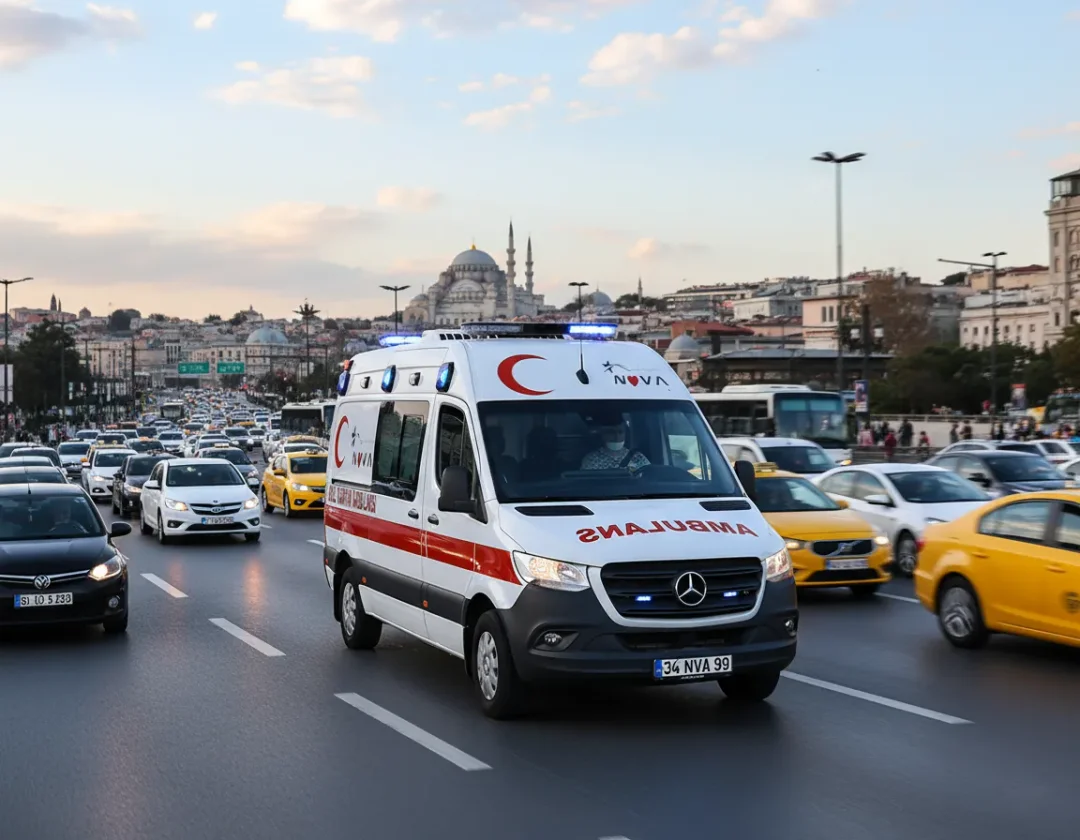
- To Do: Be calm, clear the lane with the zipper method.
- Don'ts: Do not stop suddenly, do not follow the ambulance.
- Intersections: Wait for the ambulance to pass even if the light is green.
- Responsibility: Giving way is not just a rule, it is a life-saving duty.
Ambulance siren indicates that someone needs emergency help. Rapid arrival of teams saves lives [1][2]. So what is your responsibility as a driver in Türkiye? In short, this responsibility is codified in Article 71 of Highway Traffic Law No. 2918 — the legal framework, the zipper-method (Rettungsgasse) practice, and siren acoustics are detailed below [7].
Legal Framework: Article 71 and Administrative Fines
Article 71 of Highway Traffic Law No. 2918 lists vehicles holding right-of-way priority and places "ambulances and vehicles transporting injured or critically ill patients" at the top of the list [7]. The yielding obligation in Article 71 and the related administrative-fine provisions in Article 55 were tightened by Law No. 7574, which was adopted by the Grand National Assembly on 12 February 2026 and entered into force upon publication in the Official Gazette dated 27 February 2026 (No. 33181) [7][8]:
- Drivers who fail to yield to the vehicles in Article 71(a) and (b) — ambulances and fire trucks — face an administrative fine of 46,000 Turkish Lira, a 30-day driver's licence suspension, and a 30-day vehicle impoundment [7].
- Returning the suspended licence requires payment in full of every administrative fine the driver carries.
- The same 46,000 TL fine applies in reverse: ambulance drivers who use right-of-way without genuine necessity are penalised identically — the prohibition runs both ways [7].
These figures are not symbolic. A second of hesitation can mean a critical delay in stop-and-go Istanbul traffic; for the driver, the fine equals more than a month of minimum wage in Türkiye.
Dos
- Be Calm and Do Not Panic: Avoid sudden braking or uncontrolled maneuvers. This can lead to bigger accidents [1].
- Determine Where the Ambulance Is Coming From: Listen to the sound and check your mirrors. Modern ambulance sirens typically emit over 100 dB at the source; for a driver with closed windows and loud music, locating the direction of the sound can lag by a few seconds, so regular mirror checks compensate.
- Give Way (Zipper / Rettungsgasse Method): A practice borrowed from Germany and Switzerland: on a single-lane road, pull as far right as safely possible; on a two-lane road, left-lane vehicles move left, right-lane vehicles move right to open a centre "life corridor" [3]. On three-lane motorways, the leftmost lane shifts left and the centre and right lanes shift right.
- Be Careful at Intersections: If you are at an intersection and the green light is on for you, wait for the ambulance to pass [1][2]. Move after making sure the ambulance has passed safely.
Don'ts
- Do Not Stop Suddenly: Stopping in the middle or suddenly can cause vehicles coming from behind to hit you and the road to be blocked even more [1].
- Do Not Follow the Ambulance: Do not try to go fast after the ambulance to open the way. This is both dangerous and illegal [1][2][7].
- Do Not Block the Road: Do not block the safety lane or areas where other drivers can escape.
Frequently Asked Questions
Do I have to enter the safety lane when I hear an ambulance siren?
No; since the aim is to open a corridor for the ambulance, it is sufficient to slow down in a controlled manner in your lane and approach right or left. Blocking the safety lane unnecessarily can make the ambulance's progress difficult.
What should I do if an ambulance comes while the green light is on at the intersection?
Even if the light is green for you, the ambulance with siren and beacon lights on has priority. Make sure the ambulance passes safely before leaving the intersection, then move.
Does following the ambulance and going fast require a penalty?
Yes; using the ambulance as a "path opener" is both dangerous and against the legislation. You should maintain following distance with the ambulance and return to your normal speed after helping its passage.
Rapid Emergency Support
24/7 emergency ambulance service across Istanbul. Fast response, fully equipped team.
Average response time: 15 seconds
Related Articles
Ambulance Personnel Training Standards: 2026 Regulation Update
The 8 January 2025 and 24 June 2025 regulatory amendments made ministry-designated training modules mandatory for every ambulance health worker in Türkiye: hour breakdown, certification cycle, and a family verification checklist.
EducationDog and Cat Bite First Aid: Rabies Risk, the 15-Minute Wash and When to Call 112
If a dog or cat bites or scratches you, wash the wound at once with plenty of soap and water for at least 15 minutes, press directly on it if it bleeds, cover it with a clean cloth and go to a health facility the same day. Rabies cannot be treated once symptoms begin; a doctor decides whether you need the vaccine. Call 112 for bleeding that pressure does not stop or for any threat to life.
EducationMushroom Poisoning Symptoms and First Aid: When Do Symptoms Start, When to Call 112?
If nausea, vomiting, diarrhea, abdominal pain or any other symptom begins after eating foraged mushrooms or mushrooms of unknown origin, call 112, whatever hour it began; do not induce vomiting and give nothing by mouth. People without symptoms, including a child who ate a mushroom in a garden or park, still need hospital assessment; call 112 and explain, because with amatoxin, which damages the liver, the symptom-free interval averages 8-10 hours. The National Poison Information Center (UZEM) on 114 gives advice but does not replace 112.
Popular Ambulance Topic Clusters
You may also like
- Private ambulance pricing
- Istanbul private ambulance
- Intercity patient transport
- Doctor-accompanied ambulance
- Dialysis patient transport
- How intercity patient transport works
- Ambulance response time in Istanbul
- Home-to-hospital patient transport
- Modern ambulance equipment and team standards
- Heart attack symptoms and first response
This content is informational only and does not replace professional medical evaluation. In emergencies, call 112 or +90 216 339 00 39.
