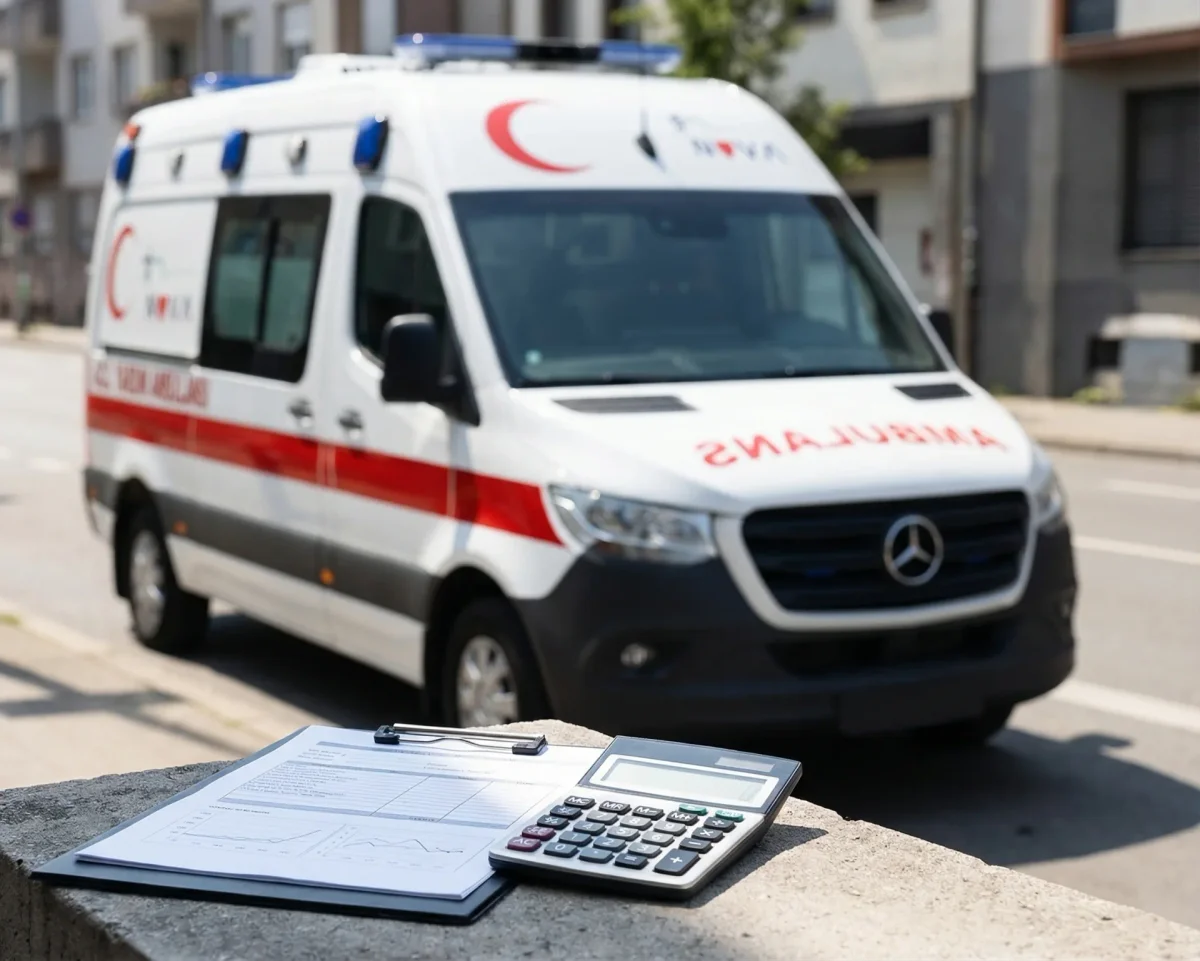
- Ambulance fees are set by a Provincial Health Directorate commission — not freely by operators (Article 27).
- The commission sets minimum and maximum prices annually, before the end of February.
- Fees vary by ambulance class, city vs. intercity, and distance.
One of the most common misconceptions about private ambulance services in Turkey is that operators can charge whatever they want. In fact, Article 27 of the 2025 Ambulance Regulation establishes a strict legal framework for ambulance fee determination. [1]
The Provincial Fee Commission (Article 27)
Article 27 of the regulation requires that, in each province, a Fee Determination Commission be set up to determine the fees private ambulance services may charge. The commission operates under the Provincial Health Directorate. [1]
Commission Membership
Under Article 27, the commission convenes under the chairmanship of the Provincial Health Director and is composed of the following representatives: [1]
- The director responsible for emergency health services
- One representative appointed by the Provincial Police Directorate
- One representative appointed by the Provincial Directorate of Industry and Technology
- One representative appointed by the Provincial Directorate of Trade
- One representative appointed by the Municipal Authority
- One representative appointed by the Chamber of Physicians
- One representative each from the ambulance services and private health institutions providing ambulance services, as designated by the Directorate
This plural structure ensures the price-setting process does not rest on the perspective of a single party.
How the Commission Sets Prices
When determining fees, the commission evaluates several criteria listed in the regulation simultaneously: [1]
1. Cost Analysis
The real costs of the ambulance service are reviewed: fuel and vehicle maintenance, personnel salaries and insurance, medical equipment and consumables, and operating expenses (parking, office, insurance, etc.).
2. Price Indices
Inflation indicators such as the consumer price index (CPI) and producer price index (PPI) are taken into account, keeping fees aligned with economic conditions.
3. Local Conditions
Each province's own dynamics are considered: traffic density and geography, population density and hospital distribution, and the competitive environment among ambulance services.
4. Comparable Fees
Fees applied in other provinces of similar size are used as a benchmark, helping to prevent excessive price differences between provinces.
Minimum and Maximum Limits
Rather than a single fixed price, the commission sets a minimum (floor) and maximum (ceiling). [1] Private ambulance services may set their own prices as long as they stay within these limits:
- The floor price prevents service quality from being undercut. A minimum amount is set because very low prices can mean compromising on personnel and equipment quality.
- The ceiling price protects patients from excessive pricing. No service may charge above the maximum set by the commission.
City vs. Intercity Transfers
In practice, the commission determines separate tariffs for different service types. The main distinctions are: [1]
City (Intra-provincial) Transfer
The tariff set for patient transfers within the same province. It usually consists of:
- Opening fee: A fixed starting amount applied when the ambulance is dispatched
- Distance fee: A variable amount calculated per kilometre
- Medical intervention fee: An additional item based on medical interventions performed during transport
Intercity Transfer
A different tariff applies to transfers that cross provincial boundaries. Because distance is more decisive in intercity transfers, the per-kilometre rate becomes more prominent. Highway, bridge, and tunnel tolls may also be added to the total cost.
Tariff by Ambulance Class
Fees also vary by the class of the ambulance: [1]
- Emergency ambulance: Sits in the highest tariff band due to its larger crew and advanced equipment.
- Patient transport ambulance: A relatively lower tariff band, as it requires fewer crew and basic equipment.
- Intensive care ambulance: Evaluated in the highest tariff band due to its advanced monitoring and treatment equipment.
Commission Timeline
Under the regulation, the Fee Determination Commission must convene before the end of February each year to set the new year's tariffs. [1] The cycle works as follows:
- January–February: The commission analyses the prior year's data, inflation rates, and cost changes.
- End of February: The new year's minimum and maximum fees are set.
- Ministry approval: The fees are submitted to the Ministry of Health and take effect upon approval.
- Year-round application: Approved tariffs remain valid until the next year's fees are set, barring extraordinary circumstances.
Fee Components: Opening, Distance, and Intervention
The total cost of an ambulance service usually comprises three main components: [1]
- Opening fee (fixed): A base fee, independent of distance, that begins when the ambulance responds to a call and is dispatched. It covers personnel, vehicle readiness, and the scope of the initial response.
- Distance fee (variable): An amount calculated per kilometre based on the distance to the hospital or destination. In intercity transfers this item can make up the largest share of the total.
- Medical intervention fee (conditional): An item added for medical interventions performed during transport. Not every case requires intervention, so this item does not appear in every service.
Patients' Price Verification Rights
Because tariffs are set under the supervision of the Provincial Health Directorate, patients have the following practical rights and options:
- Price information: You can request an estimate of the total amount before service.
- Tariff inquiry: Since tariffs are set by the Provincial Health Directorate, you can ask the Directorate for the current ambulance fee tariff. [1]
- Invoice request: Under general tax and consumer legislation, you have the right to a detailed invoice after each service.
- Filing complaints: You can report firms charging above the tariff to the Provincial Health Directorate or to ALO 184 SABİM, the Ministry of Health's general health complaint line. [6]
What Happens If the Tariff Is Exceeded?
Ambulance services that charge above the maximum set by the commission are audited by the Provincial Health Directorate and subject to sanctions. These sanctions are based not on Article 27 but on the regulation's audit and administrative-sanction provisions and on Laws No. 1593 and 3359; under the legislation and general administrative-sanction provisions, they may include:
- Warning and a request for correction
- Administrative fine
- Temporary suspension of operations
- Cancellation of the certificate of conformity (for repeated violations)
Frequently Asked Questions
Do ambulance fees change every year?
Yes. The Fee Determination Commission convenes before the end of February each year to set new tariffs. [1] Tariffs are updated in line with inflation rates, cost changes, and local conditions. The new tariff takes effect upon Ministry approval.
Can ambulance fees differ between provinces?
Yes. Each province has its own Fee Determination Commission and sets tariffs considering local conditions. [1] Fees in large metropolitan areas like Istanbul may differ from smaller provinces because cost structure, traffic conditions, and demand levels vary.
Can a private ambulance charge more than the commission maximum?
No. The commission sets a ceiling. Services charging above the approved maximum are in breach of the regulation and can be reported to the Provincial Health Directorate or to ALO 184 SABİM. [6]
Is an invoice mandatory after receiving ambulance service?
Yes. Under general tax and consumer legislation, every licensed private ambulance service must issue a detailed invoice after service, showing the service type, distance, interventions performed, and total amount separately. Be wary of firms providing service without an invoice and report them to the Provincial Health Directorate.
Can different fees apply at night or on weekends?
The tariff structure set by the commission is decisive here. In some provinces a night or weekend surcharge may be included in the tariff; in others a flat-price approach is adopted. At Nova Ambulans we apply a 24/7 flat-price policy: we do not charge extra at night, on weekends, or on public holidays.
Related Posts
Rapid Emergency Support
24/7 emergency ambulance service across Istanbul. Fast response, fully equipped team.
Average response time: 15 seconds
Related Articles
What Does a Gray Ambulance Mean? The Patient-Transport Ambulance and Turkey's 2025 Color Regulation
The gray body with a blue stripe you see in traffic or in front of a hospital is a patient-transport ambulance, redefined by Turkey's Official Gazette regulation of 8 January 2025 (RG-8/1/2025-32776). This guide explains where the gray (RAL 7004) color comes from, how it differs from the white emergency ambulance, the restriction on audible warning systems, the detachable blue light restored by the 24 June 2025 amendment, the transition period that closed on 1 January 2026, and how to behave when you see a gray ambulance in traffic — grounded in the T.C. Ministry of Health and World Health Organization (WHO) sources.
EducationAmbulance Personnel Training Standards: 2026 Regulation Update
The 8 January 2025 and 24 June 2025 regulatory amendments made ministry-designated training modules mandatory for every ambulance health worker in Türkiye: hour breakdown, certification cycle, and a family verification checklist.
EducationHow to Stop a Nosebleed: Step-by-Step Correct Technique (2026)
How to stop a nosebleed, which way to tilt the head, how many minutes to pinch, when to call 112: the Turkish Red Crescent 2025 First Aid Pocket Book, the Turkish Ministry of Health May 2025 First Aid Training Book, the American Academy of Otolaryngology-Head and Neck Surgery (AAO-HNS) 2020 Tunkel guideline, and the Özbay 2025 multi-center Türkiye cohort (n=2300) applied to the correct technique at home and on scene.
Popular Ambulance Topic Clusters
You may also like
- Private ambulance pricing
- Istanbul private ambulance
- Intercity patient transport
- Doctor-accompanied ambulance
- Dialysis patient transport
- How intercity patient transport works
- Ambulance response time in Istanbul
- Home-to-hospital patient transport
- Modern ambulance equipment and team standards
- Heart attack symptoms and first response
This content is informational only and does not replace professional medical evaluation. In emergencies, call 112 or +90 216 339 00 39.
