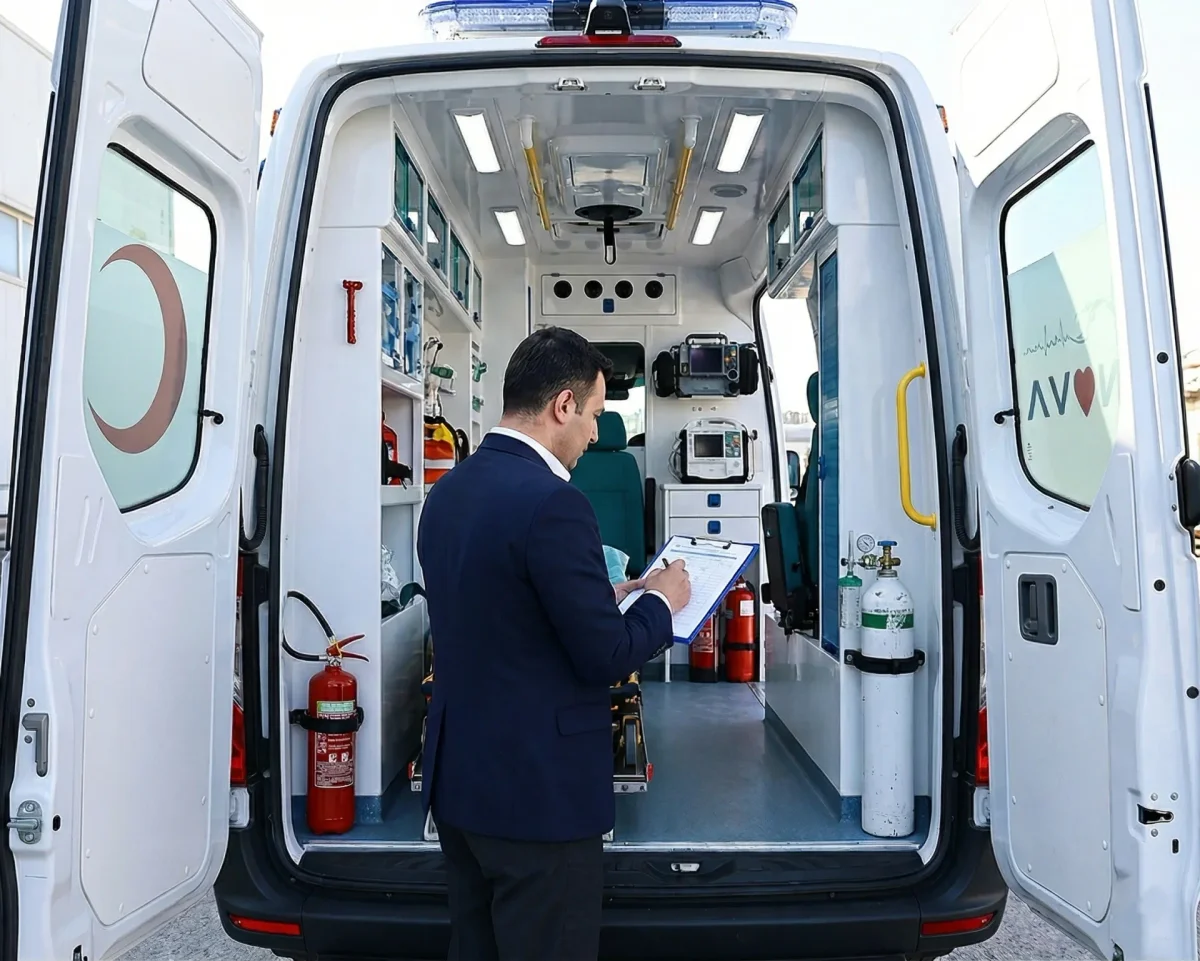
- Every ambulance service is subject to at least 3 routine audits per year (Article 26).
- Audits use standardized forms: Annex-10/A for the service and Annex-10/B for each ambulance.
- Sanctions range from fines to activity suspension and certificate cancellation.
Regulatory compliance in Turkey's ambulance sector is not self-declared — it is verified through a structured audit system governed by Article 26 of the 2025 Ambulance Regulation. Every licensed ambulance service, its stations, and individual vehicles are inspected regularly by a dedicated inspection team. [1]
How Audits Are Conducted
Inspection team composition: The regulation's definitions article (Article 4) defines the "inspection team" as a team of at least three people, with at least one being a health professional, assigned by the Provincial Health Directorate to conduct each audit. [1]
Frequency: Routine audits happen at least three times per year. Article 26(1) is explicit: "Ambulance services, stations, and ambulances...are subject to a routine inspection at least three times a year." [3] The Directorate may also conduct extraordinary (unannounced) audits based on complaints or other grounds at any time.
Audit forms: Two standardized forms are used:
- Annex-10/A — for assessing the ambulance service as a whole (management, documentation, facilities)
- Annex-10/B — for assessing individual vehicles (equipment, calibration, marking)
Real-time monitoring: Between audits, all ambulances are tracked continuously via the Emergency Health Automation System (ASOS) and the Ministry's vehicle tracking system (Article 26/2). [1] The Emergency Health Automation System (ASOS) itself is run by the Ministry of Health's Directorate General for Emergency Health and Disaster Services. [4] The technical reference for the equipment side of the audit is TS EN 1789 (medical vehicles and their equipment, road ambulances), published by the Turkish Standards Institute (TSE). [5] The June 2025 amendment also reinforced post-audit training obligations under Article 7(4). [2]
What Auditors Check
A typical on-site audit covers:
- Validity of service certificate, vehicle qualification certificates, and personnel work permits
- Equipment completeness and calibration against Annex-1 and Annex-2 requirements
- Accuracy and completeness of Emergency Health Automation System (ASOS) case records
- Crew composition compliance (minimum qualifications per Article 7)
- Uniform, identification card, and vehicle marking compliance (Articles 21–22)
- Monthly reporting submissions (Annex-13)
Sanctions (Article 26)
Non-compliance triggers escalating consequences:
| Level | Sanction |
|---|---|
| Minor deficiency | Written correction notice with deadline |
| Repeated/serious violation | Administrative fine |
| Severe violation | Activity suspension |
| Critical/systemic failure | Service certificate cancellation |
When a service certificate is cancelled following an audit, inspection, or monitoring, both the service certificate and the responsible-manager certificate may not be re-issued to the same certificate holder and responsible manager for six months (Article 26/7). [1]
Intentional obstruction of an audit is treated as a serious violation and carries the sanctions listed in Annex-10/A and Annex-10/B.
Nova Ambulans
Nova Ambulans voluntarily maintains audit-ready status at all times. Our documentation, equipment records, crew qualifications, and Emergency Health Automation System (ASOS) logs are current and accessible for inspection. The approach mirrors the Emergency Medicine Association of Turkey's pre-hospital programme, which is built around "supporting the training and development" of the professionals who must meet these audit standards every quarter. [6]
Frequently Asked Questions
How often are private ambulance services audited?
Under the regulation, private ambulance services are subject to routine audits at least three times a year. [1] In addition, extraordinary (unannounced) audits can be carried out at any time on the basis of a complaint or report.
Which documents are checked during an audit?
Using the Annex-10/A and Annex-10/B forms, the inspection team reviews the service certificate, personnel certificates, vehicle qualification certificates, medical-device maintenance records, Emergency Health Automation System (ASOS) records, and case-reporting forms. [1]
Can patients trigger an extraordinary audit?
Yes. Complaints submitted to the Provincial Health Directorate or via ALO 184 can initiate an unannounced extraordinary audit.
What happens to a vehicle when its qualification certificate is cancelled?
All markings, lights, sirens, and medical equipment must be removed from the vehicle upon written notice from the Directorate. The cancellation is also reported to the Notaries' Union and the Provincial Police Directorate.
Are audit results public?
Audit outcomes are held by the Provincial Health Directorate. Patients and clients may file information requests under Turkish public information access law.
Related Posts
Rapid Emergency Support
24/7 emergency ambulance service across Istanbul. Fast response, fully equipped team.
Average response time: 15 seconds
Related Articles
Ambulance Call and Case Reporting: From First Contact to Hospital Handover
How does a private ambulance service handle a call in Turkey? Articles 16, 17, and 18 of the 2025 Ambulance Regulation define the call intake, dispatch, and case recording workflow step by step.
EducationWhat Does a Gray Ambulance Mean? The Patient-Transport Ambulance and Turkey's 2025 Color Regulation
The gray body with a blue stripe you see in traffic or in front of a hospital is a patient-transport ambulance, redefined by Turkey's Official Gazette regulation of 8 January 2025 (RG-8/1/2025-32776). This guide explains where the gray (RAL 7004) color comes from, how it differs from the white emergency ambulance, the restriction on audible warning systems, the detachable blue light restored by the 24 June 2025 amendment, the transition period that closed on 1 January 2026, and how to behave when you see a gray ambulance in traffic — grounded in the T.C. Ministry of Health and World Health Organization (WHO) sources.
EducationAmbulance Personnel Training Standards: 2026 Regulation Update
The 8 January 2025 and 24 June 2025 regulatory amendments made ministry-designated training modules mandatory for every ambulance health worker in Türkiye: hour breakdown, certification cycle, and a family verification checklist.
Popular Ambulance Topic Clusters
You may also like
- Private ambulance pricing
- Istanbul private ambulance
- Intercity patient transport
- Doctor-accompanied ambulance
- Dialysis patient transport
- How intercity patient transport works
- Ambulance response time in Istanbul
- Home-to-hospital patient transport
- Modern ambulance equipment and team standards
- Heart attack symptoms and first response
This content is informational only and does not replace professional medical evaluation. In emergencies, call 112 or +90 216 339 00 39.
