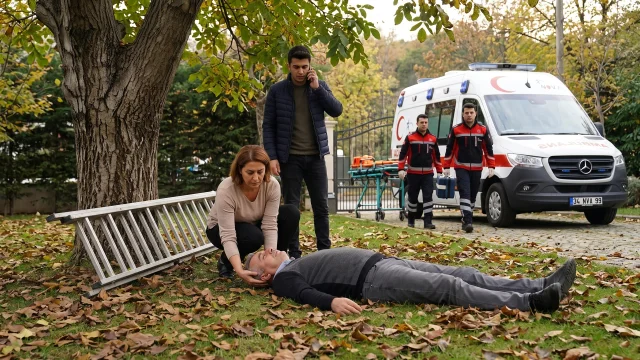
How to Stop Bleeding: Direct Pressure, Pressure Bandage and When to Use a Tourniquet
For serious external bleeding, place a clean cloth directly over the wound, press firmly and without a break for at least 5 minutes, and call 112. If the cloth soaks through, add another on top without lifting the first; if the bleeding has not stopped within 10 minutes, press harder over a wider area. Raising a bleeding arm is no longer recommended. A tourniquet is used for life-threatening arm or leg bleeding that direct pressure and a pressure bandage cannot stop; write down the time and do not loosen it before the crew arrives.
- Medical review
- Nova Ambulans Sağlık Kurulu (Medical Board)Prepared with input from the Medical Board. AI-assisted draft.
- Published
- Last reviewed
- Reading time
- 21 min
Key takeaways
- Press a clean cloth directly on the wound for at least 5 minutes, without a break.
- Do not lift a soaked cloth; add a fresh one on top and keep pressing.
- Raising a bleeding arm and pressing on pressure points are no longer recommended.
- Tourniquet only for uncontrollable life-threatening limb bleeding; write the time, never loosen it.
- Do not wash an amputated part; wrap it dry, bag it and cool it in iced water.
In this article (14 sections)
- Quick Answer
- Old Advice, New Rules: What You Learned at Driving School Has Changed
- When Is Bleeding Life-Threatening?
- Direct Pressure: Step by Step
- Tourniquet: When, Where and How?
- Amputated Parts and Impaled Objects
- Internal Bleeding and Shock: Spotting Bleeding You Cannot See
- By the Numbers: Cuts, Wounds and Amputations in Turkey
- Blood Thinners, Older Adults and Children
- When to Call 112: A Quick Checklist
- A Typical Scenario: A Glass Cut in a Workshop
- The First Minutes on a Building Site, the Check-Ups After Surgery: Nova Ambulans
- Frequently Asked Questions
- Sources
Quick Answer
The first thing to do for serious external bleeding is to place a clean cloth or piece of clothing directly over the wound and press firmly, without a break, for at least 5 minutes, and to call 112 21. According to the Turkish Ministry of Health's May 2025 first-aid book, a 70 kg adult has 5-6 litres of blood, and rapid loss of 1 litre can cause shock and death 2. If the bleeding has not stopped within 10 minutes, press harder over a wider area; a tourniquet comes in for life-threatening arm or leg bleeding that direct pressure and a pressure bandage cannot stop 2. One caveat: some steps you may have learned at driving school or from older first-aid notes, such as raising the bleeding arm or loosening the tourniquet every 15-20 minutes, are no longer part of the 2025 rules 2.
- Blood oozing, stops when you press: direct pressure, then a pressure bandage; see a doctor if needed 2.
- Blood spurting, or still flowing after 10 minutes of pressure: call 112 and keep pressing while you wait 12.
- Life-threatening arm or leg bleeding that pressure cannot control, or an amputated limb: tourniquet, write down the time, do not loosen it 23.
This guide brings together the bleeding chapter of the Turkish Ministry of Health Directorate General of Emergency Health Services' 2025 book, written by Prof. Dr. Seda Özkan of the Department of Emergency Medicine at İstanbul University-Cerrahpaşa 2, the Turkish Red Crescent's 2025 pocket book 1, Turkey's 2025 workplace-accident and traffic data 45 and international sources from 2024-2026. It was reviewed under the supervision of the Nova Ambulans Medical Board.
Old Advice, New Rules: What You Learned at Driving School Has Changed
Many adults in Turkey remember bleeding first aid from a single lesson at driving school. Someone searching "how to stop bleeding" today still mostly finds the same old list: raise the arm above heart level, press on the nearest pressure point, loosen the tourniquet at set intervals. Some of these lists still cite the Ministry of Health's 2011 basic first-aid book. The Ministry's 2025 book says something different on three of these points 2:
| Old advice | 2025 rule | Source |
|---|---|---|
| Raise the bleeding arm or leg above heart level | Not recommended as a first-aid method because no benefit has been shown | Ministry of Health 2025, pp. 111 and 123 2 |
| If blood is spurting, press on the artery above the wound (the pressure point) | The Ministry's 2025 bleeding steps contain no pressure point; the methods are direct pressure, a pressure bandage, a tourniquet and haemostatic dressings | Ministry of Health 2025, pp. 111-116 2 |
| Loosen the tourniquet every 15-20 minutes, keep it on for 2 hours at most | Tighten until the bleeding stops, write the time, do not loosen or remove it before the medical crew arrives | Ministry of Health 2025, p. 115 2; training slides, slide 18 3 |
| Replace a soaked cloth | Do not lift a soaked cloth; add a fresh one on top | Ministry of Health 2025, p. 112 2 |
The book gives its reason plainly: "raising the bleeding limb is not recommended as a first-aid method, since no benefit from it has been seen" 2. The evidence for pressure points is weak too. A systematic review published in Australia and released online in December 2024 found that 8 of the 9 studies on arterial pressure-point techniques had low levels of evidence; most reported 87.5-100% success in stopping blood flow, but the technique's effectiveness compared with a tourniquet "remains inconclusive" 10. In a moment of panic, hunting for the right spot in the groin or armpit takes longer than putting your hand on the one place you already know: the wound.
This shift is not unique to Turkey. The November 2024 first-aid guidelines of the American Heart Association (AHA) and the American Red Cross describe themselves as the first comprehensive update since 2010 and list "bleeding control" among the topics that are new or substantially revised 8. The European Resuscitation Council (ERC) October 2025 first-aid guidelines likewise base their sections on "control of life-threatening bleeding" and "preservation of an amputated body part" on the 2025 scientific review of the International Liaison Committee on Resuscitation (ILCOR) 76.
When Is Bleeding Life-Threatening?
Turkey's Ministry of Health divides bleeding into three types by vessel and reminds readers that all three can occur in the same casualty 2:
- Arterial bleeding: the blood spurts in time with the heartbeat and is bright red; from a major artery it can spray several metres. It is the most serious type, and even direct pressure may not always be enough 2.
- Venous bleeding: dark, slow and steady; easier to control than arterial bleeding 2.
- Capillary bleeding: an ooze; the most common type and usually not serious 2.
Severity is not just about the blood you can see. According to the Ministry's book, it depends on how fast the bleeding is, where in the body the blood flows, how much is lost, and the person's physical condition and age 2. A pool of blood spreading on the floor, an ooze that never stops, or a casualty who keeps getting paler is reason enough to call 112 while you keep pressing.
Time matters as well. The Turkish Red Crescent's 2025 pocket book states that "50% of deaths in accidents occur within the first 30 minutes" 1. In the General Directorate of Highways' 2025 summary, based on Turkish Statistical Institute (TÜİK) data, 2,541 (42.1%) of the 6,035 people killed in traffic collisions died at the scene 5. Not all of those deaths were from bleeding, but two of the most effective things anyone can do in those minutes at the scene are to stop the bleeding and to keep the airway open.
Direct Pressure: Step by Step
Direct pressure brings the edges of a torn vessel together and helps the body's own clotting system work; according to the Ministry's book it is enough to control the bleeding in most patients 2. The steps below are compiled from the 2025 Turkish Red Crescent and Ministry of Health texts 123:
- Make sure the scene is safe. If there is broken glass, a running machine or moving traffic, remove the danger first 12.
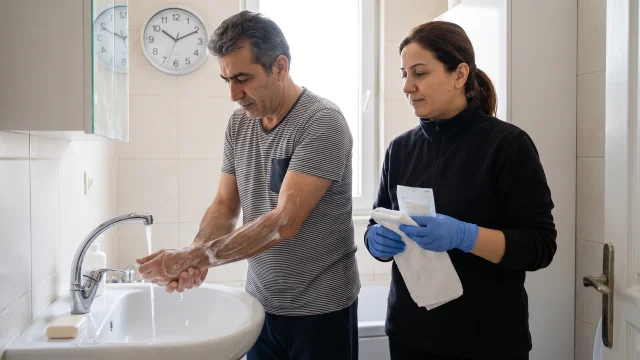
- Introduce yourself, calm the casualty and try to avoid touching blood with bare hands: wear examination gloves if you have them; if not, put extra gauze or a clean cloth between your hand and the wound 2.
- Lay the casualty flat on their back. If the injury is minor and they are more comfortable sitting, they can sit 12. Lying down prevents a fall if they faint.
- Call 112, or have someone call. If someone else is with you, they call while you press 2.
- Expose the wound. If you cannot see it, remove the clothing or cut along the seams; take off any watch, bracelet or ring on the injured arm 12.
- Place a clean cloth directly on the wound and press. Gauze, a towel, a handkerchief or the casualty's own clothing will do 1. Use your fingers for a small wound and the palm of your hand for a large one 2.
- Do not let go for at least 5 minutes. The Ministry's 2025 training slides put it in one sentence: "Pressure is applied over the wound for at least 5 (five) minutes" 3. Do not lift the cloth during this time to check whether it has stopped.
- If the cloth soaks through, do not lift it; add another on top. Replacing the first cloth can restart bleeding that was already under control 2.
- If it has not stopped within 10 minutes, add more cloth and press harder over a wider area 2.
- If the casualty is otherwise well, they can press on the wound themselves, which frees your hands for other tasks 2.
Do not give the casualty anything to eat or drink while you press; they may need surgery 2. For the other jobs while you wait, such as opening the door or preparing a list of medicines, see our guide to what to do until the ambulance arrives.
Pressure bandage
Once direct pressure has worked, a pressure bandage holds the cloth in place: the limb is wrapped firmly over the cloth with a roller bandage, a headscarf, a tie or similar fabric 2. According to the Ministry's book, the bandage lets you leave the casualty briefly, call 112 or attend to another injured person 2. It must not be tight enough to cut off circulation; increasing pain, numbness or tingling, a change in skin colour and loss of muscle function show that it is too tight 2. We list the gauze and bandages to keep at home and in the car in our emergency kit guide.
Tourniquet: When, Where and How?
A tourniquet is a band tied tightly around the upper part of an arm or leg to cut off blood flow to that limb completely. It stops bleeding well, but because it stops blood flow entirely it can cause serious tissue damage and loss of the limb; this is why the Ministry asks for the decision to be made carefully and recommends that "a tourniquet be applied by an experienced first aider" 2.
When is it used?
The Ministry of Health's 2025 book limits the tourniquet to three situations 2:
- Life-threatening arm or leg bleeding that cannot be stopped with direct pressure and a pressure bandage.
- Amputation of a limb.
- Many casualties at the scene when you are the only rescuer.
A tourniquet is not used for bleeding that pressure and a bandage can stop, and it is used only for arm and leg bleeding 2. Bleeding from the neck, chest, abdomen or groin cannot take a tourniquet; there, direct pressure continues, using a haemostatic dressing if one is available 2.
Where and how?
- Use a purpose-made tourniquet if there is one. If not, improvise one from what you have 2.
- The material must be a non-stretch bandage or fabric at least 5-10 cm wide. Thin material such as string or wire cuts the skin and must not be used 2.
- Position: on a single-bone part of the limb such as the upper arm or thigh, about 5-7 cm above the bleeding, on intact skin. Never over a joint 23. It is not applied to the forearm or lower leg because it can cut off the supply to the hand or foot; if the limb has been amputated, it can be applied there too 2.
- Tightening: put a piece of wood or a pen into the knot and twist until the bleeding stops; once it has stopped, do not tighten further 2.
- Write the time. Write the time of application on the tourniquet; if there are several casualties, write "Turnike" (tourniquet) or "T" visibly on the casualty's forehead or body 23.
- Do not cover it. The tourniquet must stay visible; if you hand the casualty over to someone else, always tell them a tourniquet has been applied 2.
- Do not loosen or remove it. The Ministry is categorical: "Make no further adjustment to the tourniquet (loosening, removing) until the medical crew arrives" 2.
Tourniquet training is not a one-off
In a study of 32 medical interns in Trabzon by the Department of Emergency Medicine at Karadeniz Technical University, published in April 2026, 3 hours of theory and hands-on simulation training in tourniquets significantly increased knowledge and skill scores. Skill scores for the junctional tourniquet, designed for junction areas such as the groin and armpit, rose from 1.7 to 10.8 and were still 10.4 two months later; by contrast, arm-and-leg tourniquet skill and self-confidence scores fell significantly after two months 9. The authors stress that "a single training exposure may not be sufficient to fully mitigate skill decay" and that regular refresher sessions are valuable 9. If this holds for future doctors, it holds even more for an ordinary driver trying to tie a tourniquet years after driving school. Turn to a tourniquet only when direct pressure really is not enough.
Amputated Parts and Impaled Objects
An amputated finger or limb
The Ministry of Health describes two separate actions after an amputation 2. For the casualty: direct pressure or a pressure bandage, and a tourniquet if the bleeding is serious. For the amputated part:
- Do not wash it or let it get wet.
- Wrap it in clean gauze or a clean cloth.
- Put it in a clean, waterproof, sealed plastic bag.
- Place that bag in a second bag or bucket holding one measure of water to two measures of ice; the part must not touch the ice directly or freeze.
- Write the casualty's first name and surname on the bag, send it in the same vehicle as the casualty, and make sure the casualty reaches a healthcare facility within 6 hours at the latest 2.
If the part is not fully severed, never cut the remaining tissue; return the part to its normal position, wrap it in a clean cloth and place an ice pack over it 2. The International Liaison Committee on Resuscitation (ILCOR) addressed preservation of an amputated body part with a new scoping review in its 2025 assessment 6, and the European Resuscitation Council (ERC) 2025 guidelines treat it as a separate heading among trauma emergencies 7.
A knife, glass or metal stuck in the wound
"Never pull the object out or move it" 2. Removing it tears the surrounding tissue and increases bleeding. Pack gauze, a rolled bandage or clean cloth around the object and bandage over that padding without pressing on the object; a ring-shaped "doughnut" bandage, if you have one, is made for exactly this 2. Then call 112. We explain how to cover an open fracture without pressing on the bone in our fracture and dislocation first-aid guide.
Internal Bleeding and Shock: Spotting Bleeding You Cannot See
After a traffic collision, a fall from height or a blow to the abdomen, there can be serious bleeding inside the body even when no blood is visible. The Ministry of Health's 2025 book lists the findings that suggest internal bleeding: blood from the mouth, nose, ears or rectum, faster breathing, cold, pale and clammy skin, a rising heart rate, restlessness and anxiety, abdominal or chest pain and swelling, and altered consciousness or drowsiness 2. The book's list of shock signs adds a fast, weak pulse, blue lips and nails, dizziness, nausea, sweating and thirst 2.
Little can be done for internal bleeding outside hospital; the common message of the Turkish Red Crescent and Ministry texts is to recognise the suspicion early and get the casualty to hospital 12:
- Call 112, lay the casualty on their back and move them as little as possible 2.
- If blood is coming from the mouth or they are vomiting, turn them flat onto their right side 2; if they lose consciousness but are breathing, put them in the recovery position.
- If there are signs of shock and no hip, leg or multiple injuries, put the casualty in the shock position the Ministry describes; if movement or the position causes pain, do not raise the legs 2.
- Cover them but do not overheat them; give nothing to eat or drink; check consciousness and breathing every 2-3 minutes 2.
- If they vomit blood, cough up blood or pass bloody stools, keep the sample and give it to the medical crew 2.
If breathing stops, or only gasping breaths (agonal breathing) remain, start Basic Life Support (BLS); the detailed chest-compression technique is in our Basic Life Support (BLS) guide.
By the Numbers: Cuts, Wounds and Amputations in Turkey
- 43.2% of workplace accidents are wounds. According to the 2025 statistical yearbook of the Social Security Institution (SGK), published in July 2026, 766,039 insured employees (those covered under Article 4-1/a, working under an employment contract) had a workplace accident; in 330,872 of them the type of injury was recorded as "wounds and superficial injuries" 4.
- 28,846 open wounds in a year. The same table records 28,846 open wounds and 728 traumatic amputations (loss of a body part) 4. The amputation category covers severed fingers and limbs.
- 21.4% of workplace accidents are in İstanbul. In 2025, 163,939 of the insured employees who had a workplace accident were recorded in İstanbul province 4. In a city full of workshops, building sites and industrial estates, injury from cutting tools is an everyday risk.
- 403,937 injured in traffic. The General Directorate of Highways' 2025 summary, based on Turkish Statistical Institute (TÜİK) data, records 403,937 people injured in traffic collisions; of the 6,035 killed, 2,541 died at the scene 5.
- Even a sixth of your blood is dangerous. Rapid loss of 1 litre, between a sixth and a fifth of a total blood volume of 5-6 litres, can cause shock and death 2.
Blood Thinners, Older Adults and Children
People on blood thinners. In someone taking warfarin, apixaban, rivaroxaban, clopidogrel or regular aspirin, even a small cut can bleed for a long time. The Ministry of Health's 2025 book asks for 112 to be called even for a nosebleed in people taking blood thinners, aspirin included, or with a bleeding disorder 2; the same approach is safe for deep cuts. In these patients bleeding may not stop with 10 minutes of pressure; keep pressing, call 112 and tell the crew the name of the medicine. We explain the correct head position for nosebleeds in our nosebleed guide.
Older adults. When thin skin, blood thinners and a fall come together, for example an older relative who slips in the bathroom and hits the edge of the bath, there may be a head injury and a fracture as well as the bleeding. We list the checks to make before helping them up in our guide to what to do when an older person falls.
Children. The Ministry's book asks for local cold application to be used carefully in children because it risks lowering body temperature too far 2. A child's total blood volume is far smaller than an adult's; a loss that looks trivial in an adult can bring on shock in a child. The direct-pressure rules are the same; talk to the child face to face to keep them calm, and have an adult keep up the pressure.
When to Call 112: A Quick Checklist
Call 112, or have someone call, without letting go of the pressure, if any of the following apply 12:
- Blood is spurting or flowing continuously.
- Bleeding has not stopped after 10 minutes of direct pressure.
- A tourniquet was needed, or a limb or finger has been severed.
- A knife, glass or metal is stuck in the wound.
- The wound is deep and on the neck, chest, abdomen or groin.
- The casualty has cold, pale, clammy skin, a fast pulse, dizziness or reduced alertness.
- The casualty takes blood thinners or has a bleeding disorder.
- After a collision or fall there is abdominal or chest pain, even with no visible blood.
After giving the address, say briefly: what happened (for example "he caught his hand in a circular saw"), where the blood is coming from and how, how conscious the casualty is and how they are breathing, and what you have done ("we have been pressing for 5 minutes, we tied a tourniquet at 10.42"). We explain how to make a collision scene safe step by step in our traffic accident first-aid guide.
A Typical Scenario: A Glass Cut in a Workshop
The example below is an anonymised, fictionalised account of a type of call that is common on İstanbul's industrial estates.
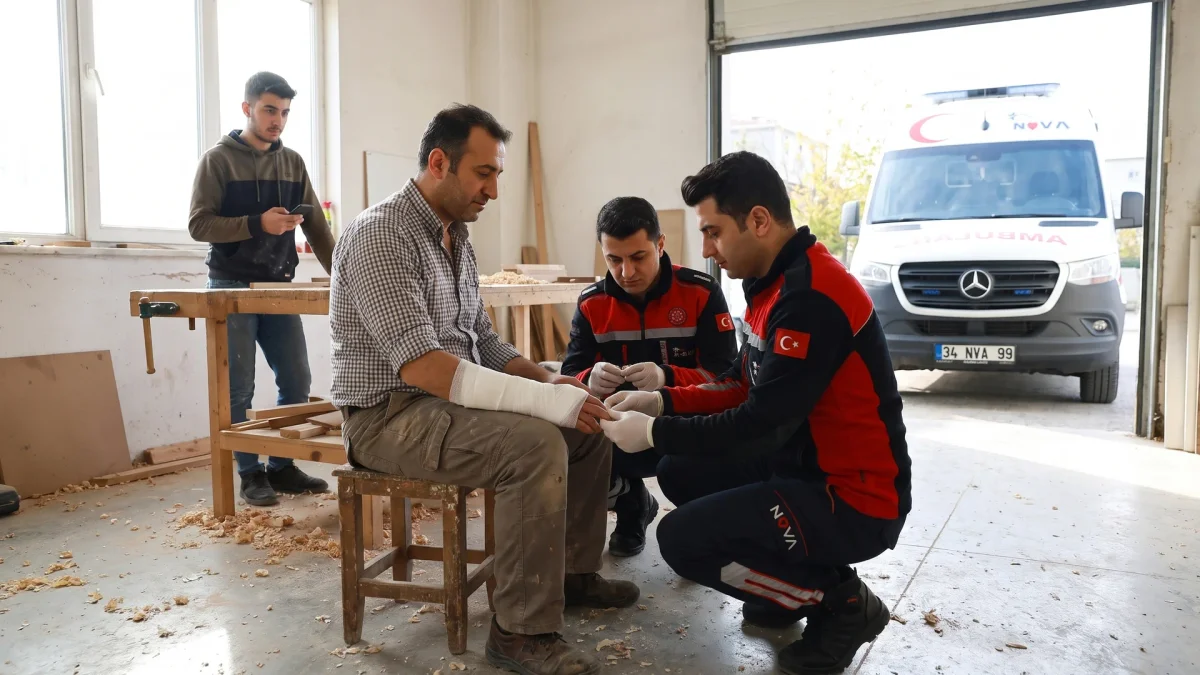
An October morning in a furniture workshop in Başakşehir. A 44-year-old craftsman is setting a pane of display-cabinet glass on the workbench when it breaks and cuts deeply into the inside of his left forearm. Bright red blood spurts in pulses. The apprentice's first reflex is to hold the arm up and keep lifting a paper towel off the wound to see whether it has stopped. A neighbour from the next workshop, who holds a first-aid certificate, sits the craftsman on a stool, folds a clean apron, places it directly over the wound and presses with the palm of his hand without letting go; he has the apprentice call 112. When the apron soaks through, he adds a second towel on top without lifting it. Ten minutes later the flow has slowed to an ooze; the neighbour wraps the towels firmly to the arm with a tie and checks the colour of the fingertips. When the crew arrives no tourniquet has been needed, but because the fingers are numb the casualty is taken to hospital with a suspected nerve and tendon injury.
The turning point in this scenario is the switch from raising the arm and constantly checking the cloth to pressing on the wound without a break 2. A tourniquet would only have come into play if pressure had failed and the bleeding had been life-threatening.
The First Minutes on a Building Site, the Check-Ups After Surgery: Nova Ambulans
For life-threatening bleeding the first number to call is 112, and you keep up direct pressure until the ambulance arrives. Nova Ambulans comes in at two points. First, on large building sites with heavy use of cutting machinery, glass and scaffolding, our construction-site ambulance service keeps a crew on the job that makes the call on pressure, bandaging and, if needed, a tourniquet on the spot in the first minute after a saw or glass injury. Second, we plan home-to-hospital transfers for patients who, after tendon or vessel surgery on the hand or forearm, need to go back and forth to their hospital in İstanbul for dressings and check-ups and cannot drive because their arm is in a splint. Telling us the site's headcount and shift hours, or the day and time of the follow-up appointment, is enough for us to plan: 0216 339 00 39.
Frequently Asked Questions
How long should you press on a bleeding wound?
The Turkish Ministry of Health First Aid Training Book (May 2025) asks for firm, steady and uninterrupted pressure with a clean cloth over the wound for at least 5 minutes 2. Do not lift the cloth during that time to check whether the bleeding has stopped; every lift disturbs the clot that is starting to form. If the cloth soaks through, add a fresh one on top without removing it. If the bleeding has not stopped within 10 minutes, add more cloth, press harder over a wider area and call 112 straight away if nobody has yet 2.
How long can a tourniquet stay on, and should it be loosened every so often?
No, it should not be loosened. The old "loosen it every 15-20 minutes" rule found in older first-aid notes is not in the Ministry of Health's 2025 book. The book says to tighten the tourniquet until the bleeding stops, write the time of application on it, and make no further adjustment such as loosening or removing it until the medical crew arrives 23. Loosening can make the casualty lose blood they cannot spare. A doctor in hospital decides when the tourniquet comes off.
Should a bleeding arm or leg be raised?
Not any more. The Turkish Ministry of Health First Aid Training Book (May 2025) states that raising a bleeding limb is not recommended as a first-aid method because no benefit has been shown 2. Rather than lose time lifting the arm, put your hand or the cloth directly on the wound and press firmly. The shock position, in which the legs are raised for a casualty showing signs of shock and with no leg injury, is a separate measure and should not be confused with raising a bleeding arm.
How do you transport an amputated finger or limb?
Do not wash the amputated part with water or any other liquid. Wrap it in clean gauze or a clean cloth and put it in a sealed, waterproof plastic bag. Place that bag in a second bag or bucket filled with one measure of water to two measures of ice, so that the part does not touch the ice directly. Write the casualty's first name and surname on the bag and send it in the same vehicle as the casualty. The Ministry of Health's 2025 book asks for the casualty to reach a healthcare facility within 6 hours at the latest 2. If the casualty has serious bleeding, a tourniquet is applied.
Should a knife, piece of glass or metal stuck in a wound be pulled out?
No. Pulling out an impaled object can damage the surrounding tissue and increase the bleeding 2. Leave the object where it is, pack gauze, a rolled bandage or clean cloth around it, and bandage over that padding without pressing on the object. The bandage should be firm enough to slow the bleeding but not so tight that it causes increasing pain, numbness or a change in skin colour. Then call 112.
Sources
Numbers in the text refer to the sources below.
- Türk Kızılay İlk Yardım Cep Kitabı 2025 (opens in a new tab)Türk Kızılay, October 16, 2025
- İlk Yardım Eğitim Kitabı (Mayıs 2025) (opens in a new tab)T.C. Sağlık Bakanlığı Acil Sağlık Hizmetleri Genel Müdürlüğü, May 16, 2025
- İlk Yardım Eğitim Sunumları — 7. Kanamalar (opens in a new tab)T.C. Sağlık Bakanlığı Acil Sağlık Hizmetleri Genel Müdürlüğü, June 18, 2025
- İstatistik Yıllığı 2025 — İş Kazası ve Meslek Hastalığı İstatistikleri (4-1/a) (opens in a new tab)T.C. Sosyal Güvenlik Kurumu, July 13, 2026
- 2025 Yılı Trafik Kazalarına Ait Özet Bilgiler (opens in a new tab)T.C. Karayolları Genel Müdürlüğü (veri kaynağı TÜİK), June 17, 2026
- First Aid: 2025 International Liaison Committee on Resuscitation Consensus on Science With Treatment Recommendations (opens in a new tab)Circulation (American Heart Association) — PMID 41122841, October 22, 2025
- European Resuscitation Council Guidelines 2025 First Aid (opens in a new tab)Resuscitation (European Resuscitation Council) — PMID 41117568, October 1, 2025
- 2024 American Heart Association and American Red Cross Guidelines for First Aid (opens in a new tab)Circulation (American Heart Association) — PMID 39540278, November 14, 2024
- Effectiveness and retention of extremity and junctional tourniquet training among medical interns (opens in a new tab)BMC Medical Education — PMID 41975403, April 13, 2026
- Review article: Evaluating the effectiveness of arterial pressure point techniques as a first aid method for external haemorrhage control: A systematic review (opens in a new tab)Emergency Medicine Australasia — PMID 39628109, December 3, 2024
Nova Ambulans Sağlık Kurulu (Medical Board)
Periodically reviewed by our editorial board of emergency physicians, paramedics and clinical coordinators.
This content is informational only and does not replace professional medical evaluation. In emergencies, call 112 or +90 216 339 00 39.