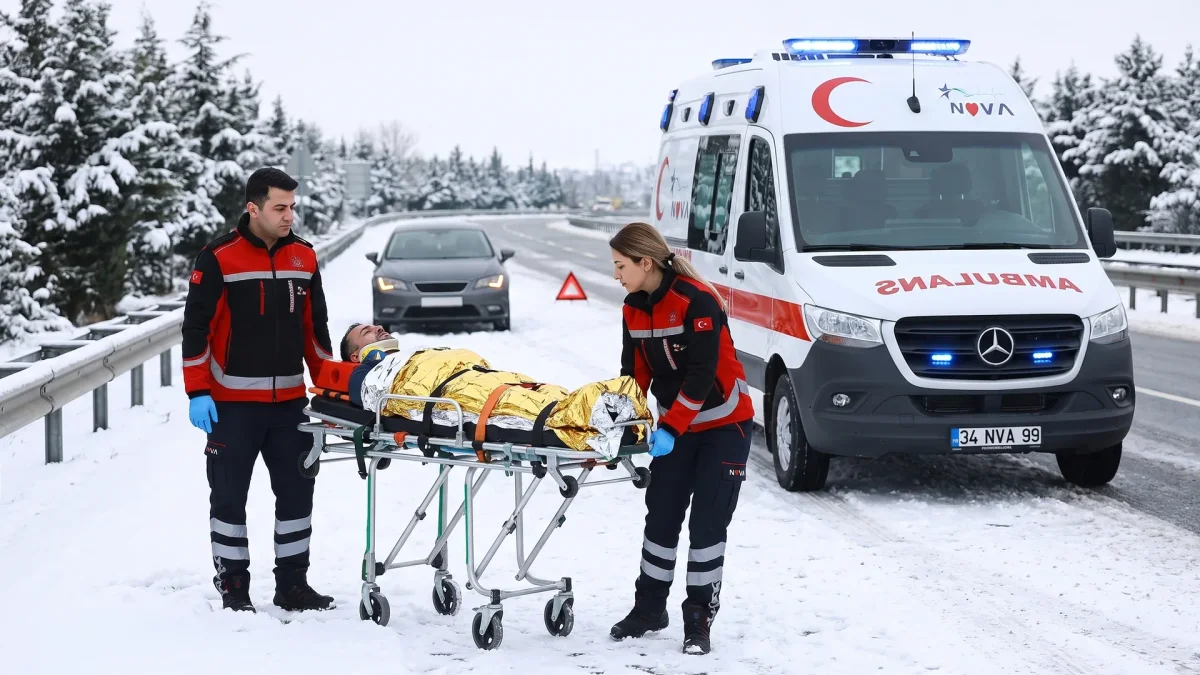
- Make scene safety your first action — prevent the second accident.
- Don't move the casualty unless there is fire or entrapment risk; spinal injury is the high-impact concern.
- Hypothermia below 35 °C is a medical emergency; in advanced stages shivering stops and consciousness clouds.
- Elderly + fall on ice is a triple risk: hip fracture, prolonged ground time, hypothermia. Don't wait — call an ambulance.
Snowfall, hidden ice and reduced visibility increase three winter emergencies together: traffic accidents, falls and hypothermia [1]. The first few minutes at the scene are critical; in prehospital trauma care the "platinum ten minutes" principle stresses limiting on-scene time (bleeding control, airway and rapid transport). There is no single fixed threshold, but early, rapid intervention markedly improves the casualty's chance of survival [3][4]. This guide covers all three intertwined winter scenarios — traffic accidents, falls on ice and hypothermia/frostbite — under a single framework, because in winter accidents rarely come alone.
Checking the Turkish Meteorological Service's regional orange/red bulletins at the start of your day demonstrably reduces fall and accident risk when planning trips, hospital visits or intercity transfers [8].
1. Golden rule: scene safety first
The instinct to leap out and help can make you the second casualty on icy roads.
- Be visible: Turn on hazard lights; place the warning triangle far enough back for the road and visibility conditions — about 30 metres in town, but 100–150 metres behind the scene on intercity roads and motorways so approaching vehicles see it in time (further in ice or fog). Regulation requires the mandatory warning triangle to be visible from at least 150 metres in normal weather [2][9].
- Move your vehicle: Off the live traffic flow if possible.
- Treat the surface seriously: Ice can be hidden; don't run, keep contact points.
2. Call an ambulance: 112 or Nova Ambulans
Accurate information shortens the response time by minutes.
- Location: "We're on the highway" is not enough. Say "TEM Highway, towards Ankara, 2 km past Kavacık exit" — direction + km [2].
- Status: Number of casualties, entrapment, level of consciousness.
- Risks: Fuel leak, vehicle near a drop, spilled cargo, etc.
- Choice: 112 routes to the nearest public hospital; Nova Ambulans (+90 216 339 00 39) transports to the private hospital you choose.
3. The casualty: do's and don'ts
Don't move the casualty
Cervical and spinal-injury risk is high in traffic accidents [3][4]. Pulling someone out of a vehicle can cause permanent paralysis.
- Exception: Fire, explosion risk or submersion → use emergency-extrication technique.
- Otherwise, stabilise in place until ambulance and fire-rescue arrive.
Bleeding control
Apply direct pressure with a clean cloth on the bleeding site [3]. Don't lift the cloth; if it soaks through, add a second cloth on top without removing the first.
Consciousness and breathing check
Call to the casualty, gently tap their shoulder. Watch for breathing. If unconscious or not breathing normally, call 112 or Nova Ambulans; if trained, follow American Heart Association (AHA) basic life support [3].
4. Falls on ice: head, fracture and hip risk
Slips on ice rarely look serious in the first instant but commonly progress to severe consequences in winter [5][6]:
- Uncontrolled fall: Reflexive arm extension increases wrist and shoulder fractures.
- Head impact: Concussion and traumatic brain injury risk.
- Elderly fragility: Osteoporosis and balance issues mean hip fracture is common. If an older person can't bear weight after falling, do not move them.
- Ground time: The longer they're on the floor, the higher the hypothermia risk; head-injury signs may also be delayed in patients on anticoagulants.
Head injury — when to call an ambulance
- Any loss of consciousness (even brief)
- Severe headache, repeated vomiting
- Drowsiness, lethargy, behavioural change
- Limb weakness, speech disturbance
- Blood or clear fluid from ear/nose
- Pupil asymmetry, seizures
Suspected fracture
- Visible deformity or abnormal angle
- Severe pain, inability to bear weight
- Rapidly increasing swelling/bruising
- Open wound with bone exposure (open fracture)
Don't try to move a suspected fracture — support the area and wait for the ambulance.
5. Hypothermia — recognising it on scene
Hypothermia is a dangerous drop in core body temperature. Per the U.S. Centers for Disease Control and Prevention (CDC), below 35 °C (95 °F) requires immediate medical attention [5]. It develops not only in extreme cold but also with wet clothing, wind, prolonged immobility and inadequate dress. The Centers for Disease Control and Prevention (CDC) defines it as "your body losing heat faster than it can produce it" [5].
Risk groups
- The elderly (impaired thermoregulation; prolonged ground time after falls) [6]
- Infants and small children
- People with cardiovascular disease, diabetes
- Those under the influence of alcohol or sedatives
- People who live alone
Signs to recognise on scene
- Shivering — but in advanced hypothermia shivering stops [5]
- Slurred speech, drowsiness, lethargy
- Coordination issues, unsteady gait
- Pale or bluish skin, blue lips
- Confusion or fainting [6]
If these appear after a fall or accident with prolonged exposure, treat as a medical emergency.
What to do for hypothermia on scene
- Move to a wind- and cold-protected area (if safe).
- Remove wet clothing and wrap in dry blankets/clothing [5].
- Cover head and neck.
- If conscious and able to swallow safely, give a warm (not hot) drink.
- Insulate from the ground (cardboard, blanket); don't leave on bare ice.
What NOT to do
- Aggressive rapid rewarming (very hot shower, direct heater) — can drop blood pressure and trigger arrhythmia [6].
- Alcohol — vasodilation worsens heat loss.
- Giving food/drink to someone with impaired consciousness.
- Excessive movement — in advanced hypothermia, cardiac rhythm is fragile [5][6].
6. Frostbite — preventing tissue loss
Frostbite is when skin and underlying tissue actually freeze, most commonly at fingertips, nose, ear lobes and cheeks [5].
Signs: numbness, pale or grey-blue skin, hardened tissue, tingling and pain on rewarming.
Field approach:
- Don't rewarm if there's a re-freezing risk en route — thaw-refreeze causes the worst tissue damage.
- Don't rub or massage the area; don't use snow or hot objects.
- If able, the casualty can put their hand under the armpit.
- Get to a warm enclosed environment as quickly as possible and seek medical evaluation.
7. Ambulance — when to call (summary)
Any of the following warrants 112 or Nova Ambulans (+90 216 339 00 39) without delay:
- Loss of consciousness, seizure, abnormal breathing
- Severe bleeding
- Head-injury signs (vomiting, drowsiness, speech changes, neurological signs)
- Neck/back pain, suspected spinal injury
- Suspected hip fracture (elderly + can't bear weight after a fall)
- Open fracture, obvious deformity
- Chest pain, shortness of breath
- Moderate–severe hypothermia (confusion, cyanosis, shivering stopped)
- Frostbite + prolonged exposure
- Cold + altered consciousness in a child
8. What to keep in the car for winter
Preparation saves lives. The emergency kit and your car should include:
- First-aid kit (sterile gauze, bandages, scissors)
- Reflectors + warning triangle (legal requirement)
- Thermal/Mylar blanket
- High-visibility vest
- Charged flashlight
- Water and durable food (1–2 days)
- Phone power bank
For more on traffic safety, see the Turkish General Directorate of Highways and Turkish Traffic Services.
Conclusion
Winter traffic accidents, falls and hypothermia are usually parts of the same picture: a casualty on the ground starts losing heat within minutes. Staying calm, securing the scene, calling the right ambulance and recognising hypothermia early are as valuable as the medical intervention itself. In an emergency, 112 or Nova Ambulans (+90 216 339 00 39).
Frequently Asked Questions
Should I move the casualty out of the vehicle?
Only if there is fire, explosion or submersion risk [3][4]. Cervical-spinal injury risk is high; in-place stabilisation until ambulance and fire arrival is the safer default.
What core temperature is dangerous in hypothermia?
The Centers for Disease Control and Prevention (CDC) threshold is below 35 °C (95 °F) [5]. Below 32 °C is moderate–severe; below 28 °C is severe with shivering stopped and arrhythmia risk [6].
My elderly relative slipped and can't stand — what do I do?
Don't move them — high hip-fracture suspicion. Cover them, insulate from the ground, call an ambulance. If they've been down a while, hypothermia risk too.
Should I rub frostbitten skin or pack it with snow?
No — rubbing damages tissue, snow worsens freezing [5]. Get to warmth; seek medical evaluation. Don't rewarm if re-freezing is possible en route.
What should I keep in the car for winter?
Reflectors, first-aid kit, thermal blanket, high-visibility vest, charged flashlight, phone battery and de-icer spray. These are both legal requirements and life-savers.
Related Articles
- Night Highway Ambulance Safety and Warning Signs — Visibility and yielding to ambulances at night.
- Calling an Ambulance During Heavy Snow — Address sharing and building access.
- Emergency Kit Guide — Home and vehicle first-aid kit.
- Winter Emergency Health Guide — Pillar guide to all winter health risks.
Rapid Emergency Support
24/7 emergency ambulance service across Istanbul. Fast response, fully equipped team.
Average response time: 15 seconds
Related Articles
Dog and Cat Bite First Aid: Rabies Risk, the 15-Minute Wash and When to Call 112
If a dog or cat bites or scratches you, wash the wound at once with plenty of soap and water for at least 15 minutes, press directly on it if it bleeds, cover it with a clean cloth and go to a health facility the same day. Rabies cannot be treated once symptoms begin; a doctor decides whether you need the vaccine. Call 112 for bleeding that pressure does not stop or for any threat to life.
EducationMushroom Poisoning Symptoms and First Aid: When Do Symptoms Start, When to Call 112?
If nausea, vomiting, diarrhea, abdominal pain or any other symptom begins after eating foraged mushrooms or mushrooms of unknown origin, call 112, whatever hour it began; do not induce vomiting and give nothing by mouth. People without symptoms, including a child who ate a mushroom in a garden or park, still need hospital assessment; call 112 and explain, because with amatoxin, which damages the liver, the symptom-free interval averages 8-10 hours. The National Poison Information Center (UZEM) on 114 gives advice but does not replace 112.
EducationTick Bite First Aid: Correct Removal Technique and the Crimean-Congo Haemorrhagic Fever (CCHF) Decision
When a tick attaches to the skin, the bystander’s step-by-step response: gloved, fine-tipped tweezers gripping the tick’s head as close to the skin as possible with steady upward traction, no alcohol, petrol, nail polish, matches or lit cigarettes, saving the removed tick in a labelled sealed plastic bag, a 14-day watch schedule for Crimean-Congo Haemorrhagic Fever (CCHF), the 112 decision when a fever, severe muscle pain, bleeding or profound weakness appears, and safe transfer to an infectious-diseases clinic — with primary sources from the Turkish Red Crescent 2025 First-Aid Pocket Book, the Turkish Ministry of Health May 2025 First-Aid Training Manual, the Turkish Red Crescent Esenyurt First-Aid Training Centre 2024 verbatim protocol, the Turkish Ministry of Health CCHF Scientific Council bulletin, Karanfil et al. 2026 (n=7,776 national surveillance), Güllü et al. 2025 (n=1,103 18-hospital cohort), the World Health Organization (WHO) 2025 fact sheet, the European Centre for Disease Prevention and Control (ECDC) factsheet, and Norman et al. 2025 European review.
Popular Ambulance Topic Clusters
You may also like
- Private ambulance pricing
- Istanbul private ambulance
- Intercity patient transport
- Doctor-accompanied ambulance
- Dialysis patient transport
- How intercity patient transport works
- Ambulance response time in Istanbul
- Home-to-hospital patient transport
- Modern ambulance equipment and team standards
- Heart attack symptoms and first response
This content is informational only and does not replace professional medical evaluation. In emergencies, call 112 or +90 216 339 00 39.
