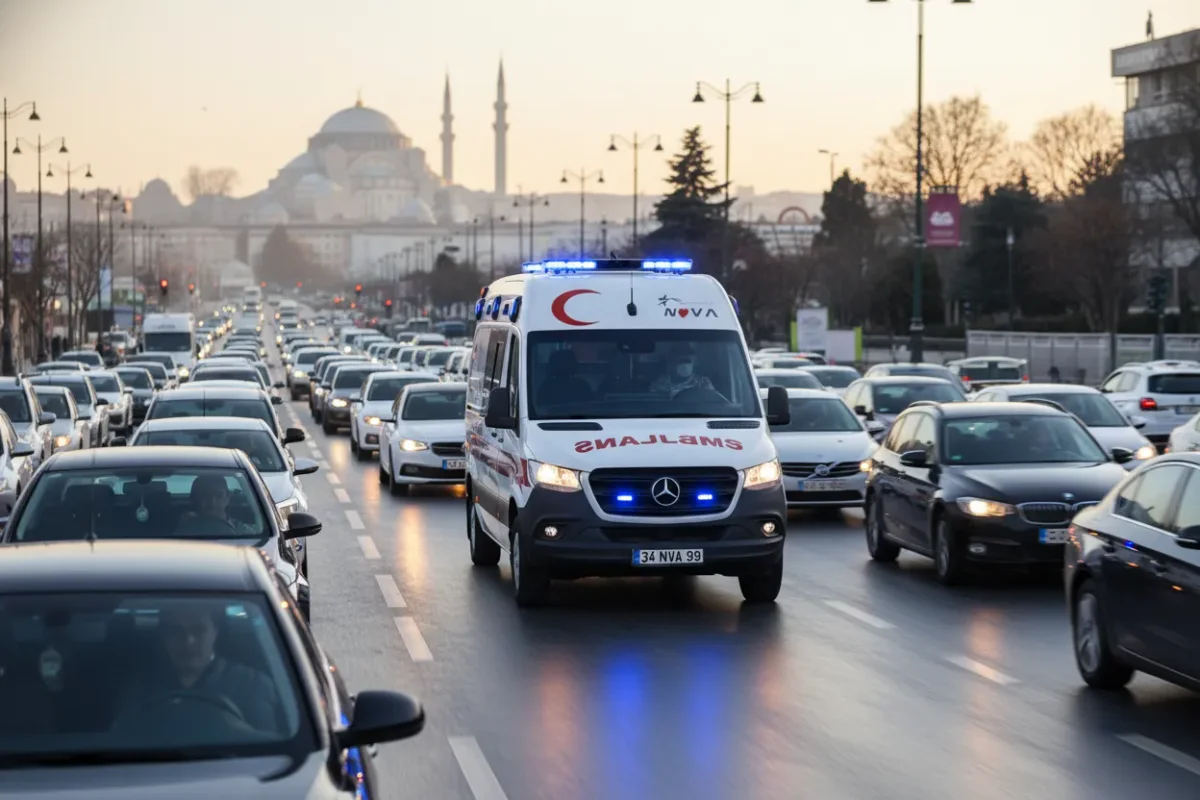
- After a fall from height, a vehicle crash or a blow to the head, assume neck or back pain is spinal.
- If there is no danger, keep the casualty where you found them; do not let them stand or sit.
- Hold the head with both palms over the ears, without pulling or turning it.
- Do not fit a neck collar unless trained; Turkish and international guidelines agree on this.
- Breathing comes before the spine: roll a vomiting or unconscious casualty onto their side as one unit.
The Short Answer
After a fall from height, a traffic collision or a hard blow to the head, neck or back pain or numbness, tingling or weakness in the arms and legs should make you suspect a spinal injury and call 112 [2]. If there is no danger, keep the casualty in the position you found them, do not let them get up and hold their head still with both palms [1][2]. According to the Turkish Red Crescent's 2025 pocket book, 50% of deaths in accidents happen in the first 30 minutes [1]; the most valuable thing you can do in those minutes is protect breathing without moving the casualty unnecessarily. There is one important exception: if the casualty is vomiting, losing consciousness, or there is a danger such as fire, traffic or water where they lie, the airway and safety come before the spine [9].
- Neck or back pain, numbness or weakness + a fall, crash or blow to the head: 112, do not move them [2].
- Unconscious, breathing: roll them onto their side as one unit, head, neck and trunk in line [2][3].
- Not breathing, or only gasping (agonal breathing): on their back, Basic Life Support (BLS) [1].
We wrote this guide for the October-November weeks when tree harvests, roof work and scaffolding jobs peak. It brings together the 2025 first-aid rules of the Turkish Red Crescent and the Turkish Ministry of Health, 2026 Turkish data and 2025-2026 international guidelines. The content was reviewed under the oversight of the Nova Ambulans Medical Board.
Which Accidents Should Make You Suspect the Spine?
The Turkish Ministry of Health First Aid Training Book (May 2025) lists the situations that suggest a serious injury one by one [2]. The most important for the spine are:
- A fall from more than 3 times the person's own height (about 5 metres for an adult of average height).
- A head-first fall from the person's own height or higher (from a ladder, a crate, a truck bed).
- In a vehicle collision, ejection from the vehicle, a rollover, high speed, or a collision on a motorcycle or bicycle.
- A head injury that changes consciousness.
After this list, the book states the rule a first aider must keep in mind in one sentence: "a casualty with a head-neck injury should also be assumed to have a spinal injury unless proven otherwise" [2]. There is a clinical observation behind this rule. In a study published in July 2026 that examined 277 confirmed spinal fractures among 12,029 files assessed at the Department of Forensic Medicine of Atatürk University in Erzurum between 2020 and 2022, people with a head or facial injury were about 3.6 times as likely to have a cervical (neck) fracture (odds ratio 3.59) [7]. That is why a casualty who becomes drowsy after a blow to the head needs their neck protected as well; we cover the head injury itself in our concussion and head injury guide.
Autumn brings this list into everyday life. Falls from ladders and branches during the walnut, olive and hazelnut harvests from the Black Sea to the Aegean, motorcycle and courier crashes on rain-slicked Istanbul roads, and falls from scaffolding on building sites all cluster in the same weeks. The mechanism differs, but the logic of first aid is the same: assess the danger first, then steady the head, then call for help.
Signs: Even Without Numbness, Even If They Can Walk
The Turkish Ministry of Health groups the signs of neck and spinal injury into five items [2][3]:
- Pain at the injury site.
- Tenderness at the injury site (pain that increases when touched).
- Reduced or lost sensation below the injury site.
- Reduced or lost strength below the injury site.
- Numbness, tingling and loss of feeling in the hands and feet.
Look at the first two items: a spinal fracture does not always come with paralysis. Someone who can move their arms and legs, or even get up and take a few steps, may still have a broken vertebra; the ligaments and bone fragments holding it can press on the spinal cord with a later movement. That is why the Ministry's 2025 training presentation opens with: "Neck and spinal injuries are extremely important because, depending on the region affected, they can cause permanent disability and death" [3].
The most common fracture site is also not the neck, as many people assume. In the Erzurum study above, 31.8% of fractures were at the junction of the thoracic and lumbar spine (between the eleventh thoracic and the second lumbar vertebra) [7]. An adult who says "my lower back hurts" after a fall and wants to stand up may be carrying exactly this fracture.
An unconscious or intoxicated casualty cannot tell you about their pain. In that case decide by the mechanism, not the signs: if they fell from height, were thrown from a vehicle or took a blow to the head, treat the spine as injured [2].
In Numbers: Spinal Injuries in Turkey and the World
- 15.4 million people worldwide. In its April 2024 fact sheet, the World Health Organization (WHO) writes that as of 2021 about 15.4 million people worldwide were living with a spinal cord injury and that "traumatic SCIs from falls and road traffic accidents are the leading cause of SCI" [5].
- 1,106.7 road injuries a day in Turkey. According to the General Directorate of Highways' 2025 summary, based on Turkish Statistical Institute (TÜİK) data, 403,937 people were injured and 6,035 people died in 288,321 fatal or injury collisions during the year; that is an average of 1,106.7 injuries a day [4].
- 43.6% of drivers killed were motorcyclists. In the same 2025 table, the 1,334 motorcycle drivers killed made up 43.6% of all drivers killed, and the 130,578 motorcycle drivers injured made up 58.2% of all drivers injured [4].
- A permanent mark in half of the fractures. In the Erzurum study, 56.3% of spinal fractures occurred in vehicle occupants; among the 174 patients followed for at least 12 months, 50% had permanent sequelae, the most common being restricted spinal movement (46.8%) and spinal cord injury (13.5%) [7].
- 88.7% of spinal cord injuries in Turkey are traumatic. In the Turkish data of the International Spinal Cord Injury Community Survey (InSCI), published in July 2026 and reaching 405 adults from different regions of Turkey through five Istanbul institutions, 88.7% of participants' injuries were traumatic and 70.5% were men [8].
The First 10 Minutes: Step by Step
- Make yourself safe first. On a road with moving traffic, switch on the hazard lights and send someone to warn approaching drivers; do not enter a structure that may collapse. We explain step by step how to make a crash scene safe in our traffic accident first aid guide.
- Talk to the casualty and tell them not to move. "I'm here, the ambulance is coming, don't turn your head, don't try to get up." The Ministry book asks you to reassess the casualty and tell them not to move [2].
- Call 112 or have someone call. Put the phone on speaker so your hands stay free [2].
- Steady the head with both hands. Kneel at the casualty's head, place your palms on either side of the head so that they sit over the ears, and hold the head in the position you found it without pulling, pushing or turning it. This is the hand position the Ministry book describes for the person holding the head during the log roll [2]. Rest your arms on your knees or the ground; you will be holding it for minutes.
- Loosen tight clothing [2]; if they are cold, cover them with a blanket.
- Watch their breathing. Follow the rise and fall of the chest and the sound of breathing; if it becomes gurgling or vomiting starts, go to the "vomiting and loss of consciousness" section below.
- Give nothing by mouth, no cigarette, no "drink some water, pull yourself together"; surgery may be needed.
- Note what you see: the height of the fall, whether they moved their arms and legs in the first minute, when the numbness started. The crew will ask this first.
Answers to the other questions you will have while waiting, such as who will open the door or which medicines to have ready, are in our checklist for until the ambulance arrives.
When Not to Move Them, When to Roll Them: A Decision Table
"Should I not touch them at all?" is the most common question in spinal first aid. Turkish and international guidelines give the same answer: the default is not to move them, but this rule gives way to breathing and life-threatening danger [1][2][9].
| Situation | What to do | Source |
|---|---|---|
| Conscious, breathing normally, no danger around | Leave them in the position found, steady the head by hand, 112 | Ministry of Health 2025 [2] |
| Conscious, wants to stand or sit up | Do not allow it; reassure them, keep holding the head | Turkish Red Crescent 2025 [1] |
| Vomiting or blood in the mouth | Roll onto their side as one unit, head-neck-trunk in line | Ministry of Health 2025 [2] |
| Unconscious, breathing | Recovery position with the head held by hand; check breathing every 2-3 minutes | Ministry of Health 2025 [2][3] |
| Unconscious, not breathing or gasping | Roll onto their back, Basic Life Support (BLS) | Turkish Red Crescent 2025 [1] |
| Fire, explosion, moving traffic, water, collapse risk | Move to safety while protecting the spine | Turkish Red Crescent 2025 [1], Australian and New Zealand Committee on Resuscitation (ANZCOR) 2026 [9] |
Approved in April 2026, the guideline of the Australian and New Zealand Committee on Resuscitation (ANZCOR) sums up this order in two sentences: "Airway management takes precedence over any suspected spinal injury" and "the need to move a person to safety takes precedence over restriction of spinal motion" [9]. The Turkish Red Crescent's 2025 pocket book gives the reason: "In an unconscious casualty the muscles relax. This relaxation can cause the tongue to block the airway" [1]. Leaving an unconscious casualty on their back to protect the spine can mean watching them choke.
The log roll: how many people, and how?
The log roll is a technique for turning the casualty onto their side in one piece, like a log, keeping the head, neck and trunk in line. The Turkish Ministry of Health May 2025 book says it needs at least 2 people, and that with a suspected spinal injury the ideal is at least 4 [2]:
- 1 person at the head: palms over the ears, holds the head and gives all the commands ("we turn on three: one, two, three").
- 2 people at the body: turn the casualty while supporting the chest, abdomen and legs.
- 1 helper: slides a blanket or stretcher under the casualty if needed.
If you are alone and the casualty is vomiting, do not wait: following the description in the head injuries section of the Ministry book, roll the casualty onto their side "supporting the head and neck carefully without moving them and keeping the head, neck and spine in line while turning" [2]; make sure the head turns together with the body. The general description of the recovery position is in our recovery (side) position guide; the difference with a suspected spinal injury is that the head never turns separately from the body [2][3].
A casualty inside a vehicle
Do not try to pull out a casualty who is trapped in a vehicle but breathing, with no fire or leak around them; reach in from behind or the side, steady the head and wait for the fire brigade and the ambulance [1][2]. If there is "a life-threatening situation such as explosion, fire or breathing stopping", the Turkish Red Crescent describes the Rentek manoeuvre for getting the casualty out of the vehicle while protecting the spine [1]. In the steps in the Ministry book, the rescuer passes one arm under the casualty's armpit and grips the chin, rests their cheek against the casualty's cheek, holds the casualty's arm with the other hand and pulls the casualty out of the vehicle "on the same plane without disturbing the head-neck and spine alignment" [2]. This manoeuvre is only for a life-threatening situation and with training; in an ordinary collision, waiting is safer.
Should You Fit a Neck Collar? What Turkish and International Guidelines Say
Many first-aid kits now include a neck collar, and "should we put it on?" is a common question at the scene. On this point the guidelines agree to an unusual degree:
| Source | Position on neck collars |
|---|---|
| Turkish Ministry of Health First Aid Training Book, May 2025 | "Do not put a neck collar on the casualty if you have not been trained." [2] |
| International Liaison Committee on Resuscitation (ILCOR), October 2025 | Suggests first aid providers do not use cervical collars (weak recommendation, very low-certainty evidence) [6] |
| Australian and New Zealand Committee on Resuscitation (ANZCOR), April 2026 | Airway management and moving to safety take precedence over restricting spinal motion [9] |
While keeping that recommendation, the 2025 first-aid statement of the International Liaison Committee on Resuscitation (ILCOR) reports the common finding of the 46 studies that compared restricting spinal motion with no restriction (35 of them on collars): collars "decrease the range of cervical motion but lead to impaired respiratory and swallowing function as well as increased intracranial pressure" [6]. The committee also notes that the existing recommendation does not preclude selective use by trained first aid providers following their own protocols [6]. For someone at the scene the practical conclusion is simple: do not waste time looking for a collar, hold the head with both hands; the ambulance crew decides on the collar and the stretcher.
What Not to Do
- Helping the casualty stand, sitting them up or saying "let's see you walk". The Turkish Red Crescent asks you not to move them and not to let them move [1].
- Putting a pillow under the head. It bends the neck forward; hold the head where you found it.
- Pulling or turning the head to "straighten" it. The point of the hand position is holding without pulling, pushing or turning [2].
- Driving the casualty to hospital yourself. Half-sitting on a back seat with the jolts of the road is very different from the one-piece transfer on an ambulance stretcher.
- Blocking fluid from the ear or nose. The Ministry forbids this explicitly [2].
- Removing an impaled object. Secure it where it is [2].
- Pressing on the fracture site [2].
- Fitting a neck collar without training [2][6].
Older People and Children
Older people. In the Erzurum study, the share of vulnerable road users such as pedestrians and motorcyclists among spinal fractures rose in people aged 65 and over [7]. If an older relative has fallen at home and describes back or neck pain, postpone any attempt to lift them off the floor and call 112. We cover the general decision order for an older person who falls at home in our what to do when an older person falls guide.
Children. For a child who falls from a bunk bed, balcony, playground or tree, the rules are the same as for adults: do not pick them up, do not lift them, steady the head and call 112 [2]. A panicking parent's first reflex is to pick the child up; instead, lying down next to the child and talking face to face both calms them and keeps their head still.
If there is a head injury as well. Protect anyone who has fainted or become drowsy after a blow to the head as if they had a spinal injury [2][7]. If they also have a broken arm or leg, apply a splint following the steps in our fracture and dislocation first aid guide, but without rolling the casualty or moving the trunk.
A Typical Scenario: Gathering Walnuts in the Garden
The example below is an anonymised, fictionalised account of a type of call that is common in Istanbul's districts with gardens during the autumn weeks.
A Saturday afternoon at the end of October, a detached house in Sarıyer. A 58-year-old father falls about 3 metres onto his back on the grass, together with the ladder he had propped up to shake down walnuts. He is conscious, says "my back hurts badly, my feet are tingling" and immediately tries to sit up. His daughter stops him, kneels behind his head and places her palms over his ears; his son calls 112 on speaker and gives the height of the fall and says the tingling started right after the fall. When the crew arrives twelve minutes later, the father is still in the position he fell in. The crew fits the collar themselves, lifts the casualty in one piece with a scoop stretcher and places him on a vacuum mattress.
Two decisions in this scenario shape the outcome: the father was not allowed to get up, and nobody turned him over "to make him comfortable". The casualty's words "my feet are tingling" are the fifth item on the list of signs [2]; passing that sentence on word for word to the 112 dispatcher makes it easier to send the right crew to the right hospital.
What Should You Tell 112?
Give the address first, then speak briefly and in order:
- What happened: "My father fell about 3 metres from a tree onto his back" or "a motorcyclist collided with a car, helmet still on".
- Consciousness: are they talking, answering questions correctly, did they pass out?
- Breathing: normal, gurgling, vomiting?
- Signs: neck or back pain, numbness, tingling or weakness in the arms or legs, and when did it start?
- What you have done: "We haven't moved them, we're holding their head."
After Hospital: A Long Road
Some patients diagnosed with a spinal fracture are treated with a brace, others with surgery; for those who develop a spinal cord injury, the real process starts after discharge. In the Turkish data of the International Spinal Cord Injury Community Survey (InSCI), 61.9% of adults living with a spinal cord injury reported muscle stiffness (spasticity), 61.1% bladder problems and 60.1% bowel problems [8]. For these patients, physiotherapy sessions, follow-up imaging and rehabilitation centre appointments last weeks, sometimes months, and most of these journeys have to be made lying down.
From the Follow-Up Scan to Rehabilitation: Nova Ambulans
At the moment of a fall or crash the number to call is always 112; a private ambulance does not replace emergency response when a spinal injury is suspected, and we explain how their roles differ in our 112 vs private ambulance article. The need changes after the first treatment in hospital. Think of a patient who has had surgery for a lumbar fracture, is not yet allowed to sit and must return to their Istanbul hospital two weeks later for a follow-up CT scan: Nova Ambulans's home-to-hospital transfer service brings them down from a walk-up apartment in one piece on a scoop stretcher and vacuum mattress, waits during the check-up and brings them home. For patients who fell in their garden, were operated on in Istanbul and need to travel lying down to a physiotherapy centre in their home province, we plan intercity patient transfers; on building sites where scaffolding and work at height continue, a construction site ambulance crew meets the first minutes of a fall on site. Telling us the date of surgery, the position the doctor allows (lying flat, half-sitting in a brace) and the floor you live on is enough for planning: 0216 339 00 39.
Frequently Asked Questions
How can you tell if someone has a spinal injury?
The Turkish Ministry of Health First Aid Training Book (May 2025) lists five signs: pain at the injury site, tenderness at the injury site, reduced or lost sensation below the injury, reduced or lost strength below it, and numbness, tingling or loss of feeling in the hands and feet [2]. The first two items are only pain and tenderness, so neck or back pain after a fall from height or a vehicle crash is enough to suspect a spinal injury even if the arms and legs move normally. In someone who is unconscious or has taken a blow to the head, a spinal injury is assumed until proven otherwise [2].
Should you move someone with a suspected broken neck?
Not if there is no danger. The Turkish Red Crescent First Aid Pocket Book 2025 says people with a suspected spinal injury should not be moved unless there is danger, and should not be allowed to move either [1]. If there is danger such as fire, explosion, moving traffic, water or a risk of collapse, move the casualty to safety keeping the head, neck and trunk in line [9]. If they vomit or lose consciousness, roll them onto their side as one unit, again keeping the head, neck and trunk aligned, to protect the airway [2].
Should you put a neck collar on a spinal injury?
No, unless you are trained. The Turkish Ministry of Health May 2025 book says so explicitly [2]. The 2025 first-aid statement of the International Liaison Committee on Resuscitation (ILCOR) also suggests that first aid providers do not use cervical collars; the studies it reviewed showed that collars reduce neck movement but can impair breathing and swallowing and raise the pressure inside the skull [6]. Holding the head still with both hands until the ambulance crew arrives is enough.
What do you do if someone with a suspected spinal injury is unconscious but breathing?
In an unconscious person the muscles relax and the tongue can block the airway [1]. That is why the Turkish Ministry of Health May 2025 book advises holding the head and neck by hand and placing the casualty in the recovery position while keeping the head, neck and spine in line [2]. Do it with two or more people if you can: one holds only the head and gives the commands, the others turn the body at the shoulder and hip. Check breathing every 2-3 minutes; if breathing stops, roll them onto their back and start Basic Life Support (BLS). The detailed chest compression technique is in our Basic Life Support (BLS) guide.
Can someone who gets up and walks after a fall still have a broken spine?
Yes. In the Turkish Ministry of Health May 2025 list of signs, pain and tenderness come before numbness or weakness [2]. In a 2026 study of 277 spinal fractures seen in Erzurum between 2020 and 2022, the most common site was the junction of the thoracic and lumbar spine (31.8%) [7]. Instead of driving someone with back pain after a fall from height or a crash to hospital yourself, call 112 and keep them lying down.
Rapid Emergency Support
24/7 emergency ambulance service across Istanbul. Fast response, fully equipped team.
Average response time: 15 seconds
Related Articles
Mushroom Poisoning Symptoms and First Aid: When Do Symptoms Start, When to Call 112?
If nausea, vomiting, diarrhea, abdominal pain or any other symptom begins after eating foraged mushrooms or mushrooms of unknown origin, call 112, whatever hour it began; do not induce vomiting and give nothing by mouth. People without symptoms, including a child who ate a mushroom in a garden or park, still need hospital assessment; call 112 and explain, because with amatoxin, which damages the liver, the symptom-free interval averages 8-10 hours. The National Poison Information Center (UZEM) on 114 gives advice but does not replace 112.
EducationBee, Wasp, and Hornet Sting First Aid: When a Sting Reaction Needs 112
Step-by-step first aid for honeybee, wasp, and hornet stings — the bystander's 30-second stinger-scrape technique (credit-card scrape, never tweezers), local vs large-local vs systemic reaction decision tree, when to call Türkiye's 112 emergency line, adrenaline auto-injector application to the outer thigh, and what to do until the ambulance arrives — with verbatim protocols from Türk Kızılay Cep Kitabı 2025, T.C. Sağlık Bakanlığı May 2025 First-Aid Training Manual, the Turkish National Society of Allergy and Clinical Immunology (AİİAD), the Society of Pediatric Allergy and Asthma Academy (CAAAD), the 2025 Katran cohort of 194 526 patients at Istanbul Süreyyapaşa Hospital, the 2021 Öziş Baba cohort of 7 904 Trabzon schoolchildren, the American Academy of Allergy, Asthma & Immunology (AAAAI) and the McMurray 2026 Hymenoptera venom anaphylaxis review.
EducationDog and Cat Bite First Aid: Rabies Risk, the 15-Minute Wash and When to Call 112
If a dog or cat bites or scratches you, wash the wound at once with plenty of soap and water for at least 15 minutes, press directly on it if it bleeds, cover it with a clean cloth and go to a health facility the same day. Rabies cannot be treated once symptoms begin; a doctor decides whether you need the vaccine. Call 112 for bleeding that pressure does not stop or for any threat to life.
Popular Ambulance Topic Clusters
You may also like
- Private ambulance pricing
- Istanbul private ambulance
- Intercity patient transport
- Doctor-accompanied ambulance
- Dialysis patient transport
- How intercity patient transport works
- Ambulance response time in Istanbul
- Home-to-hospital patient transport
- Modern ambulance equipment and team standards
- Heart attack symptoms and first response
This content is informational only and does not replace professional medical evaluation. In emergencies, call 112 or +90 216 339 00 39.
