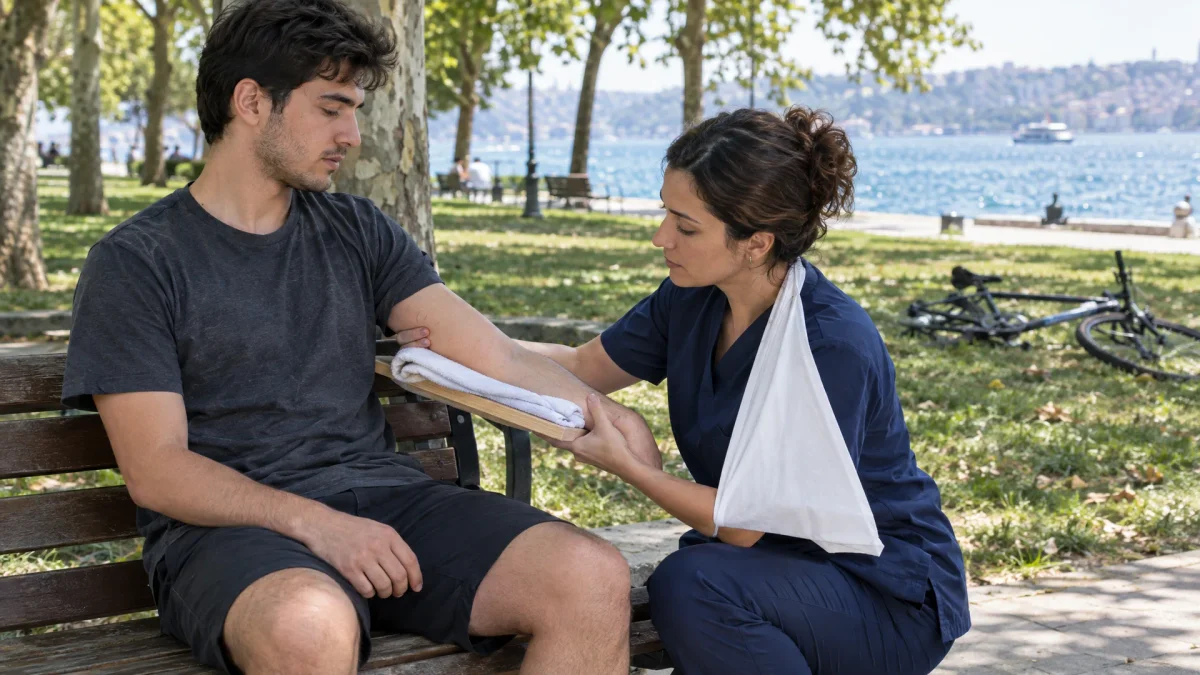
- The correct sequence: **do not try to straighten** the fracture, do not move the patient, support the **joint above and the joint below** the injury with your hands, immobilize with a splint or bandage, and check circulation below the splint every 10 minutes. This sequence matches the Turkish Red Crescent 2025 First Aid Pocket Book pages 38–40 and the T.R. Ministry of Health (Sağlık Bakanlığı, SB) May 2025 First Aid Training Book Chapter XII pages 145–147 verbatim.
- The Turkish Red Crescent 2025 protocol is unambiguous: **"If you are not sure whether a bone is broken, treat it as broken."** Distinguishing dislocation from a closed fracture is not safe at the scene; when in doubt, treat the injury as a fracture. The T.R. SB May 2025 Chapter XII repeats the rule directly: **"It is difficult to differentiate a dislocation from a closed fracture. Therefore, if there is any doubt, the injury should be treated as a fracture."**
- Never try to relocate a dislocated joint. The SB May 2025 Chapter XII page 148 rationale is direct: **"Moving it may damage the joint and surrounding muscles, ligaments, nerves or blood vessels."** This single sentence is the physiological reason not to attempt at-home reduction — the most common Türkiye home-intervention mistake.
- Call 112 immediately, without waiting: open fracture, femur or pelvic fracture, dislocation, polytrauma, shock signs, loss of consciousness, patient on anticoagulant/antiplatelet medication, patient with a bleeding disorder. In the Erzurum Atatürk University Hospital 65+ hip fracture cohort of Gonul et al. (n=120), **each 1-hour delay to surgery increased 30-day mortality odds by OR 1.066**; even transport time is a treatment variable.
- Türkiye pediatric data is worth knowing: in the Gazi University School of Medicine Pediatric Emergency cohort of Dönmez et al. (2019–2024, n=278 metacarpal/metatarsal fractures), **falls were the most common mechanism**, boys aged 10–15 dominated (%80.2), and school-garden-street-park were the most common settings. In summer, as cycling, skateboarding, and playground time rise, family first-aid knowledge becomes proportionally critical.
Late July, Sarıyer district of İstanbul. In a park by the Bosphorus, an eleven-year-old boy loses balance on the asphalt-to-earth transition while cycling; he falls onto his left arm, cries when it is touched, and a slight bend is visible in his forearm. His father instinctively reaches down: "Let me straighten it, then we'll put ice on it." That single movement is exactly what the Turkish Red Crescent 2025 First Aid Pocket Book and the T.R. Ministry of Health (Sağlık Bakanlığı, SB) May 2025 First Aid Training Book forbid verbatim [1][2]. The correct three steps are: do not move the patient, support the joint above and the joint below the injury with your hands, and immobilize in the position found with a bandage or splint. This guide sits at the intersection of two official Turkish protocols, the n=278 pediatric hand-foot fracture cohort of Dönmez et al. from Gazi University School of Medicine Pediatric Emergency (2019–2024), 65+ hip fracture mortality data from İstanbul University Çapa School of Medicine Orthopedics and Traumatology and Atatürk University Erzurum, and the World Health Organization (WHO) falls factsheet; it defines exactly what the bystander should do in the first 15 minutes, which mistake causes long-term nerve damage, and which sign makes calling 112 Emergency Health Service non-negotiable.
Quick Answer
For suspected fracture, dislocation, sprain or strain, the bystander's first three tasks are these. One: do not move the patient and do not try to straighten it. The Turkish Red Crescent 2025 First Aid Pocket Book page 38 warns directly: "If you are not sure whether a bone is broken, treat it as broken. If there is a deformity or an appearance of dislocation at the fracture site, do not try to correct it." [1] Two: support the joint above and the joint below the injury with your hands, and hold this position until the patient is immobilized with a sling or bandage. Three: immobilize the injured area with a bandage or splint and check the circulation below the splint or bandage (finger colour, warmth, pulse) every 10 minutes [1][2]. Do not give the patient any food or drink, including water — the nil per os (NPO) rule applies because surgery may be required.
When do you call 112? Immediately, without waiting: (a) open fracture (bone visible through the skin, or a wound at the fracture site); (b) suspected femur or pelvic fracture (bleeding and shock risk); (c) suspected dislocation (vessel-nerve injury risk); (d) polytrauma (road traffic collision, fall from height, sports collision); (e) shock signs (pale, sweaty, fast pulse, low blood pressure, altered mental state); (f) loss of consciousness or suspected neck-spine injury; (g) patient on anticoagulant (aspirin, clopidogrel, warfarin, apixaban, rivaroxaban, dabigatran) or antiplatelet medication; (h) patient with a bleeding disorder (haemophilia, von Willebrand disease) [1][2]. If the patient is unconscious but still breathing, the Turkish Red Crescent 2025 protocol recommends the recovery position (rescue, recovery, stable side-lying) [1]; our step-by-step recovery position guide refreshes the technique.
The Türkiye and Global Picture: How Common, How Serious?
Fracture is one of the most common mechanical injuries worldwide. The World Health Organization (WHO) "Falls" factsheet dated 26 April 2021 sets the scale: globally, 684,000 people die from falls each year, and over 80% of these deaths occur in low- and middle-income countries; falls account for over 38 million disability-adjusted life years (DALYs) lost each year; the over-60 age group carries the highest fatal fall rate; in the United States, 20–30% of older people who fall suffer moderate to severe injuries (bruises, hip fractures, or head trauma) [10]. These numbers frame an important physiological fact: fracture is the most likely and most expensive result of a fall that appears small at first.
On the Türkiye side, the T.R. Turkish Statistical Institute (Türkiye İstatistik Kurumu, TÜİK) press release number 54195 dated 19 June 2025 provides the national scale: total deaths in Türkiye in 2024 were 489,361, and external-cause deaths accounted for 3.6% of all deaths [4]. Road traffic, falls, drowning, and poisoning are the main external-cause categories; the one-year excess mortality after hip fracture is not directly visible in this statistic but the university series unmask its hidden weight.
At İstanbul University İstanbul School of Medicine Orthopedics and Traumatology (Çapa), Kizilkurt et al. reported a 2025 randomized controlled trial in Journal of Clinical Medicine (n=220, patients aged 65+ undergoing hip fracture surgery): the control group 12-month mortality was 42.9% — that is, 43 out of every 100 elderly patients were lost within a year [6]. At Atatürk University School of Medicine Hospital Orthopedics Service in Erzurum, Gonul et al. (2020–2021, n=120, mean age 79.71) reported 30-day mortality of 16.7%; each 1-hour delay from injury to surgery increased 30-day mortality odds by OR 1.066 (95% CI 1.001–1.013; p=0.013); malnutrition was an independent risk factor that raised mortality odds by 4.166-fold [7]. In a multicenter series from Gök et al. published in Ulus Travma Acil Cerrahi Derg in 2026 (n=885, İstanbul Medipol Pendik and Çamlıca hospitals, Balıkesir Atatürk City Hospital, İzmir University of Health Sciences School of Medicine), more than 90% of hip fractures occurred in patients aged 50 or older; 5-year cumulative mortality was 68.1% in the hemiarthroplasty group and 58.5% in the osteosynthesis group [8]. In other words, hip fracture is not a medically "recovered" event in Türkiye — it is a health event in which roughly one in three elderly patients loses their life within 12 months.
Türkiye pediatric data come from Gazi University. In the Gazi University School of Medicine Pediatric Emergency Department, Dönmez et al. evaluated n=278 metacarpal/metatarsal fractures between 1 January 2019 and 31 May 2024: 63.3% were metacarpal (hand) and 36.7% metatarsal (foot); 80.2% of patients were boys; the age distribution clustered between 10–15; falls were the most common mechanism; the most frequently fractured sites were the fifth metacarpal (hand) and fifth metatarsal (foot); most cases were managed conservatively with resting splints, and only one open fracture required surgical intervention. Metacarpal fractures were independently associated with male sex, spring season, swelling at presentation, violence-related mechanisms, and school-garden-street-park settings; metatarsal fractures were significantly associated with age <5 years, motor vehicle tire-crush injuries, ball sports, proximal localization, and 1st/5th bone involvement [5]. This data shows that during summer (July-August-September), when playgrounds, cycling tours and ball sports intensify, pediatric fractures are practically unavoidable in family life; correct first-aid knowledge is the parent's critical tool on precisely this ground.
Sternal (breastbone) fractures are also important context. At Selçuk University School of Medicine Emergency Medicine Department in Konya, Kara et al. reported a 10-year series (July 2010 – July 2020, n=4024 blunt chest trauma patients): sternal fracture was found in 8.2% of all cases; the median age was 41 and 72.7% of patients were male; mortality was 1.1% in isolated sternal fractures and rose to 6.6% when other injuries were present [9]. That is, a chest impact that "just bruised" may hide simultaneous internal organ injury, cardiac contusion, or spinal fracture; this is why the threshold for calling 112 in chest trauma is intentionally kept low.
Fracture, Dislocation, Sprain, Strain: What Are They, How Are They Distinguished?
These four terms are often used interchangeably in everyday Turkish; but the Turkish Red Crescent 2025 First Aid Pocket Book and the SB May 2025 First Aid Training Book define them clearly [1][2]. Knowing the difference matters because it lets the bystander give the correct message to the 112 SKKM operator.
- Fracture. SB May 2025 Chapter XII page 145 verbatim definition: "A break or a crack in a bone is called a fracture." [2] The Directorate General of Emergency Health Services of the SB has dedicated Module 11 of its official first-aid curriculum, last updated 22 April 2025, directly to this topic; it is mandatory content for certified first-aiders under the First Aid Regulation [3]. Fractures arise via three mechanical routes — direct force (a fracture at the site the force is applied), indirect force (a fracture in a bone distant from the site of impact; for example, a spinal fracture in a person who falls onto their heel from height) and muscle force (a rare mechanism such as a rib fracture during severe coughing) [2]. Two main classes exist: closed (skin intact, bone not visible) and open (skin not intact, bone or fragments may be visible; infection risk high). A complex (complicated) fracture is defined when the bone breaks into multiple pieces, when soft tissues or vital organs are severely damaged, when a single bone has multiple fracture sites, or when the joint at the fracture is dislocated [2].
- Dislocation. Turkish Red Crescent 2025 Pocket Book page 42 and SB May 2025 Chapter XII page 148 give the same definition: "A total loss of contact between the joint surfaces of the bones forming a joint, due to the displacement of those bones." [1][2] The most common causes of dislocation are falls, road traffic collisions and high-velocity sports collisions; when a bone comes out of place, that joint usually cannot function.
- Sprain. Turkish Red Crescent 2025 Pocket Book: "An injury to the ligaments of a joint or to the tissues surrounding the joint." [1] It arises from a sudden twisting or bending of a joint; ankle sprains are the most common example. A severe sprain may also fracture the bones in the joint — so a sprain and a fracture can co-exist in the same event.
- Strain. SB May 2025 Chapter XII page 149: "An injury to muscle fibres arising from excessive stretching or overuse." [2] It occurs after a sudden movement or bending while lifting a heavy object. A strain is different from a fracture — the bone and joint are not affected; the muscle fibre is injured.
The practical importance of the distinction: fracture and dislocation require immobilization and a splint or sling; dislocation additionally requires no attempt at reduction; sprain requires rest + ice + elevation; strain requires rest + ice + no massage. But the bystander often cannot tell — the Turkish Red Crescent 2025 rule resolves this uncertainty: "If you are not sure whether a bone is broken, treat it as broken." [1] So every suspected limb injury is treated as a fracture in practice.
Step-by-Step Fracture and Dislocation First Aid
What follows matches the Turkish Red Crescent 2025 First Aid Pocket Book pages 39–40 and the SB May 2025 First Aid Training Book Chapter XII pages 146–147 verbatim [1][2]. The limb changes; the sequence does not.
- Make the scene safe. Before starting first aid in a traffic collision, a fire area, or near an electrical line, make the environment safe for yourself, the patient and bystanders. SB May 2025 Chapter XII page 147 lists this as the first item: "Ensure the scene is safe for you, the patient, and bystanders." [2] Move the patient only if a second hazard (burning vehicle, collapsing building) is present.
- Call 112 or have it called. If you are alone, shout for help but do not leave the patient unattended. Ask someone at the scene to call 112 Emergency Health Service and to come back to you so you can confirm. Address, age of the patient, level of consciousness, visible injury site, and mechanism are critical information for the SKKM (Sağlık Komuta Kontrol Merkezi) operator to select the correct team type (Ambulance and Emergency Care Technician — Ambulans ve Acil Bakım Teknikeri, AABT — versus a physician-staffed team). Our ambulance call and case notification process guide covers the call chain in detail.
- Hygiene and personal protection. If possible, wash your hands with soap and water; use alcohol-based hand sanitizer if available. Wear gloves to protect yourself; if gloves are not available a clean plastic bag can be used. In an open fracture, avoid contact with the patient's blood.
- Calm the patient and do not move them. Panic raises the pulse, increases bleeding and — especially in femur-pelvic fractures — accelerates shock. Give the patient the command "do not move, stay still, I am with you." SB May 2025 Chapter XII page 147 critical warning: "Try not to move the patient until the fracture site is immobilized. If you must move them, be careful and, if possible, ask for help from bystanders." [2]
- Support the joint above and the joint below. This is the most technical principle of fracture first aid: support the joint immediately above and the joint immediately below the injury with your hands, and tell the patient to remain still. Example: in a forearm fracture the elbow (above) and the wrist (below) are supported; in a tibia (shin) fracture the knee (above) and the ankle (below) are supported; in a femur (thigh) fracture the hip (above) and the knee (below) are supported. The same principle applies to splint application: SB May 2025 Chapter XII pages 152–157 define splint length for each limb so that it covers the joint above and the joint below [2].
- Immobilize with a bandage or splint. The Turkish Red Crescent 2025 Pocket Book page 40 verbatim instruction: "Immobilize the injured part with a bandage or splint and check the circulation below the splint or bandage." [1] If a ready-made (wood or aluminium) splint is not available, everyday items around you can be used — a long board, a tree branch, a ruler, a broomstick, a chair leg, or a rolled-up magazine. Place a soft padding (towel, clothing) under the splint — it prevents pressure sores between the skin and the rigid material.
- Check circulation every 10 minutes. SB May 2025 Chapter XII page 153 states this rule verbatim for elbow injuries: "Until the 112 emergency team arrives, check the patient's forearm, wrist and hand every 10 minutes for pallor, coldness, bruising or numbness. If pallor, coldness, bruising or numbness appear, loosen the bandage slightly; if they do not resolve, remove the bandage and support the arm." [2] The same rule applies to splints on all limbs; check fingertip colour, warmth, capillary refill time (return of colour after pressure), and pulse.
- Give nothing by mouth. Turkish Red Crescent 2025 Pocket Book page 40 is direct: "Do not give the patient any food or drink, including water." [1] There are two reasons: (a) internal bleeding in a femur-pelvic fracture may lead to shock; (b) a possible surgical intervention may require general anaesthesia — aspiration on a full stomach is a fatal complication.
- Continuously monitor the patient. Until the 112 team arrives, monitor the patient's level of consciousness, breathing, skin colour and pulse. If unconscious but still breathing, the Turkish Red Crescent 2025 protocol advises putting the patient in the recovery position (rescue, recovery, stable side-lying); if breathing stops, start Basic Life Support (Temel Yaşam Desteği, TYD) — chest compressions and rescue breaths [1]. Our step-by-step Basic Life Support guide covers the full version of the protocol.
- Special care in open fractures. In open fractures where the bone end is visible through the skin, infection risk is very high; SB May 2025 Chapter XII page 147 adds specific steps: control severe bleeding with direct pressure or a pressure bandage; do not press on the exposed bone end — apply pressure only around the wound; cover the wound with a clean gauze or bandage; do not attempt to push the bone back [2]. A tourniquet is used only as a last resort for uncontrolled massive bleeding — our guide for family members waiting for the ambulance extends the management of such bleeding.
Why Not to Reduce a Dislocation — The Physiological Reason
The most common home mistake in dislocation is the "let me put it back right away" reflex. One sentence rein this reflex in: SB May 2025 First Aid Training Book Chapter XII page 148: "Do not try to move or relocate a joint that has come out of place. Moving it may damage the joint and surrounding muscles, ligaments, nerves or blood vessels." [2] Physiologically there are four separate injury pathways:
- Vessel injury. In shoulder, elbow and hip dislocations, large arteries and veins run near the joint; a reduction attempt can tear, thrombose or compress these vessels. If limb perfusion is compromised for hours, amputation risk arises.
- Nerve injury. In shoulder dislocation the axillary nerve, in elbow dislocation the ulnar nerve, and in hip dislocation the sciatic nerve run immediately adjacent to the joint. A wrong manoeuvre can stretch or compress these nerves; the result is long-lasting or permanent motor-sensory loss. SB May 2025 Chapter XII page 148 warns directly: "a spinal dislocation may damage the spinal cord, and shoulder or hip dislocations may damage the large nerves supplying the limbs, and this can result in paralysis." [2]
- Creating a fracture. A reduction attempt creates stressful force around the joint surface; even in osteoporotic or young bone it may create an additional fracture. Hospital management becomes more complex and a surgical indication develops.
- Converting a closed injury to an open one. Externally applied bending force on a closed dislocation can cause the fracture end to pierce the skin; what was a clean joint reduction on the operating table becomes an open-fracture surgery with infection risk.
Correct practice. Keep the joint stable in the position found. A soft padding (pillow, folded clothing) may be placed under it for comfort. SB May 2025 Chapter XII page 149 permits ice application for dislocations: "Ice application may be used. Apply the ice wrapped in a cloth or towel to the injured area. Do not apply ice directly to the skin. Do not exceed 20 minutes of ice application." [2] Paracetamol is preferred for pain; aspirin (an antiplatelet) increases bleeding before possible surgery. Stay with the patient until 112 arrives and monitor the level of consciousness.
What Not to Do — The 8 Most Common Mistakes in Türkiye
The following eight items are common mistakes that the Turkish Red Crescent 2025 and SB May 2025 protocols warn against directly [1][2]:
- Trying to straighten the fracture. Turkish Red Crescent 2025 Pocket Book page 38 explicit warning: "If there is a deformity or an appearance of dislocation at the fracture site, do not try to correct it. This can worsen the injury and cause severe pain." [1] Correct: support in the position found.
- Trying to reduce a dislocation. Explained above with four injury pathways — vessel-nerve tearing, creating a fracture, converting closed to open injury.
- Moving or sitting the patient up. In a femur-pelvic fracture, a sitting position may move the fracture ends; internal bleeding may increase. Leave the patient where they are. However, if there is an additional hazard such as second-vehicle impact or falling debris in a fire area, the patient is moved carefully — this is the exception, not the rule.
- Massaging or applying heat to the injured area. SB May 2025 Chapter XII page 150 verbatim ban for strain and sprain: "Do not massage the injured area. Do not apply heat to the injured area." [2] Both cause vasodilation and increased bleeding.
- Applying ice directly to skin or for more than 20 minutes. Direct skin contact causes cold burn (frostbite-like); prolonged application causes soft-tissue ischemia from vasoconstriction. Correct: ice wrapped in a cloth or towel, no more than 20 minutes [2].
- Giving the patient water, tea, or painkillers. Any oral intake before possible surgery is an aspiration risk. Aspirin (acetylsalicylic acid) is not given as a painkiller — its antiplatelet effect increases bleeding; paracetamol is preferred, and only if the patient is conscious and there is no food-in-stomach risk. Aspirin, clopidogrel, warfarin, apixaban, rivaroxaban, and dabigatran should never be stopped by the patient; the decision belongs to the physician.
- Handling or pushing back an open fracture bone end. In cases where the bone end is visible through the skin, contact with dirty fingers or materials starts an infection; osteomyelitis (bone infection) risk arises in hospital. Correct: cover with a clean gauze or bandage, do not push the bone back, control bleeding with pressure around the wound.
- The "walking, using the arm, so no fracture" assumption. SB May 2025 Chapter XII page 145 states the specific feature of pediatric fracture: "in children the bones are flexible and can split, bend or crack like a green branch." [2] Greenstick and torus (buckle) fractures in children can be clinically hidden; only plain X-ray makes the diagnosis. Similarly in the elderly, every patient with hip-area pain who describes a "small fall" should be evaluated with X-ray — impacted femoral neck fractures may initially allow the patient to bear weight.
Splint Methods by Body Region
SB May 2025 First Aid Training Book Chapter XII pages 152–157 defines a validated splint or sling method for every major body region [2]. Practical summary follows: the core principle is always the same — a splint of length covering the joint above and the joint below the injury, soft padding, circulation check.
- Clavicle (collarbone) and shoulder. Support the arm on the affected side with an arm sling; the knot should be away from the injury site. Tie a broad folded bandage around the chest and the sling to secure the arm to the chest [2]. This sling-to-chest system protects the shoulder joint and prevents swinging during transport.
- Upper arm (humerus). Slide a triangular bandage between the arm and chest and place the injured arm in a sling; the bandage should be below the fracture site. Place a soft padding material such as a towel between the injured arm and the body; then support the arm and padding with a second sling [2].
- Elbow. If the patient cannot bend the injured arm, help them sit down; comfort-pad around the elbow with a towel-like padding material; use broad folded bandages to secure the arm in the most comfortable position; keep the bandages away from the fracture site. Check the forearm, wrist and hand every 10 minutes for circulation [2].
- Forearm (radius/ulna) and wrist. Wrap the forearm in a soft padding material such as a small towel; slide a triangular bandage between the arm and chest and place the injured arm in a sling; if transport will be prolonged, tie a broad bandage around the chest and sling to secure the arm [2].
- Hand and fingers. Sit the patient down and ask them to raise and support the affected wrist and hand. Remove rings, bracelets and watches — before the hand starts to swell — that can compromise circulation. Wrap the hand with a soft, non-bulky padding material [2].
- Pelvis. Help the patient to lie supine with the head flat; keep the legs straight, or if more comfortable, slightly bend the knees by placing a pillow or folded clothing behind them. Pad any bony prominences at the knees and ankles with soft padding; immobilize the legs with folded triangular bandages; secure the feet and ankles with a narrow bandage and the knees with a broad bandage [2]. Pelvic fracture is a high-priority 112 call due to the risk of internal bleeding.
- Hip and thigh (femur). If prolonged and difficult transport is expected, use a sturdy pair of boards or sticks that reach from the armpit to the foot; apply the fixation device on the injured side; fill the space between the patient's legs and between the fixation device and the body with soft padding such as a towel; finally tie the feet together; do not apply a bandage across the fracture area; carry the patient on a stretcher only after full immobilization. Fixation order: feet, chest, pelvis, knees, above the fracture, below the fracture, and one additional point [2].
- Leg (tibia/fibula). Bring the injured leg next to the uninjured one and secure both legs together; fill the space between the legs with soft padding; secure in sequence at the feet-ankles, knees, above and below the fracture with broad folded bandages [2].
- Knee. Help the patient to lie on a blanket to insulate from the ground; place pillows or a folded soft material under the injured knee to support in the most comfortable position [2].
- Ankle. Support the ankle in a comfortable position; wrap with a bandage; apply a cold compress over the bandage but do not exceed 20 minutes; elevate and support the injured limb [2]. The SB recommendation targets sprains but in suspected fracture the same elevation and cold application shortens no time — 112 is called.
Improvised splint materials include rolled magazines, broomsticks, folded catalogues, rulers, chair legs, ski poles; what matters is rigidity and correct length. Portable aluminium and wooden ready-made splints are kept in emergency kits — our emergency kit contents guide lists a splint among recommended items.
Fracture in Children — Known Common Patterns
Türkiye pediatric fracture data come from Gazi University. The n=278 metacarpal/metatarsal fracture cohort of Dönmez et al. (2019–2024) gives a clear picture of fracture site, mechanism and setting [5]:
- Most common fracture site. Fifth metacarpal (hand) and fifth metatarsal (foot) — the "boxer's fracture" of the fifth metacarpal is punch-related and more common in adolescents; the fifth metatarsal (Jones fracture area) is related to ball sports and motor-vehicle tire crush.
- Age and sex. Boys aged 10–15 dominate (80.2%). In İstanbul this is the age group in which cycling, skateboarding, scooter use, football and basketball peak in summer.
- Setting. School, garden, street and park are the most common accident settings. As school and child supervision decrease during the summer holiday, playground and residential complex park accidents come to the front.
- Under-5 specific pattern. In children under 5, motor-vehicle tire-crush injuries (a vehicle running over the foot) are notably more frequent. During summer, attention on park/car-park street traffic is critical.
- Feature of the child's bone. SB May 2025 Chapter XII page 145 reminds us: "in children the bones are flexible and can split, bend or crack like a green branch." [2] Because of this, greenstick and torus (buckle) fractures can be clinically hidden; if swelling, tenderness and refusal to use the limb are present, "not walking / not using the arm" alone is enough finding — attend hospital for X-ray.
Practical notes on splinting a child: sit the child on a parent's lap or leaning against the parent's chest; to calm them, play a cartoon on the phone or tell a story; the parent supports the injured limb with their own hands — the child cannot hold it. Bleeding and circulation checks are done every 10 minutes in the same way. If bleeding, bruising or swelling progress quickly, or if the child cannot be woken, call 112 immediately. Our pediatric emergency signs parent guide widens the general assessment steps after a fall.
Fracture in the Elderly — Hip Fracture and Time Pressure
For the over-65 Türkiye population, hip fracture is the most serious presentation in orthopaedic emergency care. Türkiye multicenter data reveal the true burden of mortality:
- The 2025 İstanbul University Çapa Faculty of Medicine randomized controlled trial of Kizilkurt et al. (n=220, hip fracture surgery aged 65+): 12-month mortality in the control group 42.9% — that is, 43 out of every 100 elderly patients are lost within a year [6].
- The 2023 Erzurum Atatürk University series of Gonul et al. (n=120, mean age 79.71): 30-day mortality 16.7%; each 1-hour delay to surgery increased 30-day mortality odds by OR 1.066; malnutrition was an independent risk factor and raised mortality odds by 4.166-fold [7].
- The 2026 multicenter series of Gök et al. (n=885, İstanbul Medipol Pendik/Çamlıca, Balıkesir Atatürk City, İzmir SBÜ): 5-year cumulative mortality was 68.1% in the hemiarthroplasty group and 58.5% in the osteosynthesis group; and more than 90% of hip fractures occurred in patients aged 50 or older [8].
These figures generate three critical operational conclusions:
- Fast and correct transport is a treatment variable. The Erzurum data show empirically that "every hour counts" — waiting at home, taking the patient to hospital in a private car without proper immobilization, or transporting in the wrong position can delay surgical timing and increase mortality. 112 SKKM coordination guarantees both the right equipment and the right hospital choice.
- There is no such thing as a "small fall" in the elderly. The WHO falls factsheet marks the over-60 group with the highest fatal fall rate [10]. Hip-area pain, limb shortening, external foot rotation, and inability to bear weight after a fall are all indications for hospital X-ray. Impacted femoral neck fractures may present with minimal pain; elderly patients who describe "I fell a bit, small bruise" and delay presentation come back 24–48 hours later with a complicated picture.
- Anticoagulant patients need special attention. In elderly patients on aspirin, clopidogrel, apixaban, rivaroxaban, dabigatran, or warfarin, a suspected fracture after a fall is an early 112 call reason — both perioperative anticoagulant management before hip surgery and the risk of hidden internal bleeding (especially intracranial and retroperitoneal) require complex planning. Medication is never stopped by the patient; the decision belongs to the hospital physician.
Practical home fall prevention for the elderly: fixing or removing rugs, bathroom grab bars, corridor night lighting, non-slip mats on bathroom/kitchen floors, non-slip shoe/slipper soles, vitamin D and calcium supplementation (with physician advice), balance exercise (tai chi, walking), osteoporosis screening (DEXA) and treatment.
Summer Fracture Pattern: Sports, Playgrounds, Traffic
Türkiye's summer season (June–September) creates a marked load on orthopedic emergency departments. The pattern is multicomponent:
- Pediatric playground and cycling accidents. The Gazi 2026 series found metacarpal fracture to be independently associated with school-garden-street-park settings [5]. In summer holiday, children spend more hours outdoors; falls from trees, fences, play equipment, cycling imbalance, and skateboard injuries become more frequent. Helmet, knee pad, elbow pad, and wrist protection are compulsory; a cover-up sentence: "on the day the helmet was worn, in the resulting fall, it is the hand — not the head — that breaks. This is the ideal outcome."
- Adolescent and young adult sports injuries. Football, basketball, wrestling, water sports, diving, and gymnastics peak in season. Ankle sprain with an accompanying distal fibular fracture is common; the SB May 2025 ankle splint protocol is a sport-medicine emergency standard [2].
- Road traffic collisions. Motorcycle and electric scooter use increases in summer; in helmet-free riders vertex-neck-spine trauma, distal wrist fractures, and open elbow-wrist fractures are common. In suspected neck-spine injury SB May 2025 Chapter XII states the patient should be kept in the position found with manual head-neck stabilization [2]; our first 10 minutes in winter traffic collisions guide contains the core protocol that also applies in summer.
- Elderly bathroom-kitchen-poolside falls. Wet floors, bare feet, fatigue combine to produce a productive setting for hip fracture. Wet balcony floors during flower watering, running back to bed in slippers after a shower without a fixed bathroom mat — these are typical scenarios.
- Occupational accidents — construction, agriculture, industry. In summer, construction site work and agricultural harvesting peak; scaffold falls, tool-limb entrapment, and agricultural machinery crush injury are causes of open fracture and polytrauma.
Knowing these patterns clarifies the correct information to give to the SKKM operator in the 112 call: "10-year-old child, fell off a bicycle in the park, left forearm is deformed, awake, no bleeding" — this clear sentence helps the operator select the correct team type. Our ambulance call and case notification process guide lists the information to say in the call item by item.
İstanbul Orthopedic On-Call Chain
For fracture and dislocation referral in İstanbul, the main tertiary centers with 24-hour orthopedics and traumatology on-call include Kartal Dr. Lütfi Kırdar City Hospital (Anatolian Side), Başakşehir Çam and Sakura City Hospital (European Side), İstanbul University-Cerrahpaşa Cerrahpaşa Faculty of Medicine, İstanbul University İstanbul Faculty of Medicine (Çapa), Şişli Hamidiye Etfal Training and Research Hospital, and İstanbul University Çapa Orthopedics Department. Center selection is coordinated by the 112 Health Command Control Center (Sağlık Komuta Kontrol Merkezi, SKKM) based on the patient's age, presence of polytrauma, bleeding, known prior conditions, and distance to the scene; the bystander does not need to select the center. For pediatric injury, Cerrahpaşa Pediatrics, Marmara University Pendik Pediatrics, and İstanbul University Çapa Pediatrics services work in coordination; for geriatric cases such as hip fracture, orthopedics + geriatrics + anesthesiology evaluate together. For inter-city transfer needs our inter-hospital patient transfer guide covers the full process.
When Bleeding, Shock, or Loss of Consciousness Coexist
A fracture rarely comes alone. Femur (thigh) fractures may hide internal bleeding of 1–2 litres that is invisible at the scene; pelvic fractures may have retroperitoneal (back-of-abdomen) bleeding of 3–4 litres; rib fractures may include lung parenchyma injury and hemothorax; skull fractures may include intracranial bleeding. SB May 2025 Chapter XII page 146 specifically marks shock signs in femur-pelvic fractures [2]. Shock signs: pale-white skin, sweaty and cold skin, fast weak pulse, fast shallow breathing, low blood pressure, thirst, restlessness, altered mental state, and late-stage loss of consciousness.
Actions in this picture:
- Call 112 immediately; state clearly that this is polytrauma and shock signs have started — this information triggers SKKM's coordination of both a physician-staffed ambulance and the nearest trauma center.
- Lay the patient flat; raise the legs 20–30 cm (if there is active bleeding and no neck-spine trauma).
- Keep warm; cover with a blanket or coat — hypothermia worsens bleeding and shock.
- Give nothing by mouth; no water, no tea, no painkillers.
- Control visible external bleeding with direct pressure; a tourniquet may be applied as a last resort for massive extremity bleeding.
- If unconscious but still breathing and no neck-spine suspicion, place in the recovery (rescue, recovery, stable side-lying) position [1]; if breathing stops, start Basic Life Support.
Sternal (breastbone) fracture is common in chest trauma — in the 10-year Konya Selçuk University series of Kara et al., sternal fracture was found in 8.2% of blunt chest trauma cases, and mortality with accompanying injuries was 6-fold that of isolated cases (isolated 1.1% → complicated 6.6%) [9]. Therefore, in mechanisms such as steering-wheel-seatbelt impact, football chest impact, or falling onto the chest, 112 should be called and hospital evaluation done even without visible deformity.
Transport and the Next 24 Hours
Once the patient reaches hospital by ambulance, the process proceeds: emergency triage; physical examination and neurovascular assessment; plain X-ray (two views) — with computed tomography (CT) or magnetic resonance imaging (MRI) if needed; complete blood count and coagulation panel (additional tests in patients on anticoagulants); orthopedic consultation; definitive treatment selection (cast, splint, surgery). In hip fracture, both Türkiye guideline standard and international guidelines recommend early surgery (first 48 hours); the Erzurum data support this time pressure empirically by "each 1-hour delay increases mortality" [7].
Post-discharge care depends on fracture type: immobilization with a cast for 4–8 weeks, physical therapy after surgery for 2–6 months, and rehabilitation after hip prosthesis for 3–6 months. During this period, private transfer services such as Nova Ambulans provide planned ambulance + wheelchair + companion packages at fixed prices for outpatient follow-up, physical therapy sessions, and home-hospital transfers. Our when ambulance transport is needed after a doctor's visit guide explains which situations require private transfer with examples.
Nova Ambulans Fracture and Trauma Transport — 24/7 for You
In fracture and dislocation patients, correct position, correct immobilization, and correct center choice directly affect mortality and morbidity — İstanbul University Çapa and Atatürk University Erzurum data show this principle with numbers [6][7]. Nova Ambulans provides 24/7 patient transfer and trauma transport across İstanbul's 39 districts. For hip and thigh fractures, our teams use vacuum stretchers, spinal boards, cervical collars, and aluminium splint kits, and plan the tertiary orthopedic on-call chain between Kartal Dr. Lütfi Kırdar City Hospital, Başakşehir Çam and Sakura City Hospital, and İstanbul University Cerrahpaşa and Çapa Faculties of Medicine; for pediatric hand-foot fractures we coordinate with pediatric orthopedic centers; for post-discharge home-hospital, physical therapy, and outpatient follow-up transfers we offer a wheelchair + companion package at fixed prices, planned from our 0850 244 24 12 line. Our teams consist of certified Ambulance and Emergency Care Technicians (Ambulans ve Acil Bakım Teknikeri, AABT) and Emergency Medical Technicians (Acil Tıp Teknisyeni, ATT) under the T.R. Ministry of Health Ambulances and Emergency Health Vehicles and Ambulance Services Regulation; head-neck stabilization, circulation monitoring, pain monitoring, and airway protection are applied fully during transport.
Rapid Emergency Support
24/7 emergency ambulance service across Istanbul. Fast response, fully equipped team.
Average response time: 15 seconds
Related Articles
Concussion Symptoms After a Fall or Head Injury: Bystander Guide (2026)
After a fall or head injury, concussion symptoms bystanders must recognize, step-by-step first aid, the CDC HEADS UP danger signs that require calling 112 immediately, age-specific notes for children and elderly patients, and the recovery timeline — grounded in Türk Kızılay 2025 First-Aid Pocket Book pp.19-20 and 47-48, T.C. Ministry of Health May 2025 First-Aid Training Book Chapter X.A and VII.B, Gazi University Pediatric Emergency PECARN application review, Turkish Neurosurgery 2025 national survey (n=1,875 neurosurgeons), JAMA April 2026 pediatric concussion systematic review, and CDC HEADS UP with WHO falls data.
EducationSepsis Symptoms: Flu or Sepsis? How to Spot It at Home and When to Call 112
Sepsis is an emergency in which the body responds to an infection in an extreme, uncontrolled way, and it can worsen within hours. If someone with a fever or an infection becomes confused, breathes very fast, has pale or blotchy skin, a rash that does not fade when pressed, or a very high or very low temperature, call 112 without waiting. Until the ambulance arrives, do not leave them alone, give them nothing by mouth and check their consciousness every 2-3 minutes.
EducationWhat to Do When an Older Person Falls at Home: 4 Checks Before Lifting and the 112 Decision
When an older relative falls at home, do not lift them straight away. First check consciousness and breathing, then whether they hit their head, then for pain, deformity or shortening in the hip or leg. If there is a suspected fracture, a head injury or they cannot get up on their own, call 112; if there is no injury, help them get up slowly under their own power and have a doctor see them the same week.
- First Aid Pocket Book 2025 — Fractures, Dislocations, Strains and Sprains (pp.38–42)Turkish Red Crescent (Türk Kızılay) — First Aid Publications ↗
- First Aid Training Book (May 2025) — Chapter XII. Fractures, Dislocations, Strains and Sprains (pp.144–157)T.R. Ministry of Health — Directorate General of Emergency Health Services (Chapter author: Prof. Dr. Yusuf Yürümez, Sakarya University School of Medicine, Emergency Medicine Department) ↗
- First Aid Training Presentations — Module 11. Fractures, Dislocations and Sprains in First Aid (Last update 22 April 2025)T.R. Ministry of Health — Directorate General of Emergency Health Services ↗
- Death and Causes of Death Statistics, 2024 — Press Release 54195T.R. Turkish Statistical Institute (TÜİK) ↗
- Pediatric metacarpal and metatarsal fracture in pediatric emergency departmentEuropean Journal of Trauma and Emergency Surgery 2026;52(1); Dönmez E, Arslan A, Guleryuz OD, Caglar AA — Gazi University School of Medicine Pediatric Emergency, Ankara. PMID 41801445, DOI 10.1007/s00068-026-03080-0 ↗
- The Effect of Preoperative Intravenous Iron Supplementation on Mortality and Blood Transfusion Requirements in Elderly Patients Undergoing Hip Fracture SurgeryJournal of Clinical Medicine 2025;14(13):4713; Kizilkurt T, Ozkaya M, Balli M, Demirel M, Asik M — İstanbul University İstanbul School of Medicine, Orthopedics and Traumatology, Çapa. PMID 40649087, DOI 10.3390/jcm14134713 ↗
- Mortality-Related Risk Factors in Geriatric Patients with Hip FractureAnnals of Geriatric Medicine and Research 2023;27(2):126–133; Gonul R, Tasar PT, Tuncer K, Karasahin O, Binici DN, Sevinc C, Turgut M, Sahin S — Atatürk University Faculty of Medicine Hospital Orthopedics Service, Erzurum. PMID 37100436, DOI 10.4235/agmr.23.0010 ↗
- Age-stratified mortality after hip fracture surgery: A retrospective cohort study comparing hemiarthroplasty and osteosynthesisUlusal Travma ve Acil Cerrahi Dergisi 2026;32(6):735–744; Gök M, Koçoğlu T, Işık F, Bozdemir A, Çetin O, Kayali C — Balıkesir Atatürk City Hospital + İstanbul Medipol University Pendik + Çamlıca Hospital + İzmir University of Health Sciences School of Medicine. PMID 42261865, DOI 10.14744/tjtes.2026.38852 ↗
- Sternal Fractures in Blunt Chest Trauma: Retrospective Analysis of 330 CasesJournal of the College of Physicians and Surgeons Pakistan 2022;32(6):799–803; Kara H, Bayir A, Degirmenci S, Yildiran H, Kafali ME, Ak A — Selçuk University School of Medicine Emergency Medicine + Bilecik Training Research Hospital + Selçuk University Thoracic Surgery, Konya. PMID 35686415, DOI 10.29271/jcpsp.2022.06.799 ↗
- Falls (Fact Sheet, 26 April 2021)World Health Organization (WHO) ↗
Popular Ambulance Topic Clusters
You may also like
- Private ambulance pricing
- Istanbul private ambulance
- Intercity patient transport
- Doctor-accompanied ambulance
- Dialysis patient transport
- How intercity patient transport works
- Ambulance response time in Istanbul
- Home-to-hospital patient transport
- Modern ambulance equipment and team standards
- Heart attack symptoms and first response
This content is informational only and does not replace professional medical evaluation. In emergencies, call 112 or +90 216 339 00 39.
