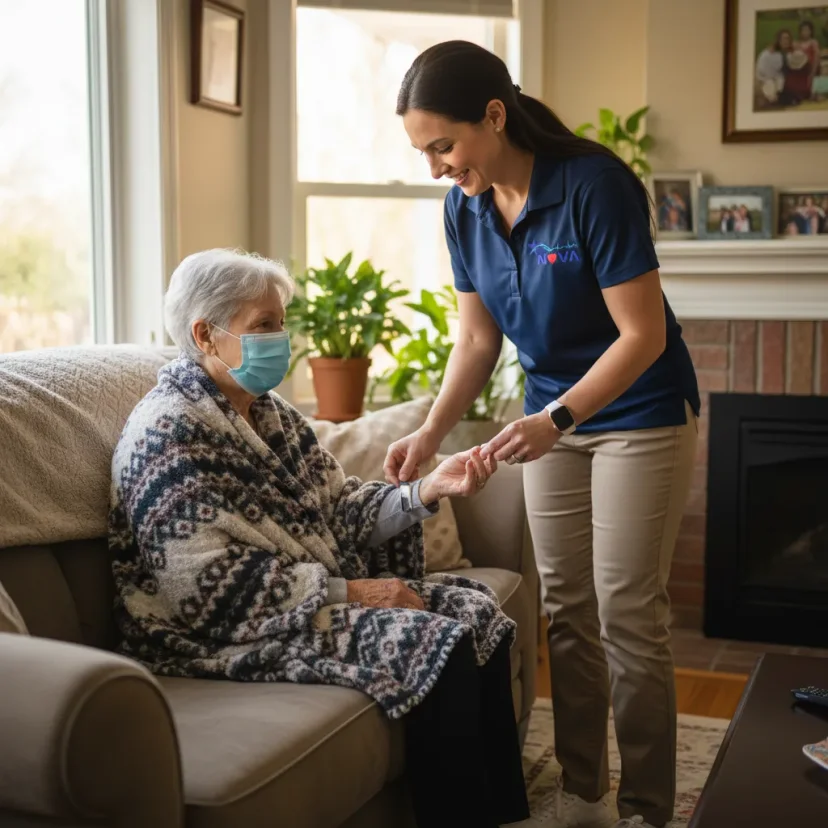
- Sepsis is the body's extreme response to infection; it can start like flu or a urinary infection.
- If someone with an infection becomes confused or breathes very fast, call 112 without waiting.
- A rash that does not fade when pressed and pale, blotchy skin are also reasons to call 112.
- While waiting, give nothing by mouth and check consciousness every 2-3 minutes.
- Signs can stay quiet in older people with dementia and in babies; take behaviour changes seriously.
The Short Answer
Sepsis is the body's extreme, uncontrolled response to an infection; it can begin with something that looks ordinary, such as pneumonia, a urinary tract infection or a wound, and disrupt the circulation within hours [5]. If someone with a fever or a known infection shows confusion, very fast breathing, pale or blotchy skin, a rash that does not fade when pressed or a very high or very low temperature, call 112 without trying to make a diagnosis yourself [2][6]. In the national study the Turkish Intensive Care Society (TYBD) announced in September 2026, 50.5% of septic intensive care patients died within 30 days [11]. One caveat: in older people with dementia and in babies, the signs are harder to notice [6]; new confusion or unusual behaviour may be the only clue [2].
- Infection + confusion, very fast breathing, pale or blotchy skin, a non-fading rash or fainting: 112 [2][4][6].
- Infection + steadily getting worse, but none of the signs above: emergency department the same day [2].
- While waiting for the ambulance: do not leave them alone, give nothing by mouth, check consciousness every 2-3 minutes [1].
Written as the flu and pneumonia season begins in October, this guide brings together the 2025 first-aid rules of the Turkish Red Crescent (Türk Kızılay) and the Turkish Ministry of Health, Turkish data from 2026 and current international sources. The content was reviewed under the oversight of the Nova Ambulans Medical Board.
What Is Sepsis, and Why Is "Blood Poisoning" Not Enough?
In Turkish it is often called "kan zehirlenmesi" (blood poisoning) or "kanda enfeksiyon" (infection in the blood), but these names mislead: in sepsis the problem is not only the germ but the body's response to it. In the World Health Organization (WHO) definition, sepsis is "a life-threatening condition that happens when the body's immune system has an extreme response to an infection" [5]. That extreme response widens the blood vessels, disrupts the circulation and starves organs such as the kidneys, lungs and brain of oxygen.
When it becomes severe, it turns into septic shock. The Turkish Ministry of Health Directorate General of Emergency Health Services' First Aid Training Book (May 2025) defines it in one sentence while listing the types of shock: "Septic shock: occurs as a result of infections." [2][3] According to the Turkish Red Crescent's 2025 pocket book, shock is the state in which "the oxygen and other basic needs of the tissues cannot be met because of a circulatory disorder" [1]. In the same chapter, the Ministry of Health book notes that irreversible damage in tissue deprived of oxygen can begin within 4-6 minutes in the brain, 45-90 minutes in the abdominal organs and 3-6 hours in skin and muscle [2]. Septic shock gradually uses up that time, which is why "let's wait until morning" is usually the wrong decision.
Sepsis can start from an infection almost anywhere. According to the US Centers for Disease Control and Prevention (CDC), the most common sources are the lungs, the urinary tract, the skin and the gut [7].
Sepsis in Numbers: The World and Turkey
| Indicator | Value | Source |
|---|---|---|
| Sepsis cases worldwide per year (2020) | 48.9 million | World Health Organization (WHO) [5] |
| Sepsis-related deaths worldwide (2020) | 11 million; 20% of all deaths | World Health Organization (WHO) [5] |
| Cases in children under 5 | about 20 million (almost half the total) | World Health Organization (WHO) [5] |
| Adults with sepsis who die in hospital in the US | at least 1 in 5 | US Centers for Disease Control and Prevention (CDC) [7] |
| Share of intensive care patients with sepsis in Turkey (2026) | 39% | Turkish Intensive Care Society (TYBD) TURK-SOFA2 [11] |
| 30-day mortality of septic intensive care patients in Turkey | 50.5% (24.5% in those without sepsis) | Turkish Intensive Care Society (TYBD) TURK-SOFA2 [11] |
| Share of sepsis-causing infections that started in the lungs | 50.7% | Turkish Intensive Care Society (TYBD) TURK-SOFA2 [11] |
| 28-day mortality in emergency department patients aged 65+ with sepsis in Istanbul | 64.5% (213 of 330 patients) | Ümraniye Training and Research Hospital, 2026 [8] |
Two separate studies supply the Turkey rows, and their context matters. TURK-SOFA2 is a multicentre observational study registered on ClinicalTrials.gov by Marmara University and run between 4 May and 10 August 2026 [12]; the Turkish Intensive Care Society (TYBD) announced its results, covering 3,368 patients in 143 intensive care units across 44 provinces, in Istanbul on World Sepsis Day [11]. The fact that more than half of the infections started in the lungs also shows why the flu and pneumonia season matters so much for sepsis. The Istanbul study followed the most severe cases: patients with a sepsis diagnosis, median age 79, who came to the Ümraniye Training and Research Hospital emergency department between November 2023 and November 2024 [8]. It does not mean that "two in three older people with sepsis die"; it shows the risk for those who reach hospital already severely ill.
Signs: What Each One Tells You
What the Turkish Ministry of Health book asks of first-aiders applies to sepsis too: "The first-aider's task is not diagnosis, but to suspect what might be wrong based on the information, signs and symptoms gathered. Diagnosis should be left to the doctor." [2] You do not have to answer the question "is it sepsis?"; noticing the signs below and calling the right number is enough.
Signs in adults that mean calling 112
The sepsis page of the UK National Health Service (NHS), reviewed in May 2026, says to call for emergency help if an adult or a child aged 5 or over has any of the following [6]:
- Very fast breathing. The chest rising and falling quickly even at rest, being unable to finish a sentence.
- Confusion, slurred speech or not making sense. New absent-mindedness or mixing up familiar people in an older person counts too.
- Bluish, pale or blotchy skin. On black or brown skin this may be easier to see on the palms and the soles of the feet.
- A very high or very low temperature, feeling hot or ice-cold to the touch, shivering.
- A rash that does not fade when you press it. If the spots do not disappear when you press on the rash, do not wait.
In its list of reasons to call 112, the Turkish Ministry of Health book also includes "changes in mental state, unusual behaviour or difficulty walking" and "fainting or unresponsiveness" [2]. In someone with a serious infection, these lines suggest that sepsis has reached the circulation and the brain.
Signs of sliding into shock
In its shock table, the Ministry of Health book lists what the person tells you and what you see separately [2]:
| What the person tells you | What you see |
|---|---|
| Anxiety and restlessness | Fast and weak pulse |
| Feeling faint, weakness | Fast and shallow breathing |
| Dizziness, light-headedness | Cold, pale and clammy skin |
| Nausea, vomiting | Bluish colour around the lips and in the nails |
| Feeling thirsty | Falling level of consciousness |
The US Centers for Disease Control and Prevention (CDC) adds "extreme pain or discomfort" and "clammy or sweaty skin" to this list [7]. Watch urine output as well: the UK National Health Service (NHS) treats no pee for 12 hours in babies as a reason for an emergency call [6]. In an adult, always tell the crew and the doctor about a marked drop in urine.
Flu or Sepsis? A Comparison
As the seasons change, this question comes up in every home; in Turkey's intensive care data, 50.7% of the infections that led to sepsis started in the lungs [11]. The table below is not a definitive diagnostic tool, but it shows the day to stop saying "rest at home".
| What do you see? | More like flu or a simple infection | Suggests sepsis |
|---|---|---|
| Consciousness | Tired, but speech and orientation intact | Absent, confused, not making sense or hard to wake [6] |
| Breathing | Cough, runny nose; comfortable at rest | Very fast breathing even at rest [6] |
| Skin | Flushed and warm with fever | Pale, bluish, blotchy; cold and clammy [2][6] |
| Rash | None, or fades when pressed | Does not fade when pressed [6] |
| Course | Slow improvement over days | Sudden worsening after starting to improve, or getting worse within hours |
| Urine | Normal | Marked drop; in a baby, none for 12 hours [6] |
We cover separately which flu signs on their own need 112 in our flu season guide. How to monitor breathlessness in winter for someone with chronic lung disease is the subject of our article on COPD and asthma attacks.
When to Call 112, When to Go to the Emergency Department, When to See a GP
The Turkish Ministry of Health book ties the rule for calling 112 to three questions: is the situation life-threatening, could it get worse, would moving the patient or injured person cause more harm? If the answer to any is "yes" or uncertain, call 112 [2]. The same book also notes that ambulances can get the patient or injured person to hospital faster than a private car [2]. For suspected sepsis, the rule works out like this:
| Situation | What to do |
|---|---|
| Infection + confusion, unresponsiveness or fainting | 112 [2][4] |
| Infection + very fast breathing at rest or shortness of breath | 112 [2][6] |
| Infection + pale, blotchy, cold and clammy skin; fast and weak pulse | 112 [2][6] |
| A rash that does not fade when pressed | 112 [6] |
| A baby not feeding, hard to wake, grunting while breathing | 112 [6] |
| Steadily getting worse while being treated for an infection, but none of the above | Emergency department the same day; if unsure, 112 [2] |
| New fever or shivering in someone who had sepsis in the past 12 months | Same-day medical assessment; 112 if they get worse [6] |
| Fever and tiredness, but consciousness, breathing and skin normal | Family doctor; reassess if a new sign appears |
There are two traps here. The first is deciding to drive the person yourself and facing a loss of consciousness on the way; the Ministry of Health guidance explicitly says to call 112 for anyone with impaired consciousness [4]. The second is the belief that "the fever has gone down, so they're getting better": the UK National Health Service (NHS) also lists a very low temperature among the emergency signs [6].
Until the Ambulance Arrives: Step by Step
The 2025 books of the Turkish Red Crescent and the Turkish Ministry of Health apply the same first-aid steps to septic shock as to other types of shock [1][2][3]. Adapted for home:
- Call 112, or have someone call. Give the call-taker the concrete sign, such as "they had a fever and now they're confused"; put the phone on speaker.
- Check consciousness and breathing. If they do not respond and are not breathing normally, start the Basic Life Support (BLS) steps [1].
- Choose the right position. If they are not short of breath, lay them on their back on a flat surface; if there is no injury to the hips or legs, you can put them in the shock position, that is, lying on their back with the legs raised [1][2]. Do not lay someone who is struggling to breathe flat; keep them half-sitting and do not raise their legs: the Ministry of Health book states this explicitly for people with breathing difficulty [2]. This distinction comes up often in sepsis that develops on top of pneumonia.
- Loosen tight clothing and let in fresh air [1].
- Cover them, but do not overheat them. Wrapping someone who is shivering in layer upon layer of thick quilts is overheating too [1][2].
- Give nothing by mouth. The Turkish Red Crescent says not to give food or drink to someone in shock [1]; the Ministry of Health explains why: the risk of it going into the airway and the possibility of surgery [2].
- Check consciousness and breathing every 2-3 minutes and stay with them [1][3].
- If their consciousness worsens, turn them into the recovery position, keeping the head, neck and trunk in line; if they stop breathing, start Basic Life Support (BLS) [1].
While you wait, get the information for the crew ready: when the symptoms started, temperature readings if you took them, the medicines they take (especially antibiotics, corticosteroids and chemotherapy), when they last passed urine, and whether they have a urinary catheter or an open wound. Leave the door open and light up the building entrance. A general checklist for the waiting minutes is in our guide to the minutes until the ambulance arrives.
What Not to Do
- Saying "let's wait until morning and go to hospital then". In septic shock, damage builds up in oxygen-starved organs within hours [2].
- Starting an old leftover antibiotic on your own and waiting. Diagnosis and treatment decisions belong to the doctor [2]; as you will see below, the real gain is getting to hospital early.
- Giving water, tea, medicine or food to someone who is confused [1][2].
- Laying someone who is short of breath flat or raising their legs [2].
- Trying to drive someone with clouded consciousness yourself [2][4].
- Ignoring the other signs once a fever reducer has brought the temperature down. A very low body temperature is also an emergency sign [6].
Why Do the Hours Matter? What Happens in Hospital?
At the centre of sepsis treatment in hospital is starting antibiotics on time [9]. The World Health Organization (WHO) stresses that "treatment for sepsis is most effective when started early" [5]. The international Surviving Sepsis Campaign guidelines recommend starting antibiotics within 1 hour when there is shock and within 3 hours for possible sepsis without shock [9].
Why these windows exist is shown by a study published in The Lancet Respiratory Medicine in August 2026 that examined 99,667 encounters at nine US hospitals: in patients with shock, each hour of delay in antibiotics was associated with an absolute increase of about 1.5% in the risk of death [9].
So is starting antibiotics in the ambulance, or even at home, the answer? A systematic review published in September 2026, pooling 23,146 patients from 11 studies, found that randomised trials did not show prehospital antibiotics reducing short-term deaths, and rated the certainty of the evidence as "very low" [10]. With what we know today, the lesson for families is simple: what matters is getting the person, monitored and by the fastest route, to a hospital that can treat them within the first hours after the signs begin [2][9][10].
Groups Where It Stays Quiet: Older People, Babies, Pregnant Women
The UK National Health Service (NHS) notes that the symptoms of sepsis can be harder to notice in babies and young children, people with dementia, people with a learning disability and people who have difficulty communicating [6]. The risk is also higher in these groups.
- Age 75 and over, care-home residents: The UK National Health Service (NHS) places people over 75 in the higher-risk group [6]. Someone with dementia may not be able to say "I have a fever"; the "changes in mental state, unusual behaviour" on the Turkish Ministry of Health's 112 list may be the first sign in these people [2]. Having a urinary catheter also raises the risk [6]; tell the doctor if the urine in the bag decreases or changes colour. We describe how this monitoring is organised in care homes in our article on emergency health protocols in nursing homes.
- Babies and children under 5: For this age group, the UK National Health Service (NHS) lists very fast or grunting breathing, the tummy sucking in under the ribs, bluish or blotchy skin, a non-fading rash, a temperature of 38°C or more in babies under 3 months and 39°C or more in babies aged 3-6 months, a temperature below 36°C, a weak, high-pitched or continuous cry, not feeding, being hard to wake and not peeing for 12 hours as reasons for an emergency call [6]. For general 112 thresholds in children, see our parents' guide to children's emergencies.
- Pregnant women and those who have recently given birth: Pregnancy and giving birth, a miscarriage or an abortion in the past 6 weeks raise the risk [6]. Tell the doctor who followed the birth about any fever in this period the same day; if one of the 112 signs above is added, do not wait.
- People on chemotherapy, corticosteroids or immunosuppressants: These medicines raise the risk of sepsis [6]. When signs of infection start, contact the doctor managing their treatment the same day.
Can It Be Prevented?
Not every case of sepsis can be prevented, but the World Health Organization (WHO) lists treating infections early, good hygiene at home and in healthcare settings and access to vaccination programmes as ways to prevent it [5]. In practice this means discussing the seasonal flu vaccine with the family doctor for a relative in a risk group, not waiting for redness around a wound or a urinary tract infection to "go away on its own", and taking an antibiotic the doctor has started for the full course. The US Centers for Disease Control and Prevention (CDC) stresses that most people who develop sepsis have at least one underlying medical condition or a recent hospital stay [7]; in other words, the first weeks after discharge also need attention.
Getting to the Follow-Up Appointments After Discharge
If sepsis is suspected, the number to call is always 112; a private ambulance does not replace 112 in that situation. A different need begins after intensive care: we explain how the roles of 112 and a private ambulance are divided in this article.
Picture a 78-year-old father who spent two weeks in intensive care with septic shock caused by pneumonia, can manage only a few steps with a walking frame when he gets home and cannot get down the stairs from his third-floor flat in a building without a lift. When he has to go to hospital for an infectious diseases clinic check-up, a blood test or a chest X-ray, Nova Ambulans' home-to-hospital transfer service brings him down on a stretcher, waits during the appointment and brings him back home. Telling us the appointment time, whether he is on oxygen and which floor you live on is enough for planning: +90 216 339 00 39.
Frequently Asked Questions
What are the first signs of sepsis?
Sepsis often starts like an ordinary infection: fever, shivering, tiredness. What turns it into sepsis are the new signs that appear on top. The UK National Health Service (NHS) lists very fast breathing, confusion, slurred speech, bluish, pale or blotchy skin, a very high or very low temperature and a rash that does not fade when pressed as reasons to call for emergency help in adults [6]. The US Centers for Disease Control and Prevention (CDC) adds clammy or sweaty skin, extreme pain, a high heart rate or weak pulse, and shortness of breath [7].
How can you tell flu from sepsis?
Flu causes fever, muscle aches and tiredness, but the person keeps their speech, orientation and colour. In sepsis the circulation is affected: the Turkish Ministry of Health First Aid Training Book (May 2025) lists cold, pale and clammy skin, a fast and weak pulse, fast and shallow breathing and a falling level of consciousness as signs of shock [2]. If one of these starts in someone with flu, or they suddenly get worse after a few days of improvement, call 112 without waiting for a diagnosis.
If sepsis is suspected, should you call 112 or go to the emergency department?
Call 112 if there is confusion, very fast breathing, pale or blotchy skin, a rash that does not fade or fainting; do not try to drive them yourself [2][6]. The Turkish Ministry of Health book says to call 112 if the situation is life-threatening or could get worse, and whenever you are unsure [2]. If these signs are absent but the person with an infection is steadily getting worse, go to an emergency department the same day.
What should you do while waiting for the ambulance if sepsis is suspected?
Following the 2025 shock first-aid guidance of the Turkish Red Crescent (Türk Kızılay) and the Turkish Ministry of Health: do not leave them alone, give no food or drink, loosen tight clothing, cover them without overheating them and check their consciousness and breathing every 2-3 minutes [1][2]. If they are short of breath, keep them half-sitting rather than lying flat [2]. If their consciousness worsens, put them in the recovery position; if they stop breathing, start Basic Life Support (BLS) [1].
Who is most at risk of sepsis?
Anyone can get sepsis, but the UK National Health Service (NHS) treats babies under 1, people aged 75 and over, pregnant women and those who gave birth in the past 6 weeks, people on chemotherapy or corticosteroids, and people with an open wound or a urinary catheter as higher risk [6]. The US Centers for Disease Control and Prevention (CDC) notes that most people who develop sepsis have at least one underlying medical condition or a recent hospital stay [7].
Rapid Emergency Support
24/7 emergency ambulance service across Istanbul. Fast response, fully equipped team.
Average response time: 15 seconds
Related Articles
Mushroom Poisoning Symptoms and First Aid: When Do Symptoms Start, When to Call 112?
If nausea, vomiting, diarrhea, abdominal pain or any other symptom begins after eating foraged mushrooms or mushrooms of unknown origin, call 112, whatever hour it began; do not induce vomiting and give nothing by mouth. People without symptoms, including a child who ate a mushroom in a garden or park, still need hospital assessment; call 112 and explain, because with amatoxin, which damages the liver, the symptom-free interval averages 8-10 hours. The National Poison Information Center (UZEM) on 114 gives advice but does not replace 112.
EducationBee, Wasp, and Hornet Sting First Aid: When a Sting Reaction Needs 112
Step-by-step first aid for honeybee, wasp, and hornet stings — the bystander's 30-second stinger-scrape technique (credit-card scrape, never tweezers), local vs large-local vs systemic reaction decision tree, when to call Türkiye's 112 emergency line, adrenaline auto-injector application to the outer thigh, and what to do until the ambulance arrives — with verbatim protocols from Türk Kızılay Cep Kitabı 2025, T.C. Sağlık Bakanlığı May 2025 First-Aid Training Manual, the Turkish National Society of Allergy and Clinical Immunology (AİİAD), the Society of Pediatric Allergy and Asthma Academy (CAAAD), the 2025 Katran cohort of 194 526 patients at Istanbul Süreyyapaşa Hospital, the 2021 Öziş Baba cohort of 7 904 Trabzon schoolchildren, the American Academy of Allergy, Asthma & Immunology (AAAAI) and the McMurray 2026 Hymenoptera venom anaphylaxis review.
EducationAsthma Attack First Aid: Step-by-Step Bystander Decisions and the 112 Chain
What a bystander does in the first five minutes of an adult asthma attack — the "5-minute rule" from the Turkish Ministry of Health's May 2025 First Aid Training Book, the mild/moderate/severe/life-threatening classification of the Global Initiative for Asthma (GINA) 2025 Summary Guide, correct metered-dose inhaler and spacer technique, differences for children, pregnant patients and the elderly, and Istanbul-specific triggers.
Popular Ambulance Topic Clusters
You may also like
- Private ambulance pricing
- Istanbul private ambulance
- Intercity patient transport
- Doctor-accompanied ambulance
- Dialysis patient transport
- How intercity patient transport works
- Ambulance response time in Istanbul
- Home-to-hospital patient transport
- Modern ambulance equipment and team standards
- Heart attack symptoms and first response
This content is informational only and does not replace professional medical evaluation. In emergencies, call 112 or +90 216 339 00 39.
