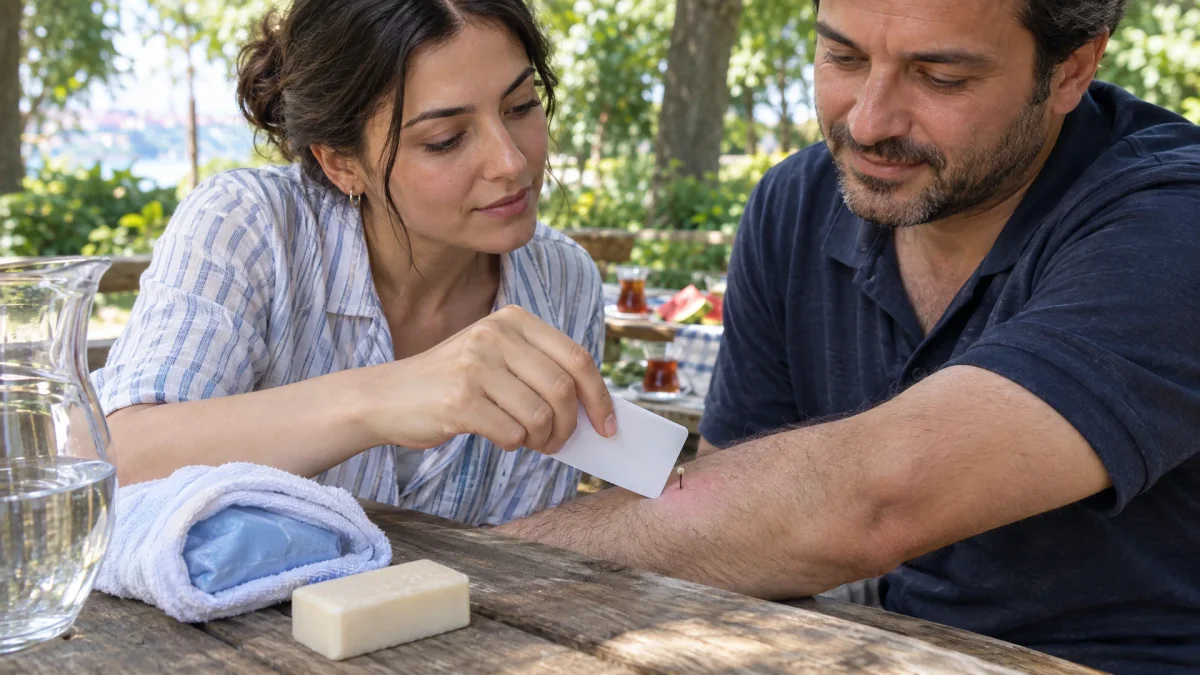
- Remove a honeybee stinger within 30 seconds by scraping with a credit-card-like flat-edged tool; tweezers are forbidden (Türk Kızılay 2025).
- Wasps and hornets do not leave their stinger behind; skip the removal step and move directly to wash-cool-observe.
- Stings to the head, neck or inside the mouth need 112 immediately (Katran 2025: 87.8% stage 3–4 reaction with head-neck stings).
- Once shortness of breath, throat swelling, widespread itching or altered consciousness starts, use the prescribed adrenaline auto-injector and call 112.
- 96–98% of stings are local reactions managed at home; the 1–4% remainder is where correct timing saves lives.
Quick answer: If a honeybee or wasp stings you or someone near you and the stinger is visible in the skin, scrape it out within the first 30 seconds using a flat-edged tool such as a credit card — do not squeeze with tweezers, because the Türk Kızılay First-Aid Pocket Book 2025 states "do not remove the stinger by squeezing with tools such as tweezers" [3]. Wash the site with soap and water and apply cold for 10–15 minutes. If the only symptoms are redness, pain and mild swelling at the sting site, no emergency service is needed. But if shortness of breath, throat or lip swelling, widespread itchy redness, dizziness, vomiting or altered consciousness develops, this is anaphylaxis — the Türk Kızılay Pocket Book 2025 explicitly notes that in such a case, the only life-saving first intervention is the prescribed adrenaline auto-injector [2] and 112 Emergency Medical Services must be called at the same time. The Turkish National Society of Allergy and Clinical Immunology (AİİAD) lists bee stings as one of the three principal adult anaphylaxis triggers in Türkiye [5]; the Türk Kızılay 2025 edition adds that "5% of patients are allergic to bee stings" [2] — meaning that in one in twenty people, a bee sting can result in a life-threatening reaction, and this risk can appear even on the first sting.
Contents
- Bee stings in Türkiye: real numbers, real risk
- Honeybee, wasp, hornet: practical distinctions and why they matter
- The first three minutes: correct stinger-removal technique
- Managing a local reaction at home
- Local, large local, systemic reaction — decision tree
- When should I call 112 immediately?
- The adrenaline auto-injector in anaphylaxis
- Until the ambulance arrives: position, do and don't
- Special groups: children, pregnant women, chronic patients, elderly living alone
- Is Vespa velutina present in Türkiye?
- Nova Ambulans' role: allergic patients and planned transfers
- Frequently asked questions
- Related blog posts
Bee stings in Türkiye: real numbers, real risk
Two recent Turkish studies show how common and how serious bee stings can be. The Istanbul Süreyyapaşa Training and Research Hospital Allergy and Immunology Clinic screened 194,526 patients between 2015 and 2023; the study by Zeynep Yegin Katran and colleagues, published in Allergologia et Immunopathologia in 2025, reports 384 patients admitted with allergic complaints following a bee sting in this pool, with a bee-sting-related anaphylaxis prevalence calculated at 0.058% in that clinic [7]. The same study contains a striking safety data point: stage 3–4 (severe) reactions developed in 87.8% of patients stung in the head and neck region, compared to 53.3% for stings elsewhere on the trunk or limbs [7]. In other words, the sting location alone can raise the urgency level; there is far less room for observation with head or neck stings.
The picture is different in children. Öziş Baba and colleagues from the Karadeniz Technical University Faculty of Medicine Department of Pediatrics distributed a survey to 17,000 school children aged 6–18 in Trabzon; in the returning cohort of 7,904 responses, 54.5% of the children had been stung by a bee at least once in their lifetime [8]. Of those 950 stings, 5.2% were large local reactions (LLRs), 1.9% were generalized cutaneous reactions (GCRs), and 1.3% were systemic reactions (SRs) [8]. The stinging insect was honeybee (Apis mellifera) in 66.2% of stings and wasp (Vespula) in 33.8% [8]. Boys were 1.44 times more likely to be stung than girls, a difference attributed to more time spent outdoors.
A national-society summary combines the adult and child distributions. The Society of Pediatric Allergy and Asthma Academy (CAAAD) summarises them as follows: "56–94% of people are stung by a bee at least once in their lifetime. Local reactions are the most common (96–98%); large local reactions occur in 0.9–3%, and systemic allergic reactions or anaphylaxis in 0.45–1%" [6]. Even though the systemic rate appears low, when applied to the population it results in repeated emergency admissions every summer across Istanbul, Bursa, Izmir, Antalya and Trabzon; the population survey by Aslı Gelincik and colleagues of 11,816 Istanbul adults showed that adults who had experienced a lifetime systemic reaction had high emergency-department attendance but only one in ten received adrenaline in the ER and only 2.3% carried an adrenaline auto-injector — this is where Türkiye's primary-care/emergency chain underperforms in bee-sting anaphylaxis.
Honeybee, wasp, hornet: practical distinctions and why they matter
In everyday Turkish, the single word "bee" corresponds to several different animals, and the correct distinction changes the first-aid response.
-
Honeybee (Apis mellifera). Yellow-brown-banded, hairy and short. Stings once; the barbed stinger tip lodges in the skin, the bee leaves the stinger and venom sac behind and dies shortly afterwards. Seeing a stinger still in the skin after a sting is a strong sign it was a honeybee. In the Trabzon paediatric cohort, 66.2% of all stings were from honeybees [8]. Visible stinger presence makes correct-technique removal life-saving — the venom sac is still actively pumping.
-
Wasp and hornet (Vespula, Polistes species). More brightly yellow-black striped, long and hairless. The stinger is smooth so it does not lodge in the skin; the same wasp can sting repeatedly in succession. During Türkiye's high-sting months (July–September), these are the species most often encountered on balconies, at picnics, in campgrounds and market stalls; they are attracted to sugar, fruit juice and meat. In the Trabzon cohort, 33.8% of stings were from the Vespula (wasp) group [8]. Because no stinger is left, the "stinger-removal" step is skipped; move directly to wash, cool and observe.
-
Yellow jackets, fire ants and giant hornets. McMurray and colleagues' 2026 review in Immunology and Allergy Clinics of North America lists the Hymenoptera group as: "Allergy to venoms of stinging insects — bees, yellow jackets, hornets, wasps, and stinging ants — causes large local reactions or systemic reactions, including anaphylaxis" [9]. Yellow jackets and giant hornets (such as Vespa mandarinia) are not part of Türkiye's natural range; Vespa velutina (the Asian hornet) is treated in a separate note below.
Why does this matter? When a patient with a known allergy is asked "what stung you?", the answer "honeybee, stinger stayed" versus "wasp, stung several times" changes the ambulance team's preparation. In the Türk Kızılay 2025 protocol, the stinger-removal step applies specifically to honeybee stings — with wasp stings this step is skipped. Similarly, multiple stings can require urgent evaluation for toxic reaction (the chemical effect of many stings); the American Heart Association (AHA) and the Turkish National Society of Allergy and Clinical Immunology (AİİAD) count multiple stings as an independent risk factor [5].
Bee stings should not be confused with scorpion or snake bites. The Türk Kızılay Esenyurt protocol treats these as separate sections: for scorpion stings, "the sting area is not moved, the patient is kept lying, cold is applied to the wound"; for snake bites, "the patient is calmed, a bandage is applied to arm or leg (no tourniquet), medical help is requested (112)" [4]. Especially in Türkiye's Southeastern Anatolia, Aegean and Mediterranean countryside, scorpion and snake bites also occur during summer; correctly identifying what stung the patient changes the first-aid step. This article covers only bee, wasp and hornet stings.
The first three minutes: correct stinger-removal technique (honeybee only)
When a honeybee stings you, the venom sac hangs on the skin and continues pumping venom for minutes. The Türk Kızılay Esenyurt First-Aid Training Center protocol defines the removal technique clearly:
"To remove the stinger, use any flat-edged tool such as a credit card, ruler or the back of a key. Gently scrape the area where the stinger is until it comes out. Do not remove the stinger by squeezing with tools such as tweezers." [3]
International consensus supports this protocol. The American Academy of Allergy, Asthma & Immunology (AAAAI) states in its official patient information: "A quick scrape of your fingernail removes the stinger and sac. Avoid squeezing the sac – this forces more venom through the stinger and into your skin." A 30-second window is the technique target [10]. In other words, both Türk Kızılay and the American Academy of Allergy, Asthma & Immunology (AAAAI) say the same thing: scrape, do not squeeze.
Why don't tweezers work? Tweezers grip not the far tip of the stinger but the venom sac itself. That gripping pressure pumps the venom in the sac into the skin. The scraping technique lifts the stinger horizontally from its base — the sac moves outward, not inward. The same principle works with a flat-edged knife back, plastic card, ID, or a coin. In practice, timing is the only thing that matters: doing the scrape within 30 seconds. That is why keeping a flat-edged plastic card in your first-aid kit (see what belongs in your emergency kit) is useful; in theory the tool matters less than how fast you act.
If a wasp or hornet stung you, skip the stinger-removal step; these species do not leave a stinger. Move directly to the wash-cool-observe steps.
Managing a local reaction at home
The great majority of stings — according to the Society of Pediatric Allergy and Asthma Academy (CAAAD), 96–98% — are local reactions and managed at home [6]. The Türk Kızılay Esenyurt protocol defines the two steps:
"Wash the sting site with soap and water. Apply cold to reduce oedema and venom absorption." [3]
Practical actions:
- Wash. Soap and running water for 20–30 seconds. Water should be lukewarm (cold constricts vessels, hot spreads venom).
- Cold application. Ice or a chilled gel pack inside a thin cloth for 10–15 minutes, then a 10-minute break, then another 10–15 minutes. Do not put ice directly on skin (frostbite risk).
- Remove rings, watch, bracelet. If the sting is on a finger, hand or wrist, swelling can worsen over hours; jewellery can constrict circulation. Remove them early.
- Elevate the area. For arm or leg stings, support the area above heart level with a pillow — this reduces oedema.
- Prevent scratching. Itching is the most uncomfortable early symptom; scratching leads to secondary infection. A cool damp cloth or an over-the-counter topical antihistamine cream can help.
- Oral antihistamine or paracetamol/ibuprofen with physician advice. These are available without prescription for itch and pain; for children, always consult a paediatrician or pharmacist for dosing.
Typical course: redness and swelling increase over the first 24 hours, peak at 48 hours, resolve within 5–7 days. Redness that continues to expand after 48 hours, along with warmth, pus, or fever suggests infection; outpatient review is required.
Local, large local, systemic reaction — decision tree
Recognising which category you are in after a sting is the core of choosing the right step. The Society of Pediatric Allergy and Asthma Academy (CAAAD) classification is established in Turkish paediatric practice [6].
1. Local Reaction (LR). Redness, pain and mild swelling 1–5 cm at the sting site. Seen in 96–98% of cases [6]. Home care is sufficient; no ambulance or emergency service needed. Resolves in 3–5 days.
2. Large Local Reaction (LLR). Swelling larger than 10 cm and lasting more than 24 hours. For example, a sting on the hand leading to swelling of the whole forearm. Seen in 0.9–3% of cases [6]; 5.2% in the Trabzon paediatric cohort [8]. An allergic mechanism is present but not systemic. Hospital review is warranted in two situations: (a) the swelling is on the face, neck or mouth (airway threat); (b) the patient is pregnant, has underlying disease or is elderly (cautious physician review). 112 is not mandatory; outpatient clinic, family physician or the nearest emergency department is sufficient. In the same patient, future stings carry a mildly elevated 5–15% systemic-reaction risk; allergy clinic referral is appropriate.
3. Generalized Cutaneous Reaction (GCR). Redness, itching, hives at sites distant from the sting; no respiratory, circulatory or consciousness change. 1.9% of cases [8]. This is a warning sign: this patient's risk of a systemic reaction with the next sting is markedly higher. Emergency department attendance and allergy clinic referral are needed.
4. Systemic Reaction / Anaphylaxis (SR). 0.45–1% of cases [6]; 1.3% in children [8]. If even one of the following is present, this is anaphylaxis and 112 must be called immediately:
- Shortness of breath, wheezing, hoarseness
- Swelling of the throat, tongue, lips or face
- Difficulty swallowing
- Widespread itchy redness (hives) — especially at sites distant from the sting
- Dizziness, faintness, visual dimming
- Abdominal pain, nausea, vomiting, diarrhea
- Altered consciousness or loss of consciousness
- Rapid pulse, sensation of falling blood pressure
When should I call 112 immediately?
The Türk Kızılay Esenyurt protocol summarises the 112 call threshold in one sentence:
"For intraoral stings, in people with allergy history, and in those showing whole-body (systemic) findings, call 112 emergency services immediately." [3]
The three categories in concrete terms:
A. Intraoral, tongue, palate, throat or face sting. Even a small local reaction can rapidly progress to airway swelling. The striking finding in the 2025 Katran et al. study is exactly this: "Stage 3–4 (severe) reactions developed in 87.8% of patients stung in the head and neck region" [7]. In other words, there may be room to wait for stings elsewhere, but with head-face-neck stings there is no waiting — a direct 112 call is correct. Keep the patient seated, give nothing by mouth, allow ice-cube sucking (if available) to delay airway swelling.
B. Documented prior bee-allergy history. A patient with an adrenaline auto-injector has had a prior anaphylaxis; at the first symptoms of a new sting, use the auto-injector and call 112 without hesitation. The auto-injector is for treatment, not diagnosis, of anaphylaxis — waiting can be fatal.
C. Systemic sign — respiration, skin, consciousness, circulation. The 4th category in the decision tree above. The T.C. Ministry of Health May 2025 First-Aid Training Manual summarises this: "The severe allergy called anaphylaxis is a picture where airway narrowing after swelling of the mouth, tongue or throat makes breathing difficult. At this stage the person's life is under threat and rapid intervention is required" [1]. Every clause in that definition is a trigger for calling 112.
Additional 112 triggers:
- Multiple stings (10+ honeybee, 5+ wasp). The venom dose alone can trigger a toxic picture.
- Young child (under 5) stung on the face or neck.
- Pregnant — especially 2nd or 3rd trimester, throat or face sting.
- Cardiac, pulmonary, renal chronic disease — the threshold is lowered even without systemic signs.
- Elderly living alone — no one can reach them in the next 60 minutes.
The adrenaline auto-injector in anaphylaxis
When anaphylaxis develops, the only effective first intervention is the prescribed adrenaline auto-injector. The Türk Kızılay First-Aid Pocket Book 2025 clearly explains who, where and how:
"For patients with severe allergic findings — shortness of breath, tongue/throat/facial swelling — apply the prescribed medication (epinephrine auto-injector), if available, to a muscular area of the patient's leg." [2]
The application site is the outer-lateral thigh (vastus lateralis). The Society of Pediatric Allergy and Asthma Academy (CAAAD) supports this: "Epinephrine should be given by the intramuscular (IM) route to the vastus lateralis or deltoid muscle" [6]. The auto-injector can be given through trousers or a skirt — even thick denim or jeans — because the clinical window is measured in minutes and saving seconds on undressing matters.
In Türkiye, adrenaline auto-injectors are obtained by direct prescription; the brands most in use are Emerade, EpiPen, Jext and Anapen. The auto-injector is for treatment, not diagnosis, of anaphylaxis; no other medication (antihistamine syrup, cortisone tablet, cold application, milk, etc.) can substitute for adrenaline. McMurray and colleagues write in their 2026 review: "Patients with sting anaphylaxis should be prescribed epinephrine and venom immunotherapy — this approach prevents allergic reactions in up to 98% of patients" [9].
For a detailed step-by-step guide to anaphylaxis, see our anaphylaxis and adrenaline auto-injector practical guide — how to apply, when to repeat, what position to use while waiting, and what to tell the ambulance team.
Until the ambulance arrives: position, do and don't
Once 112 is called, the Health Command and Control Center (SKKM) dispatches the ambulance; for Istanbul response-time benchmarks, see how many minutes does an ambulance take in Istanbul in 2025. During this window, what the bystander does matters.
Position.
- Conscious and breathing well: lie supine and elevate legs 30 cm (Trendelenburg position) — directs blood flow to the brain.
- Breathing with difficulty: keep seated; this eases respiratory work. Do not force lying down.
- Pregnant patient: left lateral position — no compression on the vena cava.
- Unconscious but breathing: apply the safe recovery (lateral) position — protects the airway if the patient vomits.
- If breathing has stopped: begin Basic Life Support (BLS) — see our adult Basic Life Support (BLS) and chest compression step-by-step guide for the 30:2 cycle (30 chest compressions and 2 rescue breaths) and iman tahtası (sternum) depth. The Türk Kızılay 2025 slogan "PRESS FAST, PRESS HARD" targets 100–120 per minute at 5–6 cm depth.
What to give? If conscious and able to swallow, small sips of cold water may be allowed; this temporarily eases the throat-swelling sensation. Otherwise, nothing by mouth.
Do NOT give any of the following:
- Solid food or drink (vomit and aspiration risk)
- Sting-related medication (aspirin, cortisone tablet, milk, yoghurt) — none substitute for adrenaline
- Folk remedies (honey, salt water, vinegar) — no evidence, do not slow oedema
- Alcohol, cigarettes
Information to give the ambulance team.
- Exact time of the sting
- Species that stung (honeybee, wasp, hornet — if possible, give a dead specimen or the stinger to the team)
- Sting location
- Symptoms in chronological order
- Auto-injector used (if any) — time and dose
- The patient's chronic conditions and regular medications
- Known allergy history
For a broader companion list of what to do until the ambulance arrives — bleeding, unconsciousness, chest pain — our until-the-ambulance-arrives guide walks through the scenarios most often encountered in summer.
Special groups: children, pregnant women, chronic patients, elderly living alone
Children. In the Trabzon cohort, boys were stung 1.44 times more often than girls [8]. Fever, restlessness and vomiting can be systemic-reaction heralds; children's anaphylaxis symptoms differ from adults' and can begin with vague statements such as "I feel odd", "my stomach hurts", "I'm thirsty". A child under 5 stung on the face or neck should be brought to 112 without hesitation. For paediatric emergency decisions, our pediatric emergencies parent guide summarises age-specific findings and decision thresholds.
Pregnant women. Anaphylaxis is dangerous for both mother and baby. Adrenaline is safe in pregnancy — it saves the mother's life and preserves uterine blood flow. Left-lateral positioning maintains blood flow to the baby. A throat or face sting requires 112.
Chronic cardiac or pulmonary patients. Adrenaline causes tachycardia and rising blood pressure; nonetheless, the risk-benefit balance in anaphylaxis is unequivocally in favour of adrenaline. Do not administer the injector without a physician's advice; but if it has been prescribed previously, do not hesitate at the moment of anaphylaxis. The same patient should be followed up in an allergy clinic and considered for venom immunotherapy.
Elderly living alone. If the person will be alone in the first hours after the sting, the 112 threshold should be lowered. Practical steps: notify a neighbour or family member, leave the door unlocked (for ambulance entry), keep the phone within reach. Keep an adrenaline auto-injector in the household medicine drawer and an identity card and medication list in the pocket. For eldercare and emergency planning at home, our home care and ambulance support for elderly guide details scenarios.
Is Vespa velutina (Asian hornet) present in Türkiye?
For the past two years, social media has circulated headlines suggesting that "the Asian giant hornet has reached Türkiye"; for a balanced read, the most recent 2024 report from the European and Mediterranean Plant Protection Organization (EPPO) is the reference document. The European and Mediterranean Plant Protection Organization (EPPO) bulletin summarises:
"Since the last report, V. velutina has been reported for the first time in Austria, Czechia, Hungary, Ireland, Luxembourg, the Netherlands and Slovakia. In all instances, either hitchhiking on transportation or natural spread are the suggested introduction pathways." [11]
Türkiye is not named in this document. That is, Vespa velutina has no recorded presence in Türkiye in the 2024 European and Mediterranean Plant Protection Organization (EPPO) list; this does not mean "absent in Türkiye" but "no verified spread data yet". The practical meaning for Turkish beekeepers and the public: the wasp you encounter in summer is most likely a honeybee, a common wasp (Vespula), or a Palearctic-range Polistes / Vespa crabro (European hornet). The first-aid protocol, wash, cool and allergy monitoring is the same — but because the Ministry of Agriculture and Forestry and the agriculture directorates of the Aegean and Black Sea regions perform regular surveillance, any new detection in Türkiye will be publicly shared. Reading past social-media "invasion" headlines and checking the European and Mediterranean Plant Protection Organization (EPPO) and Ministry of Agriculture and Forestry sources is the right habit.
Nova Ambulans' role: allergic patients and planned transfers
The most dangerous scenario in this article — a relative going into anaphylaxis at a summer house outside Istanbul, a resort village, a rural wedding, or an isolated beach — is a classic allergic-shock case for Nova Ambulans. The 112 emergency chain manages the first step: adrenaline is administered, the patient is stabilised. But the stable patient's onward transfer to an allergy-and-immunology specialty hospital in Istanbul (Süreyyapaşa, Cerrahpaşa, Istanbul Medical Faculty, Marmara) is often a long-distance inter-city patient-transport process. As Nova Ambulans, our regular planned transfers across the Marmara region, the Black Sea coast, the Aegean and the Anatolian side:
- Carry a physician or paramedic alongside IV access, monitoring, oxygen and a second dose of adrenaline for the whole trip.
- Coordinate your relative's discharge follow-up and allergy-clinic appointment.
- Coordinate with the family physician and allergy specialist so that the adrenaline auto-injector prescription renewal process begins.
Arranging a planned transfer in advance saves time in the emergency moment; our how to arrange a planned ambulance transfer guide walks through the steps and required documents. Registering a relative with an allergy history in advance and lodging their medical history with us means, in the summer months, a single phone call — Nova Ambulans 24/7 call centre 0 216 706 44 40 — starts the transfer.
Frequently asked questions
Can I use tweezers to remove a honeybee stinger?
No; tweezers grip the venom sac at the tip of the stinger and squeeze the venom into the skin. The Türk Kızılay Esenyurt First-Aid Training Center protocol states "do not remove the stinger by squeezing with tools such as tweezers" [3]. Correct technique: horizontal scraping with a credit card, ID card, flat-edged knife back, or fingernail. The American Academy of Allergy, Asthma & Immunology (AAAAI) describes this as "a quick scrape of your fingernail" with a 30-second target window [10]. If you only have tweezers and cannot find another tool within 30 seconds, grip the outer edge of the venom sac rather than the top of the stinger and pull horizontally; ideally a flat-edged tool (ice-cream stick, ruler, coin) should be found quickly.
A bee flew into my throat and stung me — what do I do?
In this scenario there is no waiting; call 112 immediately. The Türk Kızılay Esenyurt protocol advises calling 112 without delay for intraoral stings [3]. Airway swelling can progress within minutes. Keep the patient seated, not lying down. Allow them to suck a small ice cube from the freezer; internal cooling can delay swelling. Do not give any solid food, tablet or syrup — the swallowing reflex begins to fail. If a prescribed adrenaline auto-injector is available, this is the moment to use it — apply to the outer-lateral thigh. Stay with the patient until the ambulance arrives; begin Basic Life Support (BLS) if breathing stops.
I was stung by 3 wasps at a picnic, no allergy history — should I call 112?
Three stings increase systemic-reaction risk somewhat compared to one but do not by themselves mandate 112. What matters is symptoms. If the stings are on the face-neck-mouth, or if within the first 15 minutes you develop itching, redness, widespread hives, dizziness or shortness of breath, call 112. If the stings are on limbs and the only sign is local swelling: scrape stingers out (if honeybee), wash, apply cold, stay with someone for at least 2 hours, and call 112 if any systemic sign starts. More than 10 honeybee stings or more than 5 wasp stings warrants 112 even without allergy history, due to toxic-reaction risk.
My child had a mild reaction previously; should I get an auto-injector prescribed?
A definitive answer requires a paediatric allergist. But 1.3% of the Trabzon paediatric cohort had a systemic reaction [8] and Katran et al. reported that 29.4% of hospital-presenting bee-sting patients were eligible for immunotherapy [7]. If your child previously had widespread itching, hives, wheezing, or dizziness after a sting, ask your family physician for a referral to an allergy clinic. An adrenaline auto-injector should be prescribed after diagnosis; the dose is weight-based (0.15 mg for 15–30 kg; 0.3 mg for over 30 kg — Society of Pediatric Allergy and Asthma Academy (CAAAD) recommendation [6]). Also, Venom Immunotherapy (VIT) is a maturing option; McMurray et al. write in their 2026 review that Venom Immunotherapy (VIT) "prevents allergic reactions in up to 98% of patients" [9].
Is Vespa velutina (Asian giant hornet) present in Türkiye — should I worry?
The 2024 European and Mediterranean Plant Protection Organization (EPPO) report does not include Türkiye [11]. It documents the species' spread from its 2004 France detection through Western and Central Europe (2024 first-time findings in Austria, Czechia, Hungary, Ireland, Luxembourg, the Netherlands and Slovakia). Social-media "invasion" claims in Türkiye have not been confirmed by the Ministry of Agriculture and Forestry. The wasp you encounter in a Turkish summer is most likely a honeybee (Apis mellifera), a common wasp (Vespula), or the European hornet (Vespa crabro — native to Türkiye). The first-aid protocol is the same for all; the stinger-removal step applies only to honeybee stings, because the other species do not leave their stinger behind. The Ministry of Agriculture and Forestry will inform the public in the event of a new species detection.
Related blog posts
- Anaphylaxis (Allergy Shock) and Adrenaline Auto-Injector: First-Aid Guide
- Until the Ambulance Arrives — What to Do?
- How to Apply the Recovery (Lateral) Position
- Adult Basic Life Support and CPR: A Plain Bystander Guide
- Pediatric Emergencies: Parent's Guide
- Ambulance Services During Summer Vacation: Health Safety in Holiday Regions
- What Belongs in Your Emergency Kit
- How Many Minutes Does an Ambulance Take in Istanbul? 2025 Guide
- How to Arrange a Planned Ambulance Transfer
Rapid Emergency Support
24/7 emergency ambulance service across Istanbul. Fast response, fully equipped team.
Average response time: 15 seconds
Related Articles
Mushroom Poisoning Symptoms and First Aid: When Do Symptoms Start, When to Call 112?
If nausea, vomiting, diarrhea, abdominal pain or any other symptom begins after eating foraged mushrooms or mushrooms of unknown origin, call 112, whatever hour it began; do not induce vomiting and give nothing by mouth. People without symptoms, including a child who ate a mushroom in a garden or park, still need hospital assessment; call 112 and explain, because with amatoxin, which damages the liver, the symptom-free interval averages 8-10 hours. The National Poison Information Center (UZEM) on 114 gives advice but does not replace 112.
EducationAsthma Attack First Aid: Step-by-Step Bystander Decisions and the 112 Chain
What a bystander does in the first five minutes of an adult asthma attack — the "5-minute rule" from the Turkish Ministry of Health's May 2025 First Aid Training Book, the mild/moderate/severe/life-threatening classification of the Global Initiative for Asthma (GINA) 2025 Summary Guide, correct metered-dose inhaler and spacer technique, differences for children, pregnant patients and the elderly, and Istanbul-specific triggers.
EducationDog and Cat Bite First Aid: Rabies Risk, the 15-Minute Wash and When to Call 112
If a dog or cat bites or scratches you, wash the wound at once with plenty of soap and water for at least 15 minutes, press directly on it if it bleeds, cover it with a clean cloth and go to a health facility the same day. Rabies cannot be treated once symptoms begin; a doctor decides whether you need the vaccine. Call 112 for bleeding that pressure does not stop or for any threat to life.
- T.C. Ministry of Health Emergency Health Services First-Aid Training Manual (May 2025)T.C. Ministry of Health Emergency Health Services General Directorate ↗
- Türk Kızılay First-Aid Pocket Book 2025Türk Kızılay (Turkish Red Crescent) ↗
- First Aid for Insect Bites or Stings — Türk Kızılay Esenyurt First-Aid Training CenterTürk Kızılay Esenyurt First-Aid Training Center ↗
- First Aid for Animal Bites — Türk Kızılay Esenyurt First-Aid Training CenterTürk Kızılay Esenyurt First-Aid Training Center ↗
- Anaphylaxis — Turkish National Society of Allergy and Clinical Immunology (AİİAD)Turkish National Society of Allergy and Clinical Immunology (AİİAD) ↗
- Bee and Other Insect Allergies — Society of Pediatric Allergy and Asthma Academy (CAAAD)Society of Pediatric Allergy and Asthma Academy (CAAAD) ↗
- Old questions, new answers: real-world long-term efficiency of hymenoptera venom immunotherapy: prevalance of venom-induced anaphylaxis, risk factors, and field sting reactionsKatran ZY, Bulut I, Özşeker ZF — Allergologia et Immunopathologia 2025;53(2):82-88 (PMID 40088026) ↗
- Prevalence and characteristics of Hymenoptera venom allergy in urban school children aged 6 to 18 years living in TrabzonÖziş Baba Ö, Kaya G, Haktanır Abul M, Kaklıkkaya N, Çakır M, Orhan F — Turkish Journal of Medical Sciences 2021;51(3):1092-1097 (PMID 33356030) ↗
- Stinging Insect Allergy — American Academy of Allergy, Asthma & Immunology (AAAAI)American Academy of Allergy, Asthma & Immunology (AAAAI) ↗
- Update on the situation of Vespa velutina in Europe (Reporting Article 8135)European and Mediterranean Plant Protection Organization (EPPO) ↗
Popular Ambulance Topic Clusters
You may also like
- Private ambulance pricing
- Istanbul private ambulance
- Intercity patient transport
- Doctor-accompanied ambulance
- Dialysis patient transport
- How intercity patient transport works
- Ambulance response time in Istanbul
- Home-to-hospital patient transport
- Modern ambulance equipment and team standards
- Heart attack symptoms and first response
This content is informational only and does not replace professional medical evaluation. In emergencies, call 112 or +90 216 339 00 39.
