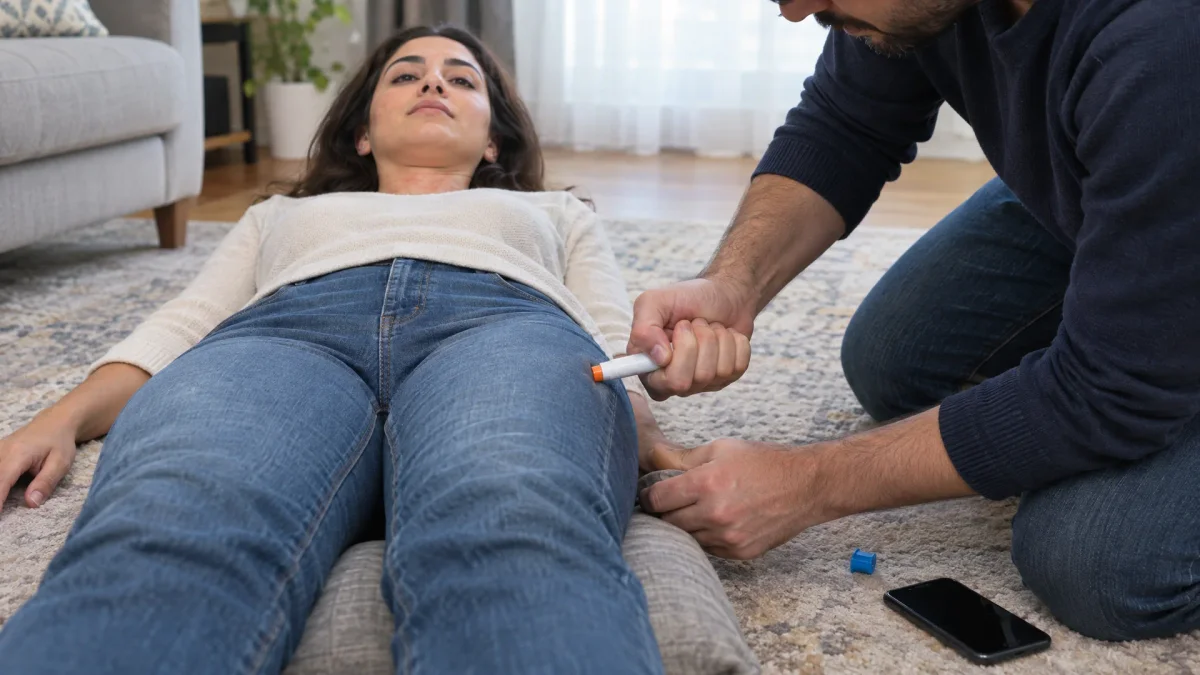
- Anaphylaxis is the body's sudden, multi-organ allergic reaction; the Turkish Ministry of Health's May 2025 First Aid Training Manual warns that "untreated severe allergic reactions can cause death within minutes".
- The first and only life-saving drug is adrenaline; antihistamines, corticosteroids and cold compresses do not stop anaphylaxis. A prescribed auto-injector is delivered into the outer mid-thigh, through clothing, within the first 5 minutes.
- In Istanbul, ICD records show an anaphylaxis incidence of 1.95 per 100,000; the Turkish Red Crescent 2025 Pocket Book puts the share of people allergic to bee stings at 5%. Hundreds of cases occur annually.
- After auto-injector use the patient must always be transported via 112 to the nearest emergency department; the biphasic-reaction risk persists 4–12 hours later, requiring at least 24-hour hospital observation.
- Adrenaline auto-injector brands available in Türkiye are PENEPİN, EpiPen, Anapen and Jext. Adult dose 300 micrograms, 10–25 kg child dose 150 micrograms. Prescription is "white", patients/families should carry at least 2 devices.
Quick Answer: If a person you know develops, within minutes of bee sting, peanut, antibiotic or any other allergen, swelling of the face/lip/tongue, a throat-tightening sensation, wheezing, widespread hives, or sudden dizziness — this is anaphylaxis. The only life-saving first action is to deliver a prescribed adrenaline auto-injector into the outer mid-thigh, through clothing, and call 112 in parallel — antihistamine syrup, cortisone tablets and cold compresses do not stop the reaction. The Turkish Ministry of Health's May 2025 First Aid Training Manual warns word-for-word: "untreated severe allergic reactions can cause death within minutes" [1]. The Turkish National Society of Allergy and Clinical Immunology (AİİAD) reports an Istanbul ICD-record anaphylaxis incidence of 1.95 per 100,000 [4]; the Turkish Red Crescent 2025 Pocket Book puts the share of people allergic to bee stings at 5% [2]. These numbers mean anaphylaxis is not a rarity but a scenario that plays out somewhere in Istanbul more than once a week.
What Is Anaphylaxis: One-Sentence Definition
The Turkish Ministry of Health's May 2025 edition defines anaphylaxis as follows: "Severe allergy known as anaphylaxis presents with swelling of the mouth, tongue or throat followed by airway narrowing and breathing difficulty; at this point the patient's life is in danger and rapid intervention is required" [1]. The international side echoes this in the Global Allergy and Asthma Excellence Network (GA²LEN) consensus report published in January 2025; its opening sentence reads, "Anaphylaxis is a serious allergic (hypersensitivity) reaction that can progress rapidly and may cause death" [8].
Two things become clear when these definitions are placed side by side. First, anaphylaxis is not simply "severe allergy" — the literal meaning is that multiple organ systems respond to an allergen suddenly and together. Second, at the heart of the clinical picture lies airway narrowing and circulatory collapse; hives confined to the skin are not yet anaphylaxis but a warning at the door. The Turkish National Society of Pediatrics summarises it in one sentence: "Anaphylaxis is a severe, potentially life-threatening, generalised or systemic allergic reaction" [5].
If someone calls you saying "they had an allergic shock, what do I do," the rest of this article is your fast decision tree. First the symptom list, then the correct auto-injector technique, then the 112 chain, and finally the Türkiye-specific medications, brands and observation periods.
Anaphylaxis Symptoms: The "One Skin + One Breathing/Circulation" Rule
The Turkish Ministry of Health's 2025 manual lists anaphylaxis symptoms as follows [1]:
- Swelling of the face, lips, eyelids, and tongue
- Widespread skin redness and hives
- Abdominal pain, vomiting, diarrhoea
- Wheezing or persistent cough
- Difficulty breathing
- Hoarseness and speech difficulty
- A sensation of throat swelling
- Dizziness and fainting
- Confusion or loss of consciousness
For a bystander, there is a practical "two-system" rule: the event must start within minutes-to-hours of contact with a known or likely allergen (food, medication, insect venom) and present with one of the following combinations.
- (1) Skin/mucosa symptom (widespread hives, itching, lip or tongue swelling) + a respiratory symptom (wheezing, throat tightness, shortness of breath, stridor), or
- (1) Skin/mucosa symptom + a circulatory symptom (sudden dizziness, sudden weakness, loss of consciousness, drop in blood pressure).
The Turkish National Society of Pediatrics guideline formulates the same rule for children as requiring "involvement of at least two different systems" and reminds the reader that "severe reactions can also occur without skin findings" [5]. So throat swelling without hives is also anaphylaxis; in a small child, reaching for the mouth, tongue clicking, or pulling the ear after allergen exposure should be read as a mucosal sign. The 2024 Global Allergy and Asthma Excellence Network (GA²LEN) consensus report codifies this two-rule logic as the international diagnostic criterion and tells both clinicians and home caregivers: "Epinephrine should be given immediately for suspected anaphylaxis; it can be given for patients that do not yet fulfill clinical criteria, based on clinical judgment" [8]. In other words, if there is any doubt, waiting is the mistake and giving the dose is the correct decision.
As covered in our Diabetes and Emergencies article, the "first give sugar, then measure" rule is reversed in anaphylaxis — give adrenaline first, do the testing at the hospital. Side effects of adrenaline in a healthy heart (mild palpitations, tremor, sweating) resolve within 10–15 minutes; but the delayed airway obstruction of anaphylaxis does not reverse.
Adrenaline Auto-Injector: Step-by-Step Use
This section is for those who have never seen an auto-injector — and a refresher for those who have. The Turkish Ministry of Health's 2025 First Aid Training Manual defines a five-step technique for the lay rescuer [1]:
1. Lay the patient down
Lay them supine, raising the feet about 30 cm (Trendelenburg position) if possible. The Turkish National Society of Allergy and Clinical Immunology (AİİAD) spells out this detail word for word: "Lay the patient down where they are and raise the legs as high as possible; if the patient is pregnant, place them on the left side" [4]. The left-lateral position in pregnancy avoids compression of the uterine vessels, preserving blood flow to mother and baby. If the patient is unconscious with vomiting risk, apply the technique from our Recovery Position Step-by-Step article.
2. Remove the device from its case and release the safety
For PENEPİN, pull off the red cap; the needle protection sleeve comes off with it. For EpiPen, pull off the blue safety cap. Whichever brand you have, grip the device firmly in a fist with the orange/black tip pointing down and the cap end up.
3. Apply to the outer mid-thigh, through clothing
The Turkish Ministry of Health's 2025 instruction reads: "Push the needle into the upper outer thigh — the lateral side of the upper leg — through the patient's clothing" [1]. The garment can be trousers, leggings, or sweatpants; choose an area without a thick leather belt, seam, or wallet underneath. The Turkish Medicines and Medical Devices Agency's (TİTCK) PENEPİN leaflet adds: "Strike perpendicular to the thigh from a distance of 10 cm, then press the trigger button with your thumb and hold it pressed for at least 5 seconds" [6].
4. Press the trigger and count to 10
Ministry of Health 2025 gives the lay-rescuer counting rule as: "Press the trigger mechanism. Count to 10 and withdraw. Then gently massage the injection site for 10 seconds" [1]. PENEPİN's manufacturer label specifies "at least 5 seconds"; the difference is a safety margin built into lay-rescuer training — when in doubt, count to 10, so all the drug stays in the tissue.
5. Call 112 and stay with the patient
Right after (or in parallel with) the injection, dial 112 on speakerphone and tell the dispatcher "suspected anaphylaxis, adrenaline auto-injector administered at HH:MM," the suspected allergen, the patient's age, and known allergies. The 2024 Global Allergy and Asthma Excellence Network (GA²LEN) report makes clear that, if symptoms persist after the first dose, a second adrenaline dose may be given 5–15 minutes later: "Epinephrine can be given every 5 to 15 minutes" [8]. The Turkish National Society of Pediatrics guideline phrases this as "may be repeated twice more at 10–15 minute intervals" [5]. This is why an action plan must include at least two spare auto-injectors.
For an unconscious patient after auto-injector use, the Turkish Ministry of Health's 2025 manual specifies: "Monitor vital signs. If there is no improvement, repeat the application with a second auto-injector. Stay with the patient and monitor them until the 112 emergency team arrives. If vital signs are absent, begin Basic Life Support" [1]. This last point is critical: if anaphylaxis progresses to cardiac arrest, Cardiopulmonary Resuscitation (CPR) is the only bridge. For the full technique, see Adult Basic Life Support and CPR: A Plain Bystander Guide.
Do and Don't: A 60-Second Bystander Checklist
In an anaphylaxis emergency, the bystander's role is less about doing the right thing and more about avoiding the wrong thing. The list below is based on the Turkish Ministry of Health's 2025 manual and the Turkish Red Crescent's 2025 Pocket Book.
Do:
- If conscious and able to swallow, help the patient assume "the most comfortable position they can breathe in" (Ministry of Health 2025 wording for a conscious patient) [1].
- If unconscious or with reduced consciousness, raise the legs 30 cm; in a pregnant patient, turn to the left side [4].
- After the auto-injector dose, leave the used device next to the patient — hand it to the 112 team; the time, dose, and injection site are essential.
- Tell the team what the allergen was: bee sting (show the stinger if available), food (close the packaging and hand it over), medication (hand over the box).
- Also have the patient's daily antihistamine or asthma controller boxes ready.
Don't:
- Do not get the patient on their feet or walk them anywhere; an abrupt postural change, especially with circulatory involvement, raises the cardiac-arrest risk.
- Do not give antihistamine syrup, tablets, or steroids "first". The Turkish National Society of Allergy and Clinical Immunology (AİİAD) is explicit: "Adrenaline must be administered first" [3]. Antihistamines may, hours later, soothe skin findings — but they do not open the airway.
- Do not give anything by mouth to an unconscious patient. With absent swallowing reflexes, aspiration is inevitable.
- Do not apply cold showers, ice packs, or massage. They obscure circulation assessment.
- Do not squeeze a bee stinger with tweezers. Tweezers compress the venom sac and inject more poison; scrape the stinger out sideways with the edge of a credit card [2].
- Do not drive the patient to the hospital yourself. The ambulance crew opens an IV line, delivers oxygen, runs an ECG and can give a second adrenaline dose en route; a private car cannot match that time win.
- Do not leave the patient alone. Until the 112 team arrives, check consciousness-breathing-pulse every minute.
Auto-Injectors Available in Türkiye: Brand, Dose, Storage, Pricing
In the Turkish pharmacy network as of 2025, four brand names circulate. Only PENEPİN carries a local market authorisation; the other three (EpiPen, Anapen, Jext) reach patients via import or special procurement [7]. All four are pharmacologically equivalent — the active drug is the same epinephrine; the difference is in the trigger mechanism and device design.
Adult dose (≥25 kg): 300 micrograms (mcg). The Turkish Medicines and Medical Devices Agency (TİTCK) PENEPİN leaflet states "the standard dose is 300 micrograms" [6].
Pediatric dose (10–25 kg): 150 micrograms. The Turkish National Society of Pediatrics specifies "0.15 mg for 10–25 kg children; 0.30 mg for those above 25 kg" and adds that "below 15 kg body weight, the auto-injector cannot deliver the 150-microgram dose with adequate accuracy" — for such infants the dose must be given under physician supervision [5]. PENEPİN's pediatric form is PENEPİN JR. 0.15 mg/0.3 ml [6].
Storage: The Turkish Medicines and Medical Devices Agency (TİTCK) leaflet says "store at room temperature below 25°C, protected from light" [6]. Do not refrigerate; do not leave it in a hot car. Heat and direct sunlight degrade epinephrine quickly. The Food Allergy Society of Türkiye states the same as "the auto-injector should not be exposed to sunlight or heat; it must be stored in a cool environment" [7].
Repeat dose timing: The Turkish Medicines and Medical Devices Agency (TİTCK) leaflet states "a repeat injection can be administered 10–15 minutes later" [6]; the 2024 Global Allergy and Asthma Excellence Network (GA²LEN) consensus report broadens the interval internationally to 5–15 minutes [8]. Practical decision: if symptoms have not improved or are returning 5–10 minutes after the first dose, give the second.
How many to carry? The Food Allergy Society of Türkiye recommends families "carry at least two devices" [7]. This is insurance against the roughly 10% of cases where one dose does not suffice.
Expiry date: Auto-injector shelf life varies by brand/manufacturer (about 12–24 months); what binds is the expiry date printed on each product's box [6]. The viewing window must show a clear solution; if there is any colour change or cloudiness, do not use it. Check the device in your bag every 3 months and request a renewal prescription one month before expiry.
Biphasic Reactions and Hospital Observation: Don't Leave Early
After the adrenaline is given, the patient is sent to a hospital by 112 and stabilised in the emergency department; many appear to improve quickly. But the Turkish National Society of Pediatrics gives a clear warning: "in approximately 6% of cases, symptoms can recur 4–12 hours after symptom onset (biphasic or recurrent anaphylaxis); recurrence is more common in severe and fatal anaphylaxis, and delays in adrenaline administration facilitate this pattern" [5]. The same guideline therefore requires "at least 24 hours of further hospital observation after symptoms have resolved" [5].
The practice is the same for adults. Do not insist on a 4-hour discharge from the emergency department, and on return home complete the chain:
- Discharge prescription: Two fresh adrenaline auto-injectors (back-up is mandatory) and an antihistamine (skin-symptom support).
- Written action plan: "If this symptom list, in this order, do this" — for school, workplace, or carer. The Turkish Ministry of Health's 2025 manual teaches the unconscious-patient checker to look "for a bracelet or card indicating allergy" [1]; this badge must travel with the patient.
- Allergist follow-up: A 4–6 week appointment for specific IgE or skin prick testing to confirm the trigger.
- Reaction record: Date, time, suspected allergen, time of onset, whether the auto-injector was given (and if not, why), the time of the 112 call. That record helps the next ambulance team to act correctly.
Our How Long Does an Ambulance Take in Istanbul (2025) article summarises response times across the city's 39 districts; in anaphylaxis those minutes transform outcomes and explain why two parallel calls (112 + private ambulance) save lives.
Türkiye Context: Incidence, Trigger Distribution, Istanbul Data
Anaphylaxis is rare but not vanishingly rare in Türkiye. According to the Turkish National Society of Allergy and Clinical Immunology (AİİAD), "national anaphylaxis statistics are limited; however, an Istanbul ICD-record-based incidence of 1.95 per 100,000 has been reported" [4]. Based on the Turkish Statistical Institute's (Türkiye İstatistik Kurumu, TÜİK) Address-Based Population Registration System (ADNKS) 2024 figures, Istanbul's population stands at 15,701,602 (about 15.7 million) [9] — at that rate, a rough estimate puts roughly 306 people in Istanbul receiving an anaphylaxis diagnosis per year, and this counts only hospital-coded cases.
Trigger distribution varies with age. The Turkish National Society of Pediatrics guideline states: "In children, the most important triggers of anaphylaxis are foods. Milk and dairy, eggs, tree nuts and fish in particular cause anaphylaxis; foods are responsible for approximately 50% of anaphylactic reactions in children" [5]. In adults the ranking changes; the Turkish National Society of Allergy and Clinical Immunology (AİİAD) highlights medications (especially beta-lactam antibiotics), bee stings, and latex [3]. Between late May and September, balcony, garden and picnic environments around the Bosphorus, Belgrade Forest, Adalar and Beykoz are prominent triggers for bee/wasp-related anaphylaxis cases in Istanbul. The Turkish Red Crescent 2025 Pocket Book states that "5% of patients are allergic to bee stings" [2] — meaning one in 20 citizens is at risk and most of them do not know it yet.
A demographic finding specific to pediatric anaphylaxis in Istanbul comes from the same pediatrics guideline: "In Istanbul state hospitals, 12.7% of patients diagnosed with anaphylaxis were under 10 years of age" [5]. That makes early childhood a meaningful share of hospital-coded cases — and shows why school and home education matter.
Special Scenarios: Pregnant, Elderly, Asthmatic, Beta-Blocker Users
The decision tree is the same in most patients, but the threshold shifts or the technique needs an extra step in some groups.
Pregnancy. The Turkish National Society of Allergy and Clinical Immunology (AİİAD) specifically reminds clinicians "if the patient is pregnant, place them on the left side" [4]. In the supine position, the gravid uterus compresses the inferior vena cava and reduces venous return; left-lateral position avoids this compression. Adrenaline is safe in pregnancy; concerns about "harming the baby" must not delay the dose. In maternal anaphylaxis, hypoxia and shock cross to the fetus far faster.
Elderly (≥65 years). While adrenaline is safe in a healthy heart, in an elderly patient with underlying coronary disease or poorly controlled hypertension it can trigger ischemia — but that is not a reason to withhold the dose; there is no alternative. In an elderly relative's anaphylaxis, tell the team the known cardiac history, current medications, and baseline blood pressure.
Asthmatics. The 2024 Global Allergy and Asthma Excellence Network (GA²LEN) report emphasises that comorbid asthma raises the death risk in anaphylaxis [8]. Beyond the blue inhaler, adrenaline must not be delayed; the "let's try the inhaler first" approach is wrong, especially when bronchospasm coexists with throat swelling. For asthma attack triage, our Chest Pain and Shortness of Breath in Cold Weather article explains how to differentiate breathing emergencies.
Beta-blocker users (hypertension or arrhythmia). Beta-blockers partially blunt adrenaline's effect, so clinical response may be inadequate; the Turkish National Society of Pediatrics adds that "if the patient is on a beta-blocker, IV glucagon 1–5 mg should be given" [5]. That dose cannot be given at home; for a bystander, the practical implication is to tell 112 "on beta-blocker" so the team can carry glucagon and expedite hospital transfer.
Istanbul Context: 112, the Command-and-Control Centre and Private Ambulance
When you call 112 for suspected anaphylaxis in Istanbul, the Command-and-Control Centre categorises the call and dispatches either a doctor-led or a paramedic-led advanced-life-support ambulance from the nearest station. Three things to say on the phone: (1) "suspected anaphylaxis", (2) the suspected trigger, (3) whether an adrenaline auto-injector was given and at what time. These three pieces of information let the team prepare the second dose, oxygen and IV access en route.
Calling a private ambulance in parallel — especially if you prefer a specific private hospital, the child's allergist's institution, or your private insurance covers it — shortens the individual response time and preserves your hospital-choice. How 112 and a private ambulance work together, how fees and authority boundaries are split, is detailed in The Difference Between 112 and Private Ambulance. If there is one clinical scenario where this dual approach saves lives, it is anaphylaxis.
Stop Waiting for the First Reaction: If You Are at Risk, Plan Today
The upper half of this article was about what to do "when it happens to someone else". The lower half is your own action plan if you suspect you might be at risk. The four steps below make a practical weekend checklist.
- Confirm the diagnosis. See an allergist (especially if you have previously had hives, sudden swelling or shortness of breath); plan specific IgE and skin prick testing. Without a diagnosis, the auto-injector prescription is incomplete.
- Get a prescription for two auto-injectors. Your physician will choose PENEPİN or EpiPen based on pharmacy stock. One stays with you (handbag); the other in a fixed location (home/work, below 25°C, not the fridge) [6]. Families with children add a separate set for school and daycare.
- A written action plan. What to do, in what order, on which symptom set, and which numbers to call; who in the family takes which role. Give a copy to the school's homeroom teacher.
- A medical identification bracelet or card. The Turkish Ministry of Health's 2025 manual asks the unconscious-patient checker to look for "a bracelet or card indicating allergy" [1]. This badge lets the 112 team give the right first dose.
Frequently Asked Questions
My spouse was stung by a bee and is grabbing their throat — no auto-injector at home. What do I do?
Call 112 immediately and state "suspected anaphylaxis, throat swelling after bee sting"; naming the symptom category correctly speeds up the dispatch of a doctor-led ambulance. Lay your spouse down on the ground and raise the legs about 30 cm (Trendelenburg position). If they are pregnant, use the left-lateral position. If they are conscious and breathing, loosen the collar; give nothing to eat or drink. The Turkish Ministry of Health's 2025 protocol then asks the bystander to monitor vital signs and, if the patient loses consciousness and breathing stops, begin Cardiopulmonary Resuscitation [1]. If a bee stinger is still visible on the skin, scrape it sideways with the edge of a credit card — do not pinch with tweezers, pinching releases more venom. If there is an active hive or wasp nest nearby, move the patient to a safer area and wait for 112 there.
Should I use the adrenaline auto-injector "just in case", or wait?
If you know the criteria and have any reasonable suspicion, use it. The Turkish National Society of Pediatrics defines anaphylaxis as "a severe, potentially life-threatening, generalised or systemic allergic reaction" and treats anything with a known allergen exposure followed within minutes by rash + breathing difficulty or lip/tongue swelling as anaphylaxis [5]. The 2024 Global Allergy and Asthma Excellence Network (GA²LEN) international consensus report (PMID 39880313) flatly rejects waiting: "Epinephrine should be given immediately for suspected anaphylaxis; it can be given for patients that do not yet fulfill clinical criteria, based on clinical judgment" [8]. Adrenaline in a healthy heart leaves only mild palpitations and tremor for 10–15 minutes; but a delay results in respiratory failure or circulatory shock within seconds. To decide, ask about two systems: skin/mucosa (hives, swelling) and breathing (wheeze, throat tightness, shortness of breath) or circulation (dizziness, sudden weakness) — if either combination is present, treat as anaphylaxis, give the auto-injector, then call 112.
Hospital treatment is done, can I go home? Is the danger over?
The danger may not be over yet. The Turkish National Society of Pediatrics guideline notes that "in approximately 6% of cases, symptoms may recur 4–12 hours after symptom onset (biphasic or recurrent anaphylaxis); the recurrence is more common in severe and fatal anaphylaxis, and delays in adrenaline administration facilitate this pattern" [5]. The same guideline therefore requires "at least 24 hours of further hospital observation after symptoms have resolved" [5]. The pattern is the same for adults; do not insist on discharge before the physician decides. When you go home, you should have a fresh prescription for two spare auto-injectors, a written action plan, a follow-up appointment with an allergist, and — if you have private insurance — your card on hand.
PENEPİN, EpiPen, Anapen, Jext — which one should I get?
As of 2025, the locally licensed PENEPİN (300 mcg adult and 150 mcg PENEPİN JR for children) is the device most commonly found on Turkish pharmacy shelves, while EpiPen, Anapen and Jext are back-up brands that may require import procurement [7]. According to the Turkish Medicines and Medical Devices Agency's (TİTCK) product information, PENEPİN's standard dose is 300 micrograms; if a single dose does not reverse the reaction in a heavier adult, a second injection may be administered 10–15 minutes later [6]. The decision is made on three axes: (1) which prescription your doctor wrote, (2) shelf availability — take whichever your pharmacy stocks; all four brands are pharmacologically equivalent intramuscular adrenaline, (3) expiry date — shelf life varies by brand (about 12–24 months); what binds is the expiry date printed on the box [6]. Check every 3 months, and replace if the viewing window shows a colour change or cloudy solution. On pediatric dose, the Turkish National Society of Pediatrics guideline specifies "0.15 mg for 10–25 kg children; 0.30 mg for those above 25 kg" [5]; for infants under 15 kg, the dose cannot be reliably delivered by auto-injector and must be administered under physician supervision.
The reaction looks mild — hives and itching only, nothing else. Still call 112?
Isolated widespread hives and itching alone does not diagnose anaphylaxis, but it does flag the risk group. The Turkish Ministry of Health's 2025 manual specifically emphasises that allergic reactions "may vary from person to person", and what starts mild can progress to severe [1]. What you should do: (1) stop ongoing allergen exposure (rinse the mouth without swallowing if food; wash skin with plenty of water if contact; remove the stinger if bee); (2) give the prescribed antihistamine in a standard dose if one is available (note that antihistamines never substitute for adrenaline — they only help with skin symptoms); (3) for the next 30–60 minutes, watch minute by minute for any new wheeze, throat swelling, dizziness, vomiting or altered consciousness. If any of those appear, change step (3) to "call 112 and use the auto-injector". Otherwise, go the same day for in-person assessment at the emergency department — long observation and any specific IgE planning cannot happen at home.
Should I administer the auto-injector, or wait for the ambulance?
Administer the adrenaline yourself, and call the ambulance in parallel. The 2024 Global Allergy and Asthma Excellence Network (GA²LEN) international consensus report states that "epinephrine should always be the first-line therapy" and stresses that it remains "significantly underused" in both prehospital and hospital settings, explicitly recommending early use [8]; delayed or absent adrenaline is a leading preventable factor in anaphylaxis deaths. The Turkish Red Crescent 2025 Pocket Book instructs the bystander to "administer the prescribed epinephrine auto-injector to a muscular area of the patient's leg if available" [2]. Practical sequence: administer the auto-injector → call 112 on speakerphone and report suspected anaphylaxis, time of adrenaline dose, the last food/allergen → lay the patient down with legs raised → if symptoms persist after 10–15 minutes, give the second auto-injector → stay with the patient until the 112 team arrives. This sequence lets the hospital team answer "when, what dose" precisely; a delayed hand-off can be fatal.
Calling Nova Ambulans for Suspected Anaphylaxis: When and Why
A Saturday afternoon on your balcony in Beşiktaş, while sipping spring lemonade, a bee stings your spouse's throat; the lips swell within five minutes, the voice becomes hoarse and they say "I can't swallow" — if you are watching this clinical picture unfold in front of you, calling 112 and a parallel Nova Ambulans doctor-led emergency ambulance line at the same time brings two advantages. First, response-diversification: in holiday traffic or peak weekend hours, whichever crew is closer responds. Second, hospital-choice flexibility: if the private hospital where your spouse's allergy records already live is not far, routing there gives the case file continuity. A doctor-led private ambulance opens an IV line en route, administers a second intramuscular or intravenous adrenaline dose to the correct site, delivers oxygen and runs ECG-and-rhythm monitoring. The decision is unambiguous: skin + (respiratory or circulatory) symptom = a medical emergency that needs minutes, not hours. Don't wait; give the auto-injector, open the 112 call, and keep the box and the spare injector ready.
Rapid Emergency Support
24/7 emergency ambulance service across Istanbul. Fast response, fully equipped team.
Average response time: 15 seconds
Related Articles
Concussion Symptoms After a Fall or Head Injury: Bystander Guide (2026)
After a fall or head injury, concussion symptoms bystanders must recognize, step-by-step first aid, the CDC HEADS UP danger signs that require calling 112 immediately, age-specific notes for children and elderly patients, and the recovery timeline — grounded in Türk Kızılay 2025 First-Aid Pocket Book pp.19-20 and 47-48, T.C. Ministry of Health May 2025 First-Aid Training Book Chapter X.A and VII.B, Gazi University Pediatric Emergency PECARN application review, Turkish Neurosurgery 2025 national survey (n=1,875 neurosurgeons), JAMA April 2026 pediatric concussion systematic review, and CDC HEADS UP with WHO falls data.
EducationSuspected Fracture and Dislocation: Splinting, Immobilization, and Calling 112 (2026)
What a bystander does at the scene for suspected fracture, dislocation, sprain and strain — the Turkish Red Crescent 2025 First Aid Pocket Book (pp.38–42), the Turkish Ministry of Health May 2025 First Aid Training Book Chapter XII, the Gazi University 2026 Ankara pediatric hand-foot fracture series (n=278), the İstanbul University Çapa 12-month hip fracture mortality data, and the World Health Organization (WHO) falls factsheet applied to splinting, immobilization, and the 112 chain.
EducationBurn Grading and Home Care: First-, Second-, and Third-Degree Burn Treatment (2026)
How to tell first-, second-, and third-degree burns apart, which burns can be managed at home, and when to call 112: the Turkish Ministry of National Education 2024 first-aid protocol, Marmara University public guide, Regulation on Burn Treatment Units (Official Gazette 8 October 2019, no. 30912), American Burn Association 2025 referral criteria and the Griffin et al. 2022 systematic review on 20 minutes of cool running water.
- Turkish Ministry of Health Emergency Health Services First Aid Training Manual (May 2025)Republic of Türkiye Ministry of Health Emergency Health Services Directorate ↗
- Turkish Red Crescent First Aid Pocket Book 2025Turkish Red Crescent (Türk Kızılay) ↗
- Anaphylaxis — Turkish National Society of Allergy and Clinical ImmunologyTurkish National Society of Allergy and Clinical Immunology (AİİAD) ↗
- Recognising Anaphylaxis and Emergency Treatment — Why It Matters for Preventable Personal and Societal TragediesTurkish National Society of Allergy and Clinical Immunology (AİİAD) ↗
- Turkish National Society of Pediatrics — Pediatric Diagnosis & Treatment Guidelines (Volume 11): AnaphylaxisTurkish National Society of Pediatrics ↗
- PENEPİN 0.3 mg/0.3 ml IM Solution Auto-Injector — Patient Information LeafletTurkish Medicines and Medical Devices Agency (TİTCK) ↗
- Epinephrine Adrenaline Auto-Injector — Food Allergy Society of TürkiyeFood Allergy Society of Türkiye (Besin Alerjisi Derneği) ↗
- Anaphylaxis Definition, Overview, and Clinical Support Tool: 2024 Consensus Report — A GA²LEN ProjectJournal of Allergy and Clinical Immunology — Dribin TE, Muraro A, Camargo CA, et al. ↗
- Address-Based Population Registration System Results, 2024Turkish Statistical Institute (TÜİK) ↗
Popular Ambulance Topic Clusters
You may also like
- Private ambulance pricing
- Istanbul private ambulance
- Intercity patient transport
- Doctor-accompanied ambulance
- Dialysis patient transport
- How intercity patient transport works
- Ambulance response time in Istanbul
- Home-to-hospital patient transport
- Modern ambulance equipment and team standards
- Heart attack symptoms and first response
This content is informational only and does not replace professional medical evaluation. In emergencies, call 112 or +90 216 339 00 39.
