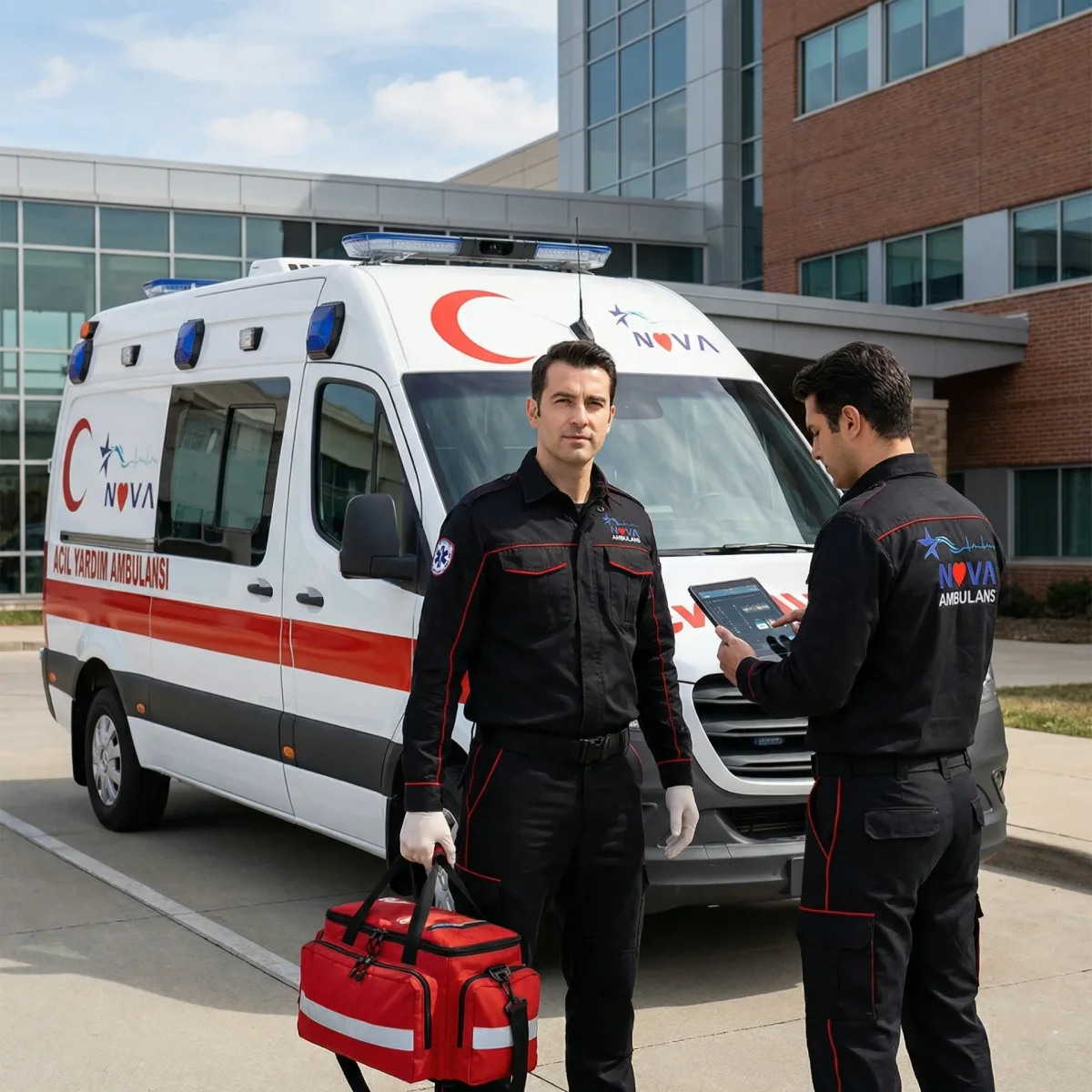
- A paramedic (Ambulance and Emergency Care Technician / AABT) is a 2-year university graduate who can deliver Advanced Life Support (ALS): IV access, intubation, and cardiac drug administration.
- An emergency medical technician (ATT) works within Basic Life Support (BLS). Health vocational high schools no longer train new ATTs; existing ATTs continue to serve in the field.
- Emergency ambulances require a team of at least 3: a physician, a paramedic, or a module-trained ATT, plus a health worker and a driver.
Who is in the ambulance team, and how far does each person's authority extend? For families this matters, because team structure directly determines intervention capacity. In Türkiye, ambulance personnel fall into two core titles: Ambulance and Emergency Care Technician (Paramedic / AABT) and Emergency Medical Technician (ATT). This article explains the training durations, intervention authorities, career paths, and salary differences within the regulatory framework. [1]
If you are considering joining Nova Ambulans, review our current ambulance vacancies for available positions and the application requirements for each role.
Training and Title Comparison
The most fundamental difference between a paramedic and an emergency medical technician (ATT) is the level of education. Training duration and depth directly determine the interventions they can perform in the field. [1] [3]
| Paramedic (Ambulance and Emergency Care Technician / AABT) | Emergency Medical Technician (ATT) | |
|---|---|---|
| Official title | Ambulance and Emergency Care Technician | Emergency Medical Technician |
| Education | 2-year university associate degree — First and Emergency Aid program [3] | Health vocational high school — Emergency Medical Technician program (this program has been closed; no new ATTs are being trained) |
| Life support level | Advanced Life Support (ALS) | Basic Life Support (BLS) |
| Team leadership | May serve as team leader on an emergency ambulance [1] | Only an ATT who has completed the modules designated by the Ministry may serve as team leader on an emergency ambulance [1] |
| Clinical assessment | Performs independent clinical assessment in the field | Works within protocols; advanced decisions require an AABT or a physician |
Intervention Authority: Who Can Do What?
The concrete field equivalent of the training gap appears in intervention authority. These authorities are critical for patient safety. [1]
What a Paramedic (Ambulance and Emergency Care Technician / AABT) Can Do
In addition to every basic intervention within an ATT's authority, a paramedic can perform the following advanced interventions independently: [1]
- All basic interventions within the ATT's scope (Basic Life Support (BLS), bleeding control, fracture stabilization, patient monitoring, etc.)
- IV (intravenous) access and fluid/drug administration [1]
- Endotracheal intubation — the most critical skill in advanced airway management
- Cardiac drug administration — emergency drugs such as adrenaline, amiodarone, and atropine
- Defibrillation and cardioversion
- 12-lead ECG acquisition and basic interpretation
- Intraosseous (IO) access — bone-marrow access when IV access cannot be obtained
- Independent triage and clinical decision-making in the field
- Team leadership on an emergency ambulance [1]
What an Emergency Medical Technician (ATT) Can Do
An emergency medical technician (ATT) may apply only interventions within the scope of Basic Life Support: [1]
- Basic Life Support (BLS): chest compressions, rescue breathing, use of an Automated External Defibrillator (AED)
- Bleeding control: direct pressure, tourniquet, hemostatic agent application
- Fracture stabilization: splinting, cervical collar application
- Basic airway management: oral suctioning, oropharyngeal/nasopharyngeal airway
- Patient monitoring: vital sign tracking (pulse, blood pressure, SpO₂, temperature)
- Patient transport: safe transfer with stretcher, scoop, and vacuum mattress
- For advanced interventions (IV, intubation, drugs), supervision by an AABT or a physician is mandatory [1]
Note: The Emergency Medical Technician program in health vocational high schools has been closed, and no new ATTs are being trained. The new programs opened in its place are nurse assistant, midwife assistant, and health-care technician; these auxiliary health titles are not counted as ambulance team personnel. ATTs already serving in the field continue to work with their existing authority.
Module-Trained Emergency Medical Technician (ATT): A Special Status
Under the regulation in force, ATTs who have completed the module training designated by the Ministry may serve as team leader on an emergency ambulance. This exception is not a new arrangement; it is a long-standing provision and is also included in the regulation in force dated 8 January 2025. This represents an important career-advancement opportunity for ATTs. [1]
Module training:
- Is delivered within a curriculum approved by the Ministry
- Covers advanced intervention skills
- Grants team-leadership authority to the ATT who completes it successfully
Ambulance Team Requirements (Regulation Article 7)
The regulation clearly defines the minimum team structure by ambulance type. These requirements are the foundation of patient safety. [1]
| Ambulance Type | Minimum Team | Description |
|---|---|---|
| Emergency ambulance | 3 people | Physician, paramedic, or module-trained Emergency Medical Technician (ATT) + health worker + driver |
| Patient transport ambulance | 2 people | Health worker + driver |
| Intensive care ambulance | 3 people | At least two health workers, one of whom is a physician or paramedic (emergency care technician) + driver |
Important: Drivers must also receive Ministry-approved training. An ambulance driver does not merely operate the vehicle; they actively participate in patient loading, transport, and safety procedures. [1]
Which Team Is Needed in Which Situation?
Team selection is determined by the patient's clinical condition; clinical need, not title preference, is the deciding factor:
- Stable, planned transport (discharge, follow-up transfer): a paramedic + driver is sufficient.
- Medium-risk transport (SpO₂ tracking, continuous blood pressure monitoring): paramedic + health worker + driver.
- High-risk transport (intubated, ventilator-dependent, fluctuating consciousness): a doctor-accompanied ambulance is recommended.
- Event medical coverage: an emergency ambulance — a team led by a paramedic or a module-trained Emergency Medical Technician (ATT). [1]
Salary and Career Differences
Paramedic (Ambulance and Emergency Care Technician / AABT) Career Path
- Entry: field paramedic on an emergency ambulance
- Advancement: team leader → deputy responsible manager → responsible manager (Article 7) [1]
- Further training: degree-completion programs to extend a career into nursing or emergency medicine
- Salary range (2026): in the public sector, entry at the associate-degree grade (grade 10 under Law No. 657); the highest grade an associate-degree graduate can reach is grade 4. In the private sector it varies by experience and posting [2]
Emergency Medical Technician (ATT) Career Path
Because the Emergency Medical Technician program in health vocational high schools has been closed, no new ATTs are being trained. For existing ATTs, the career path is as follows:
- Entry: field ATT on a patient transport or emergency ambulance
- Advancement: team-leadership authority via module training → senior ATT with experience
- Further training: the opportunity to earn the Ambulance and Emergency Care Technician (AABT) title through associate-degree completion [3]
- Salary range (2026): in the public sector, entry at the high-school-graduate grade (grade 13 under Law No. 657); in the private sector it varies by experience [2]
Important Note
Salaries vary significantly by public/private sector, province, years of experience, and working conditions. For current salary information, consult Ministry of Health and Social Security Institution (SGK) sources.
A Day in the Life: Paramedic vs Emergency Medical Technician (ATT)
A Paramedic's Day
The day starts with the morning team briefing, ambulance checks, equipment testing, and drug-stock verification. Throughout the day, the paramedic carries out triage on emergency calls, advanced interventions (IV, drugs, intubation), and hospital handover. Because of clinical decision-making responsibility, continuous learning and training are mandatory.
An Emergency Medical Technician's (ATT) Day
The day similarly begins with ambulance checks and equipment preparation. In the field, the ATT takes on basic life support, bleeding control, fracture stabilization, and patient monitoring. They support advanced interventions under the leadership of a paramedic or physician and play a critical role in patient transport and transfer logistics.
Both titles require physical endurance, stress management, and teamwork. Ambulance service runs on a 24/7 shift schedule.
Frequently Asked Questions
Do a paramedic and an emergency medical technician (ATT) do the same job?
No. A paramedic can perform all of the basic interventions within an ATT's authority and, in addition, deliver advanced life support (intubation, IV, cardiac drugs). An ATT works only within basic life support; advanced interventions require supervision by an AABT or a physician. [1]
Must there always be a doctor in the ambulance?
In this process, no. Under the regulation, it is sufficient for an emergency ambulance to have a team led by a physician, a paramedic, or a module-trained Emergency Medical Technician (ATT). A doctor-accompanied ambulance is preferred for patients at high clinical risk (ventilator-dependent, fluctuating consciousness, requiring active drug management). [1]
Can an emergency medical technician (ATT) become a paramedic?
Yes. Existing ATTs can earn the Ambulance and Emergency Care Technician (AABT) / paramedic title by completing the First and Emergency Aid program through associate-degree completion programs. However, because the Emergency Medical Technician program in health vocational high schools has been closed, no new ATTs are being trained; the auxiliary health titles opened in its place — nurse assistant, midwife assistant, and health-care technician — are not counted as ambulance team personnel. [3]
What is module training and who can take it?
These are additional training programs designated by the Ministry that cover advanced intervention skills. Actively serving ATTs can become team leaders on an emergency ambulance by completing these programs. This is a long-standing provision included in the regulation in force. [1]
Can a paramedic be assigned to a patient transport ambulance?
For patient transport ambulances, having at least one health worker and one driver is sufficient. However, a paramedic may be assigned depending on the patient's clinical condition. [1]
Can I learn the ambulance team details before transport?
Yes. Before receiving service, requesting information about the team structure, staff qualifications, and monitoring capacity is both your right and a recommended practice.
Related Articles
- When Is a Doctor-Led Ambulance Needed? — 7 patient profiles and clinical criteria that require a physician-accompanied ambulance.
- Ambulance Personnel Duties and Responsibilities — All personnel roles and legal responsibilities, from the responsible manager to the driver.
- When Is an ICU Ambulance Required? — Critical transport conditions requiring a ventilator, monitoring, and advanced support.
Intercity Ambulance Transfer Service
Safe and fast intercity patient transport across Turkey. ICU support included.
Average response time: 15 seconds
Related Articles
Difference Between 112 and Private Ambulance: Which One to Call?
Understand the practical difference between 112 and private ambulance services in Turkey: dispatch, hospital choice, SGK coverage, on-scene emergency response, and which to choose for your situation.
Service UtilityThe History of Ambulance Services in Turkey: From Hilâl-i Ahmer to 077 Hızır Acil and 112 (2026)
A sourced, chronological history of ambulance services in Turkey — from the battlefield medical transport of Hilâl-i Ahmer (founded 1868), to 077 Hızır Acil, the country's first modern ambulance service opened in Ankara on 9 October 1985, through the 112 emergency system, UMKE, air and sea ambulances, and the licensed private-ambulance sector regulated by the 2025 ordinance — built on primary sources and Official Gazette dates, clarifying the public vs private division of labour.
Service UtilitySummer Vacation Ambulance Services in Türkiye: Health Safety in Holiday Regions (2026)
Planning intercity private patient transport at the end of summer vacation, the line between 112 emergency services and private ambulance providers in holiday regions, bystander step-by-step decisions in drowning and heatstroke — with the verbatim text of Türkiye's Ministry of Health 8 January 2025 and 24 June 2025 ambulance regulations, the Turkish Red Crescent First Aid Pocket Book 2025 protocols, the Turkish Statistical Institute's 2025 tourism figures, and the 13-year Sinop coastal drowning series.
Popular Ambulance Topic Clusters
You may also like
- Private ambulance pricing
- Istanbul private ambulance
- Intercity patient transport
- Doctor-accompanied ambulance
- Dialysis patient transport
- How intercity patient transport works
- Ambulance response time in Istanbul
- Home-to-hospital patient transport
- Modern ambulance equipment and team standards
- Heart attack symptoms and first response
This content is informational only and does not replace professional medical evaluation. In emergencies, call 112 or +90 216 339 00 39.
