- Correct sequence: **protect your own safety first**, attempt to reach the drowning person without entering the water (reach-throw-row), have a bystander call 112 Emergency Health Services, and after removal from water check breathing; if breathing, place in the **recovery position** (side-lying stable position), if not breathing begin Basic Life Support (BLS, cardiopulmonary resuscitation, CPR) starting with 5 rescue breaths. This sequence is verbatim identical to Türk Kızılay 2025 First-Aid Pocket Book pp.49-50 and T.C. Ministry of Health (SB) May 2025 First-Aid Training Book Chapter XI pp.140-143.
- Basic Life Support (BLS, cardiopulmonary resuscitation, CPR) in drowning differs from typical cardiac arrest: the primary problem is **hypoxia**, not circulation. The American Heart Association (AHA) and American Academy of Pediatrics (AAP) 12 November 2024 Focused Update in Circulation states verbatim: **"Resuscitation from cardiac arrest attributable to this specific circumstance must focus on restoring breathing as much as it does circulation."** For this reason, resuscitation begins with 5 initial rescue breaths, then continues with cycles of 30 chest compressions and 2 rescue breaths (ratio 30:2).
- Signs requiring an IMMEDIATE 112 call: loss of consciousness, no spontaneous breathing or abnormal breathing (agonal gasping), submersion longer than 5-10 minutes, cyanosis, persistent cough after removal from water, suspected aspiration, repeated vomiting, convulsions, suspected neck or spinal injury from shallow-water dive or blow, hypothermia signs (shivering, blue lips, slowed mentation), pregnant patient, child (especially 1-4 years), and adult over 65. A patient submerged longer than 5 minutes requires at least 4-8 hours of hospital observation even without symptoms.
- Turkish data show the scope of the problem: per TÜİK, between 2019 and 2023, 709, 657, 603, 613, and 572 people respectively died from drowning in Türkiye, with 167 additional deaths in the first 9.5 months of 2024; 27.5% of drownings occurred in the Black Sea region, 49.1% at sea, and **82% during summer months**. In the 13-year 198-case Sinop Atatürk State Hospital seawater cohort (Ersen et al., BMC Emergency Medicine, 21 October 2025), over 82% of cases occurred in July and August, 51% involved tourists, and **35.9% of fatal cases were people who drowned while trying to rescue someone else**. Rescuer self-protection is not a slogan — it is Turkish mortality data.
- SB May 2025 Chapter XI page 141 makes an important terminology update and ends a common misconception: **"The terms wet drowning, dry drowning, active drowning, passive drowning, silent drowning, and secondary drowning are no longer used."** Correct terminology: "rescued from water" (no findings; not drowning), "non-fatal drowning" (patient rescued), and "fatal drowning". However, "secondary aspiration" (development of persistent cough and shortness of breath hours after removal from water) is a clinically real presentation and justifies hospital observation — this must not be confused.
Mid-August, Istanbul Kilyos. On the Black Sea coast public beach, the wave pattern hardens in the early afternoon. A ten-year-old boy, unnoticed for a moment during a family gathering, drifts slightly beyond the shallows to a point where his feet can no longer touch bottom; he struggles for a few seconds, then goes silent. When a nearby lifeguard pulls him from the water within 90 seconds, the boy's eyes are closed and his lips are faintly blue. The father instinctively grabs the child by the heels and begins to swing him upside down — the folk maneuver of "draining the water inside." This single motion is the maneuver directly warned against by T.C. Ministry of Health (SB) May 2025 First-Aid Training Book Chapter XI: water accumulates in the stomach, not the lungs; inverting the child accelerates aspiration of stomach contents into the lungs and worsens the existing hypoxia. The correct three steps: protect your own safety, have bystanders call 112 Emergency Health Services, check breathing after removal from water, and if needed begin Basic Life Support (BLS, cardiopulmonary resuscitation, CPR) starting with 5 rescue breaths. This guide sits at the intersection of Türk Kızılay 2025 First-Aid Pocket Book pp.49-50, T.C. Ministry of Health May 2025 First-Aid Training Book Chapter XI pp.140-143 (Prof. Dr. Yusuf Yürümez, Sakarya University Faculty of Medicine Emergency Medicine Department), the American Heart Association (AHA) and American Academy of Pediatrics (AAP) 12 November 2024 Circulation Focused Update on Drowning, the European Resuscitation Council (ERC) October 2025 First Aid Guidelines, and the Sinop Atatürk State Hospital 13-year 198-case seawater drowning cohort (Ersen et al., BMC Emergency Medicine, 21 October 2025); it clarifies exactly what the bystander should do in the first 5 minutes, which signs must not delay a 112 call, and how Basic Life Support modifications differ from adult to infant.
Quick Answer
Bystander duties in a drowning event, in order. One: protect your own safety and attempt no-swim rescue — from shore or boat edge, extend a long object (Reach), throw a lifebuoy or floating object (Throw), or approach with a boat or surfboard (Row). Türk Kızılay 2025 First-Aid Pocket Book and T.C. Ministry of Health (SB) May 2025 First-Aid Training Book Chapter XI state the rule verbatim identically: "If possible, perform the rescue without entering the water." [1][2] Two: have a bystander call 112 Emergency Health Services; location, patient age, submersion time, time of removal, current consciousness, and breathing status are critical information for the Health Command and Control Center (Sağlık Komuta Kontrol Merkezi, SKKM) operator. Three: after the patient is removed from the water, perform a breathing check within 10 seconds (check for breathing and for chest movement); if breathing, place in the recovery position (side-lying stable position) and cover with a blanket or dry towel, if not breathing begin Basic Life Support (BLS, cardiopulmonary resuscitation, CPR) starting with 5 rescue breaths.
Which signs require an IMMEDIATE 112 call? Loss of consciousness, absent spontaneous breathing or agonal gasping, submersion longer than 5 minutes, cyanosis (blue lips or nail beds), persistent cough after removal from water, repeated vomiting, seizure, suspected neck or spinal injury from a shallow-water dive or a blow, hypothermia signs (shivering, blue lips, slowed mentation), and any pregnant patient, child (especially 1-4 years), or adult over 65. A patient submerged for more than 5 minutes requires at least 4-8 hours of hospital observation even without symptoms. For correct call and location sharing, see our ambulance call and case-reporting process guide.
Disclaimer: This guide is general health information, not personal medical advice. To become a certified first-aider, take a T.C. Ministry of Health-approved course under the First-Aid Regulation.
Drowning in Türkiye: The Numbers and the Black Sea Pattern
Drowning in Türkiye causes triple-digit annual deaths and remains a preventable public health issue. The December 2025 paper by Mumcu et al. in the Gümüşhane University Journal of Social Sciences presents compiled T.C. Turkish Statistical Institute (TÜİK) data: 709 in 2019, 657 in 2020, 603 in 2021, 613 in 2022, and 572 in 2023 people died of drowning in Türkiye, with 167 additional deaths in the first 9.5 months of 2024 [10]. The same study clearly gives the regional breakdown: "When drowning cases are analyzed by region, the highest rate is 27.5% in the Black Sea Region. By area of occurrence, the highest rate is 49.1% at sea." [10] Seasonal clustering is pronounced: 82% of cases occur in the summer months; the most affected age group is 15-30 (40.1%) and the sex distribution is 89.2% male [10]. This profile shapes the rescue scenario: July-August, Black Sea coast, young adult male — the case pattern Nova Ambulans maintains ready-response crews for along the Kilyos–Riva–Şile line in summer months.
The T.C. Council of Forensic Medicine (Adli Tıp Kurumu) Kırklareli and Istanbul Branch Offices' 24 October 2025 Journal of Forensic and Legal Medicine study analyzed 989 autopsied drowning cases in Türkiye between 2015 and 2019 (Çapan, Doğan, Şam; DOI 10.1016/j.jflm.2025.103014). Findings align with the Mumcu data: 83.8% of victims were male, with a median age of 27; in 91.8% of cases the cause of death was solely drowning, in about 5.1% cardiovascular disease contributed; histopathology showed 67.5% acute lung swelling and edema [11]. Another key finding for the salt vs freshwater distinction: young males predominate in salt water, while women are more frequent in freshwater incidents [11]. This Turkish data is consistent with international literature and sits at the intersection of summer tourism and health planning.
For the global framework, the World Health Organization (WHO) Drowning Fact Sheet updated on 1 May 2026 states there are approximately 300,000 drowning deaths per year worldwide; children and young adults (0-29 years) account for 57% of all drowning deaths; children under 5 account for nearly a quarter of all drowning deaths [8]. WHO states that "drowning ranks as the fourth leading cause of death for children aged 1-4 years and the third leading cause of death for children aged 5-14 years" [8]. For the United States, the U.S. Centers for Disease Control and Prevention (CDC) 27 January 2026 update makes the picture more striking: annually about 4,000 fatal and 8,000 nonfatal drownings — an average of 11 deaths per day — and "More children ages 1–4 die from drowning than any other cause of death" [9]. These two points have practical meaning for every family with pool, sea, or bathtub through summer months: never leave a 1-4-year-old child alone, lock the pool, keep buckets and toilets empty.
What Is Drowning? SB May 2025 Definition and Terminology Update
In everyday use, "boğulma" (drowning) covers both airway obstruction (choking on food — the topic of the Heimlich maneuver) and drowning in water. T.C. Ministry of Health (SB) May 2025 Chapter XI page 141 makes the distinction verbatim: "Drowning is respiratory impairment caused by immersion or submersion in water/liquid, or the process ending in death. This definition includes all types of liquid except body fluids (e.g., vomit, saliva). For drowning to occur, the face (mouth and nose) of the person must be immersed in or covered by water/liquid." [2] Drowning is not limited to the sea; pools, lakes, rivers, ornamental ponds, bathtubs, buckets, mud puddles, or even 10 centimeters of rainwater collected in a hollow can be fatal for infants.
The process distinction matters. SB 2025 separates three outcomes [2]: (a) "rescued from water" — if no respiratory findings appear during immersion or submersion, this is called "rescued from water" and is not drowning; (b) "non-fatal drowning" — if the patient is rescued at any time, the drowning process halts and a disease picture emerges; (c) "fatal drowning" — death occurs due to drowning. This distinction has clinical significance: the person rescued from water requires no medical evaluation, while every non-fatal drowning patient requires at least 4-8 hours of hospital observation; in fatal drowning Basic Life Support (BLS, cardiopulmonary resuscitation, CPR) is initiated and the patient is transported to hospital via 112 dispatch.
Critical terminology update. SB May 2025 Chapter XI page 141 directly reflects public misconception with this sentence: "The terms wet drowning, dry drowning, active drowning, passive drowning, silent drowning, and secondary drowning are no longer used." [2] In other words, the concept of "secondary drowning" has been removed from official terminology. However, note: clinically, aspiration pneumonia and acute respiratory distress syndrome (ARDS) that can develop within hours of removal from water are real presentations; SB has only abandoned the descriptive term, but the rule of hospital observation after removal from water has not changed. In modern literature, this delayed deterioration is defined as "delayed pulmonary symptom" or "post-immersion syndrome."
Physiological mechanism. SB 2025 page 142 provides the pathophysiology plainly: "Brain cells can survive without oxygen for 4-6 minutes; heart cells for approximately 30 minutes. In drowning cases, rapid and effective Basic Life Support can prevent likely permanent cell damage. During drowning, the upper part of the trachea contracts to prevent large amounts of water from entering the lungs. However, during this process, most of the water is swallowed. As a result, 60% of patients vomit after the incident, and aspiration of stomach contents into the lungs can further damage respiratory function." [2] These sentences establish three critical realities after removal from water: (1) breathing-focused BLS within the 4-6 minute window can prevent permanent brain damage; (2) inverting does not expel water — water accumulates in the stomach, not the lungs; (3) vomiting is expected and the patient should be turned to the side to clear the mouth.
The 12 November 2024 Circulation Focused Update on Drowning by the American Heart Association (AHA) and American Academy of Pediatrics (AAP) contrasts this pathophysiology with normal cardiac arrest (Dezfulian et al., PMID 39530204): "Drowning generally progresses from initial respiratory arrest due to submersion-related hypoxia to cardiac arrest; thus, it can be challenging to distinguish respiratory arrest from cardiac arrest because pulses are difficult to accurately palpate within the recommended 10-second window. Therefore, resuscitation from cardiac arrest attributable to this specific circumstance must focus on restoring breathing as much as it does circulation." [6] Short sentence: BLS in drowning differs from BLS in cardiac arrest — it must be breathing-first.
No-Swim Rescue: The Reach–Throw–Row Chain
Türk Kızılay 2025 First-Aid Pocket Book and T.C. SB May 2025 First-Aid Training Book place safety of the scene and no-swim rescue first. The Sinop Atatürk State Hospital 13-year 198-case seawater drowning cohort (Ersen et al., BMC Emergency Medicine 21 October 2025) presents the direct Turkish rationale for this rule: "Notably, 35.9% of all fatal cases (n=14) involved individuals who drowned while attempting to rescue others" — that is, 35.9% of fatal cases involved would-be rescuers [4]. Turkish reading: entering the water as a rescuer is the source of more than one-third of Türkiye's fatal drowning cases. This statistic turns "protect your own safety" from a bureaucratic reminder into a data-driven survival rule.
Reach–Throw–Row steps in international literature; Türk Kızılay 2025 and SB May 2025 give this sequence in words [1][2]:
1. Reach. From a solid anchor point on shore, a dock, boat edge, or pool step, extend a long object within the patient's grasp: paddle, stick, long towel, rope, clothing, hose. SB verbatim warning: "Extend a rope, plank, paddle, or similar object that the drowning person can grasp (if they are still conscious and can understand help is being given)." [2] While doing this, keep your weight backward to avoid being pulled into the water, have another person hold your hips, and pull the patient slowly and evenly.
2. Throw. If beyond your reach distance, throw a floating object: lifebuoy, life jacket, empty plastic jug, sealed cooler, swim board, or even a bundle of sealed empty bottles from a safe distance. Rather than aiming directly at the patient, throw slightly to the side so the object drifts toward them — hitting the patient's head with the object can injure them. Have someone start the 112 Emergency Health Services call at this stage.
3. Row (Approach). If shore-reach is impossible, approach with a boat, surfboard, jetski, or windsurf board. Never lose visual contact with the patient until a lifeguard or coast guard arrives — SB 2025 warning: "If you enter the water, never submerge your head. You may lose visual contact with the drowning person." [2]
4. Water Entry (only as last resort). If none of the above three options is available and you have adequate swimming training, are not alone, and it is safe, you may enter the water. But this is the domain of professionals (lifeguards, swimming instructors, health personnel, police, firefighters, appropriately trained volunteers). SB 2025 page 143 states clearly: "If you are a trained rescuer (lifeguards, swimming instructors, health personnel, police, firefighters, and other volunteers appropriately trained for water rescue) and it is safe to do so, provide rescue breathing to the drowning person while still in the water." [2] This in-water rescue breathing increases the person's survival chance; however, it is only the domain of the trained rescuer. Water entry by the untrained person carries the highest risk in Turkish mortality data.
Diving into shallow water or being struck in the water. When removing the patient, if there are signs of spinal trauma (head injury, neck-spine tenderness, history of head-first shallow-water dive), spinal-precaution measures are taken. SB 2025 page 142 states clearly: "When removing the drowning person from the water, if they show signs of shallow-water diving or in-water injury, take spinal precautions." [2] In practice, this means keeping the patient horizontal, slowly pulling the neck and torso in alignment out of the water, and stabilizing the head until hospital transport. For spinal stabilization principles in suspected neck/head trauma, see our Concussion Symptoms guide.
After Removal from Water: 10-Second Breathing Check and Decision Tree
After the patient is placed on a safe surface (sand, beach, boat, poolside, boat deck), perform a breathing check within the first 10 seconds. The Türk Kızılay 2025 and SB May 2025 protocols identify these three observation points [1][2]:
- L (look): Is the chest rising? Is there abdominal movement?
- L (listen): Can you hear breath sounds by placing your ear near the mouth and nose?
- F (feel): Do you feel air movement against your cheek or the back of your hand?
Note: SB May 2025 removed the older Look-Listen-Feel mnemonic from module text and replaced it with the plain "10-second breathing check" phrase. The principle is the same — checking whether the chest moves and whether air is felt; but simplified language is important for the "bystander".
Decision Tree:
A. The patient is breathing. SB May 2025 page 143 protocol verbatim: "If the person is breathing: Place in the recovery position. Cover with a blanket or coat for warmth. Do not leave alone and continue to monitor." [2] The recovery position (Türk Kızılay equivalent names: rescue position, recovery position, stable side lying, side position) reduces the patient's vomiting-aspiration risk and prevents the tongue from falling back and blocking the airway. For step-by-step positioning technique, see our Recovery Position guide. Cover the patient with a blanket or dry towel — hypothermia (body temperature below 35°C) develops very rapidly in drowning, especially critical in infants and the elderly. Stay with the patient until the ambulance arrives; consciousness and respiratory rate are reassessed every 10-15 minutes; if consciousness deteriorates or breathing stops, move to the next step.
B. The patient is not breathing or is gasping (agonal breathing). SB May 2025 page 143 clearly states: "If the person's breathing is not normal or they are not breathing at all: Remove the causes of drowning. If the person is not supine, turn them supine. Kneel beside the person. Begin Basic Life Support." [2] Specific to drowning, BLS begins with 5 rescue breaths (detailed in the sections below). This differs from standard adult BLS — the reason is explained above in the AHA 2024 quote: the primary problem in drowning is hypoxia, not circulation.
What is "agonal gasping"? Slow, irregular, inefficient breathing effort observed for several minutes when cardiac arrest begins in some patients. In folk understanding it is misinterpreted as "still breathing." SB 2025 and AHA 2024 verbatim advice: agonal gasping = not normal breathing; BLS must be initiated [2][6]. Physically, you see the lower jaw open slowly, a short and noisy breath every 10-30 seconds, and the chest not rising productively — this appearance is emergent; begin BLS.
C. The patient is in an unsafe position. SB May 2025 anticipates not only securing the scene but, if needed, moving the patient to a safe area. For example, at a point where the wave is receding onto the shore, if the patient lies there, the risk of sand-salt-water mixture entering the airway increases; the patient should be moved at least half a meter upward, to a flat surface. However, if there is suspicion of spinal trauma from a shallow-water dive, slow and horizontal transport is essential.
In this three-branch decision tree, there is one constant: the 112 Emergency Health Services is called in every case; the patient "looking well" is not a reason to delay dispatch. In the Sinop Atatürk State Hospital 13-year 198-case cohort, 22.2% of patients required intensive care unit admission and 19.7% died in hospital [4]. The same hospital's second 2025 paper (Öncü et al., Int J Emerg Med 18(1):215, PMID 41126051) documents the post-hospital picture of patients removed from water: of 166 patients, 34 (20.5%) died in hospital; the CPR rate was 97.1% among non-survivors vs 0% among survivors; the intubation rate was 97.1% vs 2.3% [5]. The meaning of these numbers is clear: correct, early BLS initiated at the scene directly changes the post-hospital picture.
Adult Basic Life Support: Drowning-Specific Modifications
For an adult (post-puberty, approximately 12 years and older) drowning victim who is not breathing after removal from water, Basic Life Support (BLS, cardiopulmonary resuscitation, CPR) is initiated. Two modifications differ from standard adult BLS: (1) 5 initial rescue breaths; (2) for the bystander who has not entered the water, a breathing-first sequence (even if you think the patient is dead and not breathing, the first action is 5 rescue breaths, not 30 chest compressions). These two modifications are the direct finding of the American Heart Association and American Academy of Pediatrics 12 November 2024 Circulation Focused Update: in drowning, the pathophysiology begins with hypoxic respiratory arrest, followed by cardiac arrest [6].
Step-by-step adult drowning BLS:
-
Confirm scene safety. Place the patient supine on a flat, firm surface. Quickly remove or cut wet clothes (jeans and windbreakers, in particular, reduce compression depth).
-
Consciousness check. Shake the shoulders and call out "Are you okay? Do you hear me?" If no response, the patient is considered unconscious.
-
112 call. If alone, call yourself (on speaker); if you have help, have them call 112 Emergency Health Services; ask about Automated External Defibrillator (AED) availability and have one brought if present.
-
Airway opening. Apply the head-tilt chin-lift maneuver with one hand on the forehead and two fingers under the chin; if there is suspected neck trauma (shallow-water dive, head impact), use the jaw-thrust maneuver.
-
10-second breathing check. L-L-F (look-listen-feel) or in SB 2025's plain phrasing "chest movement + air flow + breath sound" is assessed within 10 seconds. If no normal breathing, begin BLS; agonal gasping is not normal breathing.
-
5 initial rescue breaths. Pinch the patient's nose with two fingers (use a handkerchief barrier for expected gastric reflux), seal your mouth over the patient's mouth, and give 5 rescue breaths with slow 1-second inflations, watching the chest visibly rise. Wait for the chest to fall between breaths. If the chest does not rise, check the mouth (foreign body, vomit), repeat the airway maneuver.
-
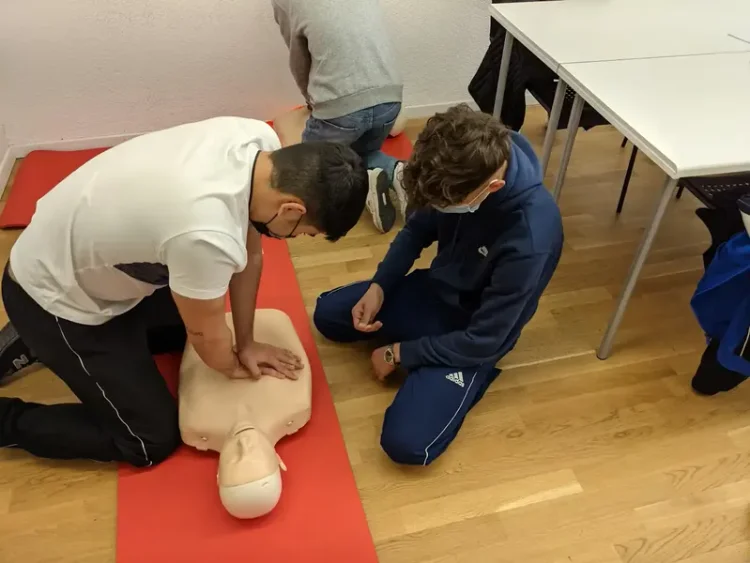
Move to cycles of 30 chest compressions + 2 rescue breaths (ratio 30:2). Türk Kızılay and SB's compression slogan verbatim: "PUSH FAST, PUSH HARD" ("HIZLI BASTIR, GÜÇLÜ BASTIR"). At a rate of 100-120 per minute, place two hand-heels (dominant hand on top) on the sternum, arms straight and elbows locked, compress the chest 5-6 centimeters (or one-third of the sternum). Allow complete chest recoil between compressions.
-
When the Automated External Defibrillator (AED) arrives, open it quickly and follow instructions. Before applying pads, thoroughly dry the chest; current shorts across a wet chest and efficacy decreases. If the AED recommends a shock, deliver the shock, then continue with 30:2 cycles rather than 5 rescue breaths. For detailed AED use, see our Automated External Defibrillator (AED) guide.
-
Continuing BLS. SB May 2025 page 143 verbatim: "Continue until the person wakes, moves, opens their eyes, and begins normal breathing; until help arrives and takes over; until you become too tired to continue; or until the scene becomes unsafe for you to continue." [2] To reduce fatigue, if possible two rescuers should switch places every 2 minutes.
-
If vomiting begins. Turn the patient to the side, clear the mouth (with an aspirator if available; do not use fingers), then turn the patient back supine and continue BLS. SB 2025's 60% vomiting prediction [2] will be encountered in most patients in real clinical practice.
-
If oxygen is available at the scene. SB May 2025 page 143 recommends: "If oxygen is available at the scene, it is recommended that trained rescuers provide oxygen to the person rescued in the early stages of the drowning process." [2] It is not expected that the public has oxygen; however, beach lifeguard stations, boats, dive centers, and hotel pool personnel may have oxygen cylinders — they should be requested.
When is compression-only CPR appropriate? The American Heart Association 2024 Focused Update principle: a bystander unable to provide rescue breaths (disgust, no barrier to a child's mouth, concern about communicable disease) can proceed with chest compressions alone — better than no BLS. However, in drowning, breathing-supported BLS provides a survival advantage; if possible, rescue breaths should be given [6]. For general adult BLS steps, see our Basic Life Support and CPR guide.
Child Drowning First Aid (1-8 Years): Different Ratio, Different Compression
Child drowning cases in Türkiye include pool, sea, lakeside, garden ornamental pond, water puddles, and — especially in the 1-4 age group — bathtub, bucket, toilet, and ornamental-pond incidents. SB May 2025 page 141 clearly separates the causes verbatim: "In adults: hypoglycemia, fainting, trauma (injury), accidents, cardiac rhythm disorders, alcohol use, epileptic seizures, exercise-related exhaustion, muscle cramps, suicide; In children: home accidents such as falling into a bucket, toilet, or bathtub." [2]
In this age group (1-8 years), drowning BLS differs from adult BLS at three points: (1) ratio 15:2 (with two rescuers; a single rescuer may use 30:2); (2) compression depth approximately one-third of the chest (about 4-5 cm); (3) compression technique with one hand-heel or with two hands in a smaller child. The initial 5 rescue breaths are the same.
Step-by-step child drowning BLS:
-
Confirm scene safety; place the child supine on a flat, firm surface; quickly remove wet clothing.
-
Consciousness check: shake the shoulders lightly and call out the child's name. If unresponsive, the child is considered unconscious.
-
Call 112 Emergency Health Services — on speaker or by having someone else call.
-
Airway opening: head-tilt chin-lift maneuver (jaw-thrust in suspected neck trauma).
-
10-second breathing check. If no normal breathing, begin BLS.
-
5 initial rescue breaths. In a smaller child, you can cover both mouth and nose with your mouth; in a larger child, pinch the nose and give mouth-to-mouth as in the adult. See the chest visibly rise with each breath.
-
Cycles of 15 chest compressions + 2 rescue breaths (ratio 15:2) (with two rescuers) or 30:2 as a single rescuer. Compression rate 100-120 per minute. Compression depth one-third of the chest — approximately 4-5 centimeters.
-
Compression technique: one hand-heel on the lower half of the sternum (in a smaller child), or two hand-heels stacked (in a larger child). Arms straight, elbows locked, shoulder perpendicular to the compression.
-
When the AED arrives, use pediatric pads if available; if not, place adult pads in anterior-posterior placement (front chest + back). The AED delivers shock only when needed; most drowning cases lack a shockable rhythm (VF/pulseless VT) initially — continue with BLS.
-
If vomiting begins, turn to the side, clear the mouth, return to supine and continue BLS.
-
Continue BLS until awakening, movement, eye opening, or return of normal breathing.
Compression depth criterion in children. SB May 2025 pediatric BLS curriculum defines compression depth as "compressing to one-third of the chest depth." Anatomically, this corresponds to 4-5 centimeters for a 1-8-year-old child. Compression is applied with the non-dominant side (one hand-heel in a small child, two hand-heels in a larger child); after compression, allow full chest recoil.
Why 15:2? In children, the underlying mechanism of cardiac arrest is often respiratory failure (drowning is the classic example of this mechanism). More frequent rescue breathing accelerates effective oxygenation. However, in terms of training and practice, a 30:2 ratio is also acceptable for a single rescuer — what matters is not stopping the continuous cycle of compression and ventilation. As with adult drowning, in children the initial 5 rescue breaths mark breathing-first BLS [6].
Infant Drowning First Aid (0-12 Months): Two-Finger Compressions and Mouth-Nose Ventilation
Infant (0-12 months) drowning cases are usually bathtub, bucket, toilet, water puddles in front of a washing machine, and ornamental-pond accidents. All causes SB May 2025 lists as home accidents in children are 100% preventable — the infant should not be left alone even for a single second in the bathtub [2]. WHO and CDC place drowning among the leading causes of death for 1-4-year-old children [8][9].
For this age group, BLS involves three important technical differences: (1) rescue breathing covers both mouth and nose simultaneously with your mouth; (2) two-thumb encircling technique (two thumbs together, other fingers wrap the infant's back) or two-fingertip chest compressions; (3) airway opening with the head in the neutral position (excessive head-tilt in an infant may cause airway obstruction).
Step-by-step infant drowning BLS:
-
Confirm scene safety; place the infant supine on a flat, firm surface (a soft mattress reduces compression effect); quickly remove wet clothing; cover with a blanket or dry towel (hypothermia develops very rapidly in infants).
-
Consciousness check: tap gently on the infant's foot sole or lightly shake the shoulders and call the name loudly. If no response, the infant is considered unconscious.
-
Call 112 Emergency Health Services — on speaker or by having someone else call.
-
Airway opening: head in the neutral position (no pillow, flat), one hand on the infant's forehead with light pressure, two fingers of the other hand under the chin bone tip lightly upward. Excessive head-tilt in an infant can block the small airway.
-
10-second breathing check. If no normal breathing, begin BLS.
-
5 initial rescue breaths. Seal your mouth over the infant's mouth and nose together; slow, controlled, only as much as fills your cheeks (an infant's lung is small — an adult inflation can tear the lung), 1-second breaths. Watch the chest visibly rise. Wait for the chest to fall between breaths.
-
Cycles of 15 chest compressions + 2 rescue breaths (ratio 15:2). Two technique options:
- Two-thumb encircling technique (preferred for two rescuers): join two thumbs at the lower half of the sternum, just below the nipple line; wrap the other fingers around the infant's back. This technique provides deeper and more effective compressions.
- Two-fingertip technique (practical for a single rescuer): index and middle fingertips just below the nipple line on the sternum; the other hand keeps the infant's forehead in position with the airway open. In both techniques, compress to one-third of the chest depth (approximately 4 centimeters). Compression rate 100-120 per minute.
-
When the AED arrives, pediatric pads are preferred; if not, adult pads are placed anterior-posterior (chest + back) for the infant. If the AED recommends a shock, deliver it; then continue BLS with 15:2 cycles.
-
If vomiting begins, turn the infant to the side, clear the mouth, return to supine and continue BLS.
-
Continue BLS until awakening, movement, eye opening, or return of normal breathing. In infants, at least 12-24 hours of intensive care observation is standard after return of spontaneous circulation (ROSC).
Practical parent notes for child and infant drowning. A 1-4-year-old child should not be left alone in the bathtub even for a second — if the phone rings, leave the room with the child; supervision must be uninterrupted in gardens with ornamental ponds, buckets, or empty buckets nearby; in homes with pools, a 4-sided locked perimeter fence reduces access to the scene by 85%. For the general emergency assessment approach in children, our Pediatric Emergencies: Parent's Guide treats fever, seizure, poisoning, burns, and drowning together.
Signs That Require IMMEDIATE 112 and the 8 Most Common Mistakes
An IMMEDIATE 112 call should be made for any of the following signs:
- Consciousness lost or continuously fluctuating.
- No spontaneous breathing, or agonal gasping.
- Submersion longer than 5 minutes prior to removal.
- Persistent cough after removal from water — especially lasting more than 1 hour.
- Cyanosis — blue lips, nail beds, earlobes, or under the tongue.
- Seizure, convulsions.
- Repeated vomiting — more than one episode.
- Neck or spinal pain, tenderness, or numbness after diving into shallow water.
- Hypothermia signs — shivering, blue lips, slowed mentation, confusion; body temperature ≤35°C.
- Elderly (65+), pregnant, infant (especially 1-4 years) — low-threshold call.
- Known cardiac or neurological disease (long QT syndrome, arrhythmia, epilepsy, prior stroke history).
- The rescuer who entered the water — even if the rescuer rescued themselves, they may have aspirated water; every person the bystander team pulls from the water for survival goes to 112 dispatch.
The 8 most common mistakes in drowning:
- Untrained rescuer entering the water. In the Sinop 13-year cohort, 35.9% of fatal cases occurred this way [4]. The Reach–Throw–Row chain must be tried; water entry is the last resort and the domain of trained persons.
- Inverting and hitting the back, hanging by the feet. SB 2025 does not include this maneuver in the curriculum; water accumulates in the stomach, not the lungs [2]. Inversion causes aspiration of stomach contents.
- Skipping the 5 rescue breaths. Reflexively going directly to 30 chest compressions with adult-BLS habit extends hypoxic damage in a drowning case. In drowning, BLS begins with 5 rescue breaths [6].
- Misinterpreting agonal gasping as "still breathing." A fatal delay cause. Normal breathing is regular, productive, 12-20 per minute (adult) or 20-30 per minute (child); agonal gasping is irregular and inefficient. When in doubt, do not accept as normal breathing; start BLS.
- Long-duration BLS without warming. In drowning, hypothermia reduces the efficacy of BLS. Wet clothing must be removed and the patient covered with a blanket or dry towel. However, this does not delay BLS; it is done simultaneously with BLS.
- Transporting the patient in your own car without calling 112. The clinical picture may deteriorate rapidly after removal from water; the ambulance has oxygen, monitors, and necessary BLS equipment. Also, if the patient loses consciousness during the drive, there is no intervention possibility.
- The assumption "looks fine, won't need hospital." Hospital mortality in the Sinop 13-year cohort was 19.7%; the ICU requirement was 22.2% [4]. Every patient removed from water goes to hospital evaluation via 112 dispatch.
- Parent panicking in a bathtub-infant event and shaking the infant upside down. If the infant is crying immediately after brief removal from water, breathing is present; calm holding, drying, and observation are sufficient. However, for loss of consciousness longer than 1 minute, persistent cough after removal, chest retractions, or lip cyanosis, 112 is called.
Nova Ambulans Istanbul Coast, Pool, and Home Drowning Operations
Nova Ambulans provides accredited emergency response and patient transport services across all 39 districts of Istanbul. In summer months (June-August), crews are pre-positioned for the Black Sea coast line (Kilyos, Şile, Riva, Ağva), the Marmara coast (Bakırköy, Küçükçekmece, Silivri), the Princes' Islands (Adalar), and city hotel pools. Drowning-specific equipment: portable oxygen cylinder and pediatric/adult bag-valve mask (BVM) set, Automated External Defibrillator (AED) — with both adult and pediatric pads, aspirator unit, cervical collar (adult and pediatric), long spinal board and head stabilizer (for suspected neck/spine injury after shallow-water dive), acute hypothermia blanket, and pulse oximetry (SpO2 monitor). The crew structure works to the AABT (Emergency Care Technician) + ATT (Emergency Medical Technician) dual standard; in critical pediatric cases, a paramedic-supported backup crew may be dispatched.
Coastal and sea cases protocol. Nova's near-coast operation is synchronized with SKKM; when scene coordinates are shared, both the 112 government crew and the Nova crew can depart in parallel. In sea cases, first response usually comes from lifeguards or coast guard teams; when the Nova crew reaches the scene, the patient is transported with oxygen support and cardiac monitor to a tertiary emergency center in Istanbul. Hospitals frequently used for the Black Sea coast: Sarıyer Hamidiye Etfal, Şile State Hospital, Ümraniye Training and Research Hospital. For the Marmara coast: Bakırköy Dr. Sadi Konuk Training and Research Hospital, Küçükçekmece Kanuni Sultan Süleyman, Silivri State Hospital. For serious patient or polytrauma cases, Istanbul University Cerrahpaşa Faculty of Medicine and Istanbul University Faculty of Medicine (Çapa) are on-call for tertiary intensive care.
Hotel and pool cases. After a 112 call for a city hotel pool, apartment pool, or public pool, the Nova crew is dispatched to the event address. Hotel personnel have a lifeguard requirement, but in practice the first intervention is started by the bystander. Nova's hotel-pool preferred hospitals are usually the nearest tertiary emergency departments — Bakırköy, Sarıyer, Kartal Lütfi Kırdar, or Marmara Pendik. Continuous oxygen support, cardiac monitor, and, if needed, intravenous fluid support are provided in the ambulance.
Home bathtub infant events. In 1-4-year-old bathtub, bucket, toilet, or ornamental-pond events, the Nova crew keeps pediatric BVM + pediatric oxygen mask + pediatric AED pads ready. Hospital choice for these events is pediatric-focused: Cerrahpaşa Pediatric Emergency, Marmara University Pendik Pediatric Emergency, Kanuni Sultan Süleyman Pediatric Emergency, Zeynep Kâmil Pediatric Emergency. For newborn drowning cases (rare; usually bathtub or scald-drowning), Zeynep Kâmil Women's and Children's Hospital and Sarıyer Cengiz Gökçek neonatal intensive care come into play.
Nova call line: 0850 244 24 12 — open 24/7; the rapid call-response threshold is under 4 hours (for in-Istanbul patient transport target). Drowning is an acute emergency; the first call is always to 112 Emergency Health Services; the right time for a Nova transport booking is post-hospital discharge and rehabilitation-period scheduled transfers. For details on Istanbul ambulance response times, our Istanbul ambulance response time guide explains 2025 data.
After Recovery from Drowning: Hospital Process and Long-Term Care
Correct BLS begun at the scene after removal from water directly changes the post-hospital picture. In the 2025 second paper from Sinop Atatürk State Hospital (Öncü et al., International Journal of Emergency Medicine 18(1):215, PMID 41126051), the SNOP (Saturation and Natremia-based Outcome Predictor) score was developed to estimate early hospital mortality. From data on 166 seawater drowning patients, a two-parameter model was derived: arterial oxygen saturation (SpO2) and serum sodium level — AUC 0.996, sensitivity 99.0%, specificity 96.2% [5]. The clinical meaning of the Sinop model: simple blood gas and electrolyte measurements done in hospital after removal from water can stratify mortality risk in minutes. In other words, the correctly timed bystander call → oxygen initiated in the ambulance → risk stratification in hospital within hours → ICU decision — this chain is what the bystander's action shapes.
Typical hospital process:
- Triage assessment: Glasgow Coma Scale (GCS), Szpilman score (1-6 drowning severity scale), vital signs, SpO2, hypothermia degree.
- Imaging: Chest X-ray (screening for aspiration pneumonia, pulmonary edema); if spinal trauma is suspected, cervical-thoracic-lumbar computed tomography (CT).
- Laboratory: Complete blood count, biochemistry (especially sodium, potassium, chloride), arterial blood gas (pH, pO2, pCO2, lactate), cardiac enzymes (troponin).
- Electrocardiography (ECG): Arrhythmia and ischemia screening in adult drowning; especially in a patient with known cardiac history.
- Respiratory support: Oxygen mask for mild-moderate cases; nasal high-flow oxygen for severe cases; invasive mechanical ventilation and ICU admission if ARDS develops.
- Warming: If hypothermia is present, active external warming (blanket, warmed fluids); in severe hypothermia (≤30°C), controlled active internal warming.
- Antibiotics: Not routine; broad-spectrum antibiotics are started if evidence of aspiration pneumonia is present.
- Admission criteria: Symptomatic patient is hospitalized; asymptomatic patient may be discharged after 4-8 hours of observation. In the Sinop cohort, 22.2% intensive-care admission is required [4].
Long-term follow-up. Patients who recover from drowning are followed for 24-48 hours regarding pulmonary symptoms, within 2 weeks regarding neurocognitive evaluation, and after 1 month regarding cardiac assessment. In patients who suffer anoxic brain damage, neurological rehabilitation (physical therapy, speech therapy, occupational therapy) is a long-term process. Nova Ambulans' post-discharge home-to-hospital physical therapy transport package offers scheduled transportation service for this patient group. For similar protocols in scheduled transfers of chronic patients, our Regular Transport Services for Dialysis Patients guide elaborates.
Summer Drowning Prevention: Individual and Societal Steps
The strongest treatment for drowning is prevention. The 2026 WHO Drowning Fact Sheet's clear note: "92% of drowning deaths occur in low- and middle-income countries" [8]; although Türkiye is in the upper-middle-income group, the summer-month drowning death count on the Black Sea and Marmara coasts averages 500-700 per year [10].
Individual prevention steps:
-
Learn to swim and teach your child. The critical policy recommendation of the DergiPark 2025 paper: "It is recommended that swimming education be provided to children across Türkiye, that measures in prohibited areas be increased, and that awareness research on swimming and first aid among citizens be conducted and the process monitored." [10] Take advantage of municipality-provided free swimming schools and school swimming classes.
-
Wear a life jacket. A life jacket is mandatory when using a boat, jetski, or water motorcycle. For children playing at the poolside, armbands or life jackets are recommended; however, these do not replace lifeguard supervision.
-
Pool safety. Home pool must be surrounded by a 4-sided locked perimeter fence (this single step reduces child drowning risk by 85%); pool edges should be non-slip, lighting adequate, rescue equipment (lifebuoy, long pole) ready.
-
Sober supervision. The adult supervising the child at the pool or seaside must be fully attentive; no swimming or child supervision after alcohol.
-
Bathtub, bucket, toilet. A 1-4-year-old child is never left alone in the bathtub even for a second; if the phone rings, leave the room with the child. Water left in buckets is emptied; the toilet lid is locked.
-
Flag system compliance. At public beaches, no swimming under a red flag; caution under a yellow flag; even under a green flag, stay in the lifeguard-supervised area.
-
No diving into shallow water. If the water depth is unknown before diving, do not dive head-first; the risk of spinal injury is high.
-
No solo swimming. Especially in open water, always swim with at least one other person; each person in the water keeps the other under observation.
-
Health assessment. Patients with epilepsy, arrhythmia, long QT syndrome, severe asthma, and COPD obtain swimming clearance from their physician; medication side effects (especially sedative drugs, alcohol interaction) are assessed.
-
Water safety training. T.C. Ministry of Health and Türk Kızılay first-aid courses are recommended for everyone; certified courses under the First-Aid Regulation are 16 hours long and are renewed every 3 years.
Societal prevention. Pre-positioning of municipal lifeguard and coast guard teams on the beach line, clear marking of prohibited areas, proper fencing of inaccessible ornamental ponds, home-pool safety inspection, school swimming classes, and inclusion of first-aid training in the school curriculum.
Frequently Asked Questions
Detailed answers to the following questions are in the frontmatter FAQ section and are read by search engines from the page's structured data (FAQPage schema):
-
Should I enter the water to reach a drowning person or not? — The Reach–Throw–Row chain must be tried; water entry is only the domain of the trained rescuer. In the Sinop cohort, 35.9% of fatal cases were rescuers [4].
-
Should I turn the person upside down and hit their back to drain water? — No; water accumulates in the stomach, not the lungs. Inversion accelerates aspiration [2].
-
The person looks fine and is breathing after removal from water; should I still take them to a hospital? — Yes; every drowning case goes to 112 dispatch and requires at least 4-8 hours of hospital observation [1][2][4].
-
My baby was briefly submerged in the bathtub and immediately cried; what should I do? — Stay calm; if the baby is crying, breathing is present. Monitor signs; take to hospital when in doubt [2].
-
Are the chest compression and rescue breath ratios the same for adults, children, and infants in drowning? — No; adult 30:2, child 15:2 (two rescuers) or 30:2 (single rescuer), infant 15:2; every age group begins with 5 rescue breaths [6].
Rapid Emergency Support
24/7 emergency ambulance service across Istanbul. Fast response, fully equipped team.
Average response time: 15 seconds
Related Articles
Tick Bite First Aid: Correct Removal Technique and the Crimean-Congo Haemorrhagic Fever (CCHF) Decision
When a tick attaches to the skin, the bystander’s step-by-step response: gloved, fine-tipped tweezers gripping the tick’s head as close to the skin as possible with steady upward traction, no alcohol, petrol, nail polish, matches or lit cigarettes, saving the removed tick in a labelled sealed plastic bag, a 14-day watch schedule for Crimean-Congo Haemorrhagic Fever (CCHF), the 112 decision when a fever, severe muscle pain, bleeding or profound weakness appears, and safe transfer to an infectious-diseases clinic — with primary sources from the Turkish Red Crescent 2025 First-Aid Pocket Book, the Turkish Ministry of Health May 2025 First-Aid Training Manual, the Turkish Red Crescent Esenyurt First-Aid Training Centre 2024 verbatim protocol, the Turkish Ministry of Health CCHF Scientific Council bulletin, Karanfil et al. 2026 (n=7,776 national surveillance), Güllü et al. 2025 (n=1,103 18-hospital cohort), the World Health Organization (WHO) 2025 fact sheet, the European Centre for Disease Prevention and Control (ECDC) factsheet, and Norman et al. 2025 European review.
EducationBee, Wasp, and Hornet Sting First Aid: When a Sting Reaction Needs 112
Step-by-step first aid for honeybee, wasp, and hornet stings — the bystander's 30-second stinger-scrape technique (credit-card scrape, never tweezers), local vs large-local vs systemic reaction decision tree, when to call Türkiye's 112 emergency line, adrenaline auto-injector application to the outer thigh, and what to do until the ambulance arrives — with verbatim protocols from Türk Kızılay Cep Kitabı 2025, T.C. Sağlık Bakanlığı May 2025 First-Aid Training Manual, the Turkish National Society of Allergy and Clinical Immunology (AİİAD), the Society of Pediatric Allergy and Asthma Academy (CAAAD), the 2025 Katran cohort of 194 526 patients at Istanbul Süreyyapaşa Hospital, the 2021 Öziş Baba cohort of 7 904 Trabzon schoolchildren, the American Academy of Allergy, Asthma & Immunology (AAAAI) and the McMurray 2026 Hymenoptera venom anaphylaxis review.
EducationAsthma Attack First Aid: Step-by-Step Bystander Decisions and the 112 Chain
What a bystander does in the first five minutes of an adult asthma attack — the "5-minute rule" from the Turkish Ministry of Health's May 2025 First Aid Training Book, the mild/moderate/severe/life-threatening classification of the Global Initiative for Asthma (GINA) 2025 Summary Guide, correct metered-dose inhaler and spacer technique, differences for children, pregnant patients and the elderly, and Istanbul-specific triggers.
Popular Ambulance Topic Clusters
You may also like
- Private ambulance pricing
- Istanbul private ambulance
- Intercity patient transport
- Doctor-accompanied ambulance
- Dialysis patient transport
- How intercity patient transport works
- Ambulance response time in Istanbul
- Home-to-hospital patient transport
- Modern ambulance equipment and team standards
- Heart attack symptoms and first response
This content is informational only and does not replace professional medical evaluation. In emergencies, call 112 or +90 216 339 00 39.
