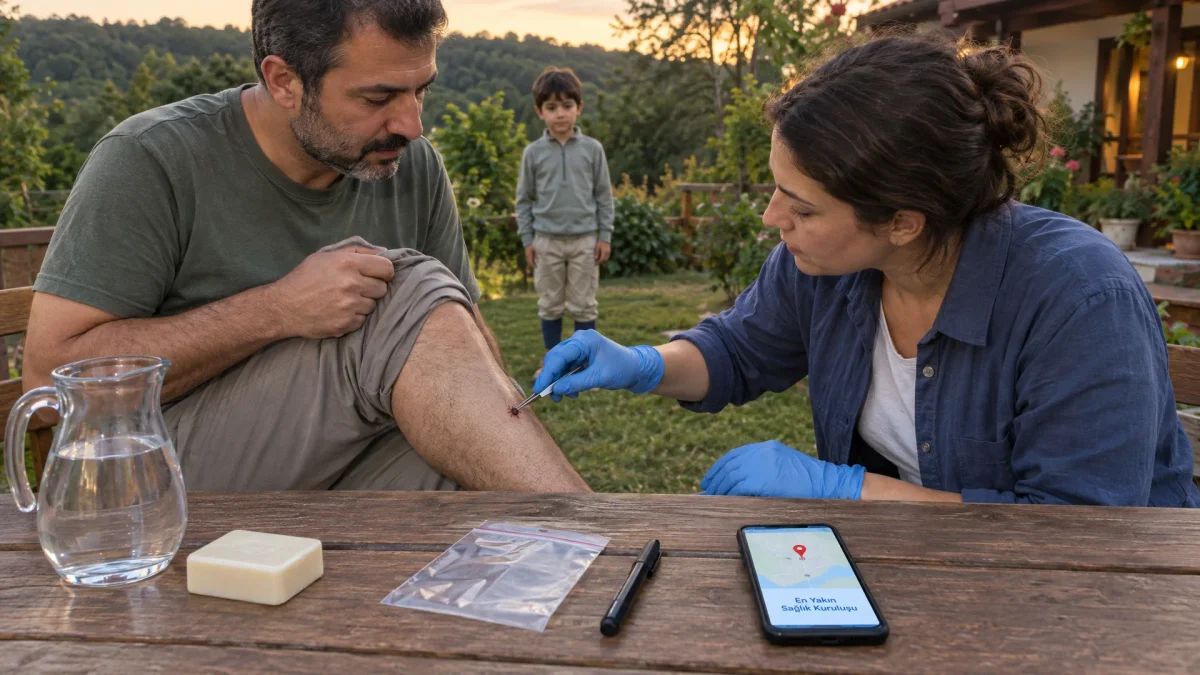
- Do not touch a tick with bare hands; put on gloves and grip the tick at its head with fine-tipped straight tweezers as close to the skin as possible, then pull straight up with steady traction (Turkish Red Crescent 2025).
- Do not apply alcohol, petrol, kerosene, acetone, petroleum jelly or burning cigarettes and matches; these methods increase virus pumping by the tick.
- Save the removed tick in a clear plastic bag and take it, dated, to the nearest health facility; watch for fever, weakness and bleeding for 14 days.
- If a fever rises above 38 °C, or diffuse muscle pain, bruising, gum or nose bleeding or bloody vomit appears, call 112 immediately.
- Türkiye carries the highest Crimean-Congo Haemorrhagic Fever (CCHF) burden in the World Health Organization (WHO) European Region: 7,776 cases with a 4.8% case-fatality rate reported between 2017 and 2024 (Karanfil et al., 2026).
Quick Answer. If a tick has attached to your skin, the first rule is: do not touch it with your bare hands. Put on a disposable glove, grip the tick at its head with fine-tipped straight tweezers as close to the skin as possible and pull straight up with steady, unhurried traction without squeezing. The Turkish Red Crescent Esenyurt First-Aid Training Centre 2024 protocol puts it in two sentences: "Remove ticks with fine-tipped tweezers (not fingers). Grip the tick as close to the skin as possible at the head and pull upward without squeezing." [3] Do not pour petroleum jelly, alcohol, petrol, kerosene or acetone on the tick, and do not burn it with matches or a cigarette — these methods make the tick regurgitate its stomach contents (including any Crimean-Congo Haemorrhagic Fever virus) back into the skin and increase transmission risk [3]. Save the removed tick in a sealed clear plastic bag, write the date and time on it, and take it to the nearest health facility [3]. Then watch yourself for 14 days, taking your temperature morning and evening and looking for muscle pain, weakness and bleeding. If a fever rises above 38 °C, or diffuse muscle pain, bruising, gum or nose bleeding or bloody vomit appears, call 112 immediately — Türkiye carries the highest Crimean-Congo Haemorrhagic Fever (CCHF) burden in the World Health Organization (WHO) European Region, with 7,776 cases and a case-fatality rate of 4.8% reported between 2017 and 2024 (Karanfil et al., 2026 International Journal of Infectious Diseases) [6].
Contents
- Ticks and Crimean-Congo Haemorrhagic Fever (CCHF) in Türkiye: the real numbers
- What a tick is, and why Hyalomma matters in Türkiye
- The first three minutes: correct tick-removal technique
- Forbidden methods and why they cause harm
- After removal: the 14-day watch schedule
- Crimean-Congo Haemorrhagic Fever (CCHF) symptoms and time-line
- When to call 112 immediately
- Until the ambulance arrives: infection control and safe transfer
- Special groups: children, pregnant patients, chronic disease, slaughter workers
- Endemic regions in Türkiye and what this means for Istanbul
- Prevention: clothing, repellents and body checks
- Nova Ambulance’s role: transfer of a suspected-infection patient
- Frequently asked questions
- Related posts
Ticks and Crimean-Congo Haemorrhagic Fever (CCHF) in Türkiye: the real numbers
Two recent studies define the weight of tick contact in Türkiye. Karanfil and colleagues’ national surveillance analysis, published by a Koç University–Turkish Ministry of Health team in the International Journal of Infectious Diseases in June 2026, reviewed 7,776 CCHF cases reported through the e-Nabız national health-record platform between 2017 and 2024. The same study compresses the picture into three numbers: men account for 63.8%, mean age is 45.3 years, and the overall case-fatality rate is 4.8% [6]. Turkish surveillance is also mathematically tractable: for 2024, the validated forecasting model predicted 931 cases; 918 were observed [6].
The clinical picture gets more detail from a more recent multicentre paper. Güllü and colleagues, in Clinical Microbiology and Infection in August 2025, followed 1,103 CCHF patients across 18 hospitals in Türkiye: 65.7% men, 87.2% rural residents, mean age 53 years; ticks were the confirmed transmission route in 68.4%; 8.0% required intensive-care admission, and overall mortality was 5.1% [7]. The most clinically useful finding relates to early ribavirin: starting the drug ≤96 hours from symptom onset was significantly associated with reduced mortality in a time-dependent Cox regression (adjusted HR 0.21; 95% CI 0.07–0.69; p = 0.010) [7]. Age ≥50 carried a mortality odds ratio of 3.1, and comorbid diabetes an OR of 4.49 [7]. Those two variables decide, in the field, which patient is transferred "immediately to an infectious-diseases clinic".
International comparison sharpens the Turkish picture. A Turkish Ministry of Health CCHF Scientific Council bulletin puts the global average CCHF mortality at "25%, reaching up to 80% in some countries", while noting that "thanks to measures taken in Türkiye, the rate stays around 4%." [5] The World Health Organization (WHO) fact sheet updated on 20 February 2025 puts outbreak case-fatality "up to 40%" and describes an approximately 30% mortality [8]. Norman and colleagues’ January 2025 Travel Medicine and Infectious Disease European review places Türkiye at the top of the table: "The Russian Federation, Turkey and several former Soviet Union countries are considered highly endemic." [10] The contrast is clear: Türkiye sees a large number of cases, but the probability of a case dying is kept low — because patients who reach a health facility in time receive early supportive care and ribavirin.
What a tick is, and why Hyalomma matters in Türkiye
A tick is an arachnid that resembles a small spider but swells into a bean shape after a blood meal; it attaches to the skin of humans and animals to feed. In Turkish it is sometimes called sakırga or keçi biti locally. An unfed adult tick is 2–3 mm long, but a fully engorged one can reach more than 1 cm — the size of a large wheat grain.
In Türkiye the main CCHF vector is the Hyalomma genus of ticks. The European Centre for Disease Prevention and Control (ECDC) factsheet lists the vectors relevant to the European region — Türkiye included — like this:
"Hyalomma ticks (mainly H. marginatum, H. anatolicum, H. rufipes and H. asiaticum) are competent CCHFV vectors and reservoirs." [9]
Hyalomma marginatum is also Europe’s principal vector. It is present from Thrace to Kars across the whole of Türkiye; livestock farming, agricultural fields, forest edges, long-grass pastures and picnic areas are its main habitats. The proportion of infected ticks varies by region and season; Karanfil and colleagues’ 2026 study clearly shows the spring-and-summer seasonal peak for CCHF cases [6]. Tick activity begins in March–April, peaks in June–August and continues through October across Türkiye.
A tick can transmit the virus through saliva within 24–48 hours of first attachment — so noticing and removing a tick early substantially lowers transmission risk. Because the tick’s saliva contains an anaesthetic, the bite is usually painless — a full body-check should be a routine at the end of any summer walk through forest or countryside.
The first three minutes: correct tick-removal technique
When you spot a tick attached to skin, you need method rather than panic. The Turkish Red Crescent Esenyurt First-Aid Training Centre protocol defines the removal technique in six clean sentences:
"Never touch ticks with your bare hands and put on gloves. Remove ticks with fine-tipped tweezers (not fingers). Grip the tick as close to the skin as possible at the head and pull upward without squeezing. Make sure no tick fragment remains in the skin." [3]
In practice, step by step:
- Put on gloves. Single-use nitrile or latex is ideal. If gloves are not available, use a clean cloth, a thin plastic bag or two layers of paper towel as a barrier. The goal: keep any tick stomach contents off skin, and keep fingers uncontaminated if the tick ruptures during removal.
- Prepare fine-tipped straight tweezers. The pharmacy "fine-tipped straight tweezers" type is ideal. Do not use eyebrow tweezers (wide-tipped, curved) or scissors. A purpose-designed plastic "tick key" or tick-removal hook is a good alternative; rural pharmacies and veterinary shops stock them.
- Bring the tweezers as close to the skin as possible. Grip the tick at the head, close to the skin — not at the abdomen. Squeezing the abdomen pumps the stomach contents (and possibly virus) into the skin.
- Pull straight up with steady force. Do not twist, rotate or jerk. Steady, patient force is enough — the tick releases in 3–10 seconds. If it is stubborn, do not increase force; wait a moment and try again. The tweezer tips hold the tick at the skin; your fingers press on the tweezer body.
- Check that no tick fragment is left in the skin. If a head or mouth-part stays under the skin, do not dig it out with a needle or blade. Wash the area with soap and water; the skin usually expels it within a few days. If redness, warmth, pus or fever develops, go to a health facility.
- Wash and disinfect. Rinse the bite site with plenty of soap and running water for at least 30 seconds, then swipe with iodine or 70% alcohol. Wash and disinfect the tweezers.
- Put the tick in a sealed clear bag and write the date on it. The Turkish Red Crescent Esenyurt protocol is explicit: "If you have removed the tick yourself, place it in a clear plastic bag and go to the nearest health facility for the necessary blood tests." [3] Write the date, time and name of the person exposed on the bag with a black permanent marker. The tick may be alive or dead — it does not matter for the laboratory.
- Go to the nearest health facility. A family-health centre, a state hospital emergency department or an infectious-diseases clinic is the entry point. Do not dismiss a tick contact if you live in an endemic province — get evaluated.
If you feel unable to remove the tick, or if the tick is stuck on the eyelid, ear canal, mouth, or genital region, do not attempt removal yourself; go directly to a health facility. The Turkish Red Crescent Esenyurt protocol is unambiguous here: "If you have difficulty removing the tick, or if you think you cannot do it, go to the nearest health facility without wasting time." [3]
Forbidden methods and why they cause harm
Türkiye has plenty of folk remedies around tick removal — all harmful. The Turkish Red Crescent Esenyurt protocol clearly forbids them:
"Do not apply substances such as petroleum jelly, alcohol, petrol, kerosene or acetone. Do not try to burn the tick with matches, a lighter or a cigarette." [3]
Understanding why each is harmful is the best way to resist the "wisdom" you may hear from an older relative.
- Alcohol, petrol, kerosene, acetone and nail polish irritate the tick’s salivary glands; the tick injects more saliva (and therefore more virus, if present) into the skin. The panicked tick may also regurgitate stomach contents into the wound.
- Petroleum jelly and olive oil suffocate the tick; during that process the tick may vomit stomach contents back into the wound.
- Matches, lighters, hot cigarette tips make the tick rupture; before it dies, saliva and stomach contents contaminate the skin. Burns and secondary infection follow.
- Squeezing the tick by hand or between two fingers crushes it, contaminating skin and fingertips with its stomach contents. Skin cuts and paronychia around the fingernails can let virus in.
- Gripping the tick at the abdomen with tweezers, or twisting and rotating it, leaves the tick’s mouth-parts embedded in the skin and can cause local infection or inflammation.
The single-sentence right answer: Gloves + fine-tipped straight tweezers + grip at the head + steady pull without squeezing + save in a clear bag + nearest health facility.
Fire, chemicals and hand-pulling are the methods to refuse politely but firmly from the "wise elder" in your family. Sharing the link to this article and standing behind the Turkish Red Crescent’s official recommendation is enough — no stronger position exists.
After removal: the 14-day watch schedule
Tick removal is not the end of the job. You must observe yourself for 14 days. That is the widest incubation window defined for CCHF. The European Centre for Disease Prevention and Control (ECDC) puts incubation at "three to seven days, range 1–14 days" [9]; the World Health Organization (WHO) gives "usually one to three days, maximum nine days" for tick-borne infection and "usually five to six days, maximum 13 days" for blood-and-tissue-borne infection [8]. Turkish practice takes the widest end of that range and recommends 14 days.
Practical monitoring:
- Take your temperature morning and evening. Use a thermometer; do not judge by feeling. A temperature of 38 °C or above is a warning sign.
- Note your general condition. If weakness, muscle pain or loss of appetite appears, write it down. A dated cell-phone note works.
- Look at the skin. Check the bite site and the entire body once a day for subcutaneous bleeding (petechiae — small dot-like bruises), larger bruises, and rashes.
- Bleeding signs. Spontaneous bleeding from the gums, nose, blood in urine, blood in vomit, or black stool are red flags.
- Consciousness and sleep. Track whether drowsiness, agitation or confusion appears.
As soon as any warning sign appears, go to a health facility with infectious-diseases expertise; if the fever rises above 38.5 °C or several symptoms appear at once, call 112 directly. The 18-hospital Turkish cohort by Güllü and colleagues demonstrated that early (≤96 h) infectious-diseases evaluation and ribavirin, when indicated, significantly reduce mortality (adjusted HR 0.21; 95% CI 0.07–0.69) [7]. Time is decisive.
Crimean-Congo Haemorrhagic Fever (CCHF) symptoms and time-line
CCHF characteristically progresses through four stages. Recognising these stages is critical to getting to a health facility on time.
Stage 1 — Incubation. 1–14 days after the tick bite (WHO: 1–9 days) [8][9]. No symptoms; the virus is multiplying. Sudden symptoms begin at the end of this stage.
Diagnosis is hardest in the next stage. Stage 2 — Sudden onset (pre-haemorrhagic period). Usually 3–7 days. Sudden high fever (38–40 °C), chills, diffuse muscle pain (especially low back and legs), headache, neck stiffness, photophobia, red eyes, loss of appetite, weakness, nausea, vomiting, abdominal pain, diarrhoea. This stage can be mistaken for flu or another viral infection — a tick-contact history is the distinguishing key.
Bleeding characterises the third stage. Stage 3 — Haemorrhagic period. From day 3–5 after symptom onset. Petechiae (dot-like bruises), ecchymoses (larger bruises), bleeding from the gums, nose, urine or stool, heavier menstrual periods in women, signs of internal bleeding. Platelet counts fall; liver enzymes rise. The World Health Organization (WHO) fact sheet notes that deaths in this period occur "in the second week of illness" [8]. Intensive-care–level monitoring is needed.
Recovery in survivors is the final stage. Stage 4 — Convalescence. In survivors, recovery begins from day 15; weakness and muscle pain may persist for weeks. Permanent sequelae are rare.
In Türkiye, the average case-fatality rate is 4.8% (Karanfil 2026 national data [6]; Güllü 2025 multicentre 5.1% [7]). This low figure is no accident: early diagnosis, timely arrival at a health facility, supportive care in hospital and ribavirin when indicated make the difference. The WHO global estimate — "30% on average, up to 40% in outbreaks" [8] — shows how much value the Turkish system delivers.
When to call 112 immediately
Ambulance decisions after a tick contact fall into three contexts:
A. Immediate 112 during tick removal.
- The tick is on a sensitive site — inside the mouth, on an eyelid, near the ear-drum, inside the throat, or in the urogenital area — that requires expertise.
- Significant bleeding starts during removal and cannot be stopped.
- The person has a known bleeding disorder (haemophilia, blood thinners, liver disease).
- Multiple ticks are present (for example on a rural livestock handler who slept in the open) and removal becomes complex.
B. 112 for a suspected CCHF picture during days 1–14 after removal.
If any of the following appears, do not wait — call 112:
- Fever 38 °C or higher, especially with chills
- Diffuse muscle pain — particularly in the low back, legs, neck
- Weakness and exhaustion — enough to prevent normal activities
- Headache, photophobia, neck stiffness
- Petechiae on the skin (dot-like bruises), widespread ecchymoses (purple patches)
- Bleeding — gums, nose, urine, blood in vomit, black stools
- Abdominal pain, persistent vomiting, diarrhoea
- Confusion, disorientation, drowsiness
- Reduced urine output (a kidney-involvement sign)
C. 112 for transfer request from a non-specialist location.
In endemic provinces district hospitals are experienced in CCHF management, but in a city an emergency department may need to transfer a suspected tick-borne patient to a tertiary hospital with an infectious-diseases clinic. In that setting the 112 call arranges transport with proper equipment (isolation gear, personal protective equipment for staff); private ambulance services can also carry out this kind of planned, safe transfer.
What to give and what not to give. Until 112 arrives, the patient should rest in a sitting or lying position. Do not give aspirin, ibuprofen or blood thinners — they increase bleeding risk. For a fever, paracetamol may be given (only if the patient can swallow and has no known allergy). If the patient can still swallow, small sips of water and electrolyte drinks are fine; if vomiting, small sips only. When the ambulance crew arrives, hand over the bag containing the removed tick, the date and time of the bite, any travel history to endemic areas, and any animal-contact history.
Until the ambulance arrives: infection control and safe transfer
CCHF can also be transmitted through unprotected contact with an infected person’s blood and body fluids, in addition to a tick bite. In Türkiye this secondary route most often affects family carers and healthcare workers. The European Centre for Disease Prevention and Control (ECDC) is emphatic:
"Hospital-acquired infections can occur due to direct contact with blood or tissues of viraemic patients or improperly sterilised medical devices." [9]
Basic infection-control measures should therefore apply during home care and ambulance transport:
- No bare-hand contact with the patient. Family carers should wear gloves — ideally single-use nitrile. If none are available, cover hands with clean plastic bags.
- Avoid direct contact with blood and body fluids. Laundry and towels stained by vomit, blood or saliva are separated. A bucket of 1:10 bleach solution disinfects them.
- No sharing of personal items. Toothbrushes, razors, nail clippers and towels stay separate.
- Alert the ambulance crew. During the 112 call, tell the Health Command and Control Centre (SKKM) operator that this is "a suspected CCHF case after a tick exposure". The crew will arrive in personal protective equipment (PPE — mask, gown, goggles, gloves).
Private ambulance operators such as Nova Ambulance provide dedicated crews with full PPE, isolation drapes and absorbent sheets for the planned transfer of a suspected CCHF patient from a rural district hospital to a tertiary hospital with an infectious-diseases clinic in Istanbul. For the framework of inter-hospital transfer, see our private-ambulance inter-hospital transfer guide.
For positioning during transport: if the patient is conscious and breathing comfortably, a comfortable sitting or semi-recumbent position; if consciousness has been lost but breathing is preserved, the safe lateral position taught in our recovery position step-by-step guide protects the airway if vomiting occurs. If breathing has stopped completely, start the 30-compression-to-2-breath basic life support cycle described in our CPR and basic life support bystander guide; the Turkish Red Crescent 2025 slogan is "COMPRESS FAST, COMPRESS HARD" at a rate of 100–120 per minute and 5–6 cm depth.
Special groups: children, pregnant patients, chronic disease, slaughter workers
Children. In children, CCHF usually runs a milder course than in adults — but that is not a reason to relax; close observation is mandatory. Tick-removal technique is the same as in adults. If the child struggles, one parent holds while the other uses the tweezers. If the tick is on a sensitive site (eyelid, ear, mouth, genital), go directly to a paediatric emergency department. If fever, weakness, bruising or bleeding appears, call 112 and request transfer to a paediatric emergency department. Our general paediatric emergencies parent guide is the reference point here.
Pregnant patients. In pregnancy CCHF can be more severe, and the risk of fetal loss is high. After tick contact, an obstetric and infectious-diseases consultation should be arranged without delay at a health facility. Tick-removal technique is unchanged; ribavirin is limited in pregnancy, and the decision is made by specialists weighing risks and benefits. Paracetamol may be used for fever; aspirin and ibuprofen must not.
Chronic-disease patients (particularly age >50 with diabetes, cardiac or renal disease). Güllü and colleagues’ 2025 Turkish multicentre study reported age >50 as an OR 3.1 mortality predictor, comorbid diabetes as OR 4.49 [7]. For this profile, the threshold should be lowered: mild symptoms alone are reason enough to reach a health facility. Early (≤96 h) ribavirin saves lives in this group in particular.
Slaughter workers, shepherds, veterinarians, gendarmerie and forestry personnel. These occupations carry high risk from both primary (tick) and secondary (infected-animal blood) transmission. Thick gloves, apron, protective goggles and mask should be standard. Before and during Eid-al-Adha, full PPE at slaughter sites, avoidance of street slaughter and verified animal-health certification save lives. Cuts, splashes and hand injuries during slaughter should trigger a 14-day watch and an infectious-diseases outpatient visit at the first symptom.
Older adults living alone. Anyone who cannot manage a 14-day watch or reach help quickly needs a planned family/neighbour phone chain; private ambulance services such as Nova Ambulance provide planned and safe home-to-hospital transport in scenarios like this (see our guide for relatives waiting for the ambulance).
Endemic regions in Türkiye and what this means for Istanbul
The Turkish Ministry of Health official bulletin defines the geography of CCHF in Türkiye as follows:
"The disease is concentrated in the northern part of Central Anatolia, the Central Black Sea and the northern part of Eastern Anatolia in our country." [5]
Karanfil and colleagues’ 2026 national surveillance study confirms the same three regions: "endemic areas of northeastern Central Anatolia, Eastern Anatolia and the southern Black Sea region" [6]. High-risk provinces include Tokat, Sivas, Yozgat, Çorum, Amasya, Kastamonu, Gümüşhane, Erzurum, Erzincan, Bayburt and Bartın.
What about Istanbul? Istanbul is not a high-endemic CCHF province — but the risk is not zero. The Belgrad Forest to the north, the woods of Beykoz, the Şile-Ağva countryside, the long-grass areas between Kilyos and Rumelifeneri, the farmland belt of Çatalca-Silivri and the interior of the Islands are all suitable tick habitats. For Istanbulites the practical meaning:
- After picnics, forest walks or camping, a full body check is mandatory (particularly the scalp, behind the ears, the neck, the armpits, the navel, the groin and behind the knees).
- Istanbulites travelling home to their families in endemic provinces at religious holidays face a much higher probability of tick contact; a 14-day watch should follow their return.
- Highland migration and seasonal agricultural work — workers spending long periods in rural areas multiply the probability of exposure. Continue symptom monitoring on return.
- Pets (especially dogs and cats) taken to the countryside can carry ticks home; check them before they enter the house.
For ambulance response times across Istanbul’s 39 districts, see our ambulance response time in Istanbul 2025 guide. For suspected CCHF cases the referral network in Istanbul consists of tertiary hospitals with active infectious-diseases clinics: Çapa (Istanbul Faculty of Medicine), Cerrahpaşa Faculty of Medicine, Marmara University Pendik Training and Research Hospital, Şişli Hamidiye Etfal, Kartal Lütfi Kırdar Training and Research Hospital, Bakırköy Sadi Konuk Training and Research Hospital, and Ümraniye Training and Research Hospital.
Prevention: clothing, repellents and body checks
The best first aid is never being bitten. A standard tick-season protection set:
1. Clothing.
- Light colours — ticks are easier to spot on a pale background.
- Long-sleeved tops and long-legged trousers. Do not enter tall grass in shorts and a T-shirt.
- Tuck trouser cuffs into your socks. This single step slows a tick’s climb and increases your chance of spotting one.
- Hiking boots or high-ankle shoes; not sandals.
- A hat or bandana; makes tick climbing to the scalp harder.
2. Repellents.
- DEET (20–30%) can be applied to the skin; safe above age 12.
- Icaridin (Picaridin, 20%) is a DEET alternative, applicable to skin and clothing.
- Permethrin is applied only to clothing (never to skin) — it remains effective for several wash cycles.
- For young children, use DEET below 10% and avoid hands and face.
- Follow the age limits and reapplication intervals on the label.
3. Body checks.
- Do a full-body inspection as soon as you return from the countryside. Use a mirror for your back and scalp — with a helper if possible.
- Take a shower; warm water and soap usually slow a climbing tick, but they will not remove one that has attached.
- A palm-sized mirror helps find ticks too small to see easily.
- Tumble-drying clothes on high for 10 minutes kills ticks and larvae.
4. Animal and environmental control.
- Screen pets by hand before they enter the house.
- Keep garden grass short and clear leaf-piles from garden edges.
- Do not touch dead or unhealthy animals with bare hands.
- Before Eid-al-Adha, check the health certificate of the animal to be slaughtered; wear full PPE for the slaughter.
Nova Ambulance’s role: transfer of a suspected-infection patient
Nova Ambulance provides 24/7 patient transport and emergency-care services across Istanbul’s 39 districts. For a suspected or confirmed CCHF patient the following equipment is standard:
- Full personal protective equipment (PPE) for the crew: double gloves, an N95/FFP2 mask, protective goggles, coveralls, shoe covers.
- Isolation drape and single-use absorbent sheet for the patient.
- Equipment and ambulance-cabin disinfection (1:10 bleach solution and hospital-grade disinfectant) after every transfer.
- Planned transfer from rural district hospitals to Istanbul tertiary hospitals with infectious-diseases clinics (Çapa, Cerrahpaşa, Marmara Pendik, Şişli Hamidiye Etfal, Kartal Lütfi Kırdar, Bakırköy Sadi Konuk, Ümraniye).
- Intensive-care ambulance option for patients requiring advanced monitoring (see when an ICU ambulance is needed).
- Inter-city transfer coordination — for a relative in an endemic province whose Istanbul-based family needs planned transport to a tertiary centre in Ankara, Samsun or Tokat.
Our 24/7 lines are open for a planned-transfer request for a suspected CCHF picture in a family member in an endemic region. If you have a question while monitoring yourself or a relative after a tick contact, you can call the same line before contacting your family doctor. Ensuring the crew arrives with correct PPE and that the destination hospital is notified in advance is the basic condition of your safety and the crew’s safety — this is where a private-ambulance service starts to matter; for a short comparison, see our 112 versus private ambulance guide.
Frequently asked questions
In addition to the FAQ block above, the three most common questions on-scene:
"Only one tick bit me — should I worry?" Do not worry, but do observe. A tick bite does not always mean CCHF; the probability that the tick carries the virus varies by region and season. Correct removal greatly lowers transmission risk. Fourteen days of temperature and general-condition monitoring is enough.
"Is there a Crimean-Congo vaccine?" According to the World Health Organization (WHO) 2025 fact sheet, "There is no vaccine available for either people or animals." [8] Prevention rests entirely on clothing, repellents and body checks.
"Does CCHF spread from person to person?" Yes, but only through unprotected contact with an infected person’s blood or body fluids. Ordinary family contact (living in the same home, sharing meals, hugging, staying in the same room) does not carry transmission risk. In hospital, as ECDC states, "direct contact with blood or tissues of viraemic patients or improperly sterilised medical devices" is the route [9] — which is why healthcare staff must work in full PPE.
Related posts
- Anaphylaxis and Adrenaline Auto-Injector Guide — the same principles apply if an allergic reaction develops after a tick bite.
- Bee, Wasp and Hornet Sting First Aid — a general insect-sting comparison and decision tree.
- Guide for Relatives Waiting for the Ambulance — the bystander steps after a 112 call.
- Recovery Position: Step-by-Step — the safe lateral position for an unconscious but breathing patient.
- CPR and Basic Life Support: Bystander Guide — if breathing stops, the 30:2 cycle.
- Private Ambulance for Inter-Hospital Transfer — transfer of a relative in an endemic province to a tertiary infectious-diseases clinic in Istanbul.
- When Is an ICU Ambulance Required — for a bleeding CCHF patient who needs advanced monitoring in transit.
- Ambulance Response Time in Istanbul 2025 — response times across 39 districts.
- Pediatric Emergencies: Parent Guide — for a child bitten by a tick.
- Difference Between 112 and Private Ambulance — the private-ambulance advantage in planned transfers.
Rapid Emergency Support
24/7 emergency ambulance service across Istanbul. Fast response, fully equipped team.
Average response time: 15 seconds
Related Articles
Dog and Cat Bite First Aid: Rabies Risk, the 15-Minute Wash and When to Call 112
If a dog or cat bites or scratches you, wash the wound at once with plenty of soap and water for at least 15 minutes, press directly on it if it bleeds, cover it with a clean cloth and go to a health facility the same day. Rabies cannot be treated once symptoms begin; a doctor decides whether you need the vaccine. Call 112 for bleeding that pressure does not stop or for any threat to life.
EducationMushroom Poisoning Symptoms and First Aid: When Do Symptoms Start, When to Call 112?
If nausea, vomiting, diarrhea, abdominal pain or any other symptom begins after eating foraged mushrooms or mushrooms of unknown origin, call 112, whatever hour it began; do not induce vomiting and give nothing by mouth. People without symptoms, including a child who ate a mushroom in a garden or park, still need hospital assessment; call 112 and explain, because with amatoxin, which damages the liver, the symptom-free interval averages 8-10 hours. The National Poison Information Center (UZEM) on 114 gives advice but does not replace 112.
EducationBee, Wasp, and Hornet Sting First Aid: When a Sting Reaction Needs 112
Step-by-step first aid for honeybee, wasp, and hornet stings — the bystander's 30-second stinger-scrape technique (credit-card scrape, never tweezers), local vs large-local vs systemic reaction decision tree, when to call Türkiye's 112 emergency line, adrenaline auto-injector application to the outer thigh, and what to do until the ambulance arrives — with verbatim protocols from Türk Kızılay Cep Kitabı 2025, T.C. Sağlık Bakanlığı May 2025 First-Aid Training Manual, the Turkish National Society of Allergy and Clinical Immunology (AİİAD), the Society of Pediatric Allergy and Asthma Academy (CAAAD), the 2025 Katran cohort of 194 526 patients at Istanbul Süreyyapaşa Hospital, the 2021 Öziş Baba cohort of 7 904 Trabzon schoolchildren, the American Academy of Allergy, Asthma & Immunology (AAAAI) and the McMurray 2026 Hymenoptera venom anaphylaxis review.
- Türk Kızılay İlk Yardım Cep Kitabı 2025Türk Kızılay Genel Müdürlüğü (Turkish Red Crescent) ↗
- T.C. Sağlık Bakanlığı Acil Sağlık Hizmetleri İlk Yardım Eğitim Kitabı (Mayıs 2025)T.C. Sağlık Bakanlığı Acil Sağlık Hizmetleri Genel Müdürlüğü (Turkish Ministry of Health) ↗
- Böcek Isırığı veya Sokmalarında İlk Yardım — Türk Kızılay Esenyurt İlk Yardım Eğitim MerkeziTürk Kızılay Esenyurt İlk Yardım Eğitim Merkezi (Turkish Red Crescent Esenyurt First-Aid Training Centre) ↗
- Hayvan Isırmalarında İlk Yardım — Türk Kızılay Esenyurt İlk Yardım Eğitim MerkeziTürk Kızılay Esenyurt İlk Yardım Eğitim Merkezi (Turkish Red Crescent Esenyurt First-Aid Training Centre) ↗
- Kırım Kongo Kanamalı Ateşi Bilim Kurulu Toplandı — T.C. Sağlık Bakanlığı HaberleriT.C. Sağlık Bakanlığı (Turkish Ministry of Health) ↗
- Crimean-Congo hemorrhagic fever in Türkiye, 2017–2024: evolving epidemiology and implications for surveillanceKaranfil Ö, Güllü D, Birinci Ş, Bayram S, Ata N, Gönen M, Ergönül Ö — International Journal of Infectious Diseases 2026;170:108898 (PMID 42314973) ↗
- Key predictors of mortality in Crimean-Congo haemorrhagic fever: a retrospective multicentre cohort studyGüllü D, Yigci D, Baykam N, Çelikbaş AK, Yapar D ve ark. — Clinical Microbiology and Infection 2025;31(12):2056–2062 (PMID 40849042) ↗
- Crimean-Congo Haemorrhagic Fever Fact Sheet (updated 20 February 2025)World Health Organization (WHO) ↗
- Crimean-Congo Haemorrhagic Fever Factsheet — European Centre for Disease Prevention and Control (ECDC)European Centre for Disease Prevention and Control (ECDC) ↗
- Changes in the epidemiology of Crimean-Congo hemorrhagic fever: Impact of travel and a One Health approach in the European regionNorman FF, Arce OA, Díaz-Menéndez M, Belhassen-García M, González-Sanz M — Travel Medicine and Infectious Disease 2025;64:102806 (PMID 39870124) ↗
Popular Ambulance Topic Clusters
You may also like
- Private ambulance pricing
- Istanbul private ambulance
- Intercity patient transport
- Doctor-accompanied ambulance
- Dialysis patient transport
- How intercity patient transport works
- Ambulance response time in Istanbul
- Home-to-hospital patient transport
- Modern ambulance equipment and team standards
- Heart attack symptoms and first response
This content is informational only and does not replace professional medical evaluation. In emergencies, call 112 or +90 216 339 00 39.
