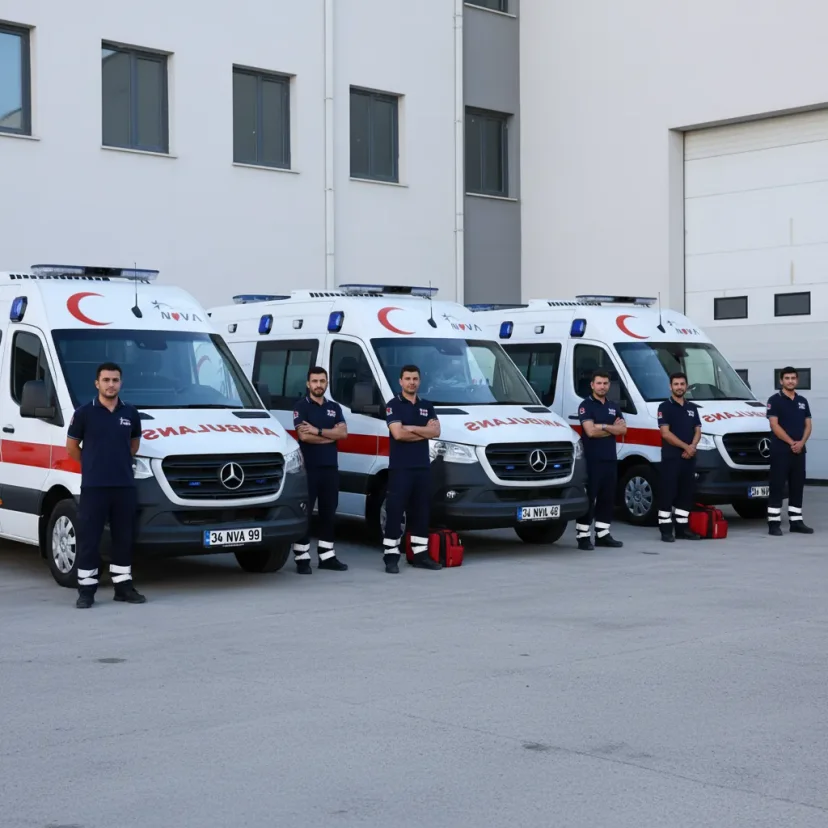
- Basic Equipment: Defibrillator, ventilator, and trauma sets are vital.
- Team Standard: Staffing requirements vary by ambulance type (2–3 crew per 2025 regulation).
- Continuous Training: Ministry-mandated training now required for all ambulance health workers.
- Selection Criteria: Question the ambulance's equipment and personnel competence.
Seeing an ambulance as just sirens and lights is a big misconception. A modern ambulance must carry equipment comparable to a small intensive care unit and a trained team that knows how to use it [1][2]. The summary below maps the equipment and team requirements against the 2025 Turkish ambulance regulation (Article 7) and the European standard TSE EN 1789:2014 (medical vehicles for road ambulances).
Basic Equipment That Should Be in Modern Ambulances
Major equipment expected to be found in an Emergency Aid Ambulance complying with Ministry of Health regulations and the EN 1789 classification [4]:
- Monitor / Defibrillator: Heart-rhythm monitoring and shock delivery. Devices used in the field include, for example, the Philips HeartStart MRx and the Stryker (Physio-Control) Lifepak 15 — these support 12-lead ECG, manual and Automated External Defibrillator (AED) defibrillation, transcutaneous pacing, and SpO₂/EtCO₂ modules.
- Oxygen and Respiratory Support Equipment: Oxygen cylinders, masks, bag-valve mask (BVM), and a portable mechanical ventilator when needed. Intensive Care Unit (ICU) ambulances may run, for example, a Hamilton T1 or comparable transport ventilator, with pressure-controlled, volume-controlled, and non-invasive ventilation (NIV) modes for long-distance critical-care transfers.
- Medications: Core emergency drug kit (cardiac, allergy, pain, sedation, etc.) [1][2].
- Trauma and Immobilisation Set: Cervical collars, splints, long spine board, Ferno scoop stretcher, Spencer immobilisation products (vacuum mattress, KED extrication vest), burn and bleeding-control kits [3].
- Birth and Paediatric Set: Emergency-delivery materials and paediatric airway tools — paediatric laryngoscope blades, the Broselow colour-coded length tape, and paediatric endotracheal tubes.
TSE EN 1789:2014 Compliance Check
EN 1789 classifies ambulances into three main types: Type A (patient transport, subdivided into A1 for a single patient and A2 for one or more patients), Type B (emergency care) and Type C (mobile Intensive Care Unit (ICU)) [7]. For Emergency Aid and Intensive Care Unit (ICU) ambulances, the critical compliance items include:
- Stretcher mounting points with documented 10 g crash-test certification.
- Cabin minimum height of 1.9 m (Type B/C) and oxygen storage capacity ≥2,000 L.
- Equipment cabinets that are covered, illuminated, and fitted with collision-resistant latches.
- All critical medical devices (defibrillator, ventilator, suction unit) carrying ECE-R10 EMC certification.
Nova Ambulans treats this list as a per-season checklist, not a one-off audit.
Team Standards: Staffing Requirements by Ambulance Type
In a modern ambulance, not only a driver who knows how to drive, but a team trained in emergency health should be present. [4] Staffing requirements are set by ambulance class in Article 7 of the base regulation (Official Gazette 8/1/2025, no. 32776): [6]
Emergency Ambulance (Red Stripe):
- Min 3 crew: one physician or emergency-care technician (paramedic/AABT), or an EMT (acil tıp teknisyeni) who completed Ministry-mandated module training + one additional health worker + one driver. [6]
Patient Transport Ambulance (Blue Stripe):
- Min 2 crew: one health worker + one driver. [6]
Intensive Care Unit (ICU) Ambulance:
- Min 3 crew: at least two health workers (one must be a physician or emergency-care technician (paramedic)) + one driver. [6]
Special-Purpose Ambulance:
- Min 3 crew: at least two health workers (one must be a physician or emergency-care technician (paramedic)) + one driver. [6]
The team must be able to apply many interventions beyond basic first aid in the field:
- Opening vascular access [1]
- Advanced airway management [2]
- Rhythm monitoring and medication administration [1]
Continuous Training and Simulation Studies
Medical information and guidelines are constantly updated. Therefore, it is expected that:
- Teams regularly participate in theoretical training and practical simulations [2][3]
- Master new devices and current treatment protocols
- Become competent in scene safety, disaster management, and communication
This increases both patient safety and team harmony.
Regulatory Requirement: The June 2025 amendment (Official Gazette 24/6/2025-32936, Article 3) added a provision to the regulation's personnel article making it mandatory for health personnel working in ambulances to complete Ministry-determined training programs. [5] This ensures consistent service quality across all ambulance types.
What Should You Pay Attention to When Choosing an Ambulance?
Do not hesitate to ask these questions when receiving private ambulance service:
- Are your ambulances at Emergency Aid Ambulance standard?
- Which monitor, defibrillator, and ventilator systems are in the vehicle?
- What is the title and experience of the personnel working in the team?
- Are your regular maintenance and disinfection records kept?
If you can get clear and transparent answers to these questions, you are in the right place.
Frequently Asked Questions
Is private ambulance very different from 112 ambulance in terms of equipment?
Both ambulance types must comply with the minimum standards determined by the Ministry of Health; basic equipment is largely similar. The difference often emerges in service scope, additional comfort elements, and planning flexibility; talking to the company about details is the healthiest way.
How can I understand if the ambulance is modern when I call by phone?
During the call, you can ask clear questions about monitor/defibrillator, ventilator, trauma sets, and pediatric equipment. The company official giving transparent and consistent answers about equipment and personnel qualification is an important sign of trust.
Is there special equipment and trained personnel for pediatric patients?
Different sizes and features of equipment and personnel experienced in communicating with children are required for pediatric patients. You should definitely state that there is a pediatric patient during reservation and ask for information about pediatric equipment and team experience.
What did the 2025 regulation change regarding ambulance staffing?
Article 7 of the base regulation (Official Gazette 8/1/2025) clarified minimum staffing requirements by ambulance type: emergency and Intensive Care Unit (ICU) ambulances require at least 3 crew members, while patient transport ambulances require at least 2. [6] Additionally, the June 2025 amendment (Official Gazette 24/6/2025-32936, Article 3) made Ministry-mandated training programs compulsory for ambulance health personnel. [5]
Rapid Emergency Support
24/7 emergency ambulance service across Istanbul. Fast response, fully equipped team.
Average response time: 15 seconds
Related Articles
Ambulance Personnel Training Standards: 2026 Regulation Update
The 8 January 2025 and 24 June 2025 regulatory amendments made ministry-designated training modules mandatory for every ambulance health worker in Türkiye: hour breakdown, certification cycle, and a family verification checklist.
EducationWhat Does a Gray Ambulance Mean? The Patient-Transport Ambulance and Turkey's 2025 Color Regulation
The gray body with a blue stripe you see in traffic or in front of a hospital is a patient-transport ambulance, redefined by Turkey's Official Gazette regulation of 8 January 2025 (RG-8/1/2025-32776). This guide explains where the gray (RAL 7004) color comes from, how it differs from the white emergency ambulance, the restriction on audible warning systems, the detachable blue light restored by the 24 June 2025 amendment, the transition period that closed on 1 January 2026, and how to behave when you see a gray ambulance in traffic — grounded in the T.C. Ministry of Health and World Health Organization (WHO) sources.
EducationConcussion Symptoms After a Fall or Head Injury: Bystander Guide (2026)
After a fall or head injury, concussion symptoms bystanders must recognize, step-by-step first aid, the CDC HEADS UP danger signs that require calling 112 immediately, age-specific notes for children and elderly patients, and the recovery timeline — grounded in Türk Kızılay 2025 First-Aid Pocket Book pp.19-20 and 47-48, T.C. Ministry of Health May 2025 First-Aid Training Book Chapter X.A and VII.B, Gazi University Pediatric Emergency PECARN application review, Turkish Neurosurgery 2025 national survey (n=1,875 neurosurgeons), JAMA April 2026 pediatric concussion systematic review, and CDC HEADS UP with WHO falls data.
Popular Ambulance Topic Clusters
You may also like
- Private ambulance pricing
- Istanbul private ambulance
- Intercity patient transport
- Doctor-accompanied ambulance
- Dialysis patient transport
- How intercity patient transport works
- Ambulance response time in Istanbul
- Home-to-hospital patient transport
- Modern ambulance equipment and team standards
- Heart attack symptoms and first response
This content is informational only and does not replace professional medical evaluation. In emergencies, call 112 or +90 216 339 00 39.
