Health and Safety on TV and Film Sets: Why a Standby Ambulance May Be Needed
On-set medical coverage for TV, film and commercial shoots in Istanbul: risk levels by scene type, standby Emergency Ambulance and how to book 24/7.
- Medical review
- Nova Ambulans Sağlık Kurulu (Medical Board)Prepared with input from the Medical Board. AI-assisted draft.
- Published
- Reading time
- 8 min
Key takeaways
- Risk Management: Action scenes, large crews, and long working hours create significant health hazards.
- Risk Assessment: On sets with action, stunt, or effects work, a standby ambulance is strongly recommended based on a risk assessment.
- Rapid Response: With an ambulance already on set, there is no need to wait for a vehicle to be dispatched after an accident.
- Set Service: Nova Ambulans provides set ambulance services in Istanbul.
In this article (9 sections)
- Istanbul Set Geography: Where Are the High-Risk Locations?
- Common Health Risks on Production Sets
- Set Risk Matrix (Quick Reference)
- Why Keep a Standby Ambulance on Set?
- Planning Health Coverage for Your Production
- Nova Ambulans Set Services
- A Quick Safety Checklist for Cast and Crew
- Frequently Asked Questions
- Sources
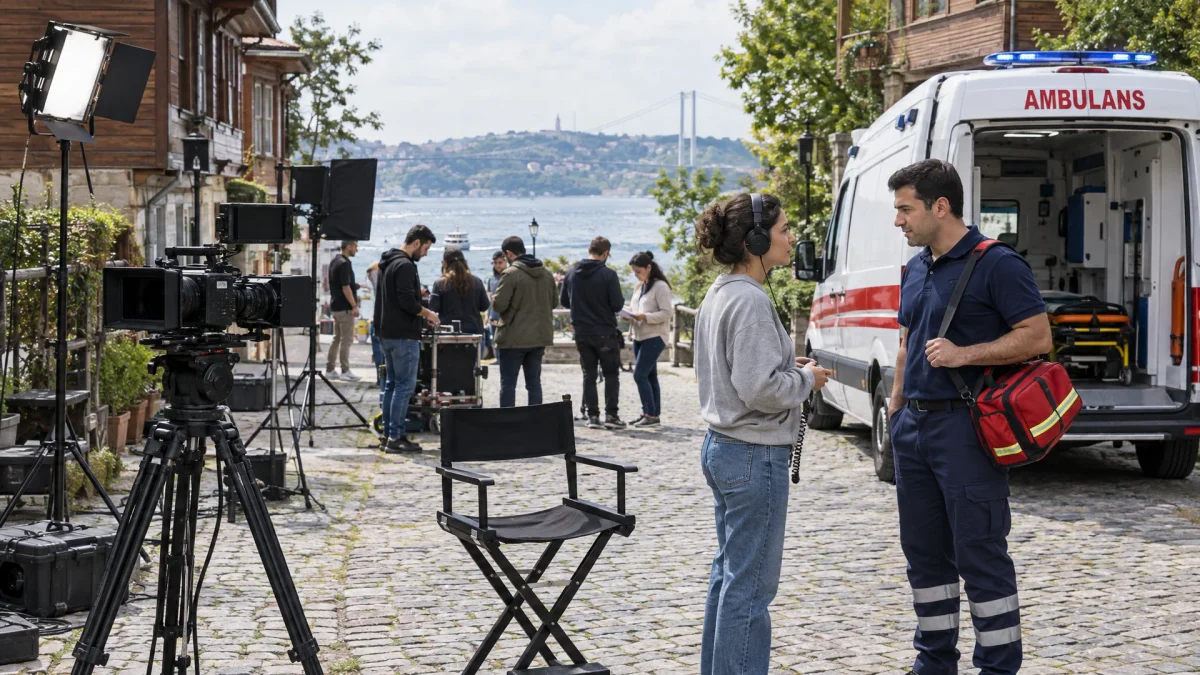
Television, film, and commercial productions may look glamorous from the outside, but behind the scenes they involve intense physical work, long hours, and genuine health risks 12. From high falls and pyrotechnics to heavy equipment and extreme weather, production sets present hazards that demand medical preparedness. Under occupational health and safety (OHS) regulations, on-site medical coverage is recommended on the basis of a risk assessment 4.
Quick answer. In Istanbul, the bulk of Turkish series and film shoots happen in Beykoz Kundura, Ayazağa, and Pendik-Tuzla studios. Any production company employing at least one worker is subject to the general employer duty under Article 4 of Turkey's Occupational Health and Safety Law No. 6331 to safeguard workers' health and safety 4. Law No. 6331 does not mention set ambulances specifically; the level of medical coverage follows from the production's own risk assessment 4. On productions with stunts, pyrotechnic effects or large crews, many producers choose a standby ambulance with an EMT/paramedic crew.
Istanbul Set Geography: Where Are the High-Risk Locations?
Turkish drama and film production is concentrated in Istanbul, and each studio district carries a different risk profile:
- Beykoz Kundura and Beykoz Studios: The home of period drama and feature films. Wooden sets, candles, sword choreography, and horse scenes elevate fire and trauma risk.
- Ayazağa, Maslak, Seyrantepe corridor: Advertising agencies and major commercial sets cluster here. High cranes, jibs, and generators on open lots, surrounded by heavy traffic that requires careful ambulance access planning.
- Güzelyalı (Pendik) and Tuzla axis: Action series favor this zone for fight, vehicle-explosion, and high-fall scenes. Coastal open lots and disused industrial backdrops mean access routes must be confirmed in advance.
- Sultanahmet, Balat, Karaköy historic streets: Narrow lanes can make ambulance maneuvering difficult. Reality shows and street shoots add crowd-control complexity.
Common Health Risks on Production Sets
Every set is different, but the most frequently encountered hazards share common themes:
- Action and stunt scenes: Traumatic injuries from falls, impacts, cuts, and closed trauma. In head-impact stunt cases, rapid assessment and prompt transport when needed are critical; AAFP concussion guidance focuses on ruling out cervical-spine injury and serious head trauma and on close symptom monitoring 5. A set ambulance service stands ready for exactly these scenarios.
- Pyrotechnic and special effects fires: Tipped candles in period dramas, smoke-machine respiratory reactions in commercials, controlled-explosion misfires in action shoots. For burns and chemical injuries, evidence-based first aid is to move away from the source and irrigate the burn with copious, lukewarm running water for at least 20 minutes 6.
- Long working hours and fatigue: Long shoot days can raise the risk of fatigue, fainting, and hypoglycemia.
- Weather exposure: Heat stroke on open lots in summer; hypothermia and frostbite risk during winter night shoots 2.
- Equipment accidents: Crush injuries caused by heavy lighting rigs, jibs, camera dollies, and grip hardware 1.
- Acute cardiac events: Chest pain in 50+ extras or hypertensive crew members. According to the American Heart Association, chest compressions (CPR) started early markedly improve the chance of survival, so starting without delay is critical 7.
Set Risk Matrix (Quick Reference)
| Scene type | Risk level | Recommended medical coverage |
|---|---|---|
| Dialogue, interior | Low | First aid kit + certified first aider |
| Outdoor, large crowd of extras (>50) | Medium | EMT/paramedic + first-aid point |
| Action, stunt, fire effects | High | An Emergency Ambulance (Acil Yardım Ambulansı) with crew; a physician on request depending on risk |
| Pyrotechnic, vehicle scene, high-fall stunt | Very high | Standby Emergency Ambulance with crew + on-site physician (on request) + hospital coordination |
Why Keep a Standby Ambulance on Set?
1. Immediate On-Scene Response
Production locations are often in remote areas, industrial zones, or neighborhoods with heavy traffic congestion. Waiting for an external ambulance to navigate to an unfamiliar set address wastes critical minutes 1. A standby ambulance crew can begin treatment on the spot, stabilize the patient, and then transport directly to the most appropriate hospital.
2. Legal Framework
In Turkey, the Occupational Health and Safety Law (No. 6331), Article 4, places the obligation on the employer to "take every measure necessary for the health and safety of workers"; Article 6 requires the employer to assign an occupational safety specialist and a workplace physician for OHS services, and -- in very-hazardous workplaces with ten or more employees -- to additionally assign other health personnel; Article 14 requires reporting any work accident to SGK within three working days 4. The Law does not itself mandate keeping an "ambulance" or an infirmary on set; maintaining a standby ambulance and EMT on site is a measure taken following a risk assessment (Article 4) and a common industry practice. Production companies typically fulfill this responsibility by contracting a private ambulance provider.
Internationally, similar standards exist. The UK's Health and Safety Executive (HSE) 1 and the US Occupational Safety and Health Administration (OSHA) 2 both provide guidelines for medical preparedness on film and television sets.
3. Crew Morale and Confidence
When the cast and crew know that medical support is on-site, they work with greater confidence and focus. This is especially important for performers executing physically demanding or potentially dangerous scenes. Knowing help is immediately available reduces anxiety and allows everyone to concentrate on their craft.
Planning Health Coverage for Your Production
Production managers and health-and-safety coordinators should address these questions during pre-production:
- Does the shooting schedule include high-risk scenes? Fights, vehicle chases, explosions, aerial work, and water scenes all warrant dedicated medical standby.
- Is the ambulance access route clear? Verify that the ambulance can always enter and exit the set location without obstruction.
- Are there cast or crew members with chronic conditions? Collect relevant medical information and share it (confidentially) with the on-set medical team.
- Have nearby hospitals been identified? Map the closest emergency departments and specialty centers (e.g., burn units, trauma centers) in advance.
- What is the night-shoot protocol? Reduced visibility and cold temperatures increase risk during overnight filming 3. Medical planning should account for these additional hazards.
Nova Ambulans Set Services
Nova Ambulans provides specialized health and safety solutions for the production industry:
- Fully Equipped Ambulance: All our vehicles are ICU-equipped Emergency Ambulances (Acil Yardım Ambulansı); a physician is added on request.
- Experienced Crew: Paramedics and emergency medical technicians familiar with the unique dynamics of a production environment.
- Flexible Scheduling: Coverage that adapts to day shoots, night shoots, and extended production hours.
- Confidentiality: Full respect for production secrecy and intellectual property.
Nova Ambulans has provided ambulance services since 2010 and has completed more than 1,100 health-standby and event/organisation jobs (operations records since March 2022, data date 23.10.2026). All 7 vehicles in our fleet are Emergency Ambulances (ALS, ICU-equipped) as standard; a physician can join the crew on request. We plan coverage with the production team in advance: call times, set location, the ambulance's access route and the nearest suitable hospital. To book a standby ambulance for your shoot, call 0216 339 00 39 or send a WhatsApp message to 0549 461 34 00, 24/7.
A Quick Safety Checklist for Cast and Crew
- Stay hydrated throughout the day; avoid heavy meals before physically demanding scenes.
- Always perform warm-up exercises before action, fight, or dance sequences.
- Report any feeling of illness or discomfort to the set manager and medical team immediately.
- Never remove safety equipment (harnesses, helmets, knee pads) for aesthetic reasons -- scene design should accommodate protective gear 2.
- Know the location of the on-set ambulance and the quickest route to reach it.
A well-run production is measured not only by the quality of its content but also by the value it places on human life. Integrating health planning and ambulance services from the very start of your project minimizes risk and gives the entire team confidence to do their best work.
Frequently Asked Questions
Is it legally required to have medical staff on film sets?
Under occupational health and safety regulations, the employer must take the health and safety measures identified by a risk assessment; on hazardous scenes an on-site medical team and ambulance standby are strongly recommended. While Law No. 6331 does not impose a specific "keep an ambulance" mandate, ambulance standby for action scenes and stunt work is an established industry practice.
What are the most common health issues on film and TV sets?
Fatigue from long working hours, heat-related illness, falls and crush injuries, allergic reactions to special effects materials, and stress-related conditions are among the most frequently reported health issues on production sets.
How is ambulance standby service planned for a production?
Planning is based on the shooting schedule, scene risk analysis, set location, and number of crew and cast. Nova Ambulans provides on-site medical teams that remain on standby throughout the production period.
What does on-set medical coverage include?
It depends on the production's risk assessment. For low-risk interior scenes, the first aid arrangements identified in that assessment may be sufficient. For action, stunt or fire-effect scenes, an Emergency Ambulance and its crew can stay on set for the whole shoot, and a physician can join on request.
How do we book a set ambulance and how is it priced?
Share the shoot dates, hours, location and scene types with us by phone on 0216 339 00 39 or by WhatsApp on 0549 461 34 00. The price depends on how long the standby lasts, the location and the crew required. We give you a quote before the shoot.
Sources
Numbers in the text refer to the sources below.
- AAFP Clinical Recommendations for Acute and Chronic Conditions (opens in a new tab)American Academy of Family Physicians (AAFP)
- ANZCOR Guideline 9.1.3 -- First Aid for Burns (opens in a new tab)Australian and New Zealand Committee on Resuscitation (ANZCOR)
- Starting bystander CPR within 10 minutes of cardiac arrest may improve survival (opens in a new tab)American Heart Association
Nova Ambulans Sağlık Kurulu (Medical Board)
Periodically reviewed by our editorial board of emergency physicians, paramedics and clinical coordinators.
This content is informational only and does not replace professional medical evaluation. In emergencies, call 112 or +90 216 339 00 39.