- Bus Safety: Check seat belts and provide an emergency info card.
- Health Plans: Inform school about allergies, asthma, and medications.
- Injuries: Use RICE protocol for sprains; clean cuts with water.
- Red Flags: Call 112 or Nova Ambulans for breathing issues, severe allergic reactions, or head trauma.
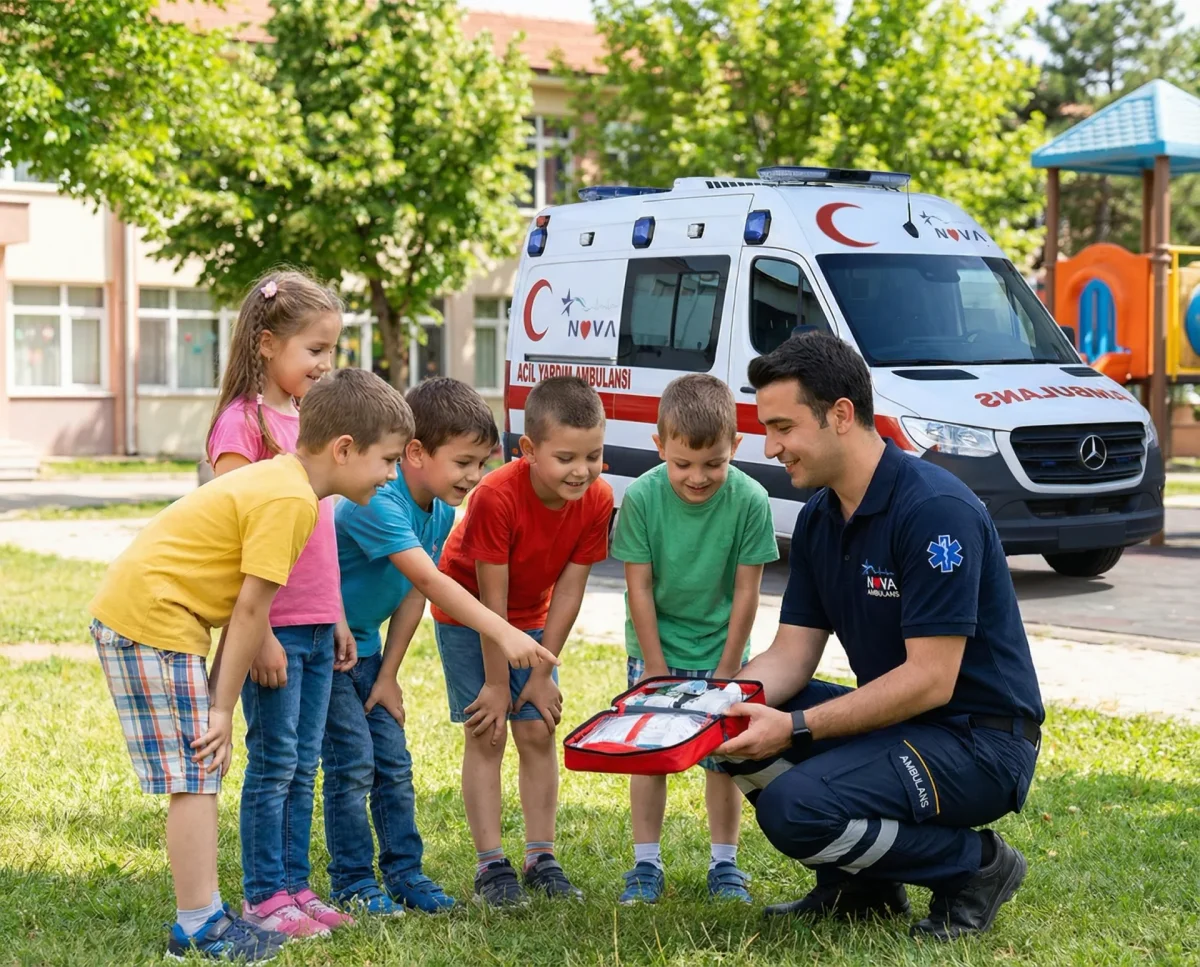
September brings back-to-school energy—and with it, more daily movement for kids. School buses, playgrounds, gyms and club activities can increase minor injuries and unexpected health issues [3]. The checklist below targets the 2026–2027 academic year for Istanbul families and schools, aligning the Turkish Ministry of National Education (MEB) school-health framework with international clinical guidance for asthma, anaphylaxis, and head-injury triage.
Back to School 2026: Emergency and First Aid Guide
1) School and Bus Safety Checklist
- Are seat belts functional and properly used on the bus? Is your child seated correctly with height-appropriate belts?
- Add an information card in the backpack including:
- Parent/guardian name and phone
- Physician info (if applicable)
- Known allergies (medication, food, insect)
- Chronic conditions (asthma, epilepsy, diabetes…)
- Clarify how the school counsellor / health coordinator will be contacted in an emergency. Under the Turkish Ministry of National Education (MEB) school-health framework, monitoring students with chronic conditions (diabetes, asthma, coeliac disease, etc.) at school is the school health nurse's responsibility; the nurse advises teachers and families. It is important for the family to give the child's medication and action plan to the school administration and the nurse in writing [7].
- Prepare a family emergency plan (who calls whom, backup contacts, home–work distance and ETA).
2) Allergies, Asthma and Chronic Conditions
- Provide signed consent forms and physician notes for regular medications.
- Asthma school coordination: Keep a spare inhaler, spacer, and a written asthma action plan with the teacher and the counselling office; locking the inhaler in a cabinet defeats the purpose because symptom onset gives only minutes [1][2].
- Severe allergies and the EpiPen protocol: AAFP guidance is explicit — first-line treatment for anaphylaxis is "intramuscular epinephrine into the anterolateral thigh," ideally administered within the first few minutes of symptom onset [4]. For a child with a documented anaphylaxis risk, it is recommended to keep an adrenaline auto-injector both at school and with the child; having at least two adults (for example the class teacher and the nurse/administrator) trained in its use is important for safety [8]. How this is arranged varies by school and resources; in Turkey, adrenaline auto-injectors are not routinely stocked in pharmacies and are often sourced from abroad, so family supply and sharing with the school matters [8]. AAFP also suggests schools consider maintaining an "institutional supply of epinephrine auto-injector for general use" [4].
- Paediatric asthma action plan: A green–yellow–red zone plan (peak-flow or symptom-based) should be visible in the classroom; the PE teacher needs to know the pre-exercise rescue-inhaler rule.
3) Sports and Play Injuries: First Steps
- For ankle sprains/knee twists: RICE protocol—Rest, Ice, Compression, Elevation [1][2].
- For cuts: gently rinse with clean water; if bleeding, apply pressure with sterile gauze [1].
- For head bumps with red flags (dizziness, vomiting, drowsiness): stop activity and seek medical assessment [2].
4) When to Call 112 or an Ambulance
“Red flag” symptoms may signal a serious condition:
- Shortness of breath, wheezing, cyanosis, difficulty speaking [1][2]
- Altered consciousness, repeated vomiting, seizures
- Severe allergic reaction (tongue/lip/throat swelling, widespread hives) [1][3]
- Uncontrolled bleeding or obvious deformity (suspected fracture)
- Severe abdominal pain, with fever and weakness
Call 112 or Nova Ambulans (0216 339 00 39) in these situations. Nova Ambulans can support with rapid access, the right equipment and experienced staff.
5) Mini Emergency Kit for the Backpack
- Assorted bandages and small sterile gauze
- Medical tape, small scissors, disposable gloves
- Antiseptic wipes, instant cold pack
- Personal medications with instructions (if any)
6) Communication and Education
- Keep regular contact with teachers/admin; watch for bullying, anxiety and psychosomatic signs.
- Teach your child simple first aid: pressure on bleeding, leaning forward for nosebleeds with gentle pinch.
Being prepared reduces panic and helps you make better decisions.
Frequently Asked Questions
What should a school first aid kit contain?
A school first aid kit should include adhesive bandages, sterile gauze, antiseptic wipes, an instant cold pack, medical tape, scissors, disposable gloves, a Cardiopulmonary Resuscitation (CPR) face shield, and any student-specific medications like epinephrine auto-injectors or inhalers.
When should a school call an ambulance for a child?
Call an ambulance immediately for loss of consciousness, severe breathing difficulty, serious allergic reactions (anaphylaxis), suspected fractures, seizures lasting more than 5 minutes, or any head/spinal injury. Do not attempt to transport a seriously injured child by car.
How can schools prepare for allergic emergencies?
Schools should maintain updated allergy action plans for each affected student, train staff on epinephrine auto-injector use, ensure medications are accessible (not locked away), and conduct regular emergency drills that include anaphylaxis scenarios.
Rapid Emergency Support
24/7 emergency ambulance service across Istanbul. Fast response, fully equipped team.
Average response time: 15 seconds
Related Articles
Dog and Cat Bite First Aid: Rabies Risk, the 15-Minute Wash and When to Call 112
If a dog or cat bites or scratches you, wash the wound at once with plenty of soap and water for at least 15 minutes, press directly on it if it bleeds, cover it with a clean cloth and go to a health facility the same day. Rabies cannot be treated once symptoms begin; a doctor decides whether you need the vaccine. Call 112 for bleeding that pressure does not stop or for any threat to life.
EducationMushroom Poisoning Symptoms and First Aid: When Do Symptoms Start, When to Call 112?
If nausea, vomiting, diarrhea, abdominal pain or any other symptom begins after eating foraged mushrooms or mushrooms of unknown origin, call 112, whatever hour it began; do not induce vomiting and give nothing by mouth. People without symptoms, including a child who ate a mushroom in a garden or park, still need hospital assessment; call 112 and explain, because with amatoxin, which damages the liver, the symptom-free interval averages 8-10 hours. The National Poison Information Center (UZEM) on 114 gives advice but does not replace 112.
EducationTick Bite First Aid: Correct Removal Technique and the Crimean-Congo Haemorrhagic Fever (CCHF) Decision
When a tick attaches to the skin, the bystander’s step-by-step response: gloved, fine-tipped tweezers gripping the tick’s head as close to the skin as possible with steady upward traction, no alcohol, petrol, nail polish, matches or lit cigarettes, saving the removed tick in a labelled sealed plastic bag, a 14-day watch schedule for Crimean-Congo Haemorrhagic Fever (CCHF), the 112 decision when a fever, severe muscle pain, bleeding or profound weakness appears, and safe transfer to an infectious-diseases clinic — with primary sources from the Turkish Red Crescent 2025 First-Aid Pocket Book, the Turkish Ministry of Health May 2025 First-Aid Training Manual, the Turkish Red Crescent Esenyurt First-Aid Training Centre 2024 verbatim protocol, the Turkish Ministry of Health CCHF Scientific Council bulletin, Karanfil et al. 2026 (n=7,776 national surveillance), Güllü et al. 2025 (n=1,103 18-hospital cohort), the World Health Organization (WHO) 2025 fact sheet, the European Centre for Disease Prevention and Control (ECDC) factsheet, and Norman et al. 2025 European review.
Popular Ambulance Topic Clusters
You may also like
- Private ambulance pricing
- Istanbul private ambulance
- Intercity patient transport
- Doctor-accompanied ambulance
- Dialysis patient transport
- How intercity patient transport works
- Ambulance response time in Istanbul
- Home-to-hospital patient transport
- Modern ambulance equipment and team standards
- Heart attack symptoms and first response
This content is informational only and does not replace professional medical evaluation. In emergencies, call 112 or +90 216 339 00 39.
