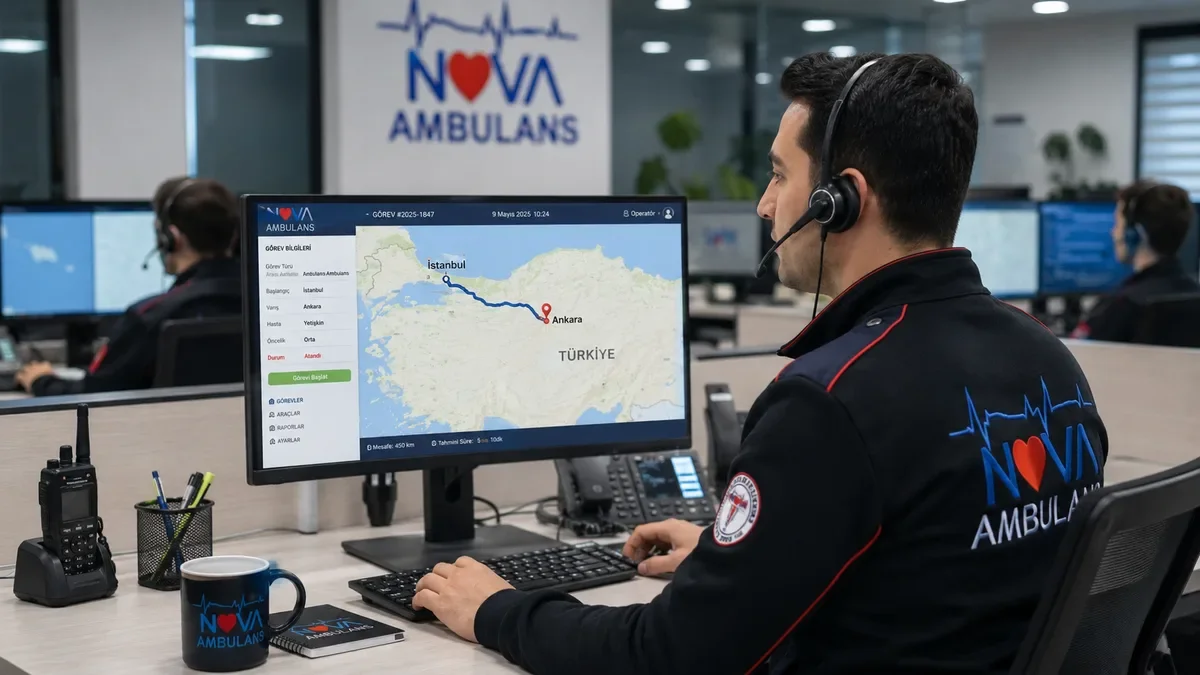
- Intercity booking starts with a clear clinical briefing, route details, and timing.
- The right ambulance class and team are selected according to patient risk, not only distance.
- Family communication, handover planning, and document readiness reduce transfer risk.
Intercity ambulance booking is not only a transport request. It is a clinical and operational plan that starts before departure and continues until handover at the destination facility. In İstanbul and across Turkey, families usually need quick, clear answers about eligibility, timing, and the process. The World Health Organization (WHO) underscores that "delays of minutes can make the difference between life and death" in time-critical care [2] — and the same time-discipline applies to scheduled long-distance transport.
Each mission is planned according to patient stability, required monitoring level, route conditions, and destination acceptance. Turkey's Ambulance Services Regulation (8 January 2025) defines vehicle types in Article 5 and intercity waiting rules in Article 30/1-k [1][4], while real-time route hazards are checked through KGM's road-conditions feed [3]. SGK does not, as a rule, reimburse private intercity ambulance services that the patient initiates. [5]
Why Intercity Transfer Needs Special Planning
There are important differences between in-city transport and an intercity transfer:
- Distance and duration: Travel time is measured in hours; patient comfort and safety must be maintained over a long period
- Team competence: An experienced crew is needed in case the clinical picture changes on a long route
- Equipment adequacy: Oxygen reserve, drug stock, and emergency-intervention equipment must be planned in proportion to the distance [1]
- Logistical coordination: Pickup point, destination facility, route, rest plan, and handover procedure must be coordinated
- Continuity of communication: Contact with the family, patient, and (where relevant) the destination hospital must be maintained throughout the journey
The Booking Process: 7 Steps
1. First Contact
You reach the operations team by phone (0216 339 00 39) or WhatsApp. On the first call, share these essentials:
- The patient's general condition (stable / under observation / intensive care)
- Pickup and destination cities
- Planned date and any appointment time
- Urgency level (planned / semi-urgent)
2. Patient Information Sharing
Detailed patient information is critical for assigning the right ambulance and team:
- Identity details: First name, last name, age
- Current medical status: Diagnosis, stage of treatment, latest clinical assessment
- Mobility level: Bed dependency, sitting tolerance, ability to walk unaided
- Stretcher need: Is a stretcher required, or is a wheelchair suitable
- Medical-support requirements: Oxygen use, SpO2 monitoring, ECG monitoring, IV infusion
- Medication details: Active treatment protocol, drugs to be administered en route
- Allergies and special conditions: Drug allergies, diabetes, epilepsy, and similar considerations
3. Address and Logistics Details
Address details are important for the operation to proceed smoothly:
- Pickup address: Building floor, elevator availability and capacity, stretcher clearance width, building entrance
- Destination address: Hospital name, department, admission details, appointment time
- Planned date and time: If there is an appointment time, the departure time is calculated from the route duration
- Companion details: How many people, and whether they ride in the ambulance or follow in a separate vehicle
4. Ambulance and Team Assignment
The appropriate ambulance class and team structure are determined from the patient information:
| Ambulance Class | Team Structure | Suitable Patient Profile |
|---|---|---|
| Standard transport | Paramedic/EMT + driver | Stable, needs a stretcher, no continuous monitoring required |
| Doctor-led ambulance | Physician + paramedic + driver | Active medication management, clinical-decision needs, moderate risk |
| ICU ambulance | Physician + health personnel + driver | Ventilator-dependent, needs intensive-care-level monitoring |
The ambulance type is recommended by the operations team based on the patient information. The final decision is made in coordination with the patient's treating physician. [1]
5. Transparent Pricing
All cost components are stated clearly before the service:
- Distance-based fee: Calculated by route kilometers [3]
- Ambulance class: An ICU ambulance is priced differently from a standard transport ambulance
- Team structure: A doctor-led ambulance includes an additional physician fee
- Night / weekend / public holiday: No surcharge applies
- Extra equipment: Any special equipment need (for example, a portable ventilator) is stated separately
The price is finalized in the first conversation. There are no later add-on charges.
6. Pre-Transfer Confirmation
Final coordination is done before the transfer day (usually one day prior):
- Confirmation of the pickup and departure time
- Checking whether the patient's condition has changed
- Verifying the destination hospital's acceptance status
- Companion preparation briefing (ID, patient file, medications)
- A final check of building-access details
7. Transfer and Handover
The team arrives at the planned time and follows this process:
- On-site patient assessment and safe loading
- Recording vital signs before loading
- Continuous monitoring and regular vital-sign recording throughout the journey
- Continuity of family communication (road status, estimated arrival)
- Detailed clinical handover and written transfer to the destination facility
For case-based planning — for example, a Friday-evening İstanbul-Antalya transfer (~720 km / 8-9 hours) where oxygen needs, building access at the pickup, and destination admission time all need to align in one call — reach Nova Ambulans at 0216 339 00 39. This first call determines whether an emergency ambulance, ICU ambulance, or home-to-hospital transfer setup is most appropriate.
Information You Should Share: Summary Table
| Information Category | Detail | Why It Matters |
|---|---|---|
| Patient mobility status | Bedridden / can sit / can walk | Determines ambulance class and team structure |
| Stretcher need | Required / preferred / not needed | Equipment and loading plan |
| Oxygen/monitoring need | Oxygen L/min, SpO2, ECG, blood pressure | Equipment level and team competence |
| Building floor and elevator | Floor no., elevator size, stair width | Operation duration and extra-staff need |
| Appointment/admission time | Destination hospital appointment time | Departure timing and route plan |
| Number of companions | In the ambulance and in a separate vehicle | Capacity planning |
| Active medication therapy | Drug name, dose, administration time | Medication management en route |
Distance and Duration References
The durations below are estimates under normal traffic conditions. An ambulance uses its right of priority passage when needed, but on planned transfers it generally proceeds in normal traffic flow. [3]
| Route | Distance (km) | Estimated Duration |
|---|---|---|
| İstanbul — Ankara | ~450 | 5-6 hours |
| İstanbul — İzmir | ~480 | 5-6 hours |
| İstanbul — Antalya | ~720 | 8-9 hours |
| İstanbul — Bursa | ~155 | 2-3 hours |
| İstanbul — Eskişehir | ~330 | 3.5-4.5 hours |
| İstanbul — Trabzon | ~1,070 | 12-14 hours |
| Ankara — İzmir | ~590 | 6-7 hours |
| Ankara — Antalya | ~480 | 5-6 hours |
Note: Snow and ice in winter and holiday traffic in summer can affect durations. The route plan is updated according to these factors.
Insurance and Payment Information
SGK Coverage
SGK (Turkey's Social Security Institution) does not cover private ambulance services that the patient requests on their own. [5] However, within the SGK referral system, the ambulance fee for inter-hospital transfers carried out with a medical-necessity report may be partly covered at the minimum tariff. Emergency ambulance service under SGK is provided through the 112 system. The full text of the Ambulance Services Regulation is held on the Mevzuat Information System. [4][1]
Private Health Insurance
Private health insurers' ambulance coverage depends entirely on the policy terms:
- Some complementary health insurance (TSS) plans may cover the ambulance fee partly or fully
- Intercity transfer coverage varies from policy to policy
- Our recommendation: Confirm the scope of your policy with your insurer before requesting the service
- Nova Ambulans prepares, as standard, all documents needed for insurance reimbursement (invoice, service report, team/vehicle details)
Payment Methods
- Cash
- Credit/debit card (in-vehicle POS)
- Bank transfer/EFT
- All services are invoiced
24/7 Service Across All 81 Provinces
Nova Ambulans provides intercity ambulance service to all 81 provinces of Turkey. No surcharge applies at night, on weekends, or on public holidays. The operations team is reachable 24 hours a day, 7 days a week.
On long-distance transfers, rest stops, driver rotation, and crew rest periods are planned in line with the regulation and highway traffic rules. [1][3]
Frequently Asked Questions
Can a booking be made on the same day?
Same-day service may be available depending on capacity. However, planning at least one day in advance improves team coordination, building-access planning, and operation quality. For a same-day departure in urgent cases, call 0216 339 00 39.
Should a stable patient also be transported by ambulance?
Patients who need a stretcher, cannot sit, require continuous monitoring, or need medical support throughout a long journey should be transported by ambulance even if they are stable. A long-distance transfer in a regular vehicle is risky both legally and medically.
Does a route change affect the price?
Yes. A route change can affect the price because it changes the duration and operational planning. Changes should be reported as early as possible; if there is a price difference, it is communicated before the transfer.
Can a companion travel in the ambulance?
One companion is accepted in standard and doctor-led ambulances. In ICU ambulances, companion capacity may be limited because the patient-care area is larger. If a second companion is needed, following in a separate vehicle is recommended.
What happens if the patient's condition worsens en route?
The team monitors continuously throughout the journey and responds to changes in vital signs. When necessary, the patient is directed to the nearest suitable hospital along the route. Coordination with 112 is possible at any moment.
Can a ventilator-dependent patient be transported?
Yes. In an ICU ambulance, ventilator-dependent patients are transferred safely with a portable ventilator, monitor, and the necessary medication support. A physician must accompany these transfers.
Related Articles
- How Intercity Patient Transport Works — A detailed walkthrough of the intercity ambulance transfer process.
- How Intercity Private Ambulance Pricing Is Calculated — The distance and team factors that determine the intercity transfer fee.
- What Determines Private Ambulance Costs? — Factors that affect ambulance pricing and our transparent fee policy.
Intercity Ambulance Transfer Service
Safe and fast intercity patient transport across Turkey. ICU support included.
Average response time: 15 seconds
Related Articles
How Intercity Private Ambulance Pricing Is Calculated
Intercity private ambulance pricing is shaped by distance, clinical risk, staffing, equipment, and operational planning factors.
Service UtilityThe History of Ambulance Services in Turkey: From Hilâl-i Ahmer to 077 Hızır Acil and 112 (2026)
A sourced, chronological history of ambulance services in Turkey — from the battlefield medical transport of Hilâl-i Ahmer (founded 1868), to 077 Hızır Acil, the country's first modern ambulance service opened in Ankara on 9 October 1985, through the 112 emergency system, UMKE, air and sea ambulances, and the licensed private-ambulance sector regulated by the 2025 ordinance — built on primary sources and Official Gazette dates, clarifying the public vs private division of labour.
Service UtilitySummer Vacation Ambulance Services in Türkiye: Health Safety in Holiday Regions (2026)
Planning intercity private patient transport at the end of summer vacation, the line between 112 emergency services and private ambulance providers in holiday regions, bystander step-by-step decisions in drowning and heatstroke — with the verbatim text of Türkiye's Ministry of Health 8 January 2025 and 24 June 2025 ambulance regulations, the Turkish Red Crescent First Aid Pocket Book 2025 protocols, the Turkish Statistical Institute's 2025 tourism figures, and the 13-year Sinop coastal drowning series.
- Ambulance Services Regulation (Official Gazette 8/1/2025-32776)T.C. Ministry of Health ↗
- WHO — Road Traffic Injuries Fact SheetWorld Health Organization ↗
- KGM — Real-Time Road Conditions SystemTurkish General Directorate of Highways ↗
- Mevzuat Information System — Ambulance RegulationTurkish Legislation Database ↗
- SGK — Health Services Pricing CommissionSocial Security Institution ↗
Popular Ambulance Topic Clusters
You may also like
- Private ambulance pricing
- Istanbul private ambulance
- Intercity patient transport
- Doctor-accompanied ambulance
- Dialysis patient transport
- How intercity patient transport works
- Ambulance response time in Istanbul
- Home-to-hospital patient transport
- Modern ambulance equipment and team standards
- Heart attack symptoms and first response
This content is informational only and does not replace professional medical evaluation. In emergencies, call 112 or +90 216 339 00 39.
