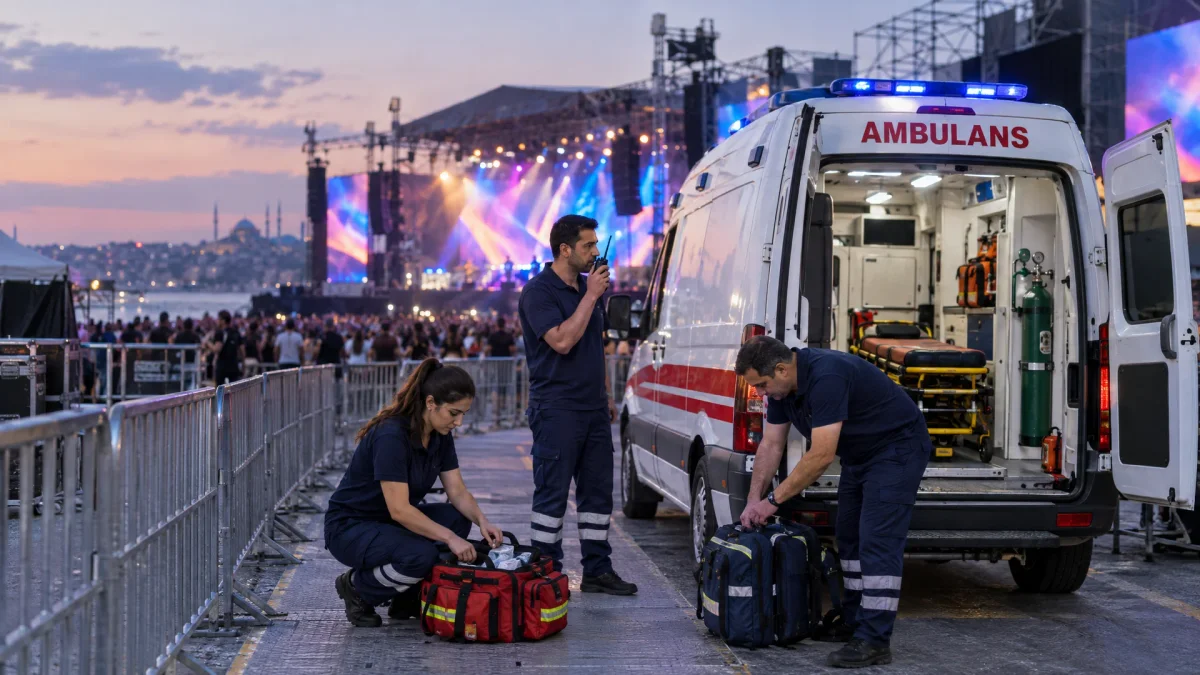
- Concert medical coverage requires an emergency ambulance, not a patient transport ambulance, by regulation.
- Risk assessment must cover participant count, venue layout, alcohol service, duration, and weather.
- High-risk concerts call for a doctor-led ambulance and experienced Ambulans ve Acil Bakım Teknikeri (AABT) paramedic crew.
- Backstage technical crew and performers must also be covered under OHS health provisions.
Health planning for concerts and festivals begins not on stage but in the queue areas, near the barriers, and with attendees overcome by heat or under the influence of alcohol. Effective health planning happens during the design phase of the event, not at the moment an incident occurs.
This guide covers ambulance selection specific to concert and festival settings, risk assessment, team structure decisions, health plan elements, and provider evaluation criteria.
Which Ambulance Can Be Used?
Under the Ministry of Health regulation, a patient transport ambulance cannot be used for event medical coverage. Only an emergency ambulance (acil yardım ambulansı) may be used at concerts. [6]
This distinction is especially critical in concert settings. Standing by and intervening on site falls within the functional definition of the emergency ambulance. A patient transport ambulance is licensed only for planned transfers and cannot be legally positioned at a concert venue. [6]
Emergency Ambulance Requirements
Personnel structure is set by Article 7 of the regulation, and equipment by its Annex-1/Annex-2 lists. [6]
| Equipment / Personnel | Standard |
|---|---|
| Defibrillator (Automated External Defibrillator, AED — or manual) and cardiac monitor | Mandatory [6] |
| Ventilator and oxygen system | Standard emergency-ambulance equipment [6] |
| Medication and consumables set | Compliant with the regulation standard [6] |
| Team leader | Physician, paramedic (Ambulans ve Acil Bakım Teknikeri, AABT) or module-trained emergency medical technician (ATT) [6] |
| Minimum personnel | At least 3 people: team leader + one other health worker + driver [6] |
Risk Assessment by Concert Format
Different concert formats create different risk profiles. The table below shows the factors that influence the risk level and how they combine. The participant-count and duration thresholds in the table (e.g. 500 and 2,000 people, 3–6 hours) are not drawn from regulation; they are operational recommendations derived from mass-gathering health planning good practice (risk-assessment approaches). [8]
Risk Factors
| Factor | Low Risk | Medium Risk | High Risk |
|---|---|---|---|
| Participant count | <500 | 500–2,000 | >2,000 |
| Alcohol service | None | Limited | Free-flowing |
| Venue | Indoor, seated | Indoor, standing | Outdoor, standing |
| Duration | <3 hours | 3–6 hours | >6 hours |
| Weather | Mild / air-conditioned indoor | Seasonal norm | Extreme heat/cold/rain |
| Age profile | Adult (25–55) | Mixed | Young (15–25) |
| Genre / performance | Acoustic/jazz/classical | Pop/rock | Heavy metal/electronic/rap |
| Multi-day event | Single day | - | Multi-day festival |
Recommended Structure by Risk Level
| Risk Level | Ambulance Structure | Team Recommendation |
|---|---|---|
| Low | 1 emergency ambulance | Standard crew led by a paramedic |
| Medium | 1 emergency ambulance + medical point | Experienced paramedic crew |
| High | 1+ emergency ambulance + medical point | Doctor-led ambulance, experienced AABT crew |
| Very high (festival) | Multiple ambulances + fixed medical station | Physician + paramedic + nurse, shift rotation |
Note: Risk level should be assessed by the combination of factors, not a single factor. For example, a 300-person indoor acoustic concert is low risk, while a 300-person outdoor night concert with alcohol service rises to medium-high risk.
Team Structure
Standard Concert Medical Coverage
- Emergency ambulance + crew led by a paramedic (AABT)
- Suitable for: medium-scale, low-to-medium-risk events
- A paramedic crew can perform trauma assessment, basic and advanced life support, medication administration, and patient stabilization
- A 112 escalation protocol should be ready
Doctor-Led Ambulance
- Physician-led crew + fully equipped emergency ambulance
- Suitable for: large concerts (>2,000), high-risk formats, night programs, multi-day festivals
- The physician provides active clinical decision-making capacity: medication changes, interpreting the clinical picture, hospital referral decisions
- Offers a critical advantage in life-threatening scenarios such as anaphylaxis, cardiac arrest, severe trauma, and heat stroke
When Should a Doctor-Led Ambulance Be Chosen?
- Participant count above 2,000
- Combination of alcohol service + night program
- Outdoor + extreme heat or cold
- Predominantly young audience (ages 15–25)
- High-intensity genres (mosh pit, pogo)
- Venues where travel time to the nearest hospital exceeds 15 minutes
- Multi-day festival format
Health Plan Elements
A concert health plan should cover the following:
- Ambulance access route — independent of barriers and security points, at least 3.5 meters wide, free of parked vehicles and obstacles, with adequate lighting for night visibility
- Medical point (first-aid station) — close to the ambulance, clean, well-lit and ventilated, with a stretcher, chairs, basic medical supplies, water, and a private enclosed area
- Security coordination — a shared radio channel, a medical emergency signal, a crowd-management protocol, and a crowd-clearance procedure
- Escalation plan — a 112 communication channel and protocol, a triage plan for mass-casualty scenarios, and conditions for calling a second ambulance
- Destination hospital — the nearest suitable hospital identified in advance (emergency-department capacity and specialty: trauma, cardiology), route and estimated travel time, and alternative options
Provider Selection Criteria
When obtaining concert ambulance services, we recommend asking these six questions:
- Is the Ministry of Health license current? Working with an unlicensed or expired provider creates legal liability; request the license document.
- Is the ambulance in the emergency class? A patient transport ambulance cannot be used for medical coverage. [6] Check the vehicle license for the "emergency ambulance" designation.
- How is the crew assigned? Question the qualifications, diplomas, and certificates of paramedics (AABT), ATTs, and physicians. Prefer personnel experienced in event medical coverage.
- Is a doctor-led option available for high-risk scenarios? Some providers offer only a paramedic crew; if concert risk is high, a doctor-led option matters.
- Are KVKK-compliant documentation and a service contract in place? Protecting the personal health data of those treated is a legal requirement.
- Are ambulance access routes planned in advance? A quality provider conducts a site survey or requests detailed venue information.
Backstage Crew Health: An OHS Requirement
An often-overlooked area in concert health planning is backstage. Under Occupational Health and Safety Law No. 6331, the technical crew, stage hands, and performers working on the production are also covered by OHS. [7]
Backstage Health Risks
- Falls from height: during stage assembly and teardown
- Electric shock: sound and lighting systems
- Heat exposure: long hours under stage lights
- Heavy lifting: loading and unloading equipment
- Noise exposure: prolonged high decibel levels
The organizer is legally obliged to ensure worker health and safety, and the risk assessment must cover backstage as well. [7]
Frequently Asked Questions
Is an ambulance needed even for a small concert?
It depends on the risk profile. A 200-person indoor acoustic concert may be low risk. However, for outdoor events with alcohol and a night program, an ambulance should be considered even with a low headcount. Legal liability rests with the organizer.
When is a doctor-led ambulance needed?
A doctor-led ambulance is recommended for the combination of over 2,000 participants, alcohol service, an outdoor setting, a duration longer than 6 hours, and a young audience. The physician provides trauma intervention, anaphylaxis management, and rapid clinical decision-making capacity.
Is a medical team needed backstage too?
Yes. For large productions, health planning should also cover performers and the technical crew. Under OHS legislation, worker safety is the organizer's legal responsibility. [7]
Does the ambulance stay on site for the whole concert?
Yes. The ambulance is positioned at the venue for the duty period stated in the contract. A backup ambulance plan should be included in the contract in case of a hospital transfer.
Is a medical point (first-aid station) mandatory?
The regulation sets no specific participant threshold for a medical point. As mass-gathering health planning good practice, however, providing a medical point at concerts above roughly 500 people is an operational recommendation that significantly improves both intervention quality and patient privacy; this threshold is derived from risk-assessment approaches, not from regulation. [8]
What happens if the concert is cancelled?
Cancellation terms should be specified in the service contract. In the event of cancellation due to weather, a security risk, or an organizer decision, charges are determined by the contract clauses.
Related Posts
- Is an Ambulance Mandatory for Event Medical Coverage? — For which events is an ambulance a legal requirement, and where is it recommended as good practice?
- Outdoor Events Health and Ambulance Planning — Risk assessment, ambulance positioning, and medical team planning for open-air events.
- Health and Safety on TV and Film Sets — Medical coverage and ambulance requirements on sets under OHS rules.
For concert and event ambulance bookings in Istanbul, contact Nova Ambulans at +90 216 339 00 39 or visit the event support service page.
Intercity Ambulance Transfer Service
Safe and fast intercity patient transport across Turkey. ICU support included.
Average response time: 15 seconds
Related Articles
Is an Ambulance Mandatory for Event Medical Coverage?
Is ambulance coverage mandatory at events? Learn which ambulance type the regulation allows, how to build an event medical plan, and when a doctor-led ambulance is required in Turkey.
Service UtilityThe History of Ambulance Services in Turkey: From Hilâl-i Ahmer to 077 Hızır Acil and 112 (2026)
A sourced, chronological history of ambulance services in Turkey — from the battlefield medical transport of Hilâl-i Ahmer (founded 1868), to 077 Hızır Acil, the country's first modern ambulance service opened in Ankara on 9 October 1985, through the 112 emergency system, UMKE, air and sea ambulances, and the licensed private-ambulance sector regulated by the 2025 ordinance — built on primary sources and Official Gazette dates, clarifying the public vs private division of labour.
Service UtilityPrivate Ambulance for Interhospital Transfer: What to Plan
Interhospital transfer with a private ambulance requires clear clinical communication, team fit, equipment readiness, and destination coordination.
- Directorate General of Emergency Health Services — 112 Emergency Health ServicesT.C. Sağlık Bakanlığı ↗
- Emergency and Critical CareWorld Health Organization (WHO) ↗
- AAFP Clinical Recommendations for Acute and Chronic ConditionsAmerican Academy of Family Physicians (AAFP) ↗
- Warning Signs of a Heart AttackAmerican Heart Association ↗
- ESC Clinical Practice GuidelinesEuropean Society of Cardiology (ESC) ↗
- Regulation on Ambulances, Emergency Health Vehicles and Ambulance Services (Official Gazette 8/1/2025-32776)T.C. Sağlık Bakanlığı (Ministry of Health of Türkiye) ↗
- Occupational Health and Safety Law No. 6331T.C. Çalışma ve Sosyal Güvenlik Bakanlığı (Ministry of Labour) ↗
- The Purple Guide to Health, Safety and Welfare at Music and Other EventsThe Events Industry Forum ↗
Popular Ambulance Topic Clusters
You may also like
- Private ambulance pricing
- Istanbul private ambulance
- Intercity patient transport
- Doctor-accompanied ambulance
- Dialysis patient transport
- How intercity patient transport works
- Ambulance response time in Istanbul
- Home-to-hospital patient transport
- Modern ambulance equipment and team standards
- Heart attack symptoms and first response
This content is informational only and does not replace professional medical evaluation. In emergencies, call 112 or +90 216 339 00 39.
