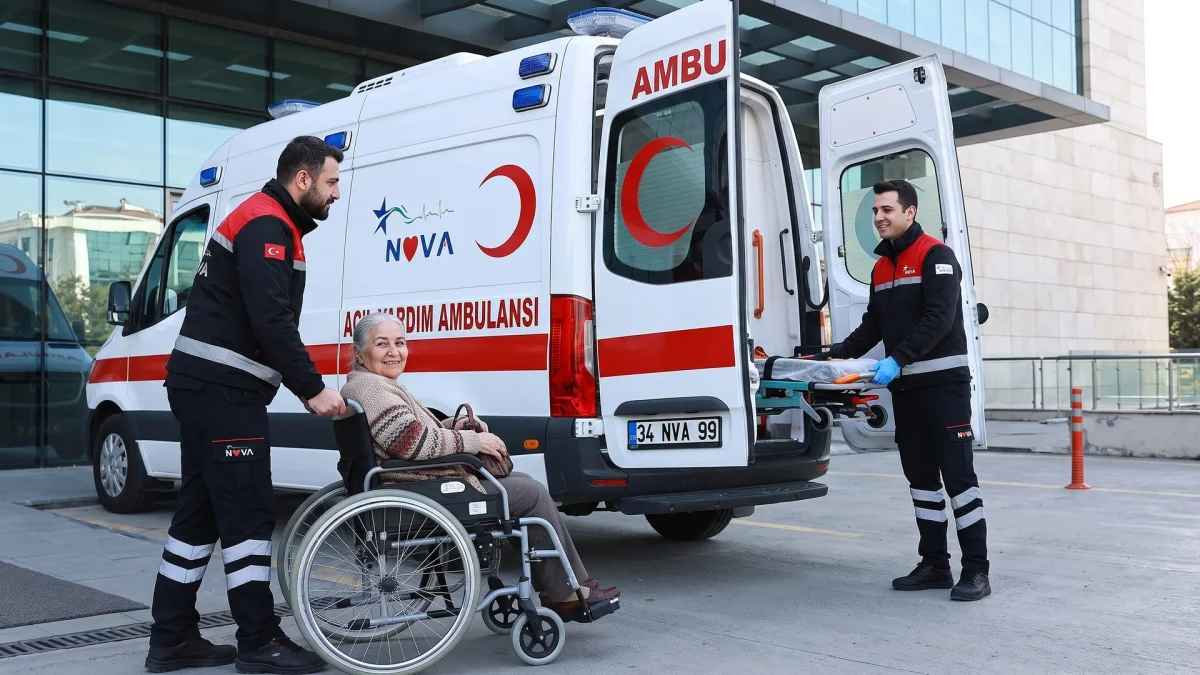
- Pre-Transport: Confirm discharge date and medical needs (stretcher, oxygen).
- Medication Plan: Prepare a written schedule for the first 72 hours.
- Home Prep: Secure rugs, clear paths, and set up the patient's room.
- Transport Day: Coordinate building access and have comfort items ready.
As discharge day approaches, excitement mixes with a demanding preparation process. Transport planning, medication schedules and readying the home are key to a smooth transition [1][2]. World Health Organization (WHO) reports that "an estimated 684,000 individuals die from falls globally" each year, with adults over 60 carrying the greatest fatal-fall burden [5]; Centers for Disease Control and Prevention (CDC) adds that "more than one out of four older people falls each year" [8] — making post-discharge home safety a transport-planning step, not a separate task. World Health Organization (WHO) further estimates "$42 billion USD annually" in global medication-error costs and names transitions of care as one of three priority action areas [9] — so medication reconciliation belongs inside the transport plan, not after it. Turkish ambulance providers are licensed under the regulation listed in the Mevzuat database. [7]
Hospital Discharge Transport Planning 2026
This guide moves through four stages: (1) pre-transport coordination with the hospital discharge planner, (2) medication reconciliation and equipment, (3) Istanbul-apartment-specific home prep, (4) transport-day handover. The hospital discharge coordinator (sosyal hizmet uzmanı in Turkish public hospitals) and the private ambulance team work in parallel through these stages.
1. Pre-Transport Planning and Hospital Coordination
- Confirm the discharge date and medical requirements with the physician [3].
- In large Istanbul hospitals (training and research, university, private chains) the discharge coordinator or social-work unit owns the transition plan; once the discharge summary is ready, the typical discharge window falls between 11:00–15:00, so booking the ambulance 24–48 hours ahead protects that slot.
- Arrange private ambulance if stretcher, oxygen or monitoring is needed [1].
- Gather documents: discharge summary, prescriptions, follow-up appointments, and any SGK referral paperwork.
- For end-of-life or advanced-illness home transfers, World Health Organization (WHO) notes that "early delivery of palliative care reduces unnecessary hospital admissions and the use of health services". [6]
2. Medication Reconciliation and Equipment
- Prepare a written 72-hour medication plan that places the patient's pre-admission regimen side-by-side with the discharge prescription so duplicate therapies (e.g., two anticoagulants), missing chronic medications, or dose changes surface before discharge — this matches the World Health Organization (WHO) "Medication Without Harm" reconciliation step. [9][3]
- Follow nurse/therapist guidance for wound care, pressure sore prevention and mobilization [1].
- Set up equipment in advance: bed, walker, wheelchair, oxygen concentrator and suction unit, with written operating instructions handed over.
3. Istanbul-Apartment Home Prep
- Reduce fall risk: secure rugs, tidy cables, use non-slip mats in bathrooms [4].
- Room setup: in our Istanbul field experience a clear door width of about 80 cm is needed for a stretcher to pass comfortably, plus adjusted bed height and good lighting.
- Istanbul-specific check: narrow elevator (in our field experience a flat stretcher will not fit a cabin floor smaller than roughly 90×120 cm, forcing a stair-chair transfer; the published standard TS EN 81-70 sets a stretcher-capable Class III lift cabin at 1100×2100 mm [10]), stairwell angle, building manager permission, and ambulance parking in narrow streets.
- Nutrition and hygiene: water/food stocks, disposable gloves, waste management.
4. Transport Day and Receiving-Facility Handover
- Building access: share security, door codes and elevator info with the crew.
- Comfort: blanket, pillow, personal items; be ready for waiting times.
- Communicate with the destination: arrival time and admitting unit.
Nova Ambulans supports planned transfers from hospital to home, home to hospital and between facilities with experienced teams. For example: a bedridden patient discharged tomorrow to a third-floor flat with a narrow elevator — the team coordinates stair-chair handling, oxygen concentrator handover, and the first 72-hour medication chart in one call.
Frequently Asked Questions
When should I book an ambulance for hospital discharge?
Book your ambulance transport at least 24-48 hours before the planned discharge date. This allows the medical team to prepare the appropriate vehicle, equipment, and staff based on the patient's condition and transfer distance.
Does health insurance cover discharge ambulance transport?
Many insurance policies cover medically necessary ambulance transport. Contact your insurance provider before discharge to confirm coverage details and obtain any required pre-authorization or documentation.
What medical equipment is available during discharge transport?
Depending on patient needs, ambulances can be equipped with oxygen systems, cardiac monitors, IV administration, suction devices, and patient warming systems. Specialized equipment requests should be communicated during booking.
How long does discharge transport planning typically take?
Once the discharge date is confirmed by the treating physician, transport planning — including route assessment, equipment preparation, and receiving facility coordination — typically takes 24-48 hours.
Rapid Emergency Support
24/7 emergency ambulance service across Istanbul. Fast response, fully equipped team.
Average response time: 15 seconds
Related Articles
Concussion Symptoms After a Fall or Head Injury: Bystander Guide (2026)
After a fall or head injury, concussion symptoms bystanders must recognize, step-by-step first aid, the CDC HEADS UP danger signs that require calling 112 immediately, age-specific notes for children and elderly patients, and the recovery timeline — grounded in Türk Kızılay 2025 First-Aid Pocket Book pp.19-20 and 47-48, T.C. Ministry of Health May 2025 First-Aid Training Book Chapter X.A and VII.B, Gazi University Pediatric Emergency PECARN application review, Turkish Neurosurgery 2025 national survey (n=1,875 neurosurgeons), JAMA April 2026 pediatric concussion systematic review, and CDC HEADS UP with WHO falls data.
EducationSuspected Fracture and Dislocation: Splinting, Immobilization, and Calling 112 (2026)
What a bystander does at the scene for suspected fracture, dislocation, sprain and strain — the Turkish Red Crescent 2025 First Aid Pocket Book (pp.38–42), the Turkish Ministry of Health May 2025 First Aid Training Book Chapter XII, the Gazi University 2026 Ankara pediatric hand-foot fracture series (n=278), the İstanbul University Çapa 12-month hip fracture mortality data, and the World Health Organization (WHO) falls factsheet applied to splinting, immobilization, and the 112 chain.
EducationHealth and Ambulance Planning for Outdoor Events
How to ensure participant safety by correctly planning health teams and ambulances for concerts, festivals, and sports events.
Popular Ambulance Topic Clusters
You may also like
- Private ambulance pricing
- Istanbul private ambulance
- Intercity patient transport
- Doctor-accompanied ambulance
- Dialysis patient transport
- How intercity patient transport works
- Ambulance response time in Istanbul
- Home-to-hospital patient transport
- Modern ambulance equipment and team standards
- Heart attack symptoms and first response
This content is informational only and does not replace professional medical evaluation. In emergencies, call 112 or +90 216 339 00 39.
