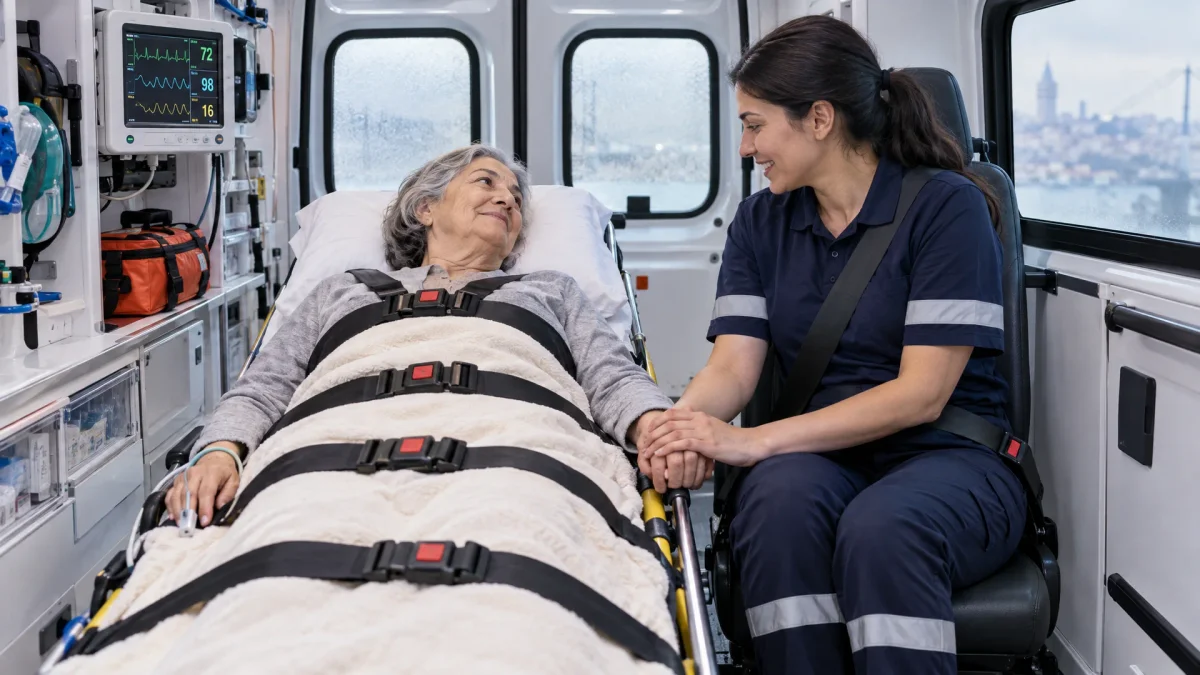
- Safety: Regularly maintained devices and trained personnel are essential.
- Comfort: Smooth journey is ensured with air conditioning and special suspension system.
- Privacy: Respect for patient privacy and ethical rules are priority.
- Communication: Patient and relatives are informed regularly throughout the process.
Speed is not the only goal in ambulance transport. Stability of medical condition, safety, and comfort must be ensured together [1][2]. EPUAP frames this clearly — its mission is to "provide relief for persons suffering from, or at risk of, pressure ulcers, through research and education" [4] — and TÜVTÜRK underlines that an ambulance without a valid emissions measurement "will be rated as severely defective" in inspection [5]. Ambulance types (ground, air, sea) and their technical and medical equipment requirements are set out in the full text and annexes (Annex-1, Annex-2) of the current Ambulance Services Regulation, published in the Official Gazette dated 8 January 2025 (No. 32776). [6] As Nova Ambulans, patient safety and comfort is our priority.
Precautions We Take for Patient Safety
- Correct Equipment and Vehicle Maintenance: Our ambulances are equipped with the latest technology medical devices, fitted in line with EN 1789, the standard for road ambulance medical equipment [1]. Calibrations and maintenance of all equipment (defibrillator, ventilator, monitors, etc.) are done periodically [1]. Mechanical maintenance of our vehicles is also not neglected.
- Trained and Experienced Personnel: Our teams consist of expert doctors, paramedics, and emergency medical technicians in their field. Our personnel keep their knowledge up to date by constantly receiving training on subjects like advanced life support and trauma management [2].
- Safe Fixation and Transport: Patients are fixed safely to the stretcher with belt systems; the stretcher and fixation system are additionally tested under EN 1865 [1]. The principle of "minimum shaking" is followed during transport [1][2]. Extra care is taken for spine and neck protection, especially in trauma patients [2].
- Infection Control: After every transfer, our ambulances and all equipment are meticulously cleaned with special disinfectants, minimizing the risk of infection transmission to the next patient [3].
Elements Increasing Patient Comfort
- Air Conditioning: The internal temperature of our ambulances is kept at an ideal level according to the patient's condition and seasonal conditions.
- Suspension Systems: Our vehicles have special suspension systems that minimize shaking caused by road conditions [1], which provides great comfort especially in long-distance transports.
- Privacy: Respecting patient privacy is one of our basic principles. All interventions and the transport process are carried out with this sensitivity.
- Communication: Our team is in constant communication with conscious patients and patient relatives. Giving information about the process, relieving the patient's concerns, and giving them morale is an important part of our job.
Frequently Asked Questions
Is there a comfort difference between private ambulance and 112 ambulance?
Although both ambulances meet mandatory standards in terms of medical safety, private ambulances generally focus on additional features that will increase comfort in longer road and planned transports. Details like suspension reducing shaking, extra pillow, and blanket are part of this difference.
Can air conditioning setting and light level be changed according to the patient inside the ambulance?
Yes; air conditioning and lighting are adjusted according to the patient's comfort and medical need. When the patient's feeling cold, sweating, or sensitivity to light is noticed along the way, the team changes these settings dynamically.
How is communication with the family ensured along the way?
If the companion is in the ambulance, regular information is given about the process; in cases where there is no companion, the team can inform relatives by phone at appropriate intervals. Transparent communication about arrival time and the patient's general condition contributes to a safer and calmer process.
Rapid Emergency Support
24/7 emergency ambulance service across Istanbul. Fast response, fully equipped team.
Average response time: 15 seconds
Related Articles
Ambulance Safety and Warning Signs on Night Highway
Basic rules increasing the safety of you and the environment when you encounter an ambulance on the highway at night or while waiting for an ambulance.
EducationComfort and Psychology in Long Distance Ambulance Travel
How is the patient's physical comfort and psychological support ensured in ambulance journeys lasting for hours? Tips for families.
EducationAmbulance Personnel Training Standards: 2026 Regulation Update
The 8 January 2025 and 24 June 2025 regulatory amendments made ministry-designated training modules mandatory for every ambulance health worker in Türkiye: hour breakdown, certification cycle, and a family verification checklist.
Popular Ambulance Topic Clusters
You may also like
- Private ambulance pricing
- Istanbul private ambulance
- Intercity patient transport
- Doctor-accompanied ambulance
- Dialysis patient transport
- How intercity patient transport works
- Ambulance response time in Istanbul
- Home-to-hospital patient transport
- Modern ambulance equipment and team standards
- Heart attack symptoms and first response
This content is informational only and does not replace professional medical evaluation. In emergencies, call 112 or +90 216 339 00 39.
