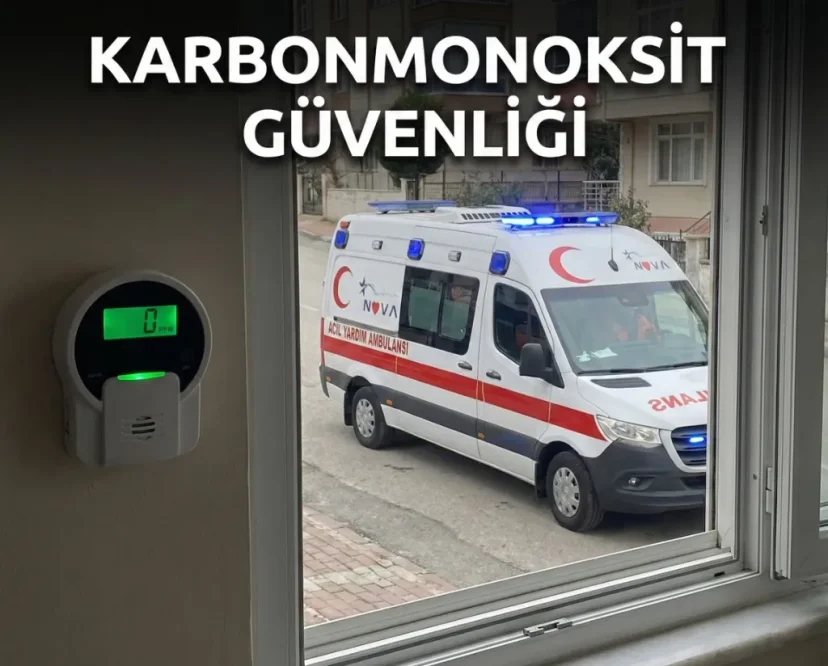
- CO Symptoms: Headache, nausea, and dizziness are often mistaken for the flu -- think CO.
- First Aid: Ventilate the area and move the person to fresh air immediately, then call 112 or Nova Ambulans.
- Risk Groups: Infants, the elderly, pregnant women, and those with chronic illness are affected faster.
- Prevention: Regular chimney maintenance, boiler servicing, and CO alarms save lives.
During winter, the increased use of stoves, boilers, water heaters, and similar heating devices -- combined with chimney blockages, poor ventilation, and equipment malfunctions -- raises the risk of carbon monoxide poisoning. Carbon monoxide (CO) is a colorless, odorless, and non-irritating gas, making it one of the most difficult poisons to detect. [1][2] This guide walks you through CO symptoms, practical first aid steps you can apply at home, and clear criteria for when to call 112 or an ambulance.
What Is Carbon Monoxide (CO) and Why Is It Dangerous?
Carbon monoxide forms when fuels such as natural gas, coal, wood, and gasoline undergo incomplete combustion. The U.S. Centers for Disease Control and Prevention describes CO as "an odorless, colorless gas that kills without warning" and reports that "each year, more than 400 Americans die from unintentional CO poisoning not linked to fires, more than 100,000 visit an emergency department" [5]. When inhaled, CO passes from the lungs into the bloodstream and binds to hemoglobin far more strongly than oxygen, disrupting oxygen delivery to tissues throughout the body [1]. This is why CO exposure can cause headache, dizziness, weakness, upset stomach, vomiting, chest pain, and confusion within minutes [5], progressing to loss of consciousness and life-threatening complications.
CO Threshold Values: What Do the ppm Numbers Mean?
The U.S. EPA reports that "average levels in homes without gas stoves vary from 0.5 to 5 parts per million (ppm)," with "levels near properly adjusted gas stoves often 5 to 15 ppm and those near poorly adjusted stoves 30 ppm or higher" [4]. Two occupational reference values frame the danger zone [7]:
- OSHA PEL: 8-hour time-weighted average (TWA) of 50 ppm.
- NIOSH REL: TWA of 35 ppm with a ceiling value of 200 ppm that must never be exceeded at any moment in the workday.
With continuous exposure, levels around 35 ppm can trigger headache and weakness within hours, while 200 ppm can cause headache, dizziness, and nausea over a few hours. Much higher levels (roughly 800 ppm and above) cause fainting and become life-threatening in a short window [9]. Note that 35 ppm is an 8-hour workplace TWA value, not a firm symptom threshold for homes. A headache that starts the moment you walk through the front door, or simultaneous nausea in two household members, is enough practical evidence to act on — even without a meter reading.
CO or Flu? The Diagnostic Trap
Turkey's Halk Sağlığı Genel Müdürlüğü and the Centers for Disease Control and Prevention (CDC) both warn that CO poisoning is frequently misread as flu in winter households [5][6]. Three features help separate the two:
- No fever: CO poisoning typically does not cause a fever. Fever plus sore throat shifts the picture toward influenza or COVID-19.
- Simultaneous onset in the same home: Multiple people — and pets — developing headache and nausea at the same hour points to CO.
- Resolution when away from home: Symptoms that disappear at work or school and return in the evening are characteristic.
CO poisoning in winter commonly occurs in these scenarios:
- Stove poisoning: Improper ignition, leaving the stove lit overnight, or using low-quality coal
- Chimney blockage or reverse draft (caused by wind, bird nests, soot buildup, or lack of maintenance)
- Boiler or water heater leaks or combustion problems
- Generators or motor-powered devices running in enclosed spaces
- Running a car engine in a closed garage or parking area
Why Is CO Poisoning More Common in Winter?
In winter, homes are kept sealed to retain heat. Windows stay closed for extended periods, ventilation grilles are blocked, and chimneys go uncleaned. These conditions cause indoor CO levels to rise. The danger is especially acute at night, when household members are asleep and CO accumulates to hazardous concentrations unnoticed.
Carbon Monoxide Poisoning Symptoms
CO poisoning symptoms are frequently mistaken for the flu, which delays recognition. [2] The following complaints should raise suspicion of CO exposure, especially if multiple people in the same household develop symptoms simultaneously.
Early Symptoms
- Headache (the most common symptom) [1]
- Dizziness and lightheadedness
- Nausea and vomiting (headache and nausea often occur together)
- Fatigue, weakness, and drowsiness
- Shortness of breath (especially in those with heart or lung disease)
- Palpitations and chest tightness
Moderate to Severe Symptoms
- Difficulty concentrating, confusion (mental fog)
- Loss of balance, difficulty walking
- Visual disturbances
- Loss of consciousness
- Seizures, fainting
- Cherry-red or unusually flushed skin (though this sign may be subtle or absent) [1] and severe respiratory distress
Who Is at Higher Risk?
- Infants and children
- Elderly adults
- Pregnant women
- Those with heart disease, Chronic Obstructive Pulmonary Disease (COPD), asthma, or other chronic conditions [1][2]
- People who are asleep when exposure occurs (nighttime stove/boiler scenarios)
First Aid for Carbon Monoxide Poisoning: What to Do at Home
The most critical action when CO poisoning is suspected is to stop the exposure immediately and provide fresh air. [1][2] The following steps can be lifesaving until professional help arrives.
1) Ensure Your Own Safety First
CO is odorless, so a rescuer entering the space can quickly become affected as well. If possible:
- Open doors and windows to ventilate the area.
- If an unconscious person is inside, do not remain in the enclosed space alone and unprotected for a prolonged period.
2) Move the Person to Fresh Air
- Take the affected person outdoors or to a well-ventilated area as quickly as possible.
- Do not remain in the enclosed space; CO accumulation may still be ongoing.
3) Call 112 or Nova Ambulans and Describe the Situation Clearly
When calling 112 or Nova Ambulans (0216 339 00 39), provide the following information:
- Suspected carbon monoxide poisoning (mention stove, boiler, or heater if applicable)
- How many people are affected
- Level of consciousness (awake, drowsy, or unconscious)
- Full address and access details
4) Basic Checks for an Unconscious Person
- Check whether they are breathing.
- If there is no breathing and you are trained, begin Cardiopulmonary Resuscitation (CPR), or basic life support. [3]
- Do not give food or drink to an unconscious person.
- If the person is unconscious and vomiting, position them to protect the airway (if untrained, follow the phone guidance from 112 or Nova Ambulans).
5) Shutting Off the Source -- Exercise Caution
- If it is safe to do so, the stove or boiler can be turned off. However, the priority is getting people out of the environment.
- If shutting off a gas valve seems risky, do not waste time -- professional teams will handle it.
When Should You Call an Ambulance? (112 or Nova Ambulans)
Even seemingly mild CO exposure ("I just had a headache, it passed") can progress insidiously. In the following situations, do not delay calling an ambulance:
Always Call 112 or Nova Ambulans (0216 339 00 39) For:
- Loss of consciousness, fainting, or unresponsiveness
- Seizures
- Severe shortness of breath, chest pain, or pronounced palpitations
- Persistent vomiting, marked weakness, or excessive drowsiness
- CO suspected in a pregnant woman, baby, child, elderly person, or someone with chronic disease
- Similar symptoms appearing in multiple people in the same household simultaneously
- Symptoms that do not fully resolve after moving to fresh air, or that recur shortly after
Why Is Medical Evaluation Important Even for "Mild" Cases?
Because CO disrupts tissue oxygenation, some individuals may appear to have minimal symptoms while still facing ongoing risk. Medical evaluation ensures appropriate treatment -- including oxygen therapy and hospital monitoring when needed -- and reduces the risk of delayed complications.
What Happens at the Hospital? (Brief Overview)
Medical teams will typically address CO poisoning with:
- Oxygen therapy
- Monitoring of vital signs (pulse, respiratory rate, blood pressure, oxygen saturation)
- Necessary blood tests and physician assessment
The goal is to restore adequate oxygen delivery to tissues and minimize the risk of complications.
Winter Safety: Practical Tips to Prevent CO Poisoning
Carbon monoxide poisoning is largely preventable. The following precautions are critical during winter months:
For Stove Users
- Have a plan to safely extinguish the stove before going to sleep; avoid leaving it burning overnight.
- Burn coal properly; do not overload the stove.
- Ventilate the room regularly.
Chimney Blockage and Maintenance
- Have stove and coal-heater chimneys cleaned at least once before each heating season, with a mid-season recheck if usage is heavy (weekly coal burning) [6]. Boiler and natural-gas appliances should follow the manufacturer's annual service schedule and have the maintenance record signed in the service booklet.
- Be aware that strong winds can cause reverse drafts; if you develop a headache or dizziness, think of CO.
Boiler and Water Heater Safety
- Schedule periodic maintenance for your boiler combustion system.
- Do not seal ventilation grilles; ensure the room where the device is located has adequate airflow.
- If you feel sudden weakness or dizziness in the bathroom while the water heater is running, leave the area immediately.
CO Alarm Devices (EN 50292 Reference)
- The European standard BS EN 50292 (code of practice for selection, installation and maintenance of CO detectors in domestic premises) recommends a CO alarm in every room containing a fuel-burning appliance and, if you sleep in a separate room, in the bedroom too. The device should sit 1–3 m horizontally from the source: if ceiling-mounted, at least 30 cm (300 mm) from any wall; if wall-mounted, at least 15 cm (150 mm) below the ceiling and above the height of any door or window [8]. (Alternatively, it can be mounted at breathing-zone height per the manufacturer's instructions.)
- Test alarms monthly with the on-device button and replace batteries annually; most sensors have a 5–7 year service life printed on the housing.
Private Ambulance Support in Istanbul: Nova Ambulans
In suspected carbon monoxide poisoning, rapid and accurate triage can be lifesaving. Nova Ambulans provides 24/7 emergency ambulance service in Istanbul with experienced crews and appropriate equipment for both emergency situations and patient transport needs. In CO exposure, the correct approach is to move the person safely to fresh air, call 112 or Nova Ambulans (0216 339 00 39), and not delay medical evaluation. The key difference: 112 transports to the nearest public hospital, while Nova Ambulans can take you to the private hospital of your choice.
Conclusion
During winter, carbon monoxide poisoning can strike suddenly due to stove, boiler, and chimney-related risks. It often starts with flu-like symptoms but can escalate rapidly. Take early signs such as headache, nausea, and dizziness seriously -- especially if multiple household members are affected simultaneously. In first aid, the priority is fresh air and rapid medical assistance. For loss of consciousness, shortness of breath, chest pain, or exposure involving pregnant women, children, or the elderly, call 112 or Nova Ambulans (0216 339 00 39) without hesitation.
Frequently Asked Questions
Where should carbon monoxide detectors be placed in a home?
Under BS EN 50292, site the device 1–3 m horizontally from the fuel-burning source: at least 30 cm from any wall if ceiling-mounted, or at least 15 cm below the ceiling if wall-mounted [8]. Install at least one CO detector on every floor and, if you sleep in a separate room, near the bedroom. Avoid placing detectors directly next to fuel-burning appliances, windows, or in bathrooms where steam may cause false alarms.
What are the earliest symptoms of carbon monoxide poisoning?
The earliest symptoms include headache, dizziness, nausea, and fatigue. Because these mimic flu symptoms, a key warning sign is when multiple people in the same enclosed space develop similar complaints simultaneously.
What should I do immediately if I suspect CO poisoning?
Open all windows and doors, turn off all fuel-burning appliances, evacuate everyone from the building, and call 112 or Nova Ambulans immediately. Do not re-enter the building until emergency services confirm it is safe.
How is carbon monoxide poisoning treated?
Treatment involves high-flow oxygen therapy to displace CO from hemoglobin. In severe cases, hyperbaric oxygen therapy in a specialized chamber may be required. Early medical intervention significantly improves outcomes.
Rapid Emergency Support
24/7 emergency ambulance service across Istanbul. Fast response, fully equipped team.
Average response time: 15 seconds
Related Articles
Mushroom Poisoning Symptoms and First Aid: When Do Symptoms Start, When to Call 112?
If nausea, vomiting, diarrhea, abdominal pain or any other symptom begins after eating foraged mushrooms or mushrooms of unknown origin, call 112, whatever hour it began; do not induce vomiting and give nothing by mouth. People without symptoms, including a child who ate a mushroom in a garden or park, still need hospital assessment; call 112 and explain, because with amatoxin, which damages the liver, the symptom-free interval averages 8-10 hours. The National Poison Information Center (UZEM) on 114 gives advice but does not replace 112.
EducationSepsis Symptoms: Flu or Sepsis? How to Spot It at Home and When to Call 112
Sepsis is an emergency in which the body responds to an infection in an extreme, uncontrolled way, and it can worsen within hours. If someone with a fever or an infection becomes confused, breathes very fast, has pale or blotchy skin, a rash that does not fade when pressed, or a very high or very low temperature, call 112 without waiting. Until the ambulance arrives, do not leave them alone, give them nothing by mouth and check their consciousness every 2-3 minutes.
EducationWhat to Do When an Older Person Falls at Home: 4 Checks Before Lifting and the 112 Decision
When an older relative falls at home, do not lift them straight away. First check consciousness and breathing, then whether they hit their head, then for pain, deformity or shortening in the hip or leg. If there is a suspected fracture, a head injury or they cannot get up on their own, call 112; if there is no injury, help them get up slowly under their own power and have a doctor see them the same week.
Popular Ambulance Topic Clusters
You may also like
- Private ambulance pricing
- Istanbul private ambulance
- Intercity patient transport
- Doctor-accompanied ambulance
- Dialysis patient transport
- How intercity patient transport works
- Ambulance response time in Istanbul
- Home-to-hospital patient transport
- Modern ambulance equipment and team standards
- Heart attack symptoms and first response
This content is informational only and does not replace professional medical evaluation. In emergencies, call 112 or +90 216 339 00 39.
